Neural Minute may earn a commission if you buy through our links. It doesn’t change our verdicts. How we test · How we make money
Postiz is the scheduler to pick if you publish to many networks and want Claude, ChatGPT or n8n to post for you: its API, MCP server and CLI come with every plan. Plans start at $29 a month for 5 channels. The 7-day trial is free, but it needs a card.
Is Postiz worth it?
Yes, for social media managers, small agencies and automation builders who run 8 or more accounts. Postiz is cheaper than Blotato from 8 to 30 accounts, covers about three times as many networks, and lets an AI agent post from the first plan. It is a weaker buy for creators who want AI images on every post, since the $29 plan carries none.
| Question | Answer |
|---|---|
| Price | $29, $39, $49 or $99 a month for 5, 10, 30 or 100 channels; $278 to $950 a year on yearly billing |
| Free plan | None on the hosted version; free to self-host |
| Free trial | 7 days, once per organisation, card required |
| Refund | At most one month of fees, ask within 60 days; one twelfth of a yearly charge |
| Networks | 30+, including Reddit, Mastodon, Telegram, Bluesky and WordPress |
| AI agents | Hosted MCP server, public API, webhooks and CLI on every plan, trial included |
| Open source | Yes, AGPL-3.0 |
| Our score in Postiz vs Blotato | 7.4 out of 10, against 7.3 for Blotato |
What does Postiz do?
Postiz schedules and publishes posts to more than 30 networks from one calendar. The list covers X, LinkedIn (profiles and Pages), Instagram, Facebook, TikTok, YouTube, Threads, Pinterest, Reddit, Bluesky, Mastodon, Telegram, Discord, Slack, Google Business Profile, Lemmy, Nostr, Farcaster, Medium, Dev.to, Hashnode and WordPress. If one network decides your purchase, check it on Postiz’s channel list before you start the trial.
You write a post once in a Global tab, then adjust it per network if you need to. The composer shows a preview for each platform and asks for the fields some networks require: a title for YouTube, a subreddit for Reddit, a board for Pinterest. Around the calendar, Postiz adds:
- An AI copilot that drafts and rewrites captions, and an AI agent you can chat with to schedule posts.
- AI images (from the Team plan), AI videos and AI video clipping, which cuts a long YouTube video into short vertical clips with captions.
- Scheduled follow-up comments and threads, repeated posts for evergreen content, and delays between posts.
- “Plugs” that repost or comment from your other accounts, or act when a post reaches a set number of likes.
- Customer groups to sort channels by client, and posting sets to reuse a group of channels with a template.
- Analytics per channel and per post, pulled from each network.
Postiz is built for agents: the same account can be driven from Claude, ChatGPT, Cursor, Codex or Gemini through its MCP server, or from your own code through its API. That is the part that sets it apart from Buffer or Later.
On this page
- 01Is Postiz worth it?
- 02What does Postiz do?
- 03How much does Postiz cost?
- 04Does the Postiz free trial need a credit card?
- 05What is Postiz’s refund policy?
- 06Can Claude or ChatGPT post through Postiz?
- 07What can the built-in AI agent do?
- 08What do Postiz users report?
- 09Can you self-host Postiz for free?
- 10What happens if you cancel or downgrade?
- 11How does Postiz compare with Blotato?
- 12What are the best Postiz alternatives?
- 13Who is Postiz for?
- 14Our take
- 15How we checked Postiz
- 16FAQ
- 17Sources
- 18Update log
How much does Postiz cost?
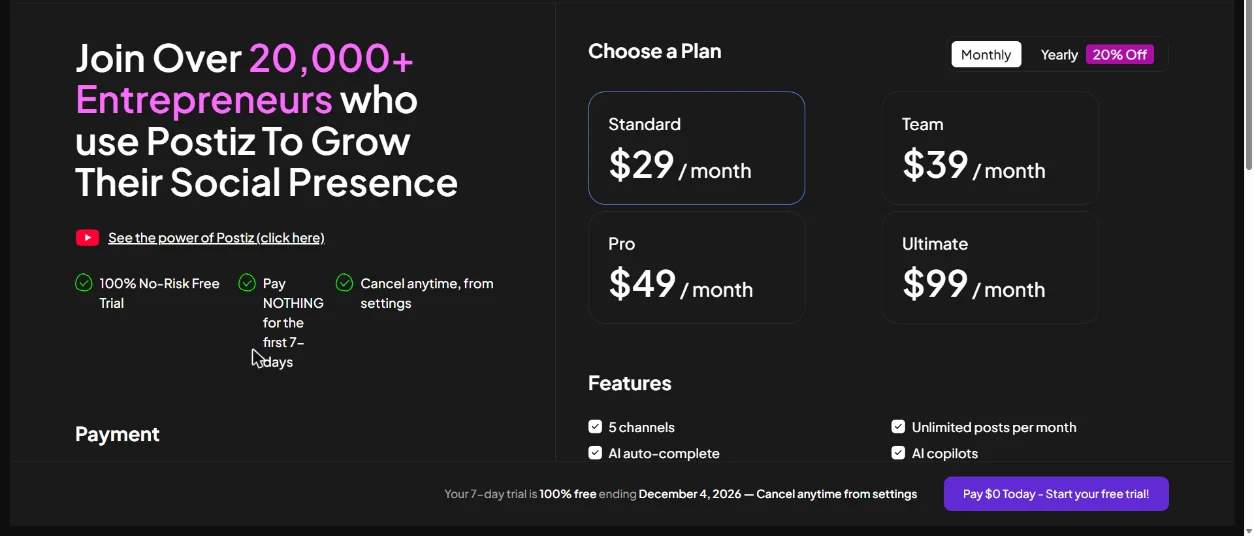
Postiz costs $29 a month on Standard, $39 on Team, $49 on Pro and $99 on Ultimate. Yearly billing costs $278, $374, $470 and $950, about 20% less, or roughly $23, $31, $39 and $79 a month. Plans differ by channel count and AI allowance; posts are unlimited on all four.
| Plan | Monthly | Yearly | Channels | AI images a month | AI videos a month | Video clipping | Team members |
|---|---|---|---|---|---|---|---|
| Standard | $29 | $278 | 5 | None | 3 | 60 min | No |
| Team | $39 | $374 | 10 | 100 | 10 | 120 min | Unlimited |
| Pro | $49 | $470 | 30 | 300 | 30 | 300 min | Unlimited |
| Ultimate | $99 | $950 | 100 | 500 | 60 | 600 min | Unlimited |
Your own number of accounts? Our social media scheduler cost calculator gives the monthly price of Postiz, Blotato, Zernio, Metricool and Buffer for any count, from the same pricing data as this page.
Channel count is the deciding number. One X profile is one channel, one Facebook Page is one, one Discord server is one. Pro is the sweet spot: 30 channels for $49 is $1.63 a channel, against $5.80 on Standard; Ultimate drops to $0.99 a channel but only pays off past 30. Team at $39 matters for two reasons beyond the 10 channels: it adds team members, which Standard lacks.
A few smaller limits sit behind the plans. Webhooks go from 2 on Standard to 10, 30 and 10,000. Uploads are capped at 10 MB per image and 1 GB per video on every plan. AI credits reset on your subscription anniversary, not on the first of the month, and a failed generation does not spend one. Promo codes apply to monthly plans only, so switching to yearly removes the code field.
Does the Postiz free trial need a credit card?
Yes. You can create the account without a card, but the app opens straight on the plan picker, and starting the 7-day trial asks for a card number, expiry date, CVC and country. Postiz places a $2 hold to confirm the card and releases it at once. Nothing is charged during the trial; on day 7 the card is charged for the plan you picked.
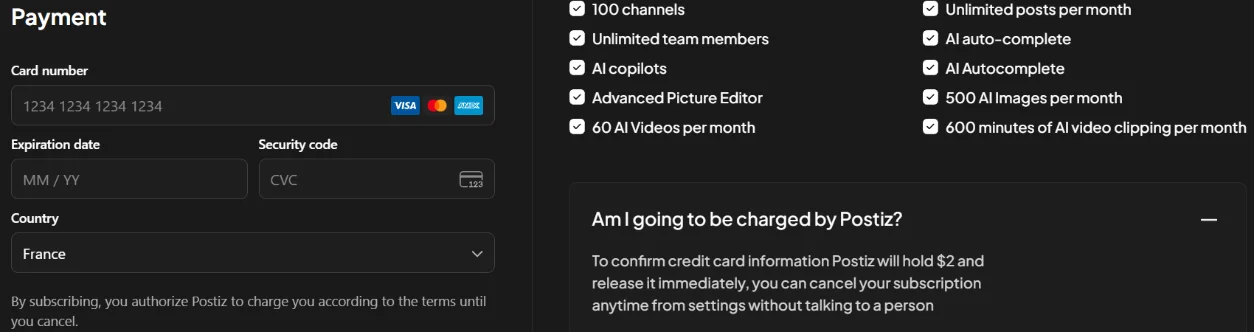
Five rules shape the trial:
- Once per organisation. An organisation that has already trialled or subscribed will not see the offer again.
- The full plan, with three exceptions. AI video clipping is off, some AI video generators with a real per-generation cost are held back, and you cannot reconnect a channel you already disconnected, which stops channel cycling.
- The API works. Scheduling, publishing, analytics, automations and the API behave as they will once you pay, so you can test an n8n flow or the MCP server before the first charge.
- Cancel before day 7 and you pay nothing. Cancelling is done from the settings, without talking to anyone.
- You can end it early. “Finish trial” on the billing page bills you at once and switches on clipping and the held-back generators.
Plan the week with that in mind: connect the networks you care about on day one, since a channel you remove cannot come back during the trial, and set a reminder for day 6.
What is Postiz’s refund policy?
Postiz refunds at most one month of a subscription, and you should ask within 60 days of the charge. The quickest route is the in-app support chat, which issues the refund automatically if the charge is a subscription charge under 60 days old; it allows one refund per customer and cancels the subscription. The terms of service set an outer limit of 120 days, by email to support@postiz.com, and exclude annual charges; the in-app chat still refunds one twelfth of a yearly charge under 60 days old.
In practice, that makes yearly billing a commitment. The 20% saving is real, but if you are unsure after the trial, pay monthly for the first month or two, then switch: the billing page moves you between monthly and yearly with proration.
Can Claude or ChatGPT post through Postiz?
Yes. Every plan includes a hosted MCP server, so Claude, ChatGPT, Cursor, Codex or another MCP client can list your channels, schedule or publish a post, upload media, generate images and video, and read analytics. Clients that support OAuth connect to mcp.postiz.com/mcp-oauth-dynamic and open a Postiz page where you approve the access, with no API key to paste. Tokens do not expire; you revoke a client under Settings, Apps, Approved Apps.
Developers get a REST API (an API key in the Authorization header, or OAuth tokens that start with pos_), webhooks, a CLI, an official Node.js SDK and an n8n node; Make and Zapier are listed too. The one limit to plan around is about 90 requests an hour on the create-post endpoint. It is the same on every plan, and one request can carry several posts, so batch them rather than looping. Self-hosters can change it with the API_LIMIT variable.
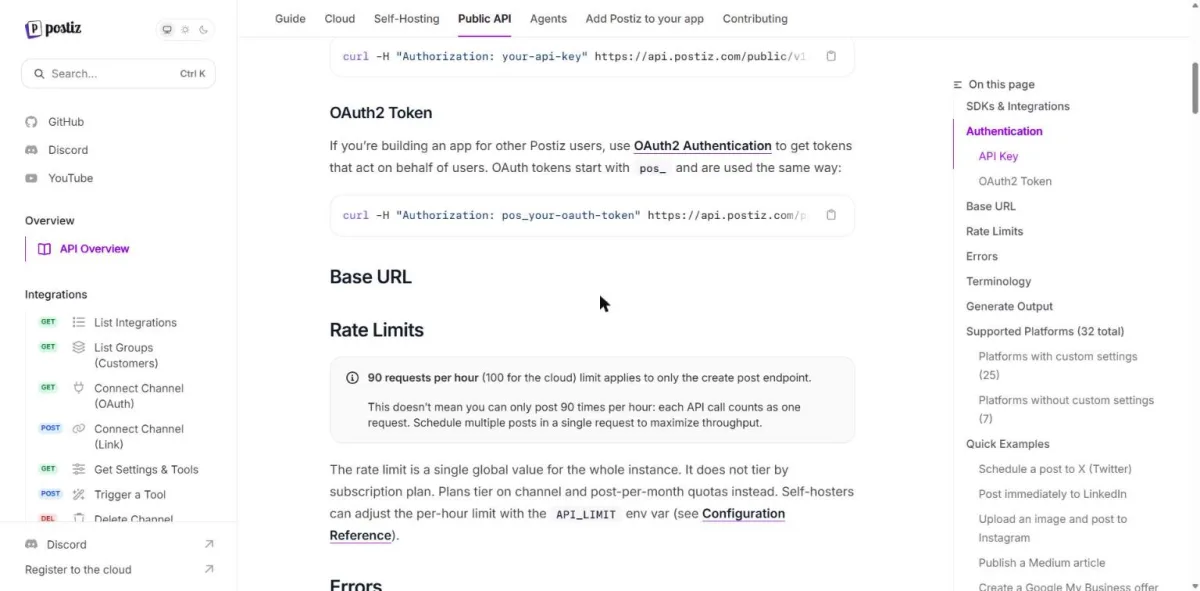
If your assistant posts a few times a day, 90 requests an hour is far more than you need. If you build a tool that publishes for many clients at once, compare it with Blotato, whose publish endpoint takes 30 requests a minute, about 1,800 an hour. For a step-by-step setup, see how to post to Instagram from Claude.
What can the built-in AI agent do?
The Smart Agent is Postiz’s own chat, available from Standard. You pick the channels it may act on, then describe what you want: schedule this image on Thursday morning with a caption about our launch, draft a week of LinkedIn posts, clip this YouTube video. It can schedule to one channel or several, generate images and video, clip long videos and open the composer prefilled so you review before saving.
It has three hard limits: it cannot read or reply to comments, it cannot connect a channel for you, and it cannot change billing or settings. Postiz’s own advice is to ask for drafts while you learn what the agent does, since a draft lands on the calendar and reaches no one until you promote it. If you already use Claude or ChatGPT, the MCP server gives the same actions with your choice of model.
What do Postiz users report?
Few independent reviews exist, and they are split. On Trustpilot, Postiz has a TrustScore of 3.4 out of 5 from 20 reviews: 55% gave 5 stars and 40% gave 1 star. The positive reviews praise the trial, having every network in one place and fast answers from support. The negative ones are about money: a refund refused on a $278 annual plan, cancellation requests left unanswered, a failed delivery during a trial followed by charge attempts.
The GitHub issue tracker is more specific, because the code is public:
- TikTok on Postiz Cloud. Issue 1854, open since Aug 7, 2026, reports TikTok Direct Post failing with a “reached_active_user_cap” error: the shared TikTok app hit its daily user quota. Issue 2369, from November, reports a failed TikTok upload shown as pending for about 30 minutes before it errors.
- Analytics. Issue 1911 found the trend badge on Facebook, Instagram, Threads and LinkedIn Page cards hard-coded at 5%. It was closed on Nov 23, 2026.
Two habits follow. If TikTok matters, schedule TikTok posts during the trial and check that they go out. And whatever you plan, read the billing rules above before choosing yearly, since most complaints are about refunds and cancellation, not about scheduling.
Can you self-host Postiz for free?
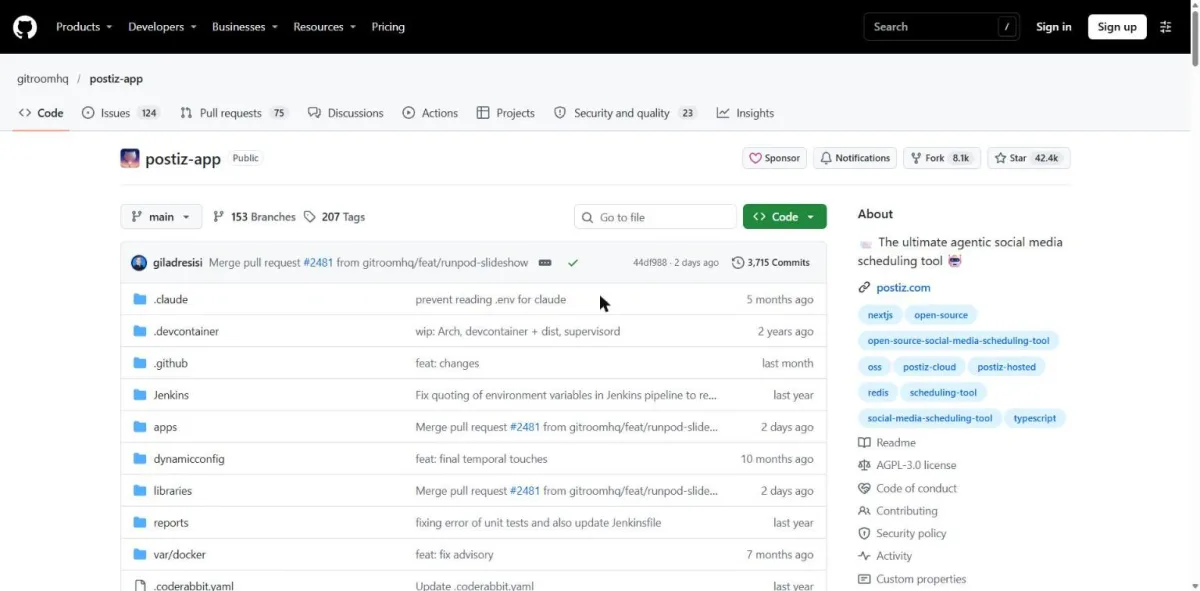
Yes. The code is open source under the AGPL-3.0 license on GitHub, where the repository has 42.5k stars and 8.1k forks and gets commits almost every day. A self-hosted install has no plans and no channel cap: it behaves as the top tier. It needs at least 2 vCPU and 2 GB of RAM (4 vCPU, 8 GB and 50 GB of disk recommended), PostgreSQL, Redis, Temporal and object storage, all bundled in the official docker-compose.
Free software is not free work. Three costs come with it:
- Your own developer apps. On the cloud, every network is ready to connect. Self-hosted, most networks need you to register a developer app and add its keys; only eight (Bluesky, Lemmy, Nostr, Medium, Dev.to, Hashnode, WordPress and Listmonk) take credentials directly. Postiz sells help with approvals and warns that Facebook, Instagram, Threads and YouTube usually take more than a month.
- Your own AI keys. AI images and video need your OpenAI and generator keys.
- Later features and community support. Agent features reach the hosted version first, and support is the community Discord, with no guaranteed answer.
For one person with a few channels, $29 a month is usually cheaper than a server plus the hours. Self-hosting pays off for a developer who already runs Docker, or a team that must keep data on its own infrastructure.
What happens if you cancel or downgrade?
Your data stays, but publishing stops. When a subscription ends, scheduled posts remain on the calendar and are not published, and they are not published later if you subscribe again. The API stops answering too, so any n8n flow or agent built on it breaks.
A downgrade applies at once and does not ask what to keep. Channels above the new cap are disabled, and Postiz chooses which; scheduled posts on a disabled channel do not go out. Moving to Standard disables every other team member. Before changing plan, disable the channels you can live without yourself, and check the calendar afterwards.
How does Postiz compare with Blotato?
Postiz edges Blotato, 7.4 to 7.3 out of 10, in our Postiz vs Blotato grid. Postiz wins on price for most account counts, networks, API access during the trial and refund terms. Blotato wins on AI generation, with 1,250 AI credits on its $29 Solo plan, and on comments and DMs, which it handles on Instagram and Facebook. Weighted for a creator who generates visuals for every post, Blotato comes first; weighted for an agency, Postiz leads clearly.
| Accounts | Postiz, monthly | Blotato, monthly | Cheaper |
|---|---|---|---|
| 5 | $29 | $29 | Same price |
| 10 | $39 | $54 | Postiz |
| 20 | $49 | $97 | Postiz |
| 50 | $99 | $97 | Blotato, by $2 |
Both run a 7-day trial that needs a card. The difference is what you can test: Postiz opens its API during the trial, while Blotato keeps its API and MCP server out of it and starts billing when you create a key. Our Blotato review has the full detail.
What are the best Postiz alternatives?
- Blotato if you generate AI images and video every day: 1,250 AI credits on its $29 Solo plan, DM automations, 11 networks (12 with Google Business Profile), and a trial without the API.
- Zernio if you run few accounts: 2 are free and 10 cost $48 a month. It stays cheaper than Postiz up to 8 accounts.
- Metricool if reporting to clients matters more than publishing: $25 a month for 5 brands, with a free plan for 1.
- Buffer if you post to 1 to 3 channels: its free plan covers 3 channels.
Blotato alternatives prices six schedulers side by side at 5, 10, 20 and 50 accounts, and our social media tools page lists every scheduler we review.
Who is Postiz for?
Social media managers and small agencies who publish to many networks and bring their own visuals: Pro at $49 covers 30 channels with unlimited team members. Developers and automation builders who want an assistant or n8n to post through a documented API and an MCP server, and want to test that before paying. Teams that want to own the stack: the same code runs on your own server.
It is not the best fit for a creator who needs a large monthly allowance of AI images. Nor for someone who will not give a card for a trial, or a single-network user, who will find free plans elsewhere.
Our take
Postiz is the most complete scheduler for the price once you pass 8 accounts. It is also the most open one for AI agents: the MCP server, API and CLI come with the $29 plan and work during the trial. Its weak points are AI images on the entry plan, a support and billing record that worries some users, and TikTok on the cloud. Start on monthly billing, test the networks you depend on during the 7 days, and move to yearly once you are sure. The limit of this review: we stopped at the trial’s card form, so what we say about publishing, the agent and the MCP server comes from Postiz’s documentation and user reports, not from our own posts.
How we checked Postiz
On Nov 27, 2026 we created a Postiz account with Google sign-in and went through sign-up to the trial’s payment screen, where the two captures above come from. Prices, plan limits, trial and refund rules, the MCP server and the API come from Postiz’s pricing page, terms of service and documentation; user feedback from Trustpilot and the GitHub issue tracker. The sources are listed below.
FAQ
How much does Postiz cost?
$29 a month for 5 channels on Standard, $39 for 10 on Team, $49 for 30 on Pro and $99 for 100 on Ultimate. Yearly billing costs $278, $374, $470 or $950, about 20% less. Every plan has unlimited posts and includes the API and MCP server.
Is Postiz free?
The hosted version has no free plan, only a 7-day trial on every plan. The code is open source under AGPL-3.0 and free to self-host, but you then register your own developer app on most networks and bring your own AI keys.
Does the Postiz free trial require a credit card?
Yes. Starting the 7-day trial asks for a card, and Postiz places a $2 hold that it releases at once. Nothing is charged until day 7, and cancelling before then from the settings costs nothing. The trial is offered once per organisation.
Can I get a refund from Postiz?
Yes, up to one month of fees. Ask within 60 days: the in-app support chat refunds a subscription charge under 60 days old automatically, once per customer, and cancels the subscription. The terms set an outer limit of 120 days; on a yearly plan, the chat refunds one twelfth.
Does Postiz work with Claude or ChatGPT?
Yes. Every plan includes a hosted MCP server with OAuth sign-in, so Claude, ChatGPT or Cursor can schedule posts, upload media and read analytics. A public API, webhooks and a CLI are included too, and all of them work during the trial.
Postiz or Blotato?
Postiz for most teams: it is cheaper from 8 to 30 accounts, covers 30+ networks and opens its API during the trial. Blotato if AI visuals drive your posts: its $29 plan includes 1,250 AI credits, where Postiz Standard includes no AI images.
Sources
- Postiz pricing page and FAQ, read Nov 26 and 27, 2026
- Postiz terms of service (last updated Oct 19, 2026), section 4, refund policy
- Postiz documentation: the free trial, refunds and support, plans, limits, subscription, downgrades, MCP, AI agent, public API, read Nov 27, 2026
- github.com/gitroomhq/postiz-app, issues 1854, 1911 and 2369, read Nov 27, 2026
- Postiz on Trustpilot, 20 reviews, read Nov 27, 2026
- Postiz sign-up and trial checkout at platform.postiz.com, Nov 27, 2026
Update log
Nov 27, 2026: sign-up taken to the trial’s payment screen (card required, $2 hold), two new captures; trial and refund rules settled from Postiz’s terms and documentation; sections added on the AI agent, user reports, cancellation and the Postiz vs Blotato scores.
Nov 26, 2026: review published.
Spotted an outdated price or an error on this page? Request an update. Want us to cover another tool? Suggest a review.
Featured in: AI marketing tools
