What Zernio does
Zernio is a publishing and messaging layer between your content and your accounts. You write once, and Zernio pushes it to the social platforms, blogs and messaging services you connected, with scheduling, a queue, a calendar, an inbox, analytics and advertising management around it. Its own description is deliberately wide: social accounts, blogs, ads, phone numbers, calls, SMS, RCS, WhatsApp and iMessage, described as sixteen channels.
What makes it different from a social media calendar is where the product points. The dashboard exists, but the documented path is a key, a profile, an authorised account, an account identifier, a scheduled publication, then a status to follow. SDKs are published for Node.js, Python, Go, Ruby, Java, PHP, .NET and Rust, next to a CLI and an MCP server. That is the shape of a product built for people writing code or wiring automations, not for a marketing team looking for a nicer composer.
The company behind it is named in the terms: ZERNIO SOFTWARE SL, registered in Palamos, Girona, Spain, with a VAT number published. That is more than many tools of this size disclose, and it matters when you connect a client’s accounts to it.
What you get for the money
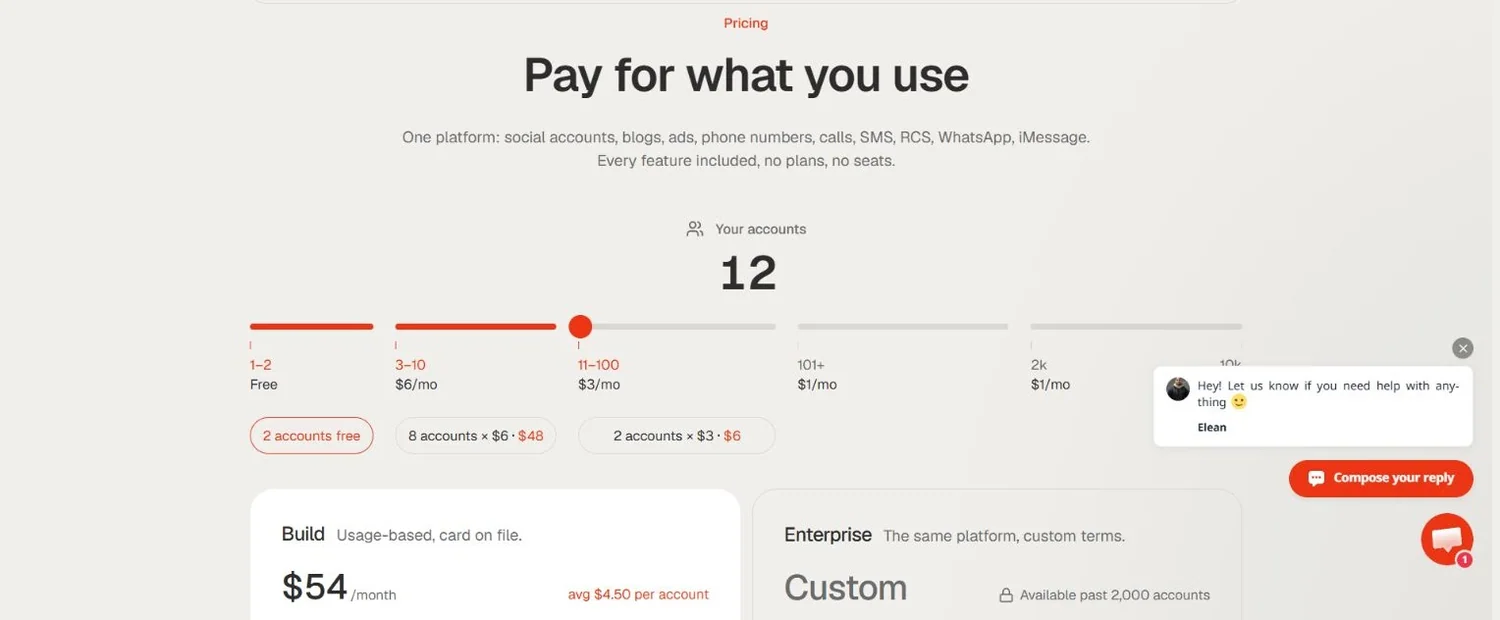
Zernio does not sell plans. It sells connected accounts and usage, and every feature comes with the account.
| Connected accounts | Price per account, per month |
|---|---|
| 1 to 2 | $0 |
| 3 to 10 | $6 |
| 11 to 100 | $3 |
| 101 and above | $1 |
| Past 2,000 accounts | Enterprise, custom terms |
The tiers are progressive, not a flat rate applied to every account. Twelve accounts cost $54 a month, which is two free, eight at $6 and two at $3, an average of $4.50 an account. One hundred accounts cost $318, and the hundred and first account adds a dollar. A WordPress site and a Shopify store each count as a connected account, so the bill tracks how many surfaces you publish to rather than how many people work with you.
Three usage lines sit outside the account price. Messages include 10,000 a month, then $1 per 10,000. Advertising includes 500 active ads, then $0.01 per ad per month. X has no allowance at all and is billed per action: $0.005 for a common read, $0.010 for some user and follow reads, $0.015 for a post or a direct message, and $0.20 for a post carrying a URL. A hundred publications with links would add $20 of X charges on top of the accounts, and the read traffic that feeds scheduling and analytics adds more. Publications, analytics, comments and webhooks are described as unlimited, which does not remove the limits of the networks themselves.
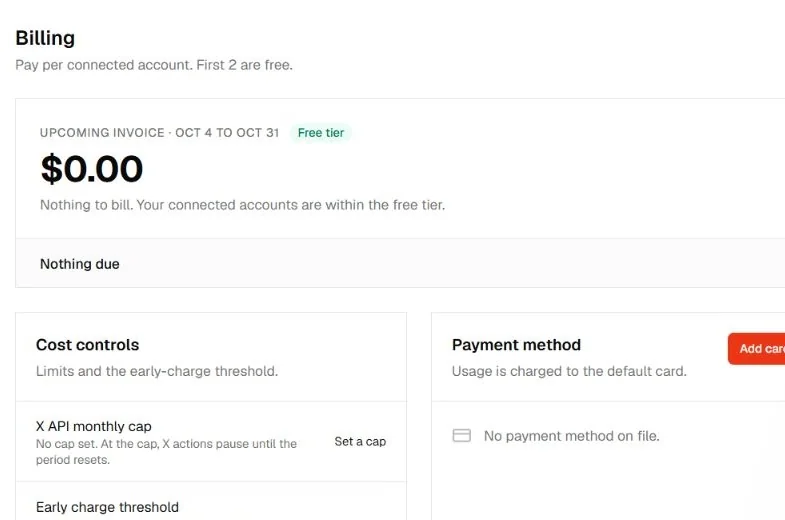
Billing runs at the end of the period, and the dashboard shows a usage threshold that triggers a payment rather than a spending cap. The terms state that fees are non-refundable outside the law. On the free tier our account showed nothing to bill and no card on file.
On this page
Where it falls short
- X is the expensive part, and it is per action. The account price is only the entry. Publications with links are billed at $0.20 each, reads at $0.005 and up, and a card is required for X even while the rest of the free tier is not.
- The trial account was empty. We could write and keep drafts, but analytics showed no data, the inbox had no conversation, and no error from a real network was ever seen. Nothing here says the publishing works on every platform.
- Snapchat was not open. The connections screen listed it as coming soon in the account we audited, while the marketing pages list it with the rest.
- The platform count moves. Sixteen on the homepage and in the quickstart, fifteen on the partner page. Worth checking the useful integrations for your case rather than trusting a number.
- Infrastructure claims are claims. SOC 2, GDPR and 99.97% uptime are stated on the editor’s pages, with 99.7% on another. No certificate or measurement was available to us, and no support message was sent, so no response time was measured.
- The MCP authorisation is account-wide. The privacy policy describes it as giving access to posts, messages, connections and advertising campaigns, which is a lot of surface to hand to an assistant. Revocation is documented in Settings, and none of it was tested here.
Zernio alternatives
- Ayrshare, $149 a month (Premium): the closest match by nature, an API that publishes to fourteen or more networks from one call, sold per social profile with the higher tiers aimed at agencies.
- Buffer, $5 a month per channel (Essentials): the mainstream calendar comparison, free up to three channels, and the same per-channel logic Zernio uses per account.
- Postiz, $29 a month (Standard): five channels, unlimited posts, a seven-day free trial, and its own agent support through MCP and API.
- Blotato, $29 a month (Starter): publishing plus generation, with official n8n and Make nodes, up to 900 TikTok posts a month, and creator and agency tiers above it.
Who it is for: Zernio
Zernio fits a developer, an agency or an automation builder who needs publishing as a component: connect a client’s accounts, keep the credentials in one place, send the same post to several networks, read the status back, and do it from code or from an agent. Two free accounts make the first integration cheap to try, and the API, SDKs, CLI and MCP server mean you are not working around the product.
It is a poor fit if your support runs on a calendar and a composer. There is no plan to compare, no seat to buy, and the interesting parts are in the API. It is also a poor fit if X is your main channel, because the per-action billing turns a habit into a variable cost, or if you need a promise about uptime and certifications signed by someone rather than stated on a page.
How we checked
Unlike the research reviews on this site, this page reports tests we ran inside Zernio. The account was already signed in, the guided onboarding was completed by skipping the social connection, and everything below was done on the free tier with no card and no social account connected.
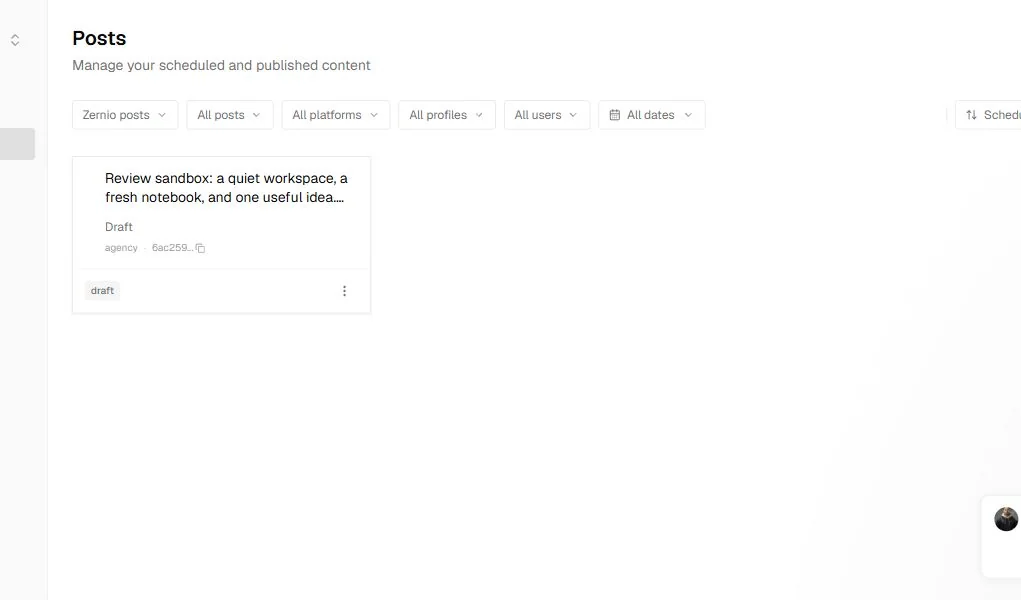
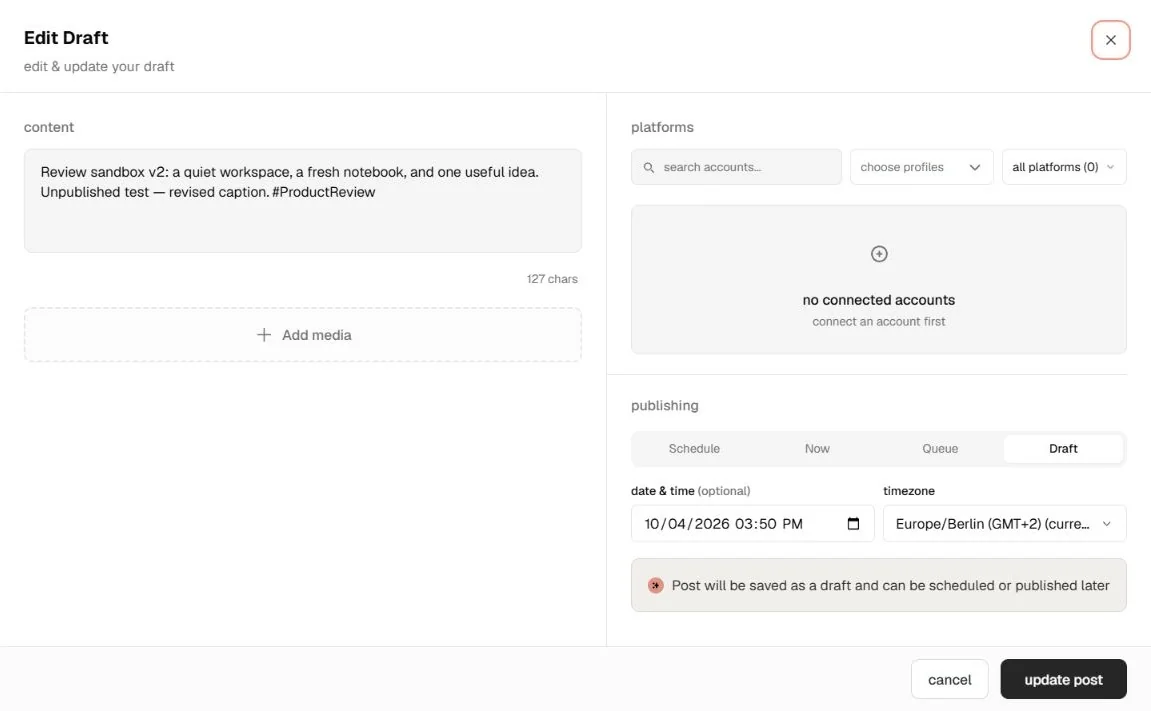
Three tests, all in the dashboard. We wrote a short English text, chose Draft and saved it: the product confirmed the creation and showed a draft card. We reopened it, replaced the text with a second version and updated the post: a confirmation appeared and the list showed the corrected text. We then navigated to other pages, came back to Posts in the table view and reopened the entry: the second version was still there, the mode was still Draft and the screen still reported zero connected accounts.
Each of those carries a limit. The persistence was verified in one session, not across days, after signing out, or from another device. The date shown in the list is not proof of scheduling, since the status stayed draft. The post had no media and no recipient. Everything we observed on the other screens is an observation, not a test: the CSV import reference, the publication queues, the connections, the analytics and the inbox were read, never used. The pricing figure comes from the editor’s simulator, set to twelve accounts while we watched.
We also read the pricing page, the quickstart documentation, the terms, the privacy policy and the partner page on October 4, 2026. What we did not do: connect a network, publish anything, send a message, import a CSV, create an API key, or pay. The advertising and telephony grids were not audited, so their prices are not repeated here.
What to do next
If you are integrating publishing into a product, start with the two free accounts and the quickstart: the whole chain of key, profile, account and scheduled post is documented, and it costs nothing to see whether the model fits your case. Before you pay, work out three numbers: how many accounts you will connect, since that sets the tier, how much you will publish to X, since that is billed per action with no allowance, and whether you need messages and advertising, which carry their own lines. If you want a calendar your team can use without reading documentation, compare Buffer at $5 a channel and Postiz at $29 for five channels first. The Build and data hub groups the rest of what we have priced in this market.
FAQ
How much does Zernio cost? The first two connected accounts are free. From the third, each account costs $6 a month between 3 and 10 accounts, $3 between 11 and 100, then $1. Twelve accounts list at $54 a month. Prices are in USD, excluding taxes.
Is there a free tier? Yes. The first two connected accounts are free to start and no card is required, except for X, where the documentation asks for one.
Can I write without connecting a social account? Yes, and we tested it. A draft was created, corrected and still there after navigating away, with zero accounts connected.
What does publishing to X cost? Zernio bills X per action: $0.005 for a common read, $0.010 for some user and follow reads, $0.015 for a post or a direct message, and $0.20 for a post that carries a URL. That sits on top of the account price.
Is Zernio a content generator? No. The dashboard is built around scheduling, an inbox, analytics, ads and messaging, and the editor’s documentation describes integration and automation. Nothing in our trial suggested a writing assistant.
Is the 99.97% uptime figure verified? No. It is a claim on the editor’s pages, and one page says 99.7%. We did not measure uptime.
Does Zernio have an affiliate program? Yes. The partner page states 20% of what referred customers pay, every month for twelve months, paid through Dub from $10. We have not applied, so nothing on this page depends on it.
Sources
Sources
- zernio.com/pricing (checked October 4, 2026), the account tiers, the usage lines and the simulator
- zernio.com (checked October 4, 2026), the positioning, the channel list and the uptime and compliance claims
- docs.zernio.com (checked October 4, 2026), the quickstart, the sixteen platforms, the card requirement for X, statuses, errors, webhooks and duplicate handling
- zernio.com/tos (checked October 4, 2026), the operating company, billing at the end of the period, and refunds
- zernio.com/privacy-policy (checked October 4, 2026), the data collected, retention, the account-wide MCP authorisation and the training statement
- partners.dub.co/zernio (checked October 4, 2026), the affiliate terms and the fifteen-platform figure
Update log
Published October 4, 2026 as a hands-on review, after three tests on a free account with no social account connected. Prices, tiers and conditions read from the editor’s pages the same day.