Neural Minute may earn a commission if you buy through our links. It doesn’t change our verdicts. How we test · How we make money
Elicit is the best AI for research on academic papers: its free plan searches 138 million of them with no search limit. Consensus is faster for a yes-or-no question. For the open web, use Perplexity. For your own PDFs, use NotebookLM. We asked three of them the same question and compared the answers.
Which AI should you pick for research?
Best overall
Elicit, for students and researchers who work from published papers. The free Basic plan gives unlimited search, summaries and chat across 138 million papers, and it scores 8.5 out of 10 on our grid, the highest of the nine tools.
Runner-up for peer-reviewed evidence
Consensus, for a quick read of where the studies stand. In our test it read 20 papers and showed how many answered yes, possibly or no. It scores 8.4 out of 10, and the free plan includes 10 Pro messages a month.
Best free pick for your own documents
NotebookLM, for anyone who already has the reading list. The free plan holds 100 notebooks with 50 sources each, and every answer points to the passage it came from. More room costs $4.99 a month.
Best for web and market research
Perplexity, for questions the journals don’t cover: competitors, products, news. It answered our test question in a few seconds with 10 linked sources, on the free plan.
How do the nine research tools compare?
| Tool | Our score | Best for | Entry price | Free option | Key fact | Watch out |
|---|---|---|---|---|---|---|
| Elicit | 8.5/10 | Literature reviews and data extraction from papers | Plus $11/mo billed yearly (academic); Pro $49/mo billed yearly (industry) | Yes, unlimited search and summaries; limited reports | Searches 138M+ papers and 545,000 clinical trials; Pro screens up to 5,000 papers | Exports (RIS, CSV, BIB) start on the paid Plus plan |
| Consensus | 8.4/10 | A quick evidence check on a yes-or-no question | Pro $12/mo billed yearly ($20 monthly) | Yes, 10 Pro messages and 3 Deep reviews a month | Consensus Meter counts studies for and against; 400M+ papers and scholarly works | Free plan runs out fast: 10 Pro messages a month |
| NotebookLM Visit site | 7.9/10 | Research inside your own documents | Google AI Plus $4.99/mo | Yes, 100 notebooks with 50 sources each | Answers only from your sources, with a pointer to the passage; 500,000 words per source | Does not search for papers: you bring them |
| scite | 7.8/10 | Checking if later studies support a paper | Basic $12/mo billed yearly | No, 7-day trial | Smart Citations across 1.6B+ citations show if a finding was supported or contradicted | No free plan |
| Semantic Scholar | 7.5/10 | Free paper search | Free | Yes, fully free | 214M papers; one-line TLDR summaries on nearly 60M of them | Finds papers but writes no combined answer |
| SciSpace | 7.3/10 | Understanding a hard paper | Premium $20/mo ($12/mo billed yearly) | Yes, limited | Chat with PDF, literature review and citation generator over 270M+ papers | Refund guarantee lasts 24 hours |
| Perplexity Visit site | 7.0/10 | Web research with sources | Pro $17/mo billed yearly | Yes, cited answers; very limited Pro Searches | Answered our test question in a few seconds with 10 linked sources | Mixes web pages and journals; you sort the quality |
| ChatGPT deep research Visit site | 6.7/10 | A long report from the web and your files | Plus $20/mo | Limited deep research on Free | Editable research plan; reports download as Markdown, Word or PDF | No report count per plan |
| Gemini Deep Research Visit site | 6.3/10 | A broad report for Google users | Free; Google AI Pro $19.99/mo | Yes | Analyzes hundreds of sources to write a report in minutes | Can be unavailable at busy times on the free plan |
Prices checked on each vendor’s pricing page on Nov 26, 2026. Tool names link to our full review when we have one. Scores come from our scoring grid below.
What happened when we asked all three the same question?
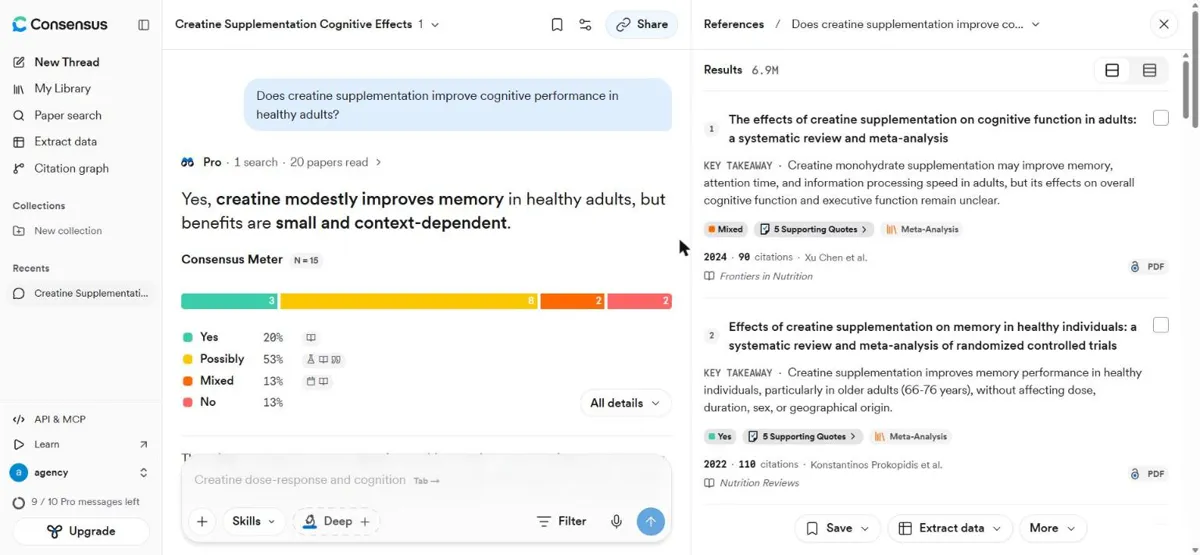
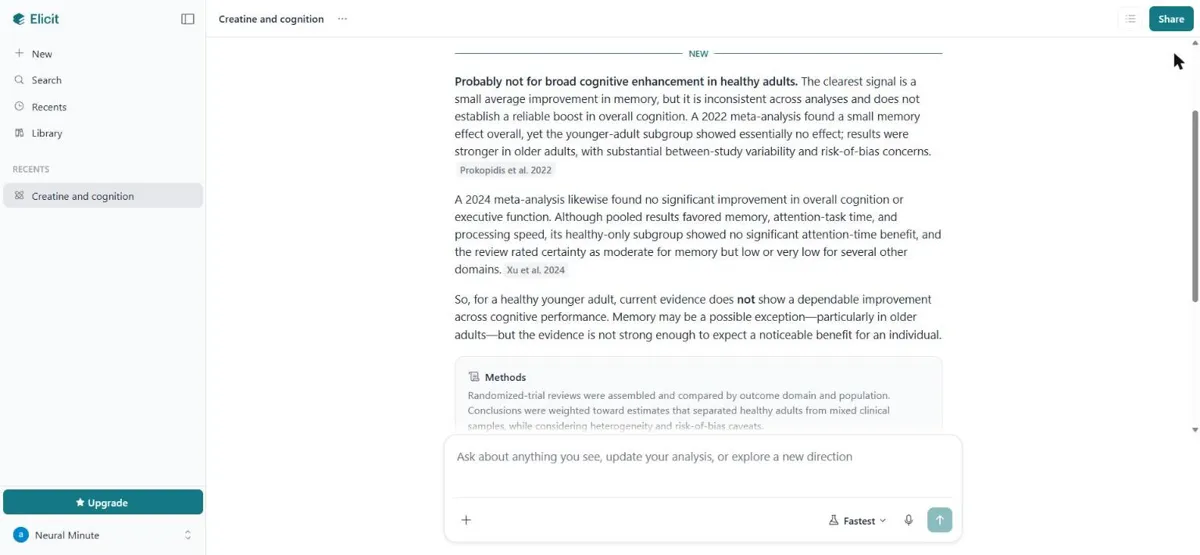
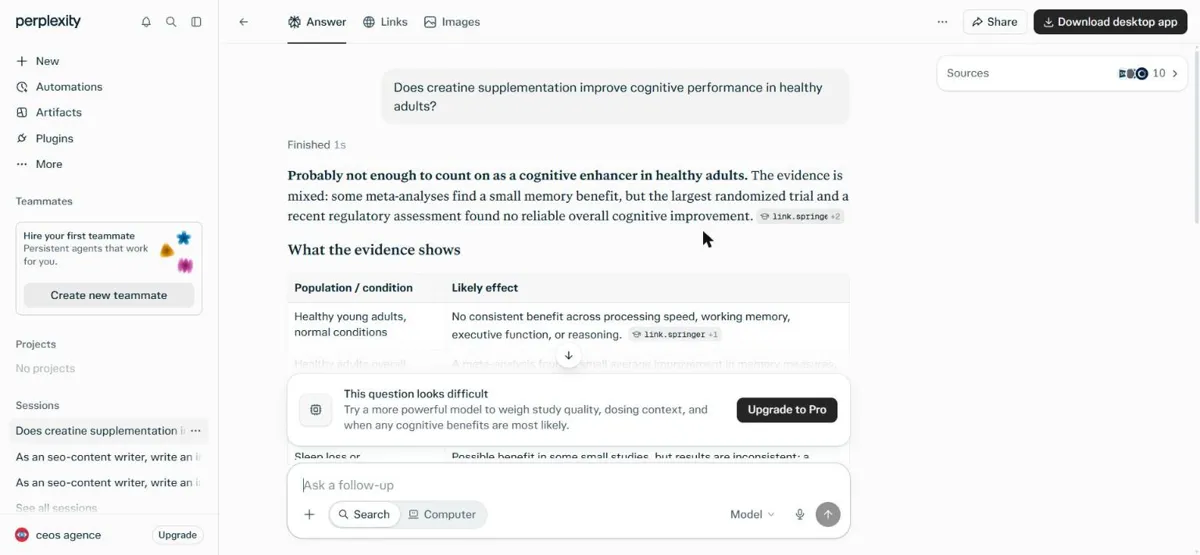
We asked Consensus, Elicit and Perplexity the same question on their free plans on Nov 26, 2026: “Does creatine supplementation improve cognitive performance in healthy adults?” All three reached the same cautious answer, a small memory benefit at best, but Consensus showed the most evidence to check, Elicit wrote the most careful bottom line and Perplexity answered fastest from web sources.
| Tool | First line of the answer | Evidence shown | Time | Free-plan cost |
|---|---|---|---|---|
| Consensus | “Yes, creatine modestly improves memory in healthy adults, but benefits are small and context-dependent.” | 20 papers read, 17 references; Consensus Meter on 15 papers: 20% yes, 53% possibly, 13% mixed, 13% no; a strength rating per claim | Under 30 seconds | 1 of 10 free Pro messages a month |
| Elicit | “Probably not for broad cognitive enhancement in healthy adults.” | 90 sources screened, 2 meta-analyses cited in the answer, a methods note | About 1 minute | Free Basic plan |
| Perplexity | “Probably not enough to count on as a cognitive enhancer in healthy adults.” | 10 sources mixing journals (Springer, Oxford Academic, PubMed Central) and the EU food safety agency’s assessment; a table by population | A few seconds | Free plan |
Our take. For a literature question, Consensus gives you the most to verify: a count of studies for and against and a strength rating for each claim. Its first line reads more positive (“Yes, modestly”) than the other two, so read the meter, not only the headline. Elicit’s answer is the most careful but cites only two reviews; Perplexity is the quickest read, with web pages you have to sort yourself. One question is not a benchmark: run your own topic through two tools before you rely on either.
How did we score each tool?
Each tool gets a score out of 10 on six criteria that matter for research. The final score is the weighted average, and the order of this page follows it.
| Tool | Source quality (20%) | Citations you can check (25%) | Written answer (15%) | Free plan (15%) | Paid price (10%) | Export and workflow (15%) | Final score |
|---|---|---|---|---|---|---|---|
| Elicit | 9 | 8 | 9 | 8 | 8 | 9 | 8.5 |
| Consensus | 9 | 10 | 8 | 7 | 8 | 7 | 8.4 |
| NotebookLM | 6 | 9 | 7 | 9 | 10 | 7 | 7.9 |
| scite | 9 | 10 | 7 | 3 | 8 | 8 | 7.8 |
| Semantic Scholar | 9 | 8 | 2 | 10 | 10 | 6 | 7.5 |
| SciSpace | 8 | 7 | 8 | 5 | 8 | 8 | 7.3 |
| Perplexity | 6 | 7 | 8 | 9 | 6 | 6 | 7.0 |
| ChatGPT deep research | 6 | 7 | 9 | 4 | 6 | 8 | 6.7 |
| Gemini Deep Research | 6 | 6 | 8 | 6 | 6 | 6 | 6.3 |
- Source quality (20%). What the tool searches. Indexes of scholarly work score 8 or 9: Elicit (138 million papers and 545,000 clinical trials), Consensus (more than 400 million papers and scholarly works), scite (more than 300 million sources), Semantic Scholar (214 million papers) and SciSpace (more than 270 million papers). Tools that read the open web or only your uploads score 6, because the quality depends on what they find or what you give them.
- Citations you can check (25%). How easy it is to confirm a claim. Consensus scores 10 on our test: a meter across 15 papers, 17 references and a strength rating per claim. scite scores 10 for Smart Citations, which show if later studies supported or contradicted a paper. NotebookLM (9) points to the passage behind each answer. Elicit (8) cites at the sentence level but put only two reviews in its answer to us. Perplexity (7) linked 10 sources of mixed quality.
- Written answer (15%). How useful the summary is. For the three tools we ran, the score comes from our test: Elicit’s bottom line was the most careful, Consensus’s headline ran ahead of its own meter, Perplexity was the quickest read. ChatGPT deep research (9) writes a full report from a plan you can edit. Semantic Scholar (2) gives a one-line summary per paper and no combined answer.
- Free plan (15%). What you get for $0. Semantic Scholar is free with no paid tier (10). NotebookLM gives 100 notebooks of 50 sources (9). Perplexity answers with sources on the free plan (9). Elicit gives unlimited search and summaries (8). Consensus gives 10 Pro messages and 3 Deep reviews a month (7). SciSpace has a limited free account (5). ChatGPT limits deep research on its free plan and gives no count (4). Gemini includes Deep Research for free but can switch it off at busy times (6). scite has a 7-day trial and no free plan (3).
- Paid price (10%). The first paid step. NotebookLM’s is $4.99 a month. Elicit Plus is $11 a month billed yearly, Consensus Pro, scite Basic and SciSpace Premium are $12 a month billed yearly. Perplexity Pro is $17 a month billed yearly, ChatGPT Plus $20 and Google AI Pro $19.99.
- Export and workflow (15%). What happens after the answer. Elicit exports to RIS, CSV, BIB, PDF and DOCX and has a systematic review workflow (9). scite plugs into Zotero and your browser (8). ChatGPT downloads reports as Markdown, Word or PDF (8). SciSpace bundles a literature review tool, data extraction and a citation generator (8).
Elicit: best for literature reviews
Who it’s for: students writing a thesis, and researchers who need to screen many papers and pull the same data out of each one.
- A large index, free to search. The Basic plan includes unlimited search, unlimited summaries and chat with full-text papers across more than 138 million papers.
- Tables, not only answers. Elicit can find up to 1,000 relevant papers and analyze up to 20,000 data points at once. You add columns such as sample size or dosage and it fills them in from each paper.
- Built for systematic reviews. The Pro plan has a dedicated workflow that screens up to 5,000 papers and writes reports from up to 135 sources.
- A careful answer in our test. It screened 90 sources, cited two meta-analyses and added a methods note.
Limits. Exports to RIS, CSV, BIB, PDF and DOCX start on the paid Plus plan, and Research Agent and report use is limited on Basic. It covers scholarly papers and clinical trials only, so it won’t help with market or news questions.
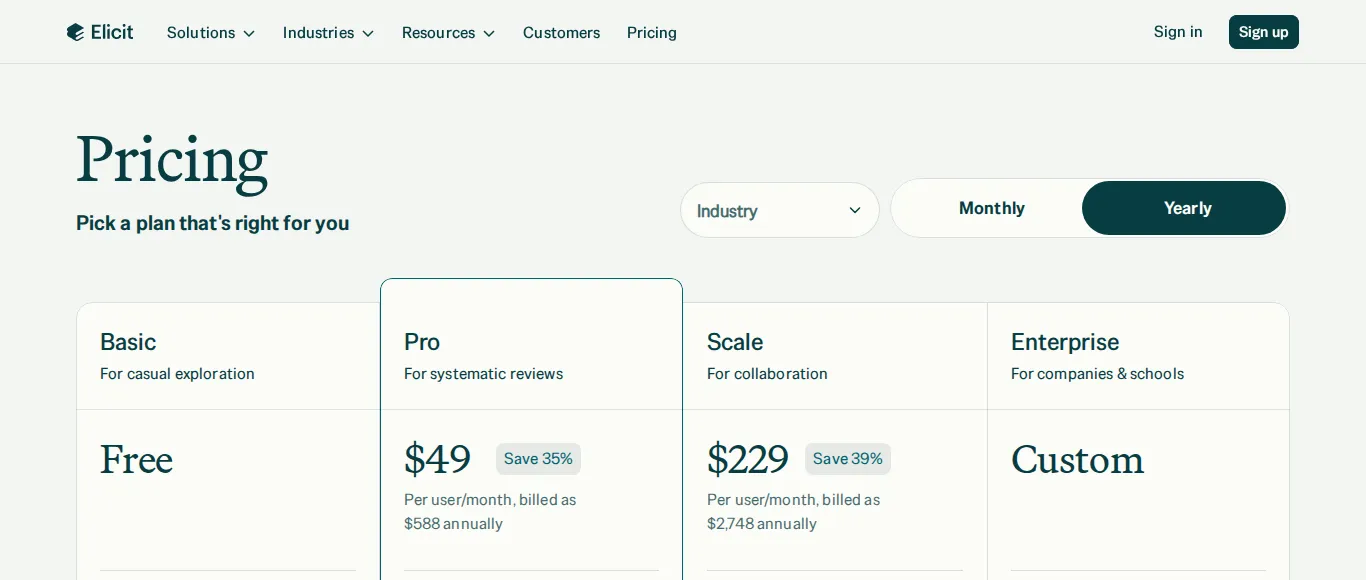
Price (checked Nov 26, 2026). Basic is free. On academic pricing, Plus is $11 a month billed yearly ($132) and Pro is $39 a month billed yearly ($468). On industry pricing, Pro is $49 a month billed yearly ($588).
Pick it if you need to compare many studies side by side. Skip it if you want one quick answer or your topic lives outside academic journals.
Consensus: best for a quick evidence check
Who it’s for: anyone with a yes-or-no question that science can answer, from a health claim to a teaching method.
- It shows where the studies stand. In our test the Consensus Meter sorted 15 papers: 20% yes, 53% possibly, 13% mixed, 13% no.
- It rates the evidence. Each claim in the answer came with a strength rating, and the answer listed 17 references.
- It reads scholarly work only. Consensus searches more than 400 million peer-reviewed papers and scholarly works.
- It is fast. The full answer took under 30 seconds.
Limits. The free plan gives 10 Pro messages and 3 Deep reviews a month; our one question used one of the ten. The first line of the answer was more positive than the meter below it, so read both.
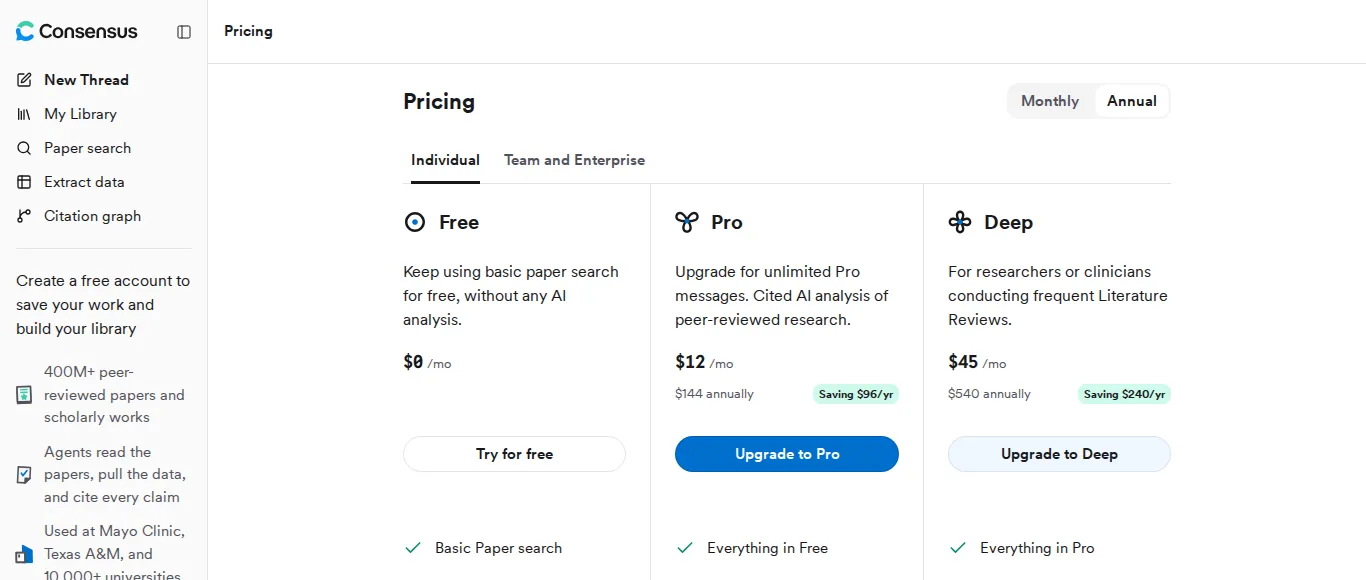
Price (checked Nov 26, 2026). Free is $0. Pro is $12 a month billed yearly ($144), or $20 month to month, with unlimited Pro messages and 15 Deep reviews a month. Deep is $45 a month billed yearly ($540), with 200 Deep reviews a month.
Pick it if you want to see agreement and disagreement at a glance. Skip it if you need to extract data from each paper into a table: that is Elicit’s job.
NotebookLM: best for research inside your own documents
Who it’s for: students and analysts who already have the papers, reports or lecture notes and need to question them. Google now labels the product Gemini Notebook; it is the same tool.
- It answers only from your sources. Each answer carries a pointer to the document and passage it came from, so you can check a claim in seconds.
- The free plan is roomy. You get 100 notebooks and 50 sources per notebook, and a source can hold up to 500,000 words or a 200 MB upload.
- One upload, several outputs. The same sources feed Audio Overviews, mind maps and slide decks.
Limits. It does not search for papers: you bring them. If your sources don’t contain the answer, it returns nothing useful. Paid limits come only inside a Google AI plan.
Price (checked Nov 26, 2026). Free with a Google account. Google AI Plus is $4.99 a month (100 sources per notebook) and Google AI Pro is $19.99 a month (300 sources per notebook).
Pick it if your reading list is set. Skip it if you still need to find the literature. Our NotebookLM review covers the plans, and NotebookLM vs Perplexity shows where each one fits.
scite: best for checking if a paper still holds up
Who it’s for: writers who are about to build an argument on a study and want to know how later research treated it.
- Smart Citations. scite shows if a finding was supported or contradicted by the papers that cited it, instead of a plain citation count.
- Scale. It has indexed more than 1.6 billion citations across more than 300 million scholarly sources, with full-text citation search.
- It fits your tools. There is a Zotero plugin and a browser extension that adds citation badges to papers you read online.
Limits. There is no free plan, only a 7-day trial that rolls into the plan you picked. It works best after you have found your papers elsewhere.
Price (checked Nov 26, 2026). Basic is $12 a month billed yearly. Pro is $40 a month billed yearly and adds API access and collections of up to 10,000 papers.
Pick it if one wrong citation would sink your paper. Skip it if you need a free tool or a first search.
Semantic Scholar: best free search engine for papers
Who it’s for: anyone who wants a free way to find papers before paying for anything.
- It is free. Semantic Scholar searches 214 million papers from all fields of science and has no paid plan.
- One-line summaries. AI-written TLDRs are available for nearly 60 million papers in computer science, biology and medicine.
- It keeps you current. You can save papers to a library, export citations in BibTeX, MLA, APA or Chicago, and get email alerts for new citations.
Limits. It finds papers and summarizes each one; it does not write a combined answer to your question. You still do the reading.
Price (checked Nov 26, 2026). Free.
Pick it if you want a starting list of papers at no cost. Skip it if you want the tool to weigh the evidence for you.
SciSpace: best for understanding a hard paper
Who it’s for: readers outside a field who need a dense PDF explained, and students who want search, reading and citing in one place.
- Chat with PDF. You upload a paper and ask questions; answers come back with citations to the text.
- A full toolkit. The same account includes a literature review tool, data extraction from several PDFs and a citation generator with APA, MLA and more than 2,300 other formats.
- A large index. The pricing page says you can discover and analyze more than 270 million research papers.
Limits. The free account is limited, and the heavier tools sit behind Premium. Refunds are only guaranteed for the first 24 hours.
Price (checked Nov 26, 2026). Premium is $20 a month, or $12 a month billed yearly ($144). Advanced is $90 a month, or $70 a month billed yearly.
Pick it if reading the paper is the hard part. Skip it if you only need search: Semantic Scholar does that for free.
Perplexity: best for web research with sources
Who it’s for: people researching a market, a product, a company or a news topic, where the answer is on the web and not in a journal.
- Every answer has sources. In our test it linked 10, mixing journals with a regulator’s assessment, and added a table by population.
- It is the fastest. The answer arrived in a few seconds, against about a minute for Elicit.
- The free plan is the real product. It gives cited answers and practically unlimited basic searches.
Limits. Web pages and journal articles arrive mixed together, and you sort the strong from the weak. Pro Searches are very limited on the free plan, and Perplexity doesn’t put a number on them.
Price (checked Nov 12, 2026, in our review). Free. Pro is $17 a month billed yearly and adds deeper research, a choice of models and up to 50 file uploads per project. Verified students and teachers pay $10 a month for Education Pro.
Pick it if you want a cited answer in seconds. Skip it if you need peer-reviewed sources only. Read our Perplexity review or see Perplexity vs ChatGPT.
ChatGPT deep research: best for a long report from the web and your files
Who it’s for: people who need a structured report on a multi-step question and are happy to wait for it.
- You approve the plan. ChatGPT proposes a research plan that you can edit before it starts, and you can interrupt it to change focus.
- You choose the sources. It can search the whole web, only the sites you list, your uploaded files and connected apps such as Google Drive.
- Reports you can reuse. Each report has citations, a sources section and a table of contents, and downloads as Markdown, Word or PDF.
Limits. Deep research is limited on the free plan, and OpenAI gives no report count per plan; you see what is left in an in-app counter. It is slower than a normal chat by design.
Price (checked Nov 13, 2026, in our review). Free with limited deep research. Go is $8 a month and Plus is $20 a month, or $16.67 a month billed yearly.
Pick it if you already pay for ChatGPT and want a full briefing. Skip it if you need to know your monthly limit before you start. See our ChatGPT review.
Gemini Deep Research: best for Google users who want a broad report
Who it’s for: people who work in Gmail and Google Docs and want a wide first pass on a topic.
- Breadth. Google says Deep Research can analyze hundreds of sources in real time to write a report in minutes.
- It is on the free plan. Deep Research is included with a Google account, with no subscription.
- Long documents fit on Pro. Google AI Pro raises the context window to 1 million tokens, about 1,500 pages of text.
Limits. On the free plan, Deep Research can be unavailable when demand is high. Google meters usage every five hours and every week and gives no report count.
Price (checked Nov 26, 2026). Free. Google AI Plus is $4.99 a month and Google AI Pro is $19.99 a month.
Pick it if you live in Google’s apps. Skip it if you need scholarly sources or a fixed quota. See our Gemini review.
How do you choose an AI research tool?
Three questions settle most of it.
- Where does the evidence live? In peer-reviewed papers, start with Elicit, Consensus or Semantic Scholar. On the open web, use Perplexity or a deep research mode. In files you already have, use NotebookLM.
- How will you check it? Pick the tool that shows its work in the way you need: a meter of studies (Consensus), a table of extracted data (Elicit), a pointer to the passage (NotebookLM) or the papers that agreed and disagreed (scite).
- Where does it go next? If you use Zotero or EndNote, RIS and BibTeX exports save hours. Elicit, Consensus and Semantic Scholar export citations; ChatGPT exports whole reports.
Two mistakes to avoid. First, don’t pay before you hit a wall: Elicit, Consensus, Perplexity, NotebookLM, Semantic Scholar and Gemini all answer real questions for free. Second, don’t use a web tool for a literature review. A general assistant can summarize a weak study as confidently as a strong one.
We left out a few tools that other lists include. ResearchRabbit is free and maps how papers cite each other across more than 320 million articles; it is a discovery map, not an answer tool, so use it next to Elicit. Jenni AI and Paperpal are writing aids, not research tools.
Can AI make up citations?
Yes. A 2023 study in Scientific Reports had ChatGPT write 84 short literature reviews and then checked all 636 citations. It found that 55% of the GPT-3.5 citations and 18% of the GPT-4 citations were fabricated (Walters and Wilder, 2023). Models have improved since, but the habit of checking should stay.
The tools at the top of this page lower the risk because they search an index of real papers and link each claim to one. That does not make the summary right: a real paper can still be weak or misread. Do three things before you cite: open the link, confirm the title and authors match, and read at least the abstract.
How we scored these tools
The scores rest on four things. First, each tool’s official pricing and help pages, read on Nov 26, 2026. Second, our own reviews of Perplexity, NotebookLM, ChatGPT and Gemini. Third, published third-party work, including a librarian’s ranking of research tools and the study on fabricated citations linked above. Fourth, our hands-on test of Consensus, Elicit and Perplexity on one question. The other six tools are scored from their documentation, not from a test of ours.
Questions about AI for research
Which AI is best for research?
Elicit is the best AI for research on academic papers, with a free plan that searches 138 million of them. Consensus is better for a quick yes-or-no evidence check, Perplexity for web research with sources, and NotebookLM for questions about documents you already have. Most people end up using two of them together.
What AI is better than ChatGPT for research?
For academic sources, Elicit and Consensus are better than ChatGPT because they search indexes of published papers and link every claim to one. For quick web answers with sources, Perplexity is faster. ChatGPT’s deep research mode is still a strong choice when you want one long report built from the web and your files.
Is there a free AI for research?
Yes. Semantic Scholar is fully free. Elicit’s free plan has unlimited paper search and summaries. Consensus gives 10 Pro messages a month, Perplexity answers with sources for free, NotebookLM is free for 100 notebooks, and Gemini includes Deep Research at no cost. Only scite has no free plan, just a 7-day trial.
Can AI do a literature review?
It can speed one up, not replace it. Elicit screens papers and extracts data into a table, and its Pro plan has a workflow that screens up to 5,000 papers. Consensus runs Deep reviews. You still set the question, check which studies were included and read the key papers yourself before you write.
Is Perplexity or ChatGPT better for research?
Perplexity is better for fast, cited answers: it replied to our test question in a few seconds with 10 linked sources. ChatGPT deep research is better for a long, structured report, because you can edit its research plan and download the result as Word or PDF. For papers, neither beats Elicit or Consensus.
Can I trust the citations an AI gives me?
Trust them only after you open them. Tools that search a paper index, such as Elicit, Consensus and scite, link each claim to a real record, which makes checking quick. General chatbots have been shown to invent references: one 2023 study found 18% of GPT-4 citations were fabricated. Open the link, match the title, read the abstract.
More guides: see every best AI for ranking and our AI tools for students.
Update log
Nov 26, 2026: guide rebuilt with nine tools, a scoring grid, one section per tool and our same-question test of Consensus, Elicit and Perplexity.