OpenAI opened OpenWorks on November 23, 2026, a program that pays local AI practitioners to sit down with independently owned small businesses in the US, free for the owners. The pilot is live in 20 communities, and OpenAI is recruiting partners now.
What was actually released
OpenWorks has two sides: a funded network of local practitioners, and free help for the businesses they serve.
Before paying for ChatGPT, read our review of ChatGPT: prices, limits and who it suits.
On the partner side, OpenAI wants technically skilled individuals and small teams, and encourages software and AI consultancies to apply alongside their existing client work. A partner gives days each month to nearby businesses, hosts a monthly workshop, and helps owners and employees build practical skills. In return: a monthly stipend of up to $8,000, plus tools, workshop support and a community.
On the business side, participation is free and needs no technical experience. The owner chooses the project: reaching new customers, launching an ad campaign, or building a tool the team keeps using on its own. The business gets one-on-one support, practice with the AI tools it already uses, and three months of ChatGPT Business at no cost.
Who pays whom
- OpenAI pays the coach, up to $8,000 a month.
- The business pays nothing and gets the coach’s time plus three months of ChatGPT Business.
- The page states no target for either side: no number of businesses, no end date.
Eligibility is where the program gets specific. It is open to independently owned US small businesses, naming restaurants, retailers, service firms and manufacturers. Software and SaaS companies are out, and so are venture-backed and private equity-owned businesses.
| Region as the page groups it | Communities named at launch |
|---|---|
| Midwest | 7: Chicago, Kansas City, Fargo, Madison, Cleveland, South Bend, St. Louis |
| South | 8: Jackson, Charlotte, Oklahoma City, Charleston, Nashville, Austin, Houston, Atlanta |
| West | 4: Los Angeles, Incline Village, Olympia, Seattle |
| Northeast | 1: New York |
| Total | 20 communities across 17 states |
The communities are the ones OpenAI lists, grouped as it groups them. The count of 17 states is ours, taken from that list on November 24, 2026.
What the claim rests on
The $8,000 is a ceiling. The page gives no median, no range and no worked example of what a partner actually receives; up to is doing all the work. Nor does it say how many partners OpenAI will fund, what the program budget is, or how long an arrangement runs. The commitments asked of a partner are stated. The ones made in return are not.
The second gap is the word nationwide. OpenAI describes a nationwide network, and that is the intent. What launched is a pilot in 20 communities across 17 states, with recruitment open and expansion described as something that follows. A network described as nationwide, running in 20 cities, is a pilot with a national ambition. That is a fair way to start. It is not the same claim.
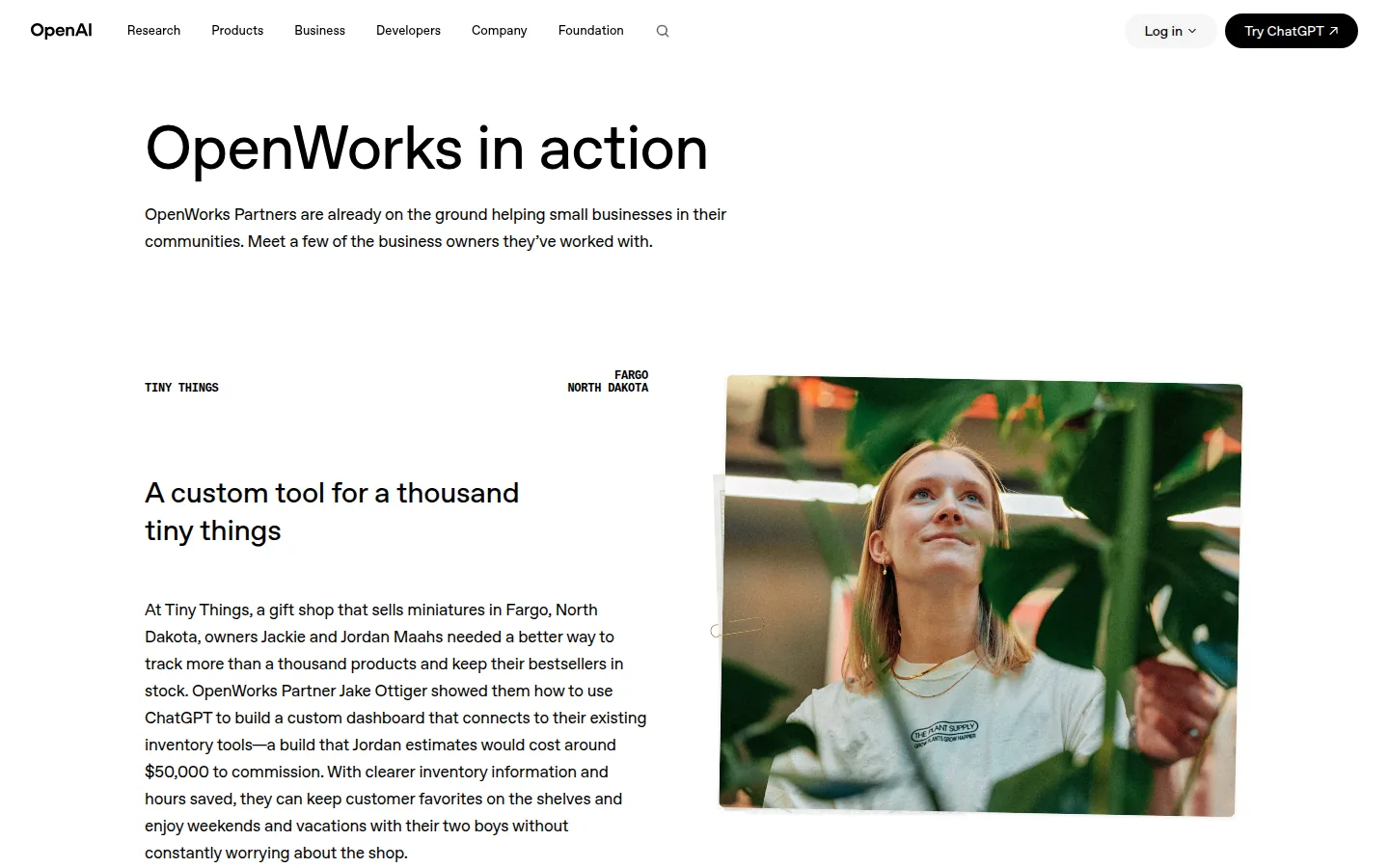
The third gap is the evidence. The page carries four customer stories, each number supplied by the owner. Ghost Grow 843 estimates its response rate rose from 20% to 75% and gained 10 restaurant customers in four months. The Tiny Things dashboard is one the owner estimates would cost around $50,000 to commission. Sign Badgers went from hours of price checks to 15 to 20 minutes, and saves two to five hours a week by the owner’s account. No baseline, no method, and no period before the program for comparison.
We fund and equip OpenWorks Partners to work alongside small business owners on projects they choose.
What is not published
- A median or a range for the stipend, only the ceiling.
- The number of partners funded, the program budget, and the length of an arrangement.
- Vetting criteria, beyond “technically skilled and curious”.
- How many businesses are enrolled, and any outcome measured by anyone outside OpenAI.
- Who owns a tool built for a business: the page says the team can keep using it, not that the business owns it.
On this page
What it changes for a small business owner
If your business qualifies, the offer is worth more than its price tag: what is given away is the scarcest input in small business AI adoption, a few days of somebody who knows the tools, on your premises, on your problem. The three months of ChatGPT Business are the smaller half, and the page never states that seat’s list price, so the trial cannot be priced from it.
The stipend only means something once divided by the commitment, and the page asks for days each month without naming how many. Our arithmetic on that ceiling:
| Days a month with local businesses | Stipend per day, at the ceiling | Per hour, at 8 hours a day |
|---|---|---|
| 2 | $4,000 | $500 |
| 4 | $2,000 | $250 |
| 6 | $1,333 | $167 |
| 8 | $1,000 | $125 |
Our division of OpenAI’s published ceiling, not an OpenAI figure. The page states a monthly ceiling and a commitment of days, but never a day rate, so the spread between 2 and 8 days is the open question a partner should settle before applying.
Two things before asking for support. Write down the number you want to move before the project starts and measure it the same way at the end: the four stories on the page are owners’ estimates, not measurements. Then get the ownership of anything built for you in writing.
The Neural Minute take
This is a distribution program wearing the clothes of a grant, and better designed than most corporate small business initiatives we read this year. Google put a hub and a set of connectors in front of owners, covered in our piece on the Gemini small business hub. OpenAI put a person in front of them. That is the more interesting bet: adoption stalls on labor, not on features, and a restaurant owner with three free seats and nobody to show her which one to open will use none of them.
The arithmetic makes the claim legible. $8,000 a month is $500 an hour of practitioner time at a light commitment and $125 at a heavy one, within what an independent consultant charges, so the partner is paid rather than subsidized and the subsidy lands on adoption. Judge OpenWorks on how many businesses finish a project, not on how many partners sign up. That is the number OpenAI has not published.
Our reservation is the case studies: four stories chosen by the company, with owners’ estimates and no baseline. A program sold on measurable outcome should publish the measurement, and when it does we will write about that number.
For readers on the consulting side, the partner role is arguably the better half: a stipend for work some already sell, plus a workshop channel. The page does not address exclusivity, so assume none and price accordingly.
Sources
- OpenWorks | OpenAI, program page, read on November 24, 2026: https://openai.com/openworks
- The date used here, November 23, 2026, comes from the page entry in the openai.com sitemap, last modified on November 23 at 18:19 UTC, because the page prints no date: https://openai.com/sitemap.xml/page/
- The stipend ceiling, the 20 communities, the eligibility lists and the partner commitments are read on that page
- Customer figures (20% to 75%, 10 customers, 15 to 20 minutes, two to five hours a week, around $50,000) are OpenAI’s, from the owners’ own estimates
- The day and hour rates in the table are our division of the published ceiling