Google announced on October 20, 2026 a set of tools inside the Gemini app for people who run a small company: a landing page that works as a hub, a brand style the app keeps between sessions, and connectors to ten outside services. The page says the set is beginning to roll out globally in the coming days, for all Gemini app users. It carries no price.
What was actually released
Three pieces ship together, and only one of them is a new surface to look at.
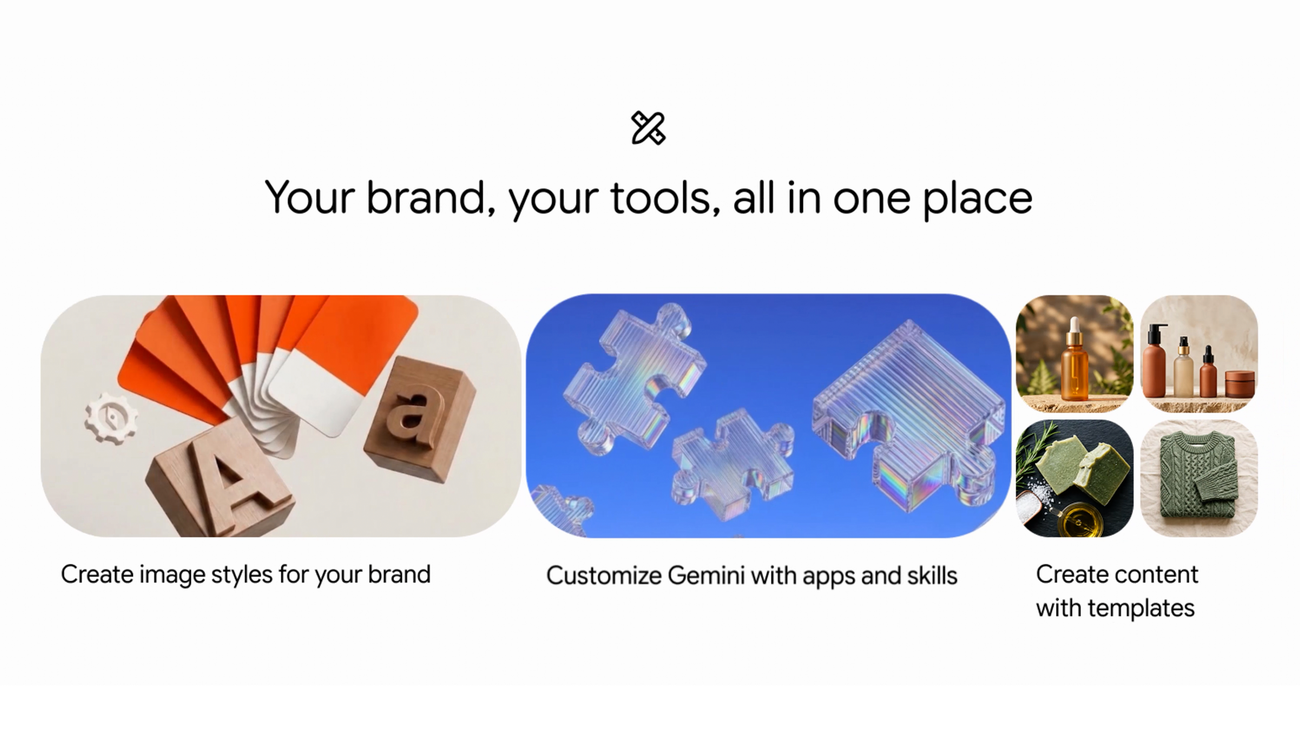
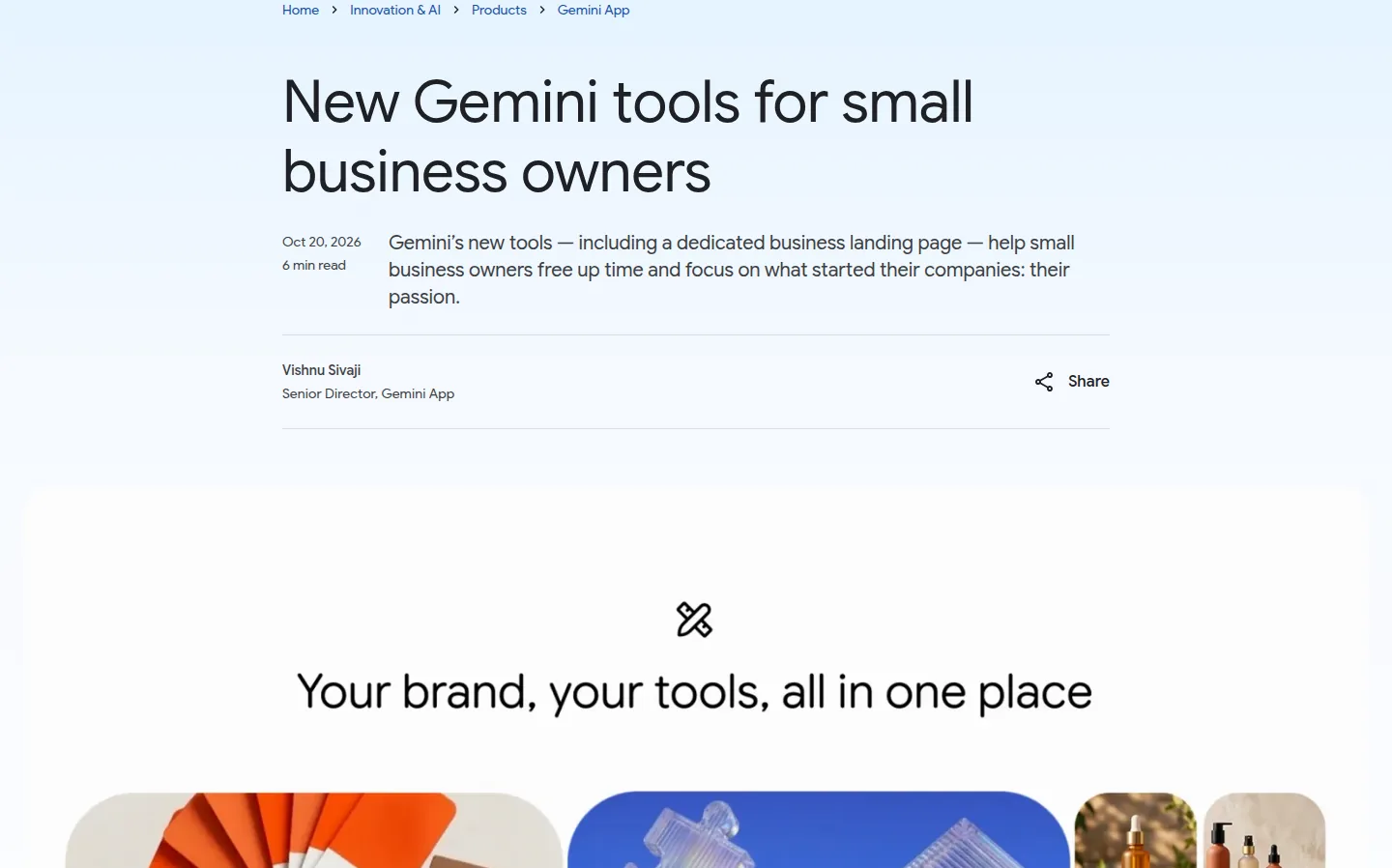
The business landing page is a central place inside Gemini where an owner builds a brand, analyzes finances and reads customer insights without switching apps. It is a new front door on the same assistant, not a separate product.
The second piece is the brand style. An owner uploads a website, a brand kit, fonts or a set of color palettes, and Gemini keeps that style and applies it again later. Google pairs it with Nano Banana 2.1, which the page calls its latest image generation model, so a launch or a running campaign can be illustrated without uploading the guidelines a second time. The claim that matters is persistence: the style is stored, not re-pasted into each prompt.
The third piece is the connectors. Gemini links to Google Business Profile, Google Ads and Google Workspace, and to seven outside services: Adobe, Canva, Dropbox, Shopify, Wix, Zoho and Xero. Ten in total, three of them Google’s own.
On the money side, the page promises that Gemini turns spreadsheets, receipts and purchase records into financial graphics and interactive models. A closing paragraph points larger companies to Gemini for your business, with centralized administrative controls, data governance and enterprise security.
What is actually new here
The hub, the finance view and the connectors are mostly packaging around models Google already ran. The change that matters for a repeatable workflow is that the brand style is the part that persists across sessions, which is what turns one good output into a template.
What the claim rests on
Each claim is worth separating from what the page shows.
| Claim on the page | What backs it | What is missing |
|---|---|---|
| Tens of millions of owners use Gemini | One sentence, no date attached | No definition, no method, no source |
| Financial models built in seconds | One sentence | No task, no dataset size, no error rate |
| Two to three hours a day saved | One named ceramicist in Bordeaux | One person, one trade, self-reported |
| Rolls out globally in the coming days | One sentence | No date, no region list, no tier |
| Ten connected services | The services are named | No permission scope, no plan requirement |
| Cohesive, on-brand assets | Nano Banana 2.1 named | No version detail, no comparison, no figure |
The user count is the softest number in the piece. “Tens of millions” sits anywhere between twenty million and ninety million, it is tied to no period, and no survey is cited. It is a framing figure, not a measurement.
The saved-hours figure has the same problem in miniature. The Bordeaux case is a ceramicist who writes product descriptions, newsletters and social hooks, and the page says she saves two to three hours every day. That is a real testimonial, and still one business reporting its own experience.
Gemini can turn messy spreadsheets, receipts, and purchase records into clear financial graphics and interactive models in seconds.
That sentence is the strongest thing in the release, and the one with nothing behind it. No task, no sample, no accuracy figure, and no statement of what happens when the receipts are photographed badly.
What the page does not say
No price, no tier, and no date beyond “in the coming days”. It does not say whether the connectors are read only or can write to an ad account, whether the finance view works on the free plan, what happens to uploaded receipts after the session, or which model handles the financial work.
On this page
What it changes for a one-person business
The practical shift is not that Gemini writes better copy. It is that the three things a small operator keeps in three places, a brand guide, a spreadsheet and an ad account, are meant to sit in one context window.
That matters most for the person doing marketing between other tasks. If the style truly survives between sessions, the weekly job stops being “prompt an image and fix the palette afterwards” and becomes “approve an asset that already matches the shop”. The gain is in the repeat, not in the first output.
The cost sits in the same place. A brand kit and a palette are low risk. Receipts and purchase records are a different category of data, and the page does not say how long they are kept. Connecting Google Ads gives an assistant access to the account that pays for traffic, which is a permission decision, not a feature decision. Try the brand style on one real campaign, keep the finance view on data you would email an accountant, and read the connector permissions before attaching an ad account.
The Neural Minute take
We have covered this app three times in two weeks, and the pattern holds: Gemini ships features as defaults, then explains them afterwards. Personal Intelligence put Gmail and photos into the assistant, and Argon cut the price per million tokens. This one moves the app from something you prompt to a surface that holds your brand and reads your books.
That is why “for all Gemini app users” is the most consequential line in the release. If the hub and the marketing skills reach everyone, the difference between a free account and a paid one stops being features and becomes limits: how many images, how much context, which model. Google does not say which side of that line this lands on.
Our second reservation is the finance view. Turning receipts into charts is the kind of task where a wrong total is worse than no total, and nothing on the page addresses accuracy. One wrong column in a cash flow view costs more than the subscription. Until Google publishes how the numbers are checked, treat that panel as a sketchpad, not as bookkeeping.
The third point is competitive, and it cuts both ways. Canva and Shopify already sell brand consistency inside their own tools, which is why a stored style is the right feature to copy. But a style stored in Gemini only pays off if the asset leaves the app in a usable format, and the page is silent on export.
What we would do with this: one campaign, one week, the same brief given to the hub and to the pipeline already in place, then the assets compared side by side. If the brand style does not survive a second session, the announcement reduces to a shortcut, and a shortcut is not worth moving a stack for. If it does survive, that is a real change in how a small team produces marketing, and the ten connectors become the interesting half.
Sources
- New Gemini tools for small business owners, blog.google, published October 20, 2026. The date, the ten connected services, the Nano Banana 2.1 reference and the rollout wording are read there.
- The named businesses are Morgane in Bordeaux, Santosh Jadhav in Maharashtra, Patricia Morais in Goiania, Gumilang in Jakarta and Josh in New Jersey. Their figures are their own accounts, reproduced by Google.
- Our earlier coverage of the same app: Gemini answers from your Gmail and photos while you drive and Google ships Gemini 4 Argon at $2 per million tokens.