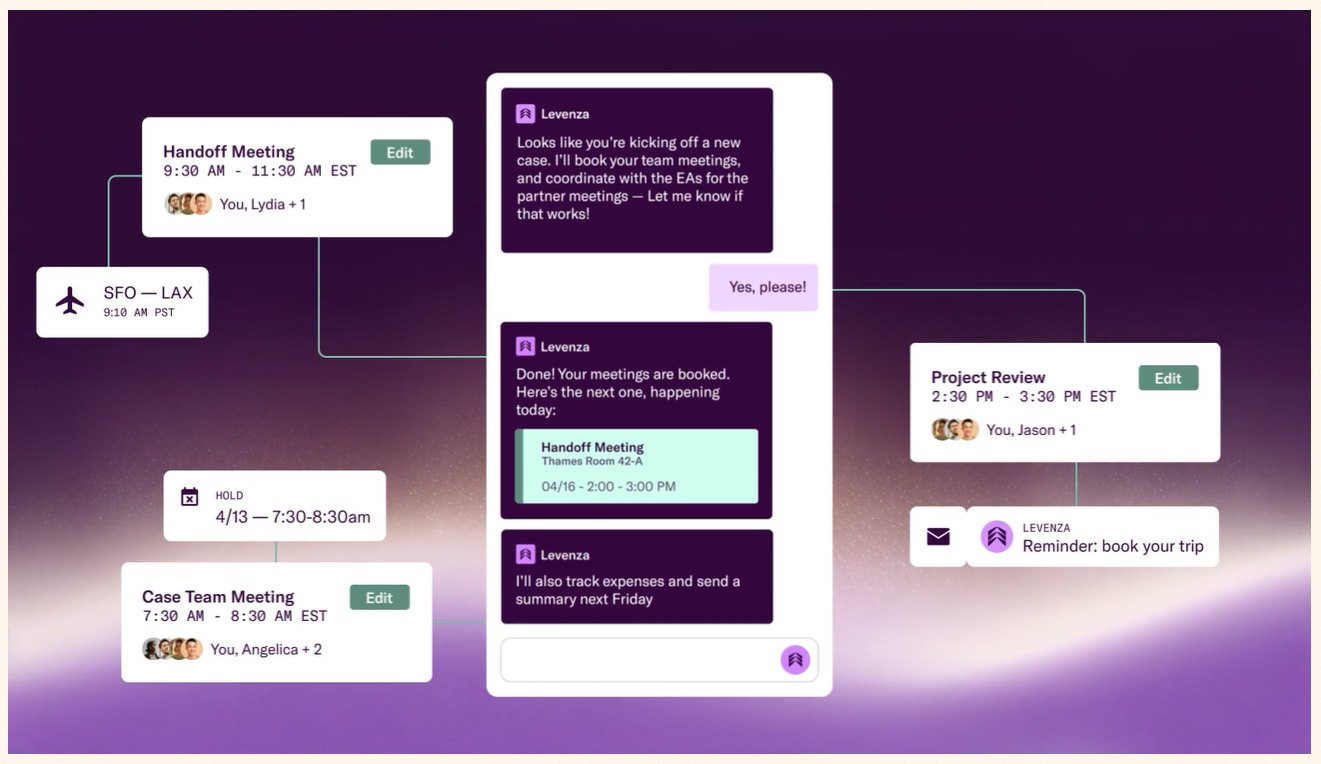
Levenza made its AI agents generally available on November 23, 2026, running inside Microsoft Teams, Slack and Outlook rather than in an application of its own. The same announcement disclosed an acquisition: Fluid Inference, a voice research lab bought in September, now supplies the speech layer that lets a user call an agent and ask it to move a meeting.
What was actually released
The product is administrative, not conversational. Inside Teams, Slack or Outlook, the agent coordinates scheduling across attendees, offices and time zones, books rooms, liaises with travel agents, submits timesheets, and keeps a to-do list assembled from meetings, chats and email. Levenza’s pitch is that the agent owns the coordination to the end instead of answering one request and stopping.
“People have seen what personal AI agents can do outside work, and they’re expecting the same experience in the office.”
Two limits sit inside the release and matter more than the feature list. Travel booking and expense management are scheduled for 2027, so today the agent can contact a travel agent and cannot book the trip. And the rollout is not self-serve: Levenza places forward-deployed engineers with each customer to adapt the agent to how that firm routes requests, including through executive assistants. The stated audience is two groups, professionals without dedicated admin support and the assistants already carrying the heaviest workloads.
Voice is the part that is new. The release says Fluid Inference’s speech and system one models were downloaded more than 4.7 million times and are used in more than 60 apps. The integration is already live: call the agent for a briefing on the day ahead, work through urgent email or rearrange a meeting without opening a laptop. Fluid Inference founder Brandon Weng joined Levenza as Head of Engineering.
What exists from November 23, 2026
- Agents that schedule, book rooms, log timesheets and hold a to-do list inside Teams, Slack and Outlook.
- A voice mode, from Fluid Inference, for briefings and meeting changes made away from a desk.
- A customization step with Levenza engineers for every customer.
- Not included: travel booking and expense management, both listed for 2027.
What the claim rests on
The release carries five figures, and they are the whole of the evidence.
| Figure in the release | What it describes | What the release leaves out |
|---|---|---|
| More than 300 customers | Signed accounts, including Oliver Wyman, Kearney, Goodwin, Baird, Hg Capital and Spencer Stuart | How many are live, and on how many seats |
| Net revenue retention of 170% | Expansion inside existing accounts | The cohort, the period, the method |
| Gross revenue retention of 99% | Accounts that stayed | The same, and the base it is calculated on |
| More than 95% rate it highly | Satisfaction | Sample size, question wording, scale |
| Up to three hours a day saved | What users report | An average, and what the time is measured against |
None of these is a measurement of the product. The retention pair is the most informative, because 170% net and 99% gross describe accounts that expand and almost never leave, which is the habit a scheduling tool has to earn. But with no cohort and no period, a price change and a real increase in use produce the same number. The three hours are a ceiling reported by users, not an average observed by anyone.
The release puts no price on the agents it announces. Levenza’s pricing page, read on November 23, 2026, publishes $60 a month billed annually for the individual calendar plan, $20,000 a year as the entry point for calendar enterprise agreements, and lists AI agents under enterprise with a contact form and custom agreements. So the product that went global today has no public price, and “globally available” arrives without a country list or a language list. A buyer cannot compare it to a Copilot or Gemini seat without a conversation.
The framing is borrowed. The release cites an October Gartner survey of more than 2,000 CIOs, where 13% reported significant value from AI. That describes why admin work is expensive, not whether this agent reduces it.
What the release does not publish
No independent test of the agent, no error rate for a rescheduled meeting or a sent email, no definition of the two retention figures, no sample behind the satisfaction share, no price for the agent product, and no country or language list behind the word global.
On this page
What it changes for teams that run on executive assistants
The unit of value is a finished coordination, so the comparison is not another chat seat. It is the assistant’s morning: the multi-round exchange across offices and time zones, where hierarchy decides whose hour moves first. That exchange is what Levenza claims to take over, and it is also the hardest thing to hand to software, because the wrong move is not a bad paragraph, it is a meeting that moved.
For a company already paying for Copilot or Gemini seats, the overlap is direct. Those assistants draft inside the same applications; this one acts on the calendar and the inbox. The budget line differs too: a calendar plan at $60 a month per person is a per-seat decision, while an agent rollout arrives as an annual enterprise agreement.
The named customers read as a profile: consultancies, a law firm, an asset manager and a search firm all run on assistants. A team with no executive assistants is not the buyer this release describes.
The Neural Minute take
We hold no tool sheet on Levenza, so this rests on the release and the pricing page. Together they describe a business selling a calendar to individuals and admin agents to enterprises, announcing the second with numbers earned by the first.
The risk profile of an admin agent is different from a chat assistant. A wrong sentence costs a correction; a wrong action moves someone’s meeting and sends the email on their behalf. Levenza’s own product page describes a risk assessment that decides when to execute and when to ask for confirmation, on a spectrum administrators control. That default, not the feature list, is the thing to test, and its setting is not in the release.
A two-week protocol answers most of it. Take one team that works with assistants, feed it ten cross-time-zone meeting requests, and measure two numbers: time to a confirmed slot, and how often a person steps in. Then check whether drafted replies stop for review before sending and whether the activity log shows what the agent changed. If the intervention rate is high, the three hours saved are the team’s own hours, relocated. We made the same point about retail agents, where a voice agent that nails a shopping task still loses on a wrong charge, in our October 22 piece.
What would change the picture is narrow: an error rate per action type, and a price with a term. Until then, watch the 170% net retention, because expansion is measured on customers who already paid, and that is the one figure a launch cannot manufacture in a morning.
Sources
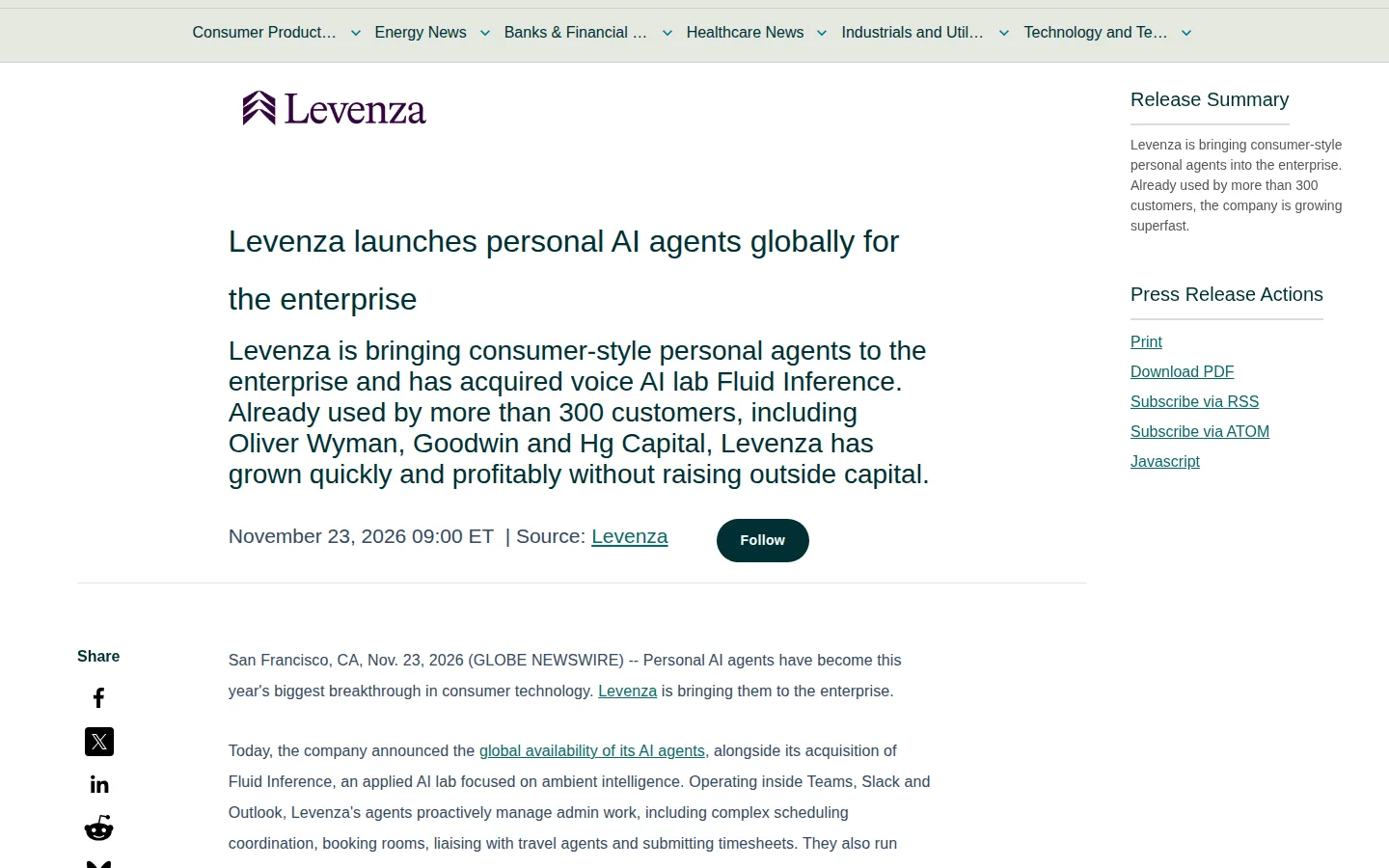
The primary source is the release Levenza issued on November 23, 2026, distributed by GlobeNewswire, which carries the date in its dateline and repeats it in the body. Every figure here except the pricing comes from that page, quoted as Levenza states it.
The pricing comes from Levenza’s pricing page, read the same day, which routes AI agents to a sales contact. That page carries no date of its own.
Levenza launches personal AI agents globally for the enterprise, Levenza, November 23, 2026.