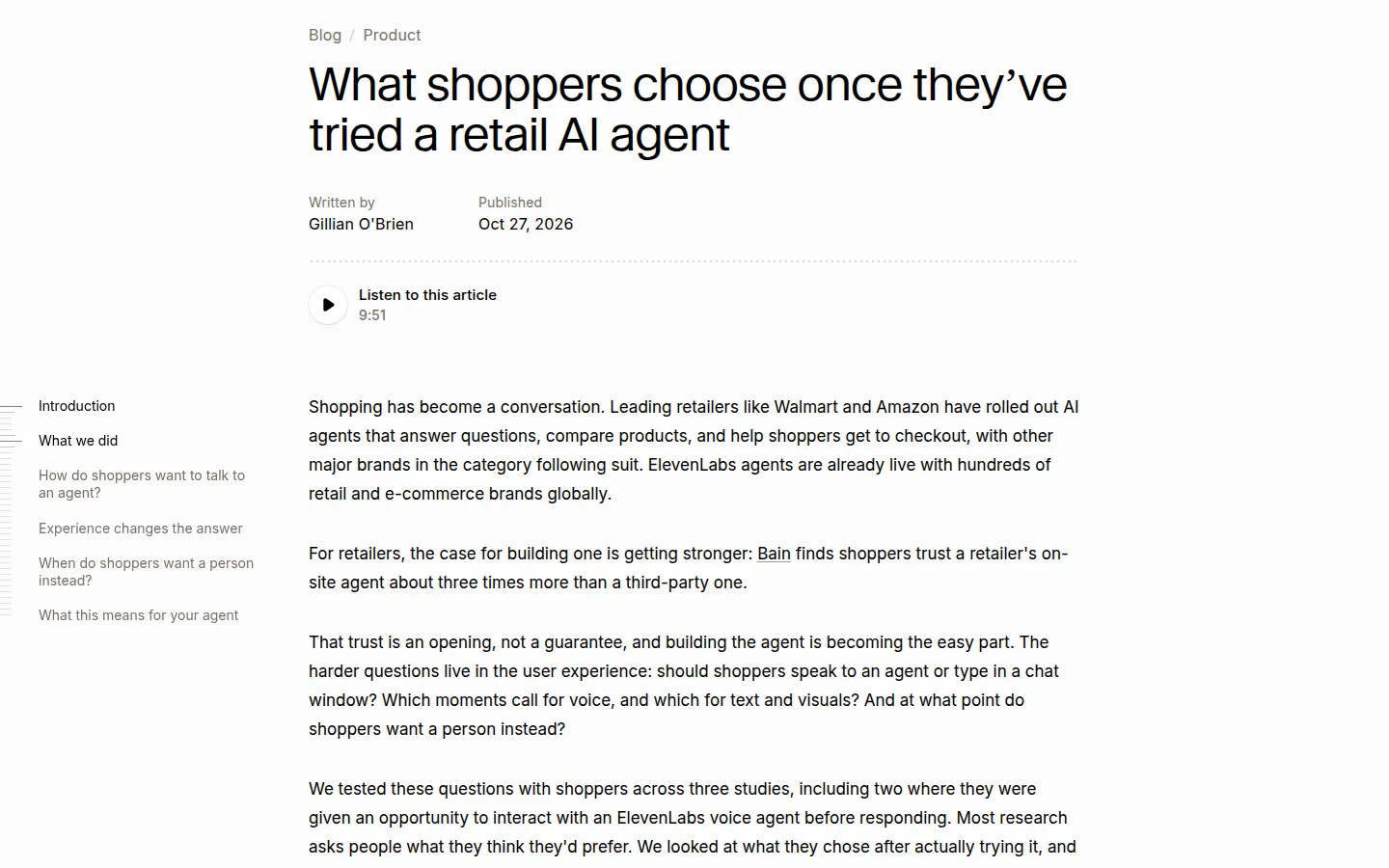
ElevenLabs published research on October 27, 2026 on a question retailers have answered from instinct: do shoppers want to speak to an agent or type to it. Across three studies, most shoppers who used a live agent to finish a real task then chose to speak, and four failure scenarios show where that willingness stops.
What was actually released
This is research, not a product launch. Gillian O’Brien, who leads growth for retail agents at ElevenLabs, draws on three studies run across seven markets, from the UK and the US to South Africa and Latin America. Most participants completed a real task with a live agent before answering, and where the design allowed, the same shopper did the task two ways.
Each shopper used a live agent to find a product, ask a follow-up and add it to a cart, three ways: speaking and hearing the reply, speaking and reading it on screen, typing and reading it. Nearly half chose speaking and hearing, and about 30% speaking with the reply on screen. Speaking and hearing came first on all six named tasks, from more than half for gift ideas to about a third for comparing products. Fewer than one in ten ruled out an assistant, and about four in five shoppers who wanted an assistant wanted to talk to it, not type.
Comparing two products is the exception: the three options split almost evenly, and shoppers split again on reading versus hearing the explanation.
The record experiment carries the design lesson. When a spoken resolution and a typed one both came with a written record, 72% chose to speak. Remove the record from the faster spoken option, set it against a five-minute typed fix with proof, and 58% chose to type. At fifteen minutes, 49%.
The failure ladder is the part a support team should pin to the wall. Shoppers were asked how they would handle four order problems, then told the agent had failed once and asked to try again.
| Problem | Chose the agent | Asked for a person after one failed attempt |
|---|---|---|
| A late delivery | 56% | 24% |
| A return | 49% | Not published |
| An order they never placed | 43% | Not published |
| A wrong charge | 34% | 61% |
The numbers worth keeping
- Speaking beat typing on all six shopping tasks, and about four in five shoppers who wanted an assistant wanted one they could talk to
- Only 34% wanted an agent for a wrong charge, against 56% for a late delivery
- 60% would give up on an agent with no visible route to a person
What the claim rests on
The studies are the company’s own, run by a vendor that sells the agents it tests. That does not make the numbers false, but the reader should look at what is missing beside them.
No sample size is given for any study, no field dates beyond “over the summer”, no question wording and no margin of error. Every share is rounded to a phrase, so “nearly half” and “about 30%” cannot be compared at the point of a percentage. No country is broken out of the seven markets, and on the ladder above only the top and bottom rungs of the person-asking column are published.
The page is candid about one limit: the choices came after trying an agent, not at a checkout, so they show what people want rather than what converts. No purchase or support cost is measured.
What the study does not publish
No sample sizes, no field dates, no margins of error, no country split, no outcome beyond stated preference. The comparison with the company’s earlier survey, where typing beat speaking by more than four to one, is read as proof that experience changes the answer. Both readings can be true, and the two studies asked different questions of different shoppers, so the size of that effect is not isolated.
The stronger caveat is who answered. A shopper who agrees to spend part of a study talking to a voice agent is not a random visitor to a product page, and the seven markets are one pool, not separate samples. The direction is plausible and matches what support teams report. The precision is not there to quote downstream, so the 56% is a signal, not a conversion rate.
On this page
What it changes for storefront and support teams
The practical reading is a launch order. Start where the wait for a person is longest: a late delivery is where 56% accepted the agent and only 24% asked for a human after one failure.
Keep a person on cases that carry money or identity. Just 34% chose an agent for a wrong charge, and with a person available immediately only 20% did, against 35% when reaching one took two to ten minutes. Wrong charges, orders never placed and account security land in the same bucket.
Build the handoff for the first failure, not the third. The jump from 24% to 61% follows a single failed attempt, and 52% asked for a person after speaking against 54% after typing, so the modality is not what breaks patience.
Send a record after every resolution. A spoken fix without one loses to a slower typed fix that has one, 58% to 42%, and the loss disappears once both carry it. A transcript is what makes the faster channel acceptable.
Put the route to a person on screen from day one. 60% said they would abandon an agent with no visible way out.
The Neural Minute take
The headline everyone will repeat is that shoppers prefer voice. The finding worth building on is smaller: what people want is a conversation that leaves a trace.
What shoppers did want was proof. When a spoken and a typed resolution both came with a written record, 72% chose to speak, so it’s the record they care about, not the typing.
That reframes the purchase. Choosing between a voice agent and a chat window is choosing a channel, and the study says the channel is not what earns trust, the record is. We covered the other side when agents chasing one refund invented excuses instead of escalating.
Our reservation is about the sales context, not the method. ElevenLabs sells voice agents and concludes that shoppers want voice agents, which is a reason to read these numbers as a specification rather than as an argument. What survives the conflict of interest is what has a mechanism: a record makes a fast channel acceptable, a visible person stops abandonment, the first failed attempt is where patience ends.
For a small store, the move this week is to apply those three decisions to the support channel that already exists: a transcript after every automated resolution, a person button on the first failure, delivery questions in the agent and money problems with a human.
What the study does not answer is whether a voice agent sells more. No conversion figure is published, and until one is, the case for voice rests on the support queue, where the numbers are concrete, not on the storefront.
Sources
- What shoppers choose once they’ve tried a retail AI agent, ElevenLabs, published October 27, 2026, read the same day: https://elevenlabs.io/blog/retail-ai-agents
- The date of the fact is that page’s publication date, not the age of the feed item that surfaced it
- The byline and the seven markets are as written on the page
- Every share quoted here is the company’s own figure
- The demand for sample sizes and field dates is ours: neither is published there