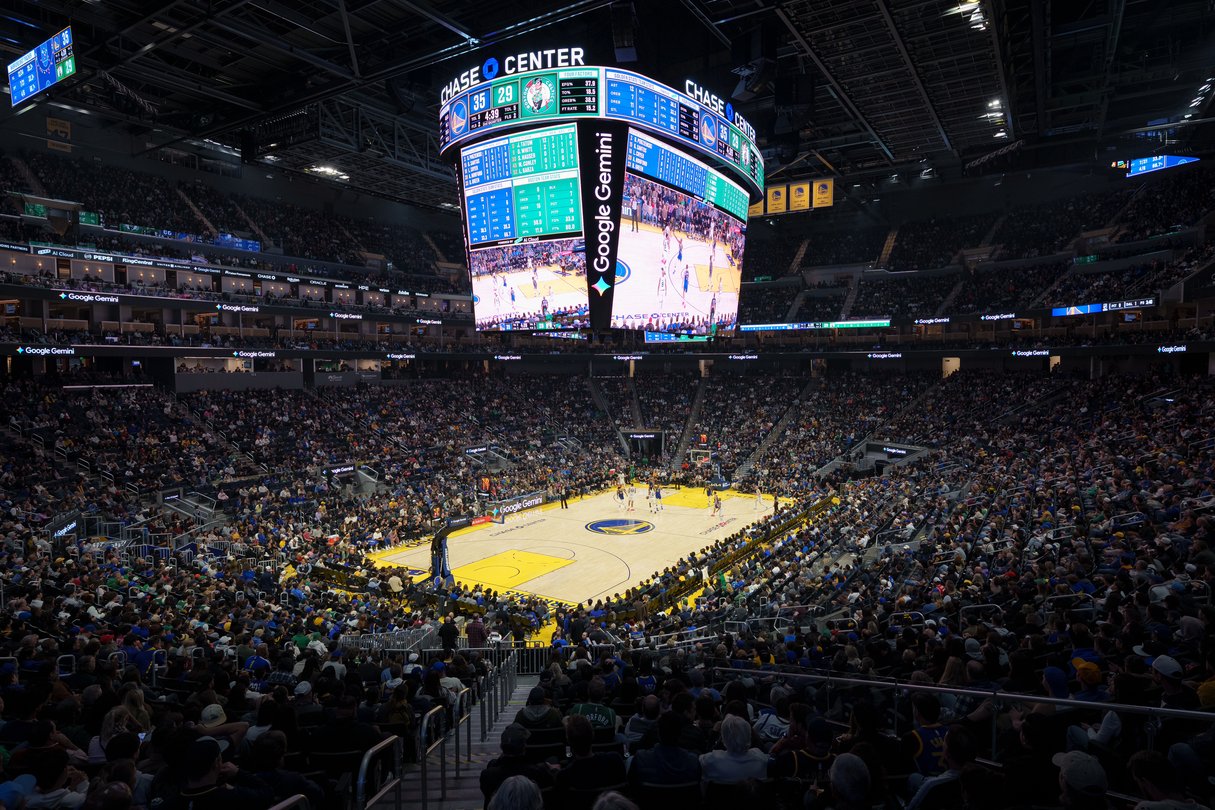
Google named Gemini the official AI partner of the Golden State Warriors, the Valkyries and Chase Center on November 24, 2026. The post describes two halves of the deal rather than a product release: interactive videoboard features inside the arena and on digital channels for fans at home, and custom Gemini agents that Golden State is building for its own business and basketball operations.
What was actually released
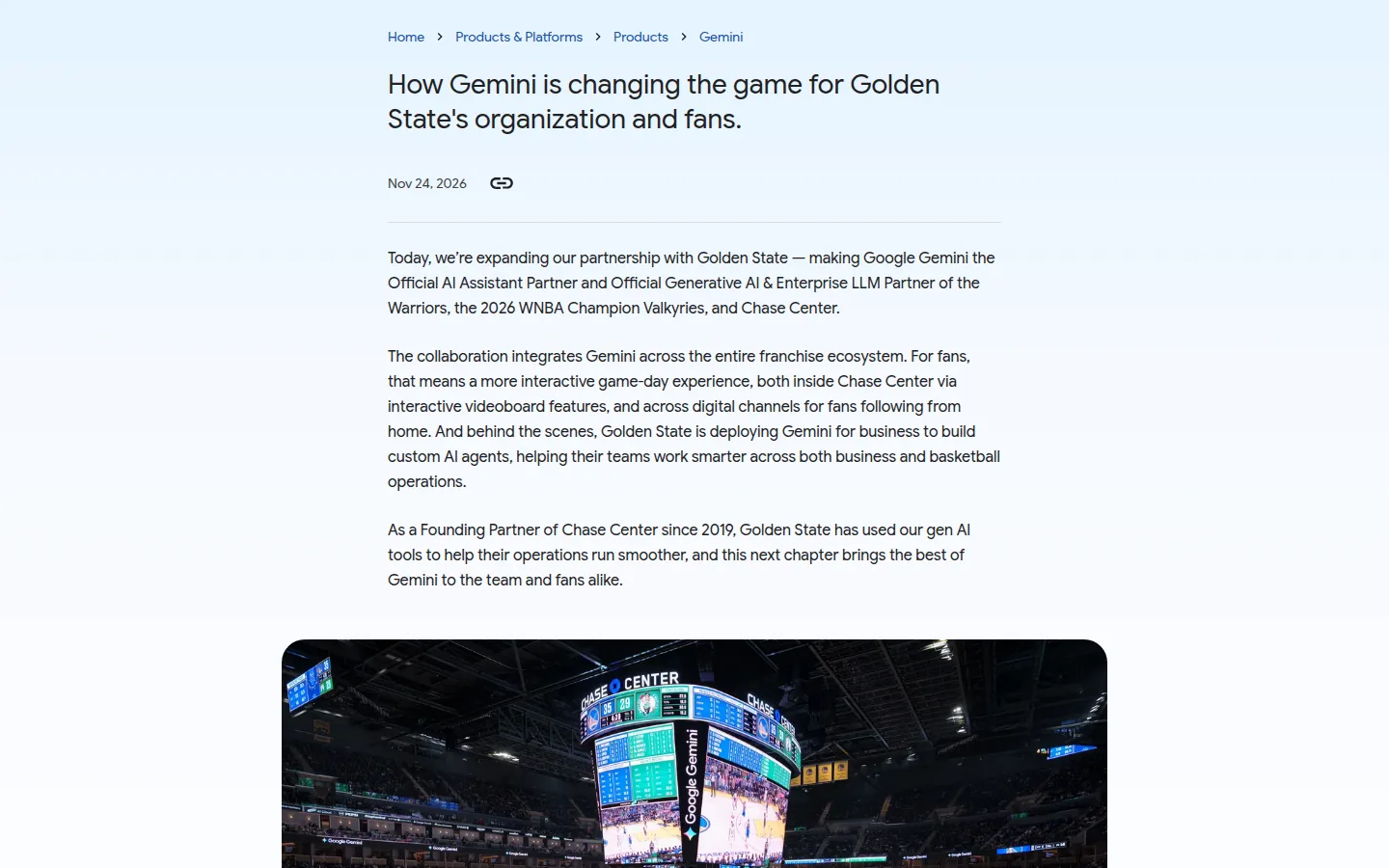
The announcement is a four paragraph post on Google’s blog that attaches two partner titles to one product. Gemini becomes the “Official AI Assistant Partner” and the “Official Generative AI & Enterprise LLM Partner” of the Warriors, of the Valkyries, which Google calls the 2026 WNBA champions, and of Chase Center, the arena the Warriors play in.
For what Google Gemini costs today, plan by plan, see the Google Gemini review.
The fan side gets a single sentence: a more interactive game-day experience, inside Chase Center through interactive videoboard features, and across digital channels for fans following from home. No fan-facing feature is named, no product is named, and nothing in that half carries a date.
The back office side is the half a reader can use. Google says Golden State is deploying Gemini for business to build custom AI agents, which the post says help its teams work across both business and basketball operations. That is one sentence, and it is the only one in the post that names a capability rather than a title.
Google adds one piece of history. Golden State has been a Founding Partner of Chase Center since 2019 and has used the company’s gen AI tools to help its operations run smoother, without naming a single one of them.
| What the post states | Surface | Product named | Figure or date published |
|---|---|---|---|
| Official AI Assistant Partner, Official Generative AI & Enterprise LLM Partner | Warriors, Valkyries, Chase Center | Gemini | none |
| Interactive videoboard features | inside Chase Center | none | none |
| Digital channels for fans at home | Warriors digital properties | none | none |
| Custom AI agents | business and basketball operations | Gemini for business | none |
What the claim rests on
The page is one source. It is published by the vendor, runs four paragraphs, and the only figure anywhere on it is the publication date. That is what the table above records: every row states a commitment and no row states a number.
Both halves of the deal rest on adjectives. “More interactive” is not a description of a feature, and “work smarter” is not a result. The post gives no count of agents, no list of the tasks they take, no number of employees using them, no spend, no timeline, and no figure of any kind for the videoboard work. It also does not say where the agents run: inside Workspace, on Vertex AI, or on a model tuned for the franchise.
The partnership titles themselves are the safest part of the page, because a franchise does not let its marks sit in a vendor post without a contract behind them. But a contract explains a title, not a deployment. Nothing here says an agent is in production, and nothing says how Golden State measures one.
What is not published
There is no price, no term, no exclusivity clause, and no statement of what either side pays. The post does not name a single agent, a single workflow, or a single internal team that uses one. The videoboard features have no launch date, no arena section, and no description of what a fan will see on the screen. No result, no baseline, and no measurement appear in the post, so there is nothing to check beyond the existence of the announcements themselves.
On this page
What it changes for teams buying Gemini
A franchise is a mid-size business with ticketing, sponsorship sales, content production, retail, travel, and a basketball department. The use case Google names is the one a fifty person company has in mind when it opens a Gemini for business page: custom agents on top of the productivity suite it already pays for.
That makes this a relevant lead for a buyer and a poor reference. The lead is that a business outside software is building agents rather than trialing a chatbot. The missing part is everything a buyer needs to copy it: which systems the agents read, who approves what they write, and who owns the budget when a run costs more than expected.
What a buyer can actually act on sits in the product layer, which this post does not touch. On October 8, 2026, Google Cloud published the Gemini agent with hard spend caps, where an administrator sets a limit per project and the agent pauses when the limit is hit. In the same period Google added a small-business hub and ten connectors to Gemini, which is the piece that decides whether an agent can reach the systems a company already runs.
Read together, the three announcements describe one offering from three angles: a sponsor title, a set of controls, and a set of connectors. Only two of the three can be bought against a spec.
The Neural Minute take
A partner title is a contract, not a capability. What Google bought here is distribution in front of a basketball audience, and what Golden State bought is a vendor relationship it already had as a founding partner of its arena since 2019. Neither of those is news about what Gemini does for a business.
The one sentence with content in it is about the back office, and it is worth quoting exactly, because it is the whole published record of the deployment:
And behind the scenes, Golden State is deploying Gemini for business to build custom AI agents, helping their teams work smarter across both business and basketball operations.
What we would want before treating that as a case: the number of agents in production, the hours they replace, and the cost per month. Our own reading of the Gemini agent on October 8, 2026 gives the control that makes such numbers auditable, a spend cap per project that stops the run instead of warning about it. A deployment you cannot meter is a deployment you cannot describe. This post describes none, which places it at the announcement stage of the franchise program.
There is a temptation with a page like this to fill the gap with our own account of what agents do for a mid-size business. We will not, because the source does not support it, and an announced partnership is not evidence of a working one. The honest reading for someone choosing an AI tool this week is that the back-office half is a lead to follow, not a reference to copy.
We will write the follow-up when numbers appear: agent count, hours saved, cost, or a named workflow. Until then the page stands as what it is, a sponsorship with one useful sentence in it.
Sources
- How Gemini is changing the game for Golden State’s organization and fans, Google blog, published November 24, 2026: https://blog.google/products-and-platforms/products/gemini/gemini-golden-state/
- The two partner titles, the videoboard features, the digital channels, and the custom AI agents are read on that post on November 24, 2026, and reproduced as the vendor’s own statement, not as an independent measurement
- The spend caps and connector details come from the Google Cloud announcement of October 8, 2026 and the Gemini small-business post, both read on the dates this site published them