Neural Minute may earn a commission if you buy through our links. It doesn’t change our verdicts. How we test · How we make money
Creatify is the best MakeUGC alternative for most brands: it builds a UGC-style ad from your product page, and a 15-second avatar video costs about $1.36 on its $15 plan. HeyGen has the best free plan. Arcads is the closest match to MakeUGC’s actors holding your product. Billo is the pick when you want real creators instead of AI.
Black Friday offers running now
| Tool | Offer | Ends | What we checked | |
|---|---|---|---|---|
| MakeUGC | 50% off the first yearly billing cycle: Starter $29.50 a month ($354), Growth $39.50 ($474), Pro $74.50 ($894), plus one-time bonus credits | No end date shown | Price seen on the pricing page, Nov 26, 2026 | Get the deal |
| Creatify | Up to 50% off annual plans: Standard $10, Pro $27, Ultra $47 a month billed yearly, for new subscriptions | Nov 30, 11:59 pm PT | Price seen on the pricing page, Nov 26, 2026 | Get the deal |
Which MakeUGC alternative should you pick?
Best overall: Creatify (7.9/10). For a store owner or a small team that runs many short ads. The $15 plan covers 11 avatar videos of 15 seconds a month, it writes the script from your product page, and you keep the rights after you cancel.
Best free plan: HeyGen (6.8/10). For anyone who wants a finished ad before paying. The free plan makes 3 videos a month with no card, and it delivered a 13-second presenter ad in our test. Ads you run need the $29 plan.
Closest to MakeUGC, for media buyers: Arcads (6.6/10). For teams that test dozens of hooks. It has 1,000+ AI actors, actors that hold your product, and Workflows that turn one winning ad into 20 variations in a single run.
Staying with MakeUGC (6.5/10)? It still makes sense if Product in Hand and Batch Mode (10 variations at once) are what you use every week, and you are ready for its refund rules. Our MakeUGC review has the details.
Why do people look for a MakeUGC alternative?
MakeUGC does one job well: an AI actor reads your script on camera, with your product in hand, in 50+ languages. The reasons to leave are about money and terms, not about the format.
- No free plan, and strict refunds. The trial costs $1. The trial fee and the first paid period after it are never refunded. Later refunds are at MakeUGC’s discretion, must be asked within 3 business days of a charge, and delete every credit, video and avatar on the account.
- A high cost per video. The app shows credits, not videos. MakeUGC’s API documentation prices a talking-actor video at 100 credits. Starter costs $59 for 500 credits, so about $11.80 a video.
- Starter stops at 720p and runs one video at a time. HD to 4K and parallel jobs start on Growth at $79 a month.
- A license on your ads. You get the copyright once you pay, but MakeUGC keeps a perpetual license over outputs, and its terms let it train models on your inputs and outputs.
So the useful question is: which tool gives you the same ad, cheaper, with a free way in or cleaner rights? The answer changes with the format you run.
How do the 8 MakeUGC alternatives compare?
| Tool (score) | Best for | Free way in | Entry paid plan | Cost of one short ad |
|---|---|---|---|---|
| Creatify (7.9) | Cheap avatar ads from a product page | 10 credits a month, watermarked | Standard, $15 a month | About $1.36 (15-second avatar video) |
| HeyGen (6.8) | Presenter ads in many languages | 3 videos a month, no card | Creator, $29 a month ($24 yearly) | Varies with model and length |
| Arcads (6.6) | The same actor-holds-product format, at volume | 72-hour trial, card required | Starter, 8,000 credits a month (dollar price in the app) | 800 credits, a tenth of Starter |
| Billo (6.6) | Real creators filming your real product | No; refund of unused funds if no creator fits | Pay per video, or packs from $1,000 | From $99 (15 seconds) |
| Synthesia (6.4) | Studio presenters and translated explainers | Free plan, 10 minutes a month, watermarked | Starter, $19 a month ($14 yearly) | About $0.40 per 15 seconds |
| Higgsfield (6.1) | Product visuals without an actor | Free plan without monthly credits | Starter, $19 a month | About $1.32 per 5-second Kling 4.0 clip on Starter ($0.92 on Plus), our test |
| TopView (5.9) | An agent that plans the whole ad | No free plan listed | Plus, $36 a month billed yearly | About $8 (15 seconds of Seedance 2.5) |
| Captions (5.6) | Editing and captioning real footage, plus AI actors | Free editor, no AI credits | Max, $24.99 a month | Varies with the feature used |
| MakeUGC (6.5, benchmark) | Actors holding your product, in batches | $1 trial, not refunded | Starter, $59 a month | About $11.80 (talking actor) |
A credit is not worth the same thing from one tool to another, so the last column turns each plan into the price of one short ad: plan price divided by the videos its credits cover. Where the tool publishes no cost per video, the column says so.
What did Creatify and HeyGen make from the same UGC brief?
We gave both free plans the same brief: “Create a 15 second UGC-style vertical video ad for this product, with an AI actor talking to camera”, with an Allbirds Tree Runner product page. HeyGen delivered a finished 13-second vertical ad in about 17 minutes. Creatify wrote a sharper script from the product page, then ran out of free credits before it rendered the talking shot.
- Creatify (Ad Agent, free plan): read the product page, wrote the script from its own wording (eucalyptus fiber, breathable, machine washable), recorded a 13.4-second voiceover and made three keyframes, including an actor holding the shoe, plus a 4-second washing-machine shot. It stopped there: the lip-synced talking shot needed about 7 credits and 5.92 were left. It also flagged that the line “I walk everywhere in these” is a dramatized testimonial you may need to disclose on Meta and TikTok.
- HeyGen (Video Agent, free plan): chose a stock AI presenter, wrote the script, added captions, text overlays and music, and rendered a 720×1280 video in four scenes. It came out at 13.2 seconds instead of 15, which the agent said itself. The presenter never holds the shoe: the product appears as an overlay and in a separate shot.
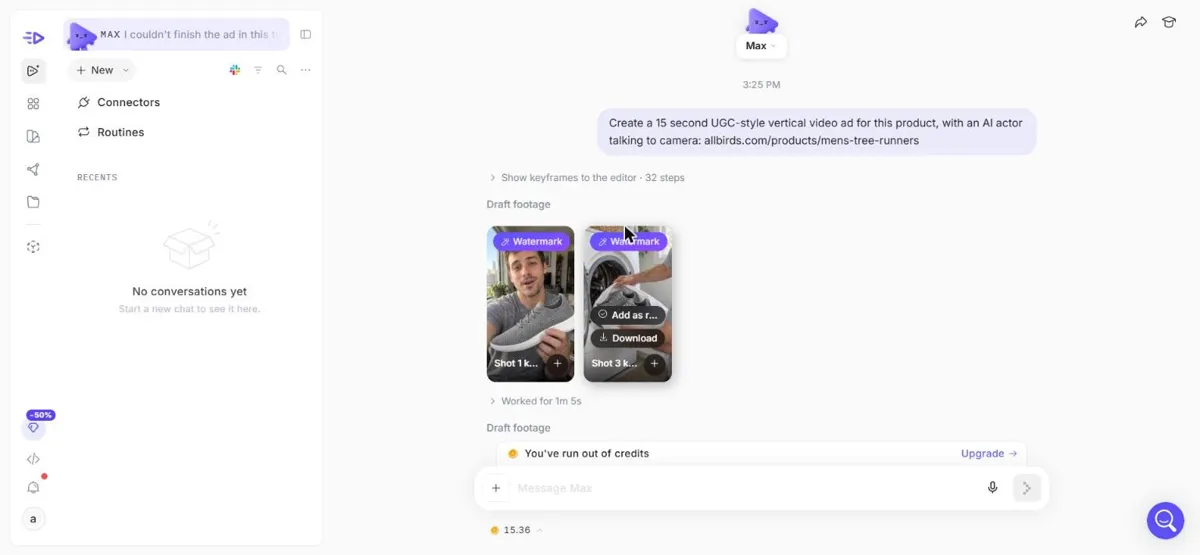
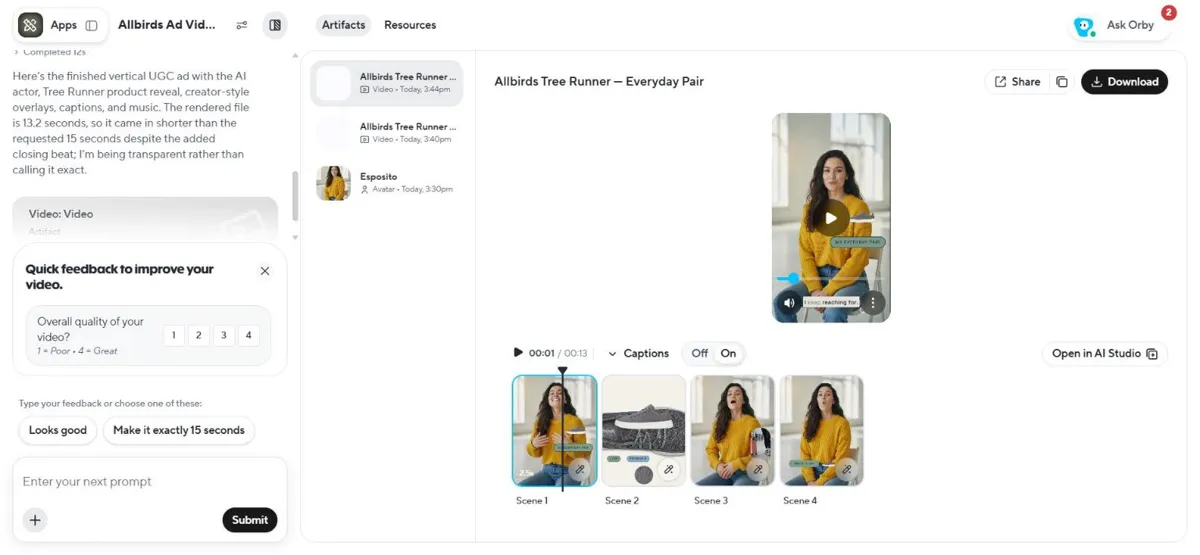
Our take. For the MakeUGC look, the actor touching the product, Creatify got closer than HeyGen. It spent 4.08 of its 10 free credits and estimated 5.2 to 13.2 more to finish, so a multi-scene ad lands at 9 to 17 credits, about $2.50 to $4.70 on the $15 plan. That is still well under MakeUGC’s $11.80. HeyGen is the safer way to judge a finished ad for free, as long as a presenter format works for you.
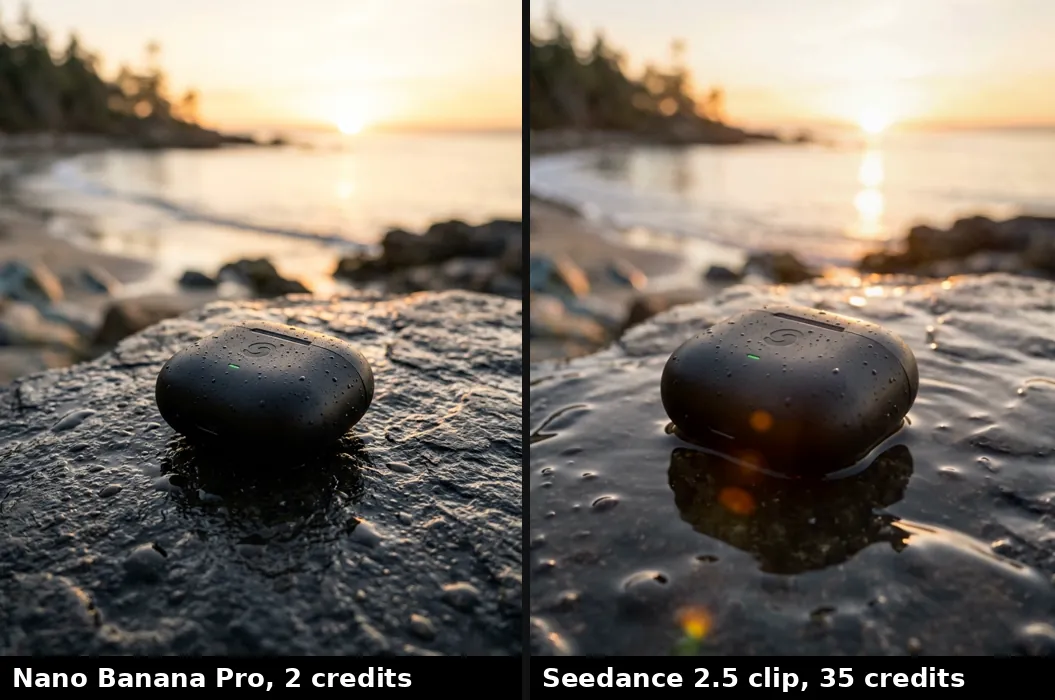
We also ran a product ad without an actor on a paid Higgsfield account: a Nano Banana Pro product photo for 2 credits, then a 5-second Seedance 2.5 clip in 720p for 35 credits.
How do we score MakeUGC alternatives?
| Criterion | Weight | Creatify | HeyGen | Arcads | Billo | Synthesia | Higgsfield | TopView | Captions | MakeUGC |
|---|---|---|---|---|---|---|---|---|---|---|
| UGC ad format | 35% | 8 | 7 | 9 | 10 | 4 | 5 | 7 | 6 | 9 |
| Cost of one ad | 20% | 9 | 6 | 3 | 2 | 9 | 8 | 5 | 6 | 4 |
| Variations for testing | 15% | 7 | 6 | 9 | 4 | 6 | 5 | 6 | 5 | 9 |
| Try before you pay | 15% | 7 | 9 | 6 | 5 | 8 | 5 | 3 | 4 | 3 |
| Rights for paid ads | 15% | 8 | 6 | 4 | 9 | 7 | 8 | 7 | 6 | 5 |
| Final score /10 | 100% | 7.9 | 6.8 | 6.6 | 6.6 | 6.4 | 6.1 | 5.9 | 5.6 | 6.5 |
The final score is the weighted average of the five notes, rounded to one decimal. MakeUGC is scored on the same grid as a benchmark. Arcads and Billo tie at 6.6; Arcads comes first because it scores higher on both cost of one ad (3 against 2) and variations (9 against 4).
UGC ad format (35%). Does the tool deliver what you used MakeUGC for: a person talking to camera, phone-shot style, with your product in the shot? Billo scores 10: real creators film your real product. Arcads and MakeUGC score 9: both have AI actors that hold your product, in 30 or more languages. Creatify scores 8: its agent drew an actor holding the shoe in our test. HeyGen and TopView score 7: HeyGen finished a captioned presenter ad but the actor never touched the product, and TopView lists UGC-style ads with AI presenters from a product URL. Captions scores 6: AI actors exist, but the app is built around editing your own footage. Higgsfield scores 5: strong clips that you still assemble. Synthesia scores 4: studio presenters made for training and explainers.
Cost of one ad (20%). We turn each published credit cost into dollars. Creatify scores 9 ($1.36 for a 15-second avatar video) and so does Synthesia (about $0.40 for 15 seconds of studio video on Starter). Higgsfield scores 8 (about $1.32 for a 5-second Kling 4.0 clip on Starter, $0.92 on Plus, in our test). HeyGen and Captions score 6: both price in credits with no fixed cost per video. TopView scores 5: about $8 for 15 seconds of Seedance 2.5 at its own conversion. MakeUGC scores 4 ($11.80). Arcads scores 3: a talking-actor video takes a tenth of the monthly plan and the dollar price sits inside the app. Billo scores 2: from $99 a video, though that buys a human creator.
Variations for testing (15%). Ads are tested in batches. Arcads and MakeUGC score 9: Workflows make 20 UGC variations in one run, and Batch Mode makes 10. Creatify scores 7: Ad Clone and 200+ templates, but the $15 plan runs one generation at a time. HeyGen, Synthesia and TopView score 6: translation into 175+ languages on HeyGen and 140+ on Synthesia, or a style clone with 4 parallel tasks on TopView Plus. Captions and Higgsfield score 5. Billo scores 4: every extra hook is a paid add-on.
Try before you pay (15%). HeyGen scores 9: 3 free videos a month and a finished ad in our test. Synthesia scores 8: a free plan with 10 minutes a month. Creatify scores 7: 10 free credits, which ran out before our ad was done. Arcads scores 6: a 72-hour trial with 1,000 credits and a full refund if you use none. Billo scores 5: no subscription, and unused funds come back if no creator fits within 30 days. Higgsfield scores 5: no monthly credits on the free plan. Captions scores 4: no AI credits on the free plan. MakeUGC and TopView score 3: a non-refundable $1 trial, and no free plan listed.
Rights for paid ads (15%). Billo scores 9: the creator assigns all rights to you when the video is submitted. Creatify and Higgsfield score 8: Creatify assigns you the copyright and you keep your ads after the plan ends; Higgsfield claims no ownership. Synthesia and TopView score 7: you own the output, Synthesia keeps a limited-term license to run the service, and TopView lets you opt out of training by email. HeyGen and Captions score 6: HeyGen bars free-plan videos from ads, and Captions keeps a license on your outputs that survives your account. MakeUGC scores 5 (perpetual license, training). Arcads scores 4: a non-exclusive license, with edits limited to a short list.
Creatify: best for cheap avatar ads from a product page
Who it is for: a store owner or a small team that wants MakeUGC’s format at a fraction of the price, and is fine with 720p avatar videos for testing.
- The lowest published cost per ad. Standard costs $15 a month for 55 credits, and Creatify’s pricing page counts 11 avatar videos of 15 seconds on it. Pro ($55, 280 credits) covers 56 of them, so about $0.98 each.
- It starts from your product page. URL to Video and the Ad Agent read the page and write the script. In our test the script used the page’s own selling points.
- Clean rights. Its terms assign you the copyright, and its pricing FAQ says you own your creatives even after your plan ends.
- A free plan: 10 credits a month and 300 actors, with a watermark. Pro opens 1,500 actors and 3 custom avatars.
Limits. The free credits ran out before our ad was finished, so budget a paid month to judge it. Standard runs one generation at a time, and payments are not refundable.
Versus MakeUGC: about $1.36 a video against $11.80, and a free plan against a $1 trial. MakeUGC keeps the edge on batch output.
Pick it if you want the most ads per dollar. Skip it if you need 10 variants rendered in parallel on day one.
HeyGen: best for a free first ad and presenter videos
Who it is for: brands that sell with a spokesperson, explainers or localized ads, and want to see a finished video before paying.
- The best free plan here. 3 watermarked videos a month, up to 1 minute each, no card. It handed us a finished ad on its free plan, where Creatify ran out of credits.
- Languages. Creator ($29 a month, $24 billed yearly) covers 175+ languages and dialects, 1080p, videos up to 30 minutes and your own avatar.
- A full agent. Its Video Agent picked a presenter, wrote the script and added captions, overlays and music without help.
Limits. It is a presenter tool: in our test the actor never held the shoe. HeyGen’s terms bar free-plan videos from advertising and client work, so a real campaign starts at $29. The credit cost of one video changes with the model and the length.
Versus MakeUGC: a real free plan and more languages; less of the handheld, product-in-hand look.
Pick it if a talking presenter fits your ads. Skip it if the product must be in the actor’s hands.
Arcads: best for the same format at volume
Who it is for: media buyers and agencies who already run UGC ads and want to multiply hooks.
- The closest format. 1,000+ AI actors, your own AI actor, actors that hold your product or show your app, and translation into 30+ languages.
- Built for testing. From the Creator plan, Workflows turn one winning ad into 20 UGC variations in a single run, and Replace Actor swaps the person in an existing ad.
- A clear credit scale. Starter gives 8,000 credits a month. A talking-actor video up to 2 minutes costs 800, an Unboxing POV 400 and Show Your App 200. Failed generations are refunded.
- A trial you can undo. 72 hours and 1,000 credits, card on file; a full refund if you use no credits and ask within 30 days.
Limits. Arcads shows its dollar prices only inside the app, so you can’t compare the bill before you sign up. Its license is non-exclusive and limits how you can edit the video.
Versus MakeUGC: the same promise, about 10 talking-actor videos a month on Starter, and a refundable trial. MakeUGC shows its prices; Arcads doesn’t.
Pick it if you test many hooks a week. Skip it if you need to know the monthly price before you hand over a card.
Billo: best for real creators instead of AI actors
Who it is for: brands whose AI ads look too polished, or whose product needs real hands, real skin or real food on camera.
- Real people, your real product. A marketplace of 5,000+ vetted creators. You ship the product, the creator films it.
- Pay per video, no subscription. Videos start at $99 for 15 seconds from a regular creator with basic editing. Packs start at $1,000 for up to 10 videos and never renew.
- Rights handed over. The creator assigns all rights in the video to the brand on submission, for social, websites and ads.
Limits. It is slow next to AI: delivery takes 7 to 12 business days after the product reaches the creator, with up to two rounds of revisions. Every extra hook costs more, and balances expire after 12 months.
Versus MakeUGC: about eight times the price per video, but no AI disclosure question and a person who really used the product.
Pick it if you need a handful of trusted testimonials. Skip it if you test 50 hooks a week. Prices are on Billo’s pricing page.
Synthesia: best for studio presenters and translated explainers
Who it is for: brands that need a clean presenter video, a product explainer or a training clip in many languages, more than a phone-shot testimonial.
- Cheap minutes. Starter costs $19 a month ($14 billed yearly) for about 12 minutes of studio video, so about $0.40 for 15 seconds.
- A free plan: 10 minutes a month, 9 avatars, with a watermark.
- Languages and avatars. 140+ languages and voices, 125+ avatars and 3 personal avatars on Starter, 180+ and 5 on Pro ($89, or $59 yearly).
- Ownership. Its customer terms give you the output; Synthesia keeps a limited-term license to run the service.
Limits. The avatars are office and studio presenters, and the plans add surveys and interactive videos for training teams. Fees are not refundable.
Versus MakeUGC: far cheaper per minute and a free plan, but not the handheld UGC look.
Pick it if you make explainers or localized product demos. Skip it if you want an actor holding your product.
Higgsfield: best for product visuals without an actor
Who it is for: brands whose ads work without a person speaking: product shots, motion, short scenes.
- The models behind many UGC tools, in one balance. Seedance 2.5, Kling 4.0 and Nano Banana Pro images, from $19 a month (Starter, 270 credits) or $59 (Plus, 1,200 credits).
- Measured costs. In our paid test a Nano Banana Pro image cost 2 credits, a 5-second Seedance 2.5 clip in 720p 35 credits, and a 5-second Kling 4.0 clip in 1080p 18.75 credits, so $0.92 on Plus.
- A Marketing Studio for product ads. See how to create ads with Higgsfield Marketing Studio.
Limits. You assemble the ad yourself, clip by clip. In our test it invented a logo on the product, and refunds stop 7 days after the first purchase. Full results in our Higgsfield review.
Versus MakeUGC: cheaper clips and clean rights, but no talking actor with lip-sync in a ready ad.
Pick it if product visuals beat testimonials in your account. Skip it if you need a talking head.
TopView: best for an agent that plans the whole ad
Who it is for: marketers who want to paste a product URL or a reference video and get a planned, editable ad.
- A video agent. Give it a script, a reference video or a product URL; it plans the scenes, picks the models and keeps every shot editable on a canvas. “Clone a video style” recreates an ad’s direction for your product.
- A large cast. 5,000+ public avatars and unlimited saved Product Avatars on every plan, with avatar videos up to 180 seconds.
- Rights. Its terms assign you the output and let you opt out of model training by email.
Limits. No free plan or trial is listed. Plus costs $36 a month billed yearly ($432 up front) for 100 credits a month, about 66 seconds of Seedance 2.5 video at 720p, and unused credits expire each month.
Versus MakeUGC: a broader agent and more avatars, with a yearly commitment and no way to try it first.
Pick it if you want one agent for product ads and short promos. Skip it if you want to test before paying for a year.
Captions: best for editing real footage with AI on top
Who it is for: founders and creators who film themselves and want captions, cuts and an AI twin, with AI actors as an extra.
- An editor first. Captions in 100+ languages, AI Edit, translation and lip dubbing, on top of trimming and transitions.
- AI actors and your twin. Max ($24.99 a month, 500 credits, 2 seats) makes fully produced AI videos, digital twins and custom AI actors.
- Credits that roll over, up to 3 times the monthly allowance.
Limits. The free plan has no AI credits, there is no published cost per video, and payments are not refundable. Its terms leave you the output but give Captions a license on it that survives your account.
Versus MakeUGC: better for your own footage, weaker for pure AI UGC at volume.
Pick it if you appear in your ads. Skip it if you never film anything yourself.
When should you stay with MakeUGC?
When actors holding your product and many variants at once are the core of your week. Product in Hand, Batch Mode (10 variations) and Ad Remake are built for media buyers, and Growth ($79 a month, 1,000 credits) adds HD to 4K exports, 10 videos in parallel and your own avatar. Its score of 6.5 sits just under Arcads: the same format, but the highest cost per video in the AI group and the strictest refunds we have read in this category. Decide during the $1 trial, and cancel before it converts if the actors don’t fit your brand. Full details in our MakeUGC review.
How do you choose the right MakeUGC alternative?
- Start from the format that already wins in your ad account. A handheld testimonial points to Creatify, Arcads or Billo. A presenter points to HeyGen or Synthesia. Product visuals point to Higgsfield or TopView. Your own face on camera points to Captions.
- Price one finished ad, not the plan. Divide the plan price by the ads its credits really make: about $1.36 at Creatify, $11.80 at MakeUGC, $99 and up at Billo.
- Check who owns the video before you scale. For client work, Billo, Creatify and Higgsfield leave you the most freedom. HeyGen’s free plan can’t be used for ads at all.
- Read the refund rule before the trial. Arcads refunds a trial with no credits used. MakeUGC never refunds the trial or the first paid period.
Checks before you switch. Export your best MakeUGC ads and scripts first: MakeUGC deletes every video on the account when it grants a refund. Then rebuild your top ad in the new tool and compare it side by side before you cancel.
Mistakes to avoid. Judging a tool on its free plan alone: Creatify’s free credits ended before our ad did. And publishing a fake testimonial: when an AI actor says “I use these every day”, disclose it where the platform asks, as Creatify’s own agent told us.
For a ranking across every ad format, not only MakeUGC’s, see our guide to the best AI video generator for ads, and our list of the cheapest AI video generators.
How we scored these tools
The scores rest on three kinds of evidence. Our own tests: Creatify and HeyGen on the same brief on their free plans, and Higgsfield on a paid account. Each tool’s pricing page, help center and terms, all checked on Nov 26, 2026, in US dollars. And our full reviews of MakeUGC and Higgsfield. Arcads, Billo, Synthesia, TopView and Captions are scored from their documentation and terms. Costs per ad are plan price divided by the videos its credits cover.
Questions about MakeUGC alternatives
What is the cheapest MakeUGC alternative?
Creatify, among tools with AI actors. Its $15 Standard plan covers 11 avatar videos of 15 seconds a month, about $1.36 each, against about $11.80 a video on MakeUGC Starter. Synthesia is cheaper per minute, at about $0.40 for 15 seconds, but it makes studio presenters, not phone-shot UGC.
Is there a free alternative to MakeUGC?
Yes. HeyGen makes 3 watermarked videos a month with no card, Creatify gives 10 credits a month, and Synthesia gives 10 minutes a month. These are for trying the tool: HeyGen’s terms bar free-plan videos from ads, and Creatify’s free credits ran out before our test ad was done.
Which MakeUGC alternative puts my product in the actor’s hands?
Arcads and Creatify. Arcads has actors that hold your product or show your app, plus an Unboxing POV format. Creatify’s agent drew an actor holding our test shoe from a product page. For real hands on your real product, use human creators on Billo, from $99 a video.
Can I use real creators instead of AI actors?
Yes, through a marketplace like Billo. You ship your product to a vetted creator, who films it in 7 to 12 business days with up to two revisions. Videos start at $99 for 15 seconds, and the creator assigns the rights to your brand, so the video can run as a paid ad.
Can an AI actor give a testimonial in an ad?
Not as a fake customer. The FTC rule on reviews and testimonials bans testimonials that misrepresent who is speaking or their experience with the product. Let the AI actor present the product, and label AI content where Meta or TikTok asks.
Is MakeUGC free?
No. MakeUGC has no free plan. A trial costs $1 and turns into the plan you picked unless you cancel, from $59 a month on Starter. The trial fee and the first paid period are not refundable, so decide during the trial.
Part of our guide: AI tools for ecommerce.
Sources
- Pricing pages: Creatify, HeyGen, Synthesia, TopView, Captions, Billo, MakeUGC.
- Arcads help center: pricing, free trial and refund articles.
- MakeUGC API limits: credit cost per video.
- Our tests: Creatify and HeyGen on the same brief; Higgsfield in our Higgsfield review.
Update log
Nov 26, 2026: page rewritten with 8 alternatives instead of 4, a scoring grid, the cost of one ad per tool, our Creatify and HeyGen test, and a section on why people leave MakeUGC.
Spotted an outdated price or an error on this page? Request an update. Want us to cover another tool? Suggest a review.