
OpenAI admitted that its newest models were cheap to run for nine days, and the correction lands on anyone who pays a monthly plan. On November 26, 2026, Thibault Sottiaux, OpenAI’s Codex engineering lead, said the company made a billing mistake at the launch of GPT-6.2 and has now fixed it. The same work reaches plan limits 40% faster on GPT-6.2 Astra and 25% faster on GPT-6.2 Sol than it did a week earlier.
What changed on November 26
- Usage of GPT-6.2 Astra and GPT-6.2 Sol was metered at a discount from the November 17 launch, for most users.
- With the meter corrected, the same work reaches plan limits 40% faster on Astra and 25% faster on Sol.
- Past usage is not charged again, and every Go, Plus, Pro and Business account gets one banked reset.
What was actually released
A correction to the meter, not a model. The two models, their token rates and the published plan prices did not move on November 26. What moved is the divisor between a task and the allowance it eats, and the difference is the discount OpenAI handed out by accident.
Sottiaux said other models were unaffected and that Astra and Sol should still go further than the models they replaced. The apology is one banked reset per account, which every subscriber on Go, Plus, Pro or Business can spend once to clear a limit early.
And ChatGPT Work and Codex now share one allowance, as the first line of the pricing page states, so a faster meter on one surface eats the other.
What the claim rests on
The two figures, and the whole story, come from OpenAI itself. Nobody outside the company has measured the corrected meter, and the announcement does not say what caused the discount, which accounts escaped it, or what the new per-task multipliers are.
The wording also leaves two different numbers open. If the meter runs 1.4 times faster, a fixed allowance covers about 71% of the work it covered the week before. If the limit instead arrives 40% sooner in time, the same allowance covers 60%. OpenAI published neither reading.
| Reading of “40% faster” | What a fixed allowance covers, same work |
|---|---|
| Meter 1.4 times faster | about 71% of last week on Astra |
| Limit 40% sooner | about 60% of last week on Astra |
| Meter 1.25 times faster | about 80% of last week on Sol |
| Limit 25% sooner | about 75% of last week on Sol |
That table is our arithmetic on OpenAI’s figures, not a number OpenAI published.
“We made a billing mistake at launch of GPT-6.2 that incorrectly discounted GPT-6.2 Astra and Sol usage for most users.”
The record is thin in a way that matters for anyone planning a budget. OpenAI keeps no page that documents the correction, no revision note and no revised multiplier table, so the only public trace of a 40% swing in what a plan buys is a post on X.
On this page
What it changes for anyone paying for ChatGPT
For subscribers, the variable that moved is not the price but the number of tasks per window. The official pricing page estimates 6 to 50 local GPT-6.2 Astra messages per five-hour period on Plus and on a standard Business seat, and 17 to 180 for GPT-6.2 Sol. The same table gives 5 to 45 for GPT-6 Astra and 15 to 160 for GPT-6.1 Sol, barely ahead of those predecessors.
| Plan | Price | Astra messages per five-hour window (estimate) |
|---|---|---|
| Go | $8 per month | lighter Codex tasks |
| Plus | $20 per month | 6 to 50 |
| Pro | $100, $200 or $500 per month | no five-hour limit |
| Business, standard seat | per seat | 6 to 50 |
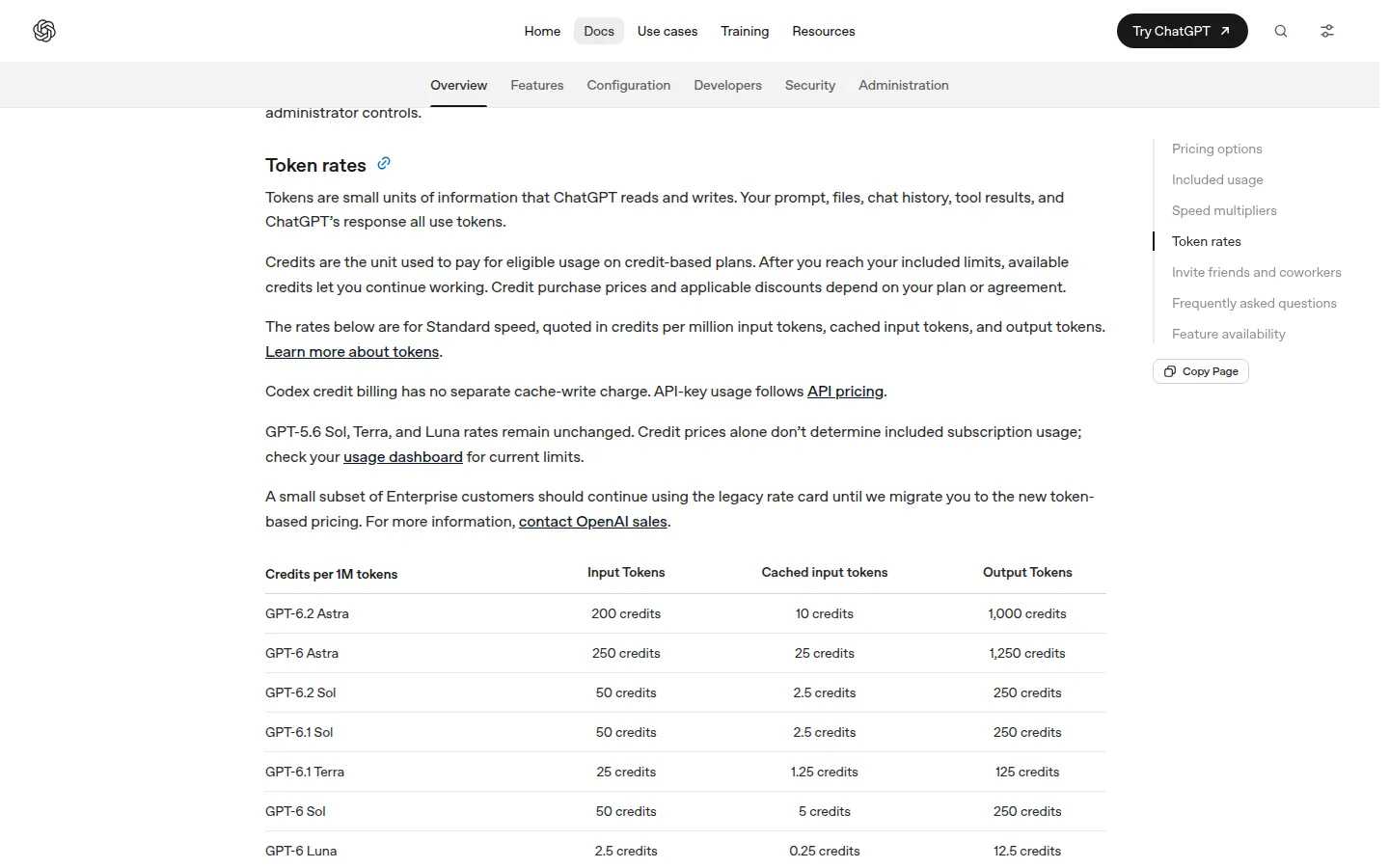
Two details on that page now weigh more. Fast mode draws twice the included usage on both GPT-6.2 models, against 2.5 times on the older ones, so a fast task still doubles its draw. The credit rates behind pay-as-you-go keep the previous model 20% more expensive per token: 200 credits per million input tokens and 1,000 per million output tokens for GPT-6.2 Astra, against 250 and 1,250 for GPT-6 Astra.
What we checked
We read that page on November 28 and did three things the announcement does not do.
First, we priced the same task twice in credits. A job that sends 40,000 input tokens and receives 8,000 output tokens costs 16 credits on GPT-6.2 Astra, and 20 credits on GPT-6 Astra, a 20% gap that survives the correction. On GPT-6.2 Sol the same job costs 4 credits, exactly what GPT-6.1 Sol costs at identical rates, so Sol’s efficiency gain does not show up in the credit table at all.
Second, we translated the correction into messages: at the top of the published range, 50 Astra messages in a five-hour window become about 36, if the 1.4 times reading holds, and 6 at the bottom become about 4. The correction costs heavy users more than the headline 40% suggests.
Third, we looked for the correction on the page and did not find it. The rates, the estimates and the plan prices on November 28 read as they did before November 26. The correction exists in a post, not in the document that sets the numbers.
The practical moves are narrow. Watch the usage dashboard for a week before drawing conclusions, since the published range is wide and heavy Codex work sits at the top of it. Hold the banked reset for a deadline day. And if the work is automated, compare the credit path at $8 per million input tokens with the allowance you already pay for, as we set out in our ChatGPT review.
The Neural Minute take
The models did not get worse on November 26, and the meter did not get dishonest: a discount that was never meant to exist was removed, nine days late, and OpenAI pays for it with one reset per account. What changed is the terms of a deal subscribers accepted without reading a multiplier table, published in a post and not in the document that governs it.
That is the part worth keeping. A plan price says what a month costs; the meter says what the month buys, and the two can move apart without a line on a pricing page changing. Anyone comparing assistant subscriptions, including the ones in our OpenAI and Anthropic comparison, is comparing a figure a vendor can adjust without a price cut.
So treat the included usage estimate as the number that matters, and re-read it after every model launch, because the first week of a launch is when metering errors run. And when a vendor calls a new model cheaper, ask cheaper than what: GPT-6.2 Astra is 20% cheaper per token than GPT-6 Astra, and after the correction it still consumes more allowance per unit of work, the sort of drift we tracked when OpenAI cut GPT-6.1 Terra to $1 per million tokens.
For Codex work this week, the ranking has not flipped. Sol is still the cheap workhorse, Astra still the expensive one, and the gap widened instead of narrowing. The habits that stretch a plan are the ones OpenAI’s prompting guide for these two models lists: tighter context, fewer sources, smaller instruction files.
Sources
- OpenAI, Pricing | ChatGPT Learn, read on November 28, 2026. The plan prices, the included usage estimates, the speed multipliers and the credit rates in this article are read there.
- Thibault Sottiaux, OpenAI, post on X, November 26, 2026. The 40% and 25% figures, the banked reset and the promise not to charge past usage come from that post. We do not link social posts.