These two labs built the same product surface, a chat window with a subscription behind it, and they are not the same kind of company. Anthropic filed for a Nasdaq listing in the autumn of 2026 and published audited accounts to do it. OpenAI runs the larger consumer surface and publishes products, a charter and a price list, but no accounts. Put the two side by side and the purchase decision gets easier to defend, because the company that shows its books is also the one selling long documents and a terminal agent.
Verdict: Claude Pro at $20 a month is the better buy for contracts, codebases and writing you will have to defend, because Opus, Claude Code, projects and research arrive in one bill. ChatGPT Go at $8 is the better default for occasional work, and Plus at $20 is where OpenAI’s reasoning models start.
The two companies in one table
| Anthropic | OpenAI | |
|---|---|---|
| Structure | Public benefit corporation. One Class T share, held by its Long-Term Benefit Trust, elects a majority of the board, which makes it a controlled company under Nasdaq rules. | Nonprofit OpenAI Foundation governs the for-profit OpenAI Group, which operates as a public benefit corporation. |
| Stated mission | Frontier systems that are reliable, interpretable and steerable, with safety treated as a science. | Ensure that artificial general intelligence benefits all of humanity. |
| Flagship model | Fable 5.2, included up to half the weekly limit on Max and Ultra, reachable on Pro through usage credits. | GPT-6.2 Astra and Sol, introduced on November 17, 2026. |
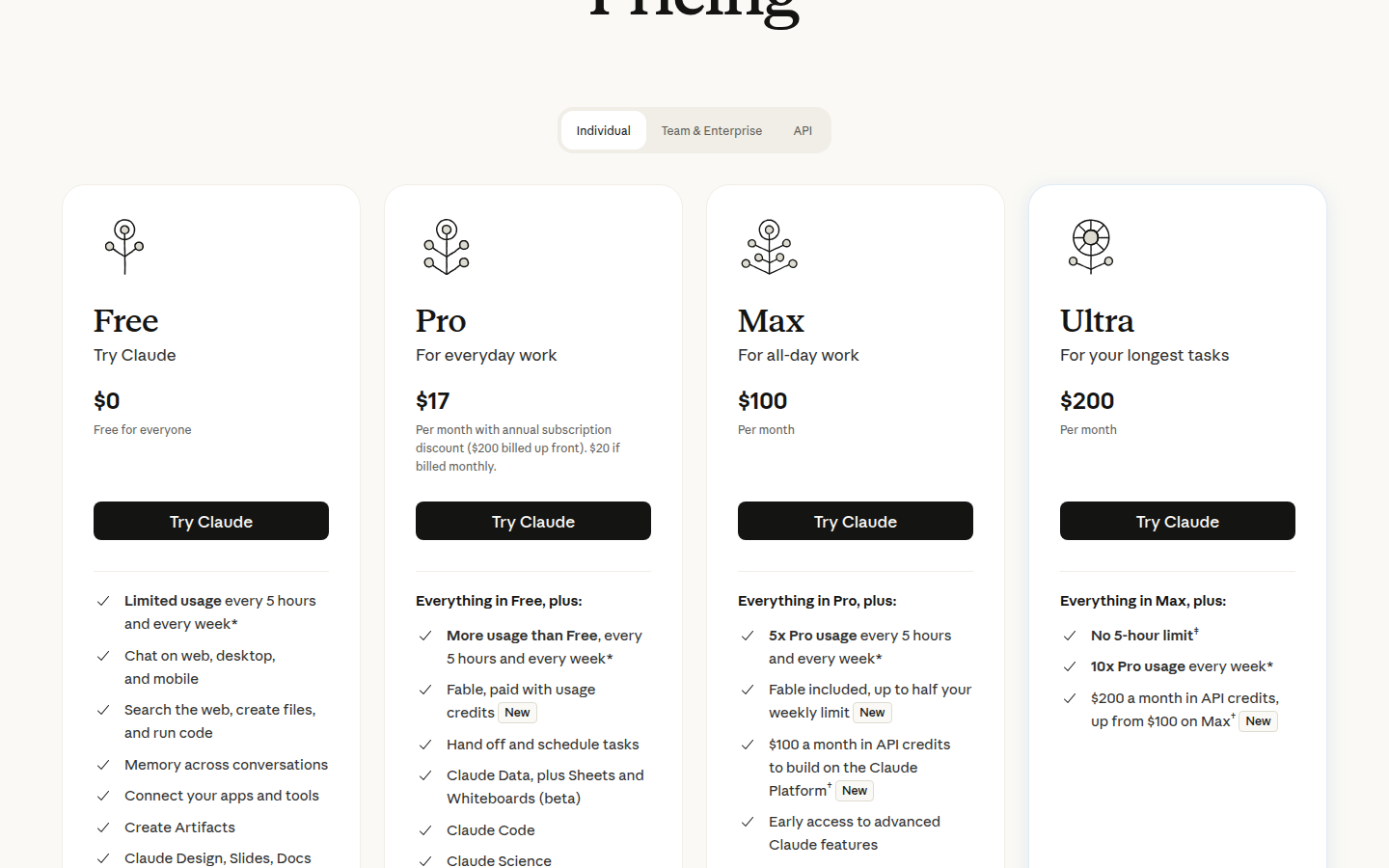
| Cheapest paid plan | Pro, $20 a month, or $17 a month with $200 paid up front. | Go, $8 a month. |
| Financial statements | Yes: Form S-1 filed October 26, 2026, amended November 2 and November 10. | None published. No revenue or valuation figure for OpenAI appears on this page. |
| Where you use it | Web, iOS, Android and desktop, plus Claude Code in a terminal. | Web, iOS, Android and desktop, plus ChatGPT Work and Codex. |
The structure and mission lines come from anthropic.com/company and openai.com/about, both read on November 21, 2026. The governance detail on the Anthropic side is from Amendment No. 1 to its Form S-1, filed November 2, 2026. The OpenAI product line is from the news list on its about page on the same day.
What each one charges
| Plan | Price | Billing view | Read on |
|---|---|---|---|
| Claude Free | No charge | permanent plan | November 21, 2026 |
| Claude Pro | $20 a month | monthly | November 21, 2026 |
| Claude Pro | $17 a month, $200 paid up front | annual | November 21, 2026 |
| Claude Max | $100 a month | monthly only | November 21, 2026 |
| Claude Ultra | $200 a month | monthly only | November 21, 2026 |
| ChatGPT Free | No charge | permanent plan | November 13, 2026 |
| ChatGPT Go | $8 a month | monthly | November 13, 2026 |
| ChatGPT Plus | $20 a month | monthly | November 13, 2026 |
| ChatGPT Plus | $16.67 a month, $200 a year | annual | November 13, 2026 |
| ChatGPT Pro | From $100 a month, with tiers at $200 and $500 | monthly | November 13, 2026 |
The dollar figures for ChatGPT are the ones openai.com/chatgpt/pricing served us on November 13, 2026, and they are the last dollar amounts that page gave our address. On November 21 the same page answered in euros: 8 for Go, 23 for Plus, from 103 for Pro, with up to 510 euros of monthly API credits on the top tier. We do not convert currencies, so the table keeps the dollars we read and the euro view is reported as it appeared. OpenAI sets these prices per country, so check the amount your own checkout shows.
Anthropic publishes a real discount rather than a rounded one. $200 paid up front is $17 a month, $240 paid monthly is $240, so the annual view saves $40 and locks the money for a year. Above the individual plans the Team seats are $25 and $125 a month, or $20 and $100 billed yearly, and Enterprise is $20 a seat a month with a 20 seat minimum, read on November 15, 2026. Neither company publishes a message count: both sell usage as an allowance that resets, so no price list tells you how many prompts a month buys.
The full breakdown of each side lives in our Claude pricing page and in the ChatGPT review.
The models, and what the cheap plans run
Claude’s lineup is four models behind one context window. Sonnet 5.5 and Haiku 5.5 sit on every plan including Free, Opus 5.5 starts at Pro, and Fable 5.2, the flagship, is included on Max and Ultra up to half the weekly limit and billed through usage credits on Pro. All four take text and images and publish a 1M token context window, which is why a whole contract or a repository fits in a single conversation.
OpenAI splits its list by tier. Free runs unlimited text chats on GPT-6, and the reasoning models arrive at Plus: GPT-6.1 Sol, GPT-6 Astra and GPT-6 Sol open there and go expanded on Pro, while the GPT-5.6 family stays on the grid and Sol Pro is reserved for Pro. The context windows say the same thing in numbers. Instant answers get 27K tokens on Free, 54K on Go and Plus, 128K on Pro. Reasoning requests get 256K on Go and Plus and 400K on Pro, which is roughly 250 pages of input on the top tier against 40 on Plus.
Put together, a 40 page document fits on ChatGPT Plus, a 250 page one needs Pro, and Claude puts the million tokens on a $20 plan but meters its best model. The Claude review and the ChatGPT review carry the model lists plan by plan; Claude Code is the part of the Anthropic offer with no direct equivalent in the $8 tier.
The business, and what each one discloses
Anthropic’s listing is the reason this page can compare money at all. The Form S-1 filed on October 26, 2026 reported $16.3 billion of revenue for the six months to June 30, 2026, a gross margin of 85% and an operating loss of $693 million. Amendment No. 1, filed on November 2, added the September quarter: $16.96 billion of revenue, twelve times the same quarter a year earlier, a $567 million operating loss and a $23.3 billion net loss.
That net loss is mostly accounting. $21.9 billion of it is a non-cash mark on convertible notes, and the operating swing has a named cause: $5.0 billion of compute bought through short-term commitments, which the filing says currently costs significantly more than comparable capacity under multi-year contracts. The customer lines describe the business better. Accounts spending $100,000 or more on a trailing twelve month basis went from more than 950 to more than 11,900 in a year, with net revenue retention around 900% on a base that grew twelve fold.
Amendment No. 2, filed on November 10, put a price on the listing: $70.00 to $78.00 a share for 825 million shares, plus $26.0 billion of Class N stock sold to seven suppliers at the same price per share. At the top of the range the offering is worth $64.35 billion before fees by our multiplication, and the same arithmetic on the share counts implies about $1.02 trillion for the company. Both numbers are ours, not the filing’s: the document states no valuation anywhere.
OpenAI sits on the other side of that line. Its about page describes a nonprofit foundation governing a for-profit group, and its newsroom publishes models, customer stories and research, but no financial statement. We found no revenue, valuation or user figure on its own pages on November 21, 2026, so this page prints none. Any such number you read elsewhere is an estimate, and the estimates that circulate differ by hundreds of billions.
Safety, in the companies’ own words
Anthropic describes itself as a public benefit corporation dedicated to securing the benefits of AI and mitigating its risks, and frames safety as a science it applies to its own products. The listing adds a mechanism to the claim: the Long-Term Benefit Trust holds a single Class T share that elects a majority of the board, which is why Nasdaq treats Anthropic as a controlled company rather than a standard one.
OpenAI’s charter commits the company to AGI that benefits all of humanity, states that its primary fiduciary duty is to humanity, and lists long-term safety among its principles. Between the charter and the about page the mission and the structure are both written down. What is missing is the financial account, and that gap is the honest answer to the question the two labs invite.
For a buyer the difference that matters is smaller than the philosophy. Anthropic sells one product family on a public price list with a published bill behind it. OpenAI sells a bundle whose breadth is the argument. Both statements can be checked on the pages cited at the bottom of this page.
Which one to pay for
Claude Pro at $20 a month is the better buy when the work is long documents, code you have to read and writing that has to sound like you, because the terminal agent, projects and research sit inside that same bill. ChatGPT Go at $8 is the better buy for everyone else, and Plus at $20 is where the reasoning models and the wider toolset begin. If the choice is between the two $20 plans, run one week on each with your own three hardest tasks and keep the one that needed fewer corrections. The Claude vs ChatGPT comparison puts those two plans against each other line by line; this page is about the companies behind them.
Related news
Frequently asked questions
Are OpenAI and Anthropic the same kind of company? Not quite. Both now operate as public benefit corporations, but OpenAI is governed by a nonprofit foundation and Anthropic by a trust holding one share class that elects a majority of its board. One publishes audited accounts; the other publishes a charter.
Which one is bigger? Only Anthropic publishes the numbers. Its September quarter revenue was $16.96 billion, and its listing implies about $1.02 trillion at the top of the range by our arithmetic. OpenAI publishes no accounts, so any comparison on revenue or valuation rests on estimates for one of the two, and this page does not print them.
Which one is cheaper? ChatGPT: Go costs $8 a month, $96 over a year at the monthly rate. Claude’s entry paid plan is Pro at $20 a month, $240 over a year, or $200 if you pay the year up front. Both have a permanent free plan.
Can I use both? Yes, and plenty of people do. Paying for Claude Pro and ChatGPT Go together costs $28 a month at the monthly rate, which is still less than ChatGPT Pro from $100, and it covers the long document work and the image and agent work in one budget.
Sources
https://www.anthropic.com/pricing (read November 21, 2026)
https://www.anthropic.com/company (read November 21, 2026)
https://openai.com/chatgpt/pricing/ (read November 21, 2026, served in euros)
https://openai.com/about/ (read November 21, 2026)
https://openai.com/charter/ (read November 21, 2026)
https://www.sec.gov/Archives/edgar/data/2130357/000162828026067168/anthropicpbc-sx1.htm (Form S-1, filed October 26, 2026)
https://www.sec.gov/Archives/edgar/data/2130357/000162828026068676/anthropicpbc-sx1ax1.htm (Amendment No. 1, filed November 2, 2026)
https://www.sec.gov/Archives/edgar/data/2130357/000162828026072484/anthropicpbc-sx1ax2.htm (Amendment No. 2, filed November 10, 2026)
Our Claude review, prices read November 15, 2026. Our ChatGPT review, prices read November 13, 2026.
Update log. November 21, 2026: page published. Anthropic prices read the same day; ChatGPT dollar prices carried from the November 13 reading, with the euro view OpenAI served on November 21 noted in the price section.