Claude and Gemini both sell long context and both write well, so the feature list settles nothing. The real difference is where each one lives: Claude is a standalone workspace with a terminal agent, Gemini is a layer inside the Google account you already use. That difference decides most of the choice before a single token is generated.
Verdict: Claude if the work happens in documents and repositories you bring to the tool. Gemini if the work already lives in Gmail, Docs and Drive, and if you pay Google for storage, because then the subscription replaces part of a bill you already have.

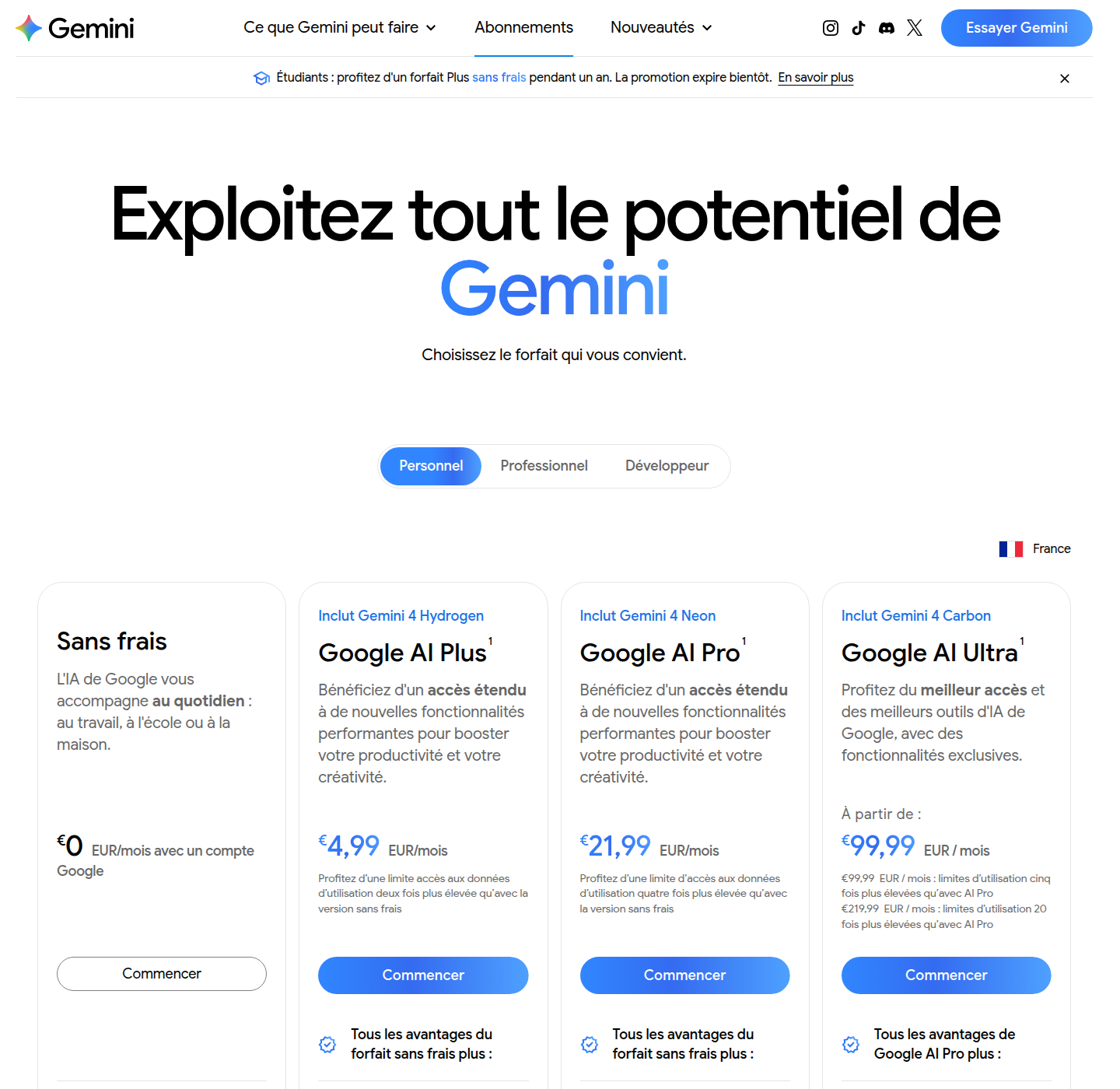
The two price sheets, read on the same day
| Plan | Price | Source |
|---|---|---|
| Claude Free | $0 | Anthropic, 19 November 2026 |
| Claude Pro | $17 a month billed annually, $20 monthly | Anthropic, 19 November 2026 |
| Claude Max | $100 a month | Anthropic, 19 November 2026 |
| Claude Ultra | $200 a month | Anthropic, 19 November 2026 |
| Gemini Free | $0 | Google, 19 November 2026 |
| Google AI Plus | $4.99 a month | Google, 19 November 2026 |
| Google AI Pro | $19.99 a month | Google, 19 November 2026 |
At the entry the comparison is not like for like: Google AI Plus at $4.99 raises the usage of the free plan, while Claude Pro at $17 to $20 is a working tier that includes Claude Code. Compare AI Pro at $19.99 with Claude Pro, not AI Plus.
Long context, and what it is worth
Anthropic’s plan table puts the context window at up to one million tokens on every paid tier. Google’s advantage is the same order of magnitude, with the difference that the document often does not need to be uploaded at all: it is already in Drive, or in the thread you are replying to. Uploading a 200-page PDF and asking a question about page 60 works in both; only one of them removes the upload.
Code and agents
Anthropic includes Claude Code from the Pro tier upward: a terminal agent that reads the repository in front of it and proposes diffs. Google’s coding story is split across its own tools and does not present the same terminal-first shape at this price. If your work is a codebase and a test command, that is the clearest difference in the whole comparison.
Writing
Both produce usable prose, and the register differs more than the quality. Claude’s default is flatter and less list-shaped; Gemini’s answers tend to be shorter and more structured, which suits email and slides. Test on your own text: give each one a page you wrote last month and ask it to rewrite the opening. The one you would not have to edit is the one to pay for.
How to choose in ten minutes
Write down what you already pay Google for. If storage, YouTube or Workspace already costs you close to $20 a month, the Google tier is a substitution and the comparison is decided. If it costs nothing, both entry tiers are new spending and the question becomes where the work lives: a repository and a folder of documents point to Claude, an inbox and a shared drive point to Gemini.
Frequently asked questions
Is Gemini cheaper? AI Plus at $4.99 is cheaper than Claude Pro, but it is a consumption tier above the free plan. The comparable tier is AI Pro at $19.99 against Claude Pro at $17 annual or $20 monthly.
Do both include a coding agent? Claude includes Claude Code from Pro upward according to Anthropic’s plan table. Google’s coding tools are sold and bundled differently; check the current plan page before assuming parity.
Which one should a team buy? The one that matches where the documents already are. A team that lives in Google Workspace pays twice if it buys a standalone assistant and keeps paying for storage.