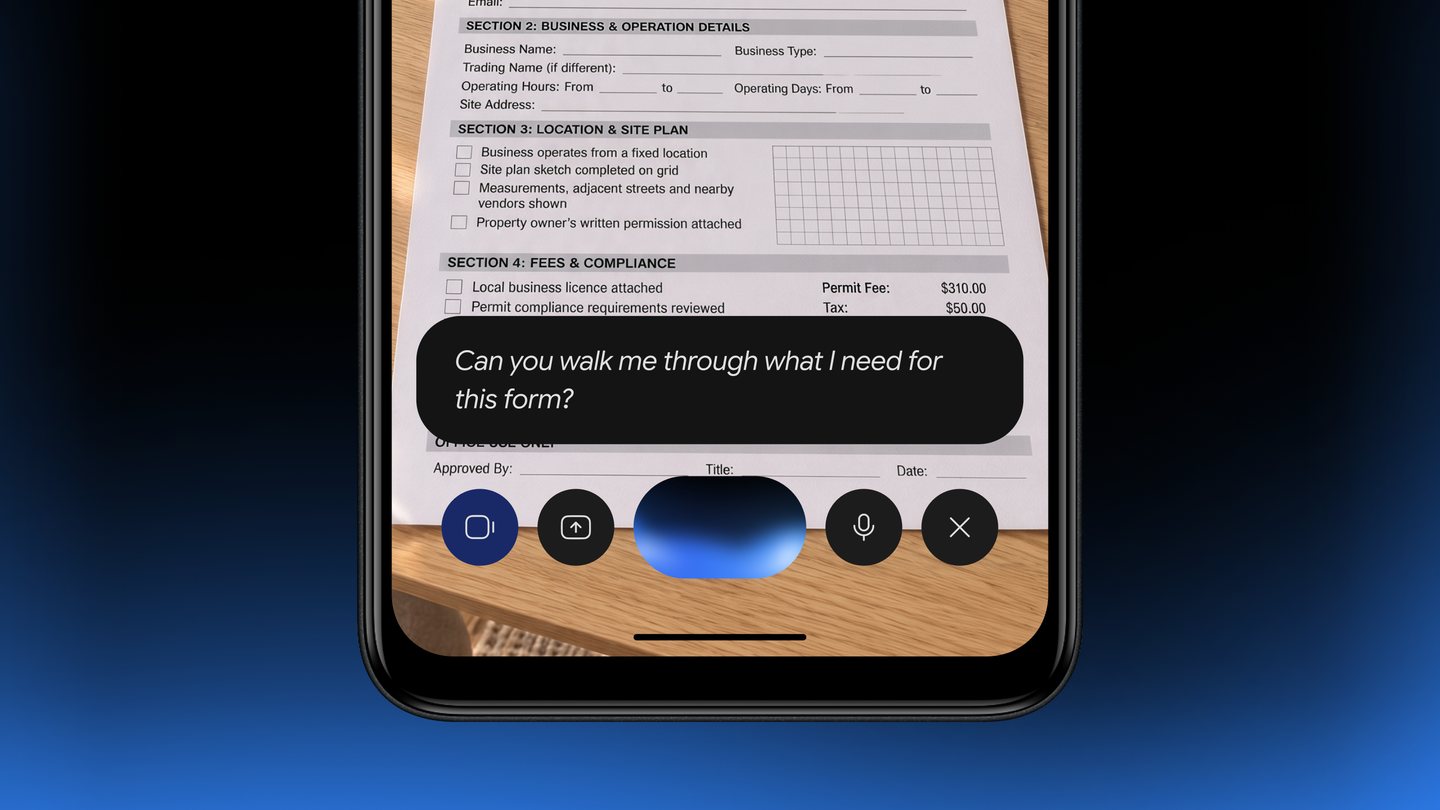
Google put its assistant on the phones that have never run one properly. On November 18, 2026, the company said the Gemini app is now available on eligible Android (Go edition) devices, the low-memory handsets that Google itself describes as the everyday connection to the internet, education and business for hundreds of millions of people. The app was re-architected for that hardware, and the help page the post links to gives the product its own name: Gemini Go, a streamlined build that replaces Assistant Go.
What was actually released
Three capabilities are named in the post. Gemini Live handles spoken conversation and interview practice in more than 45 languages. The camera reads notes and forms so they can be learned from or translated, and Nano Banana generates images, with a flyer for a weekend bakery sale as Google’s own example. Installation runs through the Gemini app on Google Play, or by pressing and holding the power button on supported phones.
For what Google Gemini costs today, plan by plan, see the Google Gemini review.
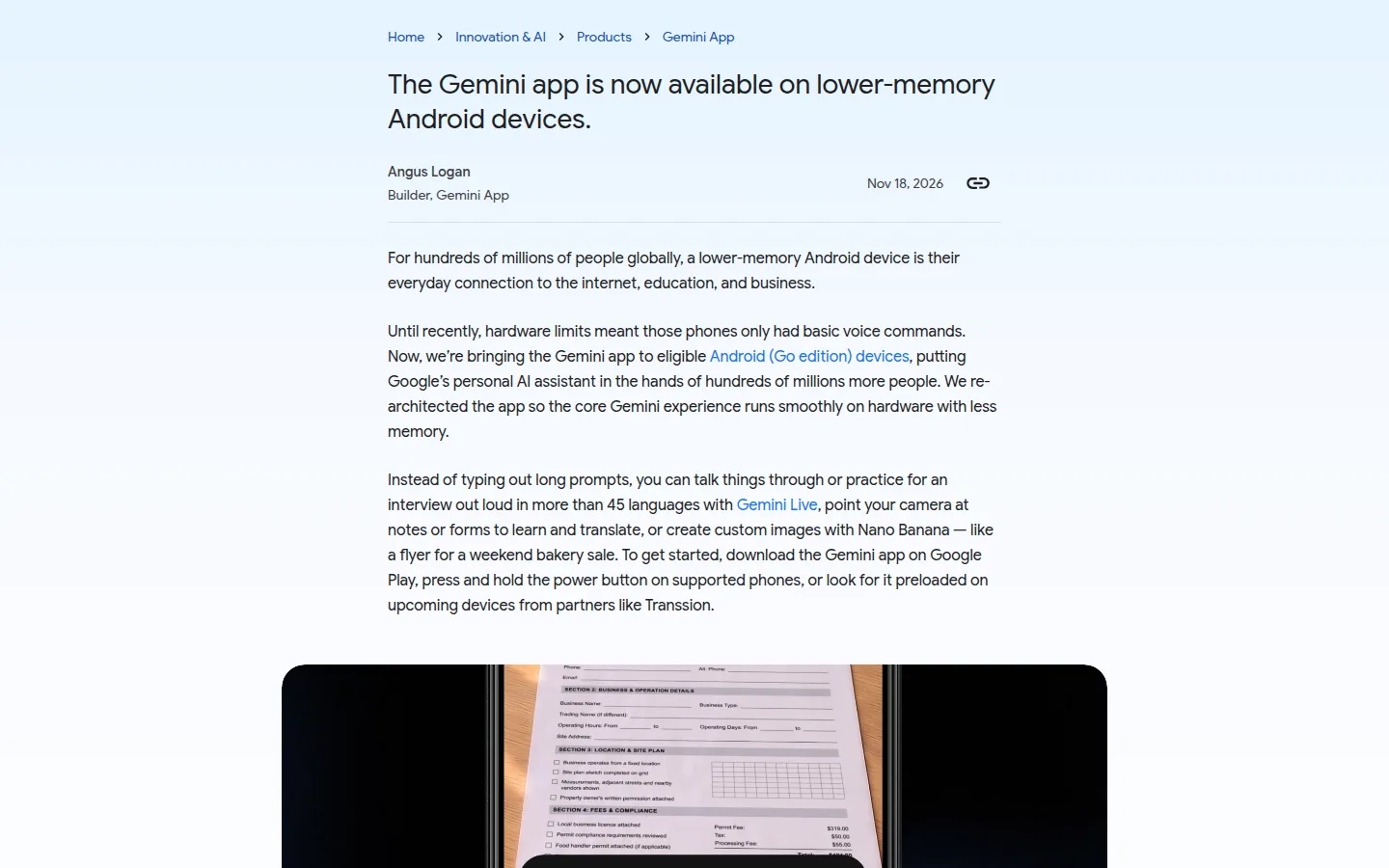
The linked help page describes a second, different path. On Android Go devices Gemini arrives inside the Google Search app, updated through Google Play, launched by touching and holding the Home button or pressing and holding Power on supported devices. The post says to download the Gemini app. Both pages carry the same company and the same week, and a buyer reading them one after the other is told two different things about how to get the assistant.
What changed on November 18
- Gemini Go runs on Android Go hardware, where the previous assistant handled basic voice commands.
- Google re-architected the app for devices with less memory.
- Eligibility is an Android Go device with 2GB of RAM or more, in the countries where Gemini already runs.
- Google calls the rollout gradual, with preloads coming on devices from partners including Transsion.
What the claim rests on
The release is three paragraphs, and it is a statement of availability rather than a measurement. It shows that Google is willing to ship its assistant on entry hardware and that the company names the three features it wants read. It shows nothing about how the app behaves on those phones.
| What the post states | What it does not state |
|---|---|
| Hundreds of millions of people use a lower-memory phone | A number of devices, a list of countries or a date per market |
| The app runs on hardware with less memory | That 2GB of RAM is the floor; the help page carries that |
| Gemini Live works in more than 45 languages | Which of those languages run on a Go device |
| The core experience runs smoothly | Startup time, memory footprint, frame rate or any test |
| The app is available on Google Play | Which handsets are on the eligible list |
| Preloads arrive on devices from partners including Transsion | Models, markets and dates for those devices |
We re-architected the app so the core Gemini experience runs smoothly on hardware with less memory.
That sentence is the engineering claim, and it travels with no number attached to it. Smoothness on a 2GB handset is exactly what a reader would want quantified, and the post does not try.
The one hard figure in the release sits on the help page: 2GB of RAM or more is the line Google draws. It also decides who is inside the announcement. A phone sold with 1GB is an Android Go device too, and it does not qualify.
A second gap runs between the two pages. The help page lists what Gemini Go can do: call and text contacts, look up local information, set alarms and calendar events, play media, upload files. Gemini Live, camera translation and Nano Banana do not appear in that list. The announcement promises those features for the Gemini app, and the page that defines Gemini Go does not repeat the promise.
What is not published
No count of eligible devices, no list of the models that qualify, no memory footprint for the app. No date for when the gradual rollout reaches a given country. No line on whether Live, camera translation and image generation reach a 2GB handset with the same features as a flagship, and no measured speed on that hardware.
On this page
What it changes for someone buying a budget phone
Until this week the choice was made for the buyer. Google’s own framing is that hardware limits left those phones with basic voice commands, so the assistant was not part of the decision. It is now a line on the spec sheet: Android Go edition, and 2GB of RAM or more to run Gemini Go.
That cuts both ways at the point of sale. A cheap phone bought last year at 1GB does not get the assistant, and nothing in the release suggests it will. A phone bought this month at 2GB does, in every market where Gemini already operates, with no separate subscription named.
Preloads are the part to watch in a store. Google names Transsion as a partner for upcoming devices, which means the assistant can arrive installed rather than downloaded. No model, market or date is attached, so a buyer cannot yet use the preload as a reason to pick one handset over another.
Our archive sets the context. Google put 66 regional voices into the Gemini app on Android and iOS on November 16, and made Task mode free in six markets on November 17. Both are features that assume a phone with room to spare. The release does not say which of them reach a 2GB device, so the cheapest phones may get the assistant without the parts we have written about this week.
The Neural Minute take
The interesting number here is not a benchmark, it is reach. Google’s advantage over OpenAI and Anthropic is that it already ships the operating system, and the phones it now targets are the ones no assistant company could reach through a store download alone. Putting Gemini on Android Go turns an installed base into an assistant base without a new device and without a new subscription.
For anyone already paying for an AI tool, nothing changes this month. For anyone buying hardware, the takeaway is narrower and more useful: the RAM floor is the whole story. A 2GB phone now runs an assistant a 1GB phone cannot, and that is a specification you can check in a product listing before spending anything.
We have not run Gemini Go on a 2GB device, and we will not describe how it feels. Google publishes no measured performance figure for this build, so the smoothness in the post is a promise, not a result.
Sources
The primary source is Google’s post, published November 18, 2026: The Gemini app is now available on lower-memory Android devices. The Gemini Go name, the 2GB memory floor and the list of supported tasks come from the Gemini Go help page that post links to. Related Neural Minute coverage: Gemini adds 66 regional voices on Android and iOS and Gemini Task mode books and pays, free in six markets.