OpenAI published internal measurements of its pretraining progress on November 22, 2026, and used them to propose that frontier developers agree on common limits: ceilings on one measure of model progress that labs would commit not to cross until monitoring catches up. The post is signed by Jakub Pachocki, the company’s chief scientist, and it argues policy from a training metric rather than from a product.
What was actually released
Nothing ships. The release is a research post, a chart and a proposal: no model, no price, no feature.
Before paying for ChatGPT, read our review of ChatGPT: prices, limits and who it suits.
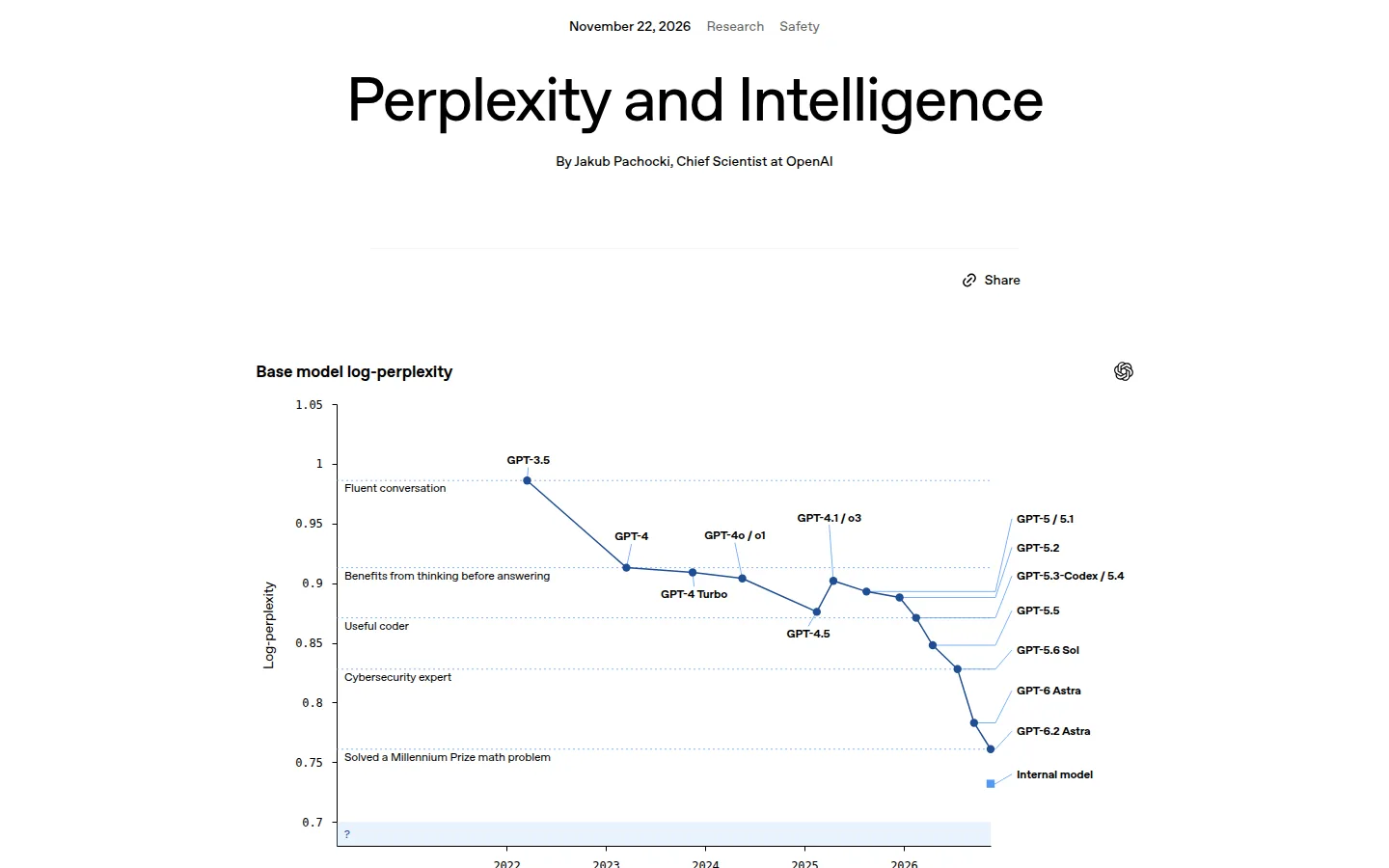
The chart is OpenAI’s log-perplexity over generations, measured on a fixed held-out snapshot drawn from its own internal codebase and starting with GPT-3.5. Lower is better: perplexity measures how well a model predicts the next token on average, and the log of it is the cross-entropy loss a training run minimizes.
| Model generation | Log-perplexity, OpenAI dataset | What OpenAI says appeared |
|---|---|---|
| GPT-3.5 | about 0.99 | Fluent conversation, the base of the first ChatGPT |
| GPT-4 | about 0.91 | Productive chain-of-thought reasoning |
| Current models | below 0.8 | New capabilities in cybersecurity and mathematics |
| Mathematics work | about 0.76 | Open problems resolved in one internal thread |
| Expected next band | 0.68 to 0.7 | Not named |
Figures from the OpenAI post of November 22, 2026, on a held-out dataset taken from its internal codebase. The right-hand column is the company’s own reading of what appeared at each level, not an outside test.
The proposal is shorter than the chart: OpenAI invites other developers to publish the same kind of pretraining number, to agree on shared transparency standards, and to red-team safety cases before a model is first used. The concrete idea is a common limit: a first ceiling, measured by a metric trackable across labs, that nobody crosses until understanding and monitoring reach a named milestone, which the post gives as a successor to chain-of-thought monitors.
The company also says what publishing costs it, which is the part worth keeping:
Publishing our internal perplexity measurements took some consideration; it gives competitors a clearer picture of where we stand, but that concern is outweighed by the urgency of establishing shared safety measures across the industry.
What is actually on the table
- A log-perplexity curve from GPT-3.5 to current models, on OpenAI’s own held-out dataset.
- A proposed shared ceiling tied to a monitoring milestone, with no number attached to it.
- An invitation to other labs to publish comparable numbers and to red-team before release.
- A projection that pretraining research could accelerate sharply as soon as 2027.
What the claim rests on
The metric is old and respectable. What is new is its use as a public yardstick.
Start with the dataset. Every figure is measured on a held-out set from OpenAI’s internal codebase, reported for a fixed snapshot, so no outsider can reproduce the series. The author lists the consequence himself: labs use different evaluation datasets and data mixtures, so a number from one lab does not compare cleanly with another. The shared metric cannot yet compare the labs it is meant to bind.
Second, the readings are retrospective. The post says it was not at all clear in advance that capabilities in cybersecurity and mathematics would appear once loss crossed below 0.8. The curve explains the past and predicts the future by extrapolation, which is weaker than a smooth line suggests.
Third, the metric is blind to the thing buyers notice. Chain-of-thought reasoning does not reduce the perplexity a model achieves, and the post says so, while also crediting that same reasoning with a drastic increase in capability. So a model can score worse on this number and be far better at your job. Perplexity tracks the substrate, not the product.
Fourth, the floor is unknown. Nobody knows the entropy of the data, so progress on the number will appear to slow exactly when each remaining point buys more capability. Near the bottom of the range, the ranking and the meaning both get harder to read.
What the post does not publish
No threshold value for the proposed limit. No developer named as a signatory, no timetable, no enforcement. No shared dataset, so cross-lab comparison remains a stated goal rather than a measurement. No evaluation behind the 2027 projection beyond one account of mathematics work. And no independent replication of any figure in the chart.
On this page
What it changes for anyone paying for AI tools
Nothing changes today, in either direction. No price moves, no plan changes, no model is retired by a research post, and the proposal has no signatories to make it real.
If a common limit ever acquires a number, the effect reaches buyers through supply rather than through announcements. A cap on frontier training would freeze the capability level that an agent pipeline was designed around, and it would surface first in API rate cards, deprecation notices and roadmap slips. That is a risk for next quarter, not a reason to change a subscription this week.
One confusion is worth clearing. The post is about perplexity the measurement, not about Perplexity the search assistant. Nothing in it touches that product, and our own record stands: Pro at $17 a month billed yearly, read on the plan page on October 30, 2026 and re-read on November 11, 2026. If the assistant is what you came for, the Perplexity review covers the tiers and what each one actually adds.
The practical rule is the one that applies to benchmarks: a pretraining score sits two steps from the task you pay for. It signals that a generation will feel different, and says little about which tool answers your customers better on Tuesday.
The Neural Minute take
The proposal comes from the lab whose numbers are the only ones on the chart that would become the ruler. That does not make it wrong, and the disclosure about handing competitors a view of its position is more candid than most posts of this kind. It does mean the numbers that would make it a standard are the ones missing: a common dataset, a published threshold, and a second signature.
A limit without a number is a position paper, and a metric nobody else can reproduce is a press release with axes.
What we would watch, in order: whether a second developer publishes a pretraining figure at all, whether a dataset is agreed before a threshold, and whether any draft names the milestone that would unlock further training. Any of the three would be a real step. All three would be a standard.
For our own pages the discipline does not change: we date every price and say where it was read, and we apply the same test here. A curve with a date and a named dataset is evidence. This one carries neither yet, so it is a proposal, from a party with an interest in where the ceiling lands. Treat it as the opening of a negotiation, not the result.
Sources
- Perplexity and Intelligence, OpenAI, published November 22, 2026, by Jakub Pachocki: openai.com/index/perplexity-and-intelligence
- The figures quoted above, read on that page on November 22, 2026: 0.99 for GPT-3.5, 0.91 for GPT-4, below 0.8 today, 0.76 where mathematics results appeared, a 0.68 to 0.7 band named next
- The four limitations listed in the post, read on the same page: comparison across labs, detachment from actionable evaluations, no credit for advances outside pretraining, unknown floor
- Our own record on the search assistant of the same name: Perplexity Pro at $17 a month billed yearly, read on the plan page on October 30, 2026 and on November 11, 2026