
Google published Tool Retrieval in the Gemini API on November 19, 2026. The feature is in preview inside the Interactions API, and it changes what travels in a prompt: an agent sends a short name and description for the tools it might use, and the API loads the full parameter schema only when the model asks for that tool by name.
Nothing here changes which model you call. It changes the request around the model, where a large part of an agent bill is built.
What was actually released
Turning it on takes two edits. You add {"type": "tool_search"} to the tools array, and you set defer_loading: true on each tool you want held back. The model still sees the name and description of every deferred tool, so it knows what exists. The schemas stay out of context until a retrieval step pulls one in.
On the default server-side path, the search, the schema load and the function call happen inside one request. The response lists tool_search_call, then tool_search_result, then the usual function_call, so when a vague description sends the model to the wrong tool you can read which names it considered.
The documentation compares the two modes with plain tool loading:
| Capability | Static loading | Server-side retrieval | Client-side retrieval |
|---|---|---|---|
| How tools reach the model | Every schema on every request | Gemini loads deferred schemas on demand | Your app returns schemas on demand |
| Extra round trips per search | None | None | One per search |
| Fit, per the documentation | Fewer than 20 stable tools | Large, known libraries and MCP servers | Dynamic registries, namespaces, per-user tools |
Server-side needs no index to build or host. Client-side exists for teams that already own a tool registry or a per-user permission filter, and costs one extra round trip per search; it also allows tools to appear mid-conversation, which server-side does not. On connectors, setting defer_loading: true on an mcp_server entry defers every tool that server exposes at once.
The limits are narrow: preview only, Interactions API only, v1beta required, generateContent unsupported, one tool_search per request, no mixing of the two modes, and a search that matches nothing returns text rather than an error.
What the claim rests on
Google publishes no saving figure, no accuracy figure, no benchmark, no customer name and no general availability date. The case is structural: schemas are expensive, so not sending them should be cheaper and should keep tool selection sharper as the list grows.
The only order of magnitude describes the problem, not the fix. “A few dozen function declarations can consume tens of thousands of tokens on every request,” the documentation says. That is plausible, and not a measurement.
The pricing section is more precise than most launch posts. No separate charge, standard rates for the model, a fixed block of input tokens for tool_search, and each loaded schema billed as input for the rest of the conversation, like a tool declared up front. Google states the condition itself:
You save tokens when the schemas you never load outweigh the ones you do, which is the usual case for large libraries.
That is the honest version, and the part a buyer should keep.
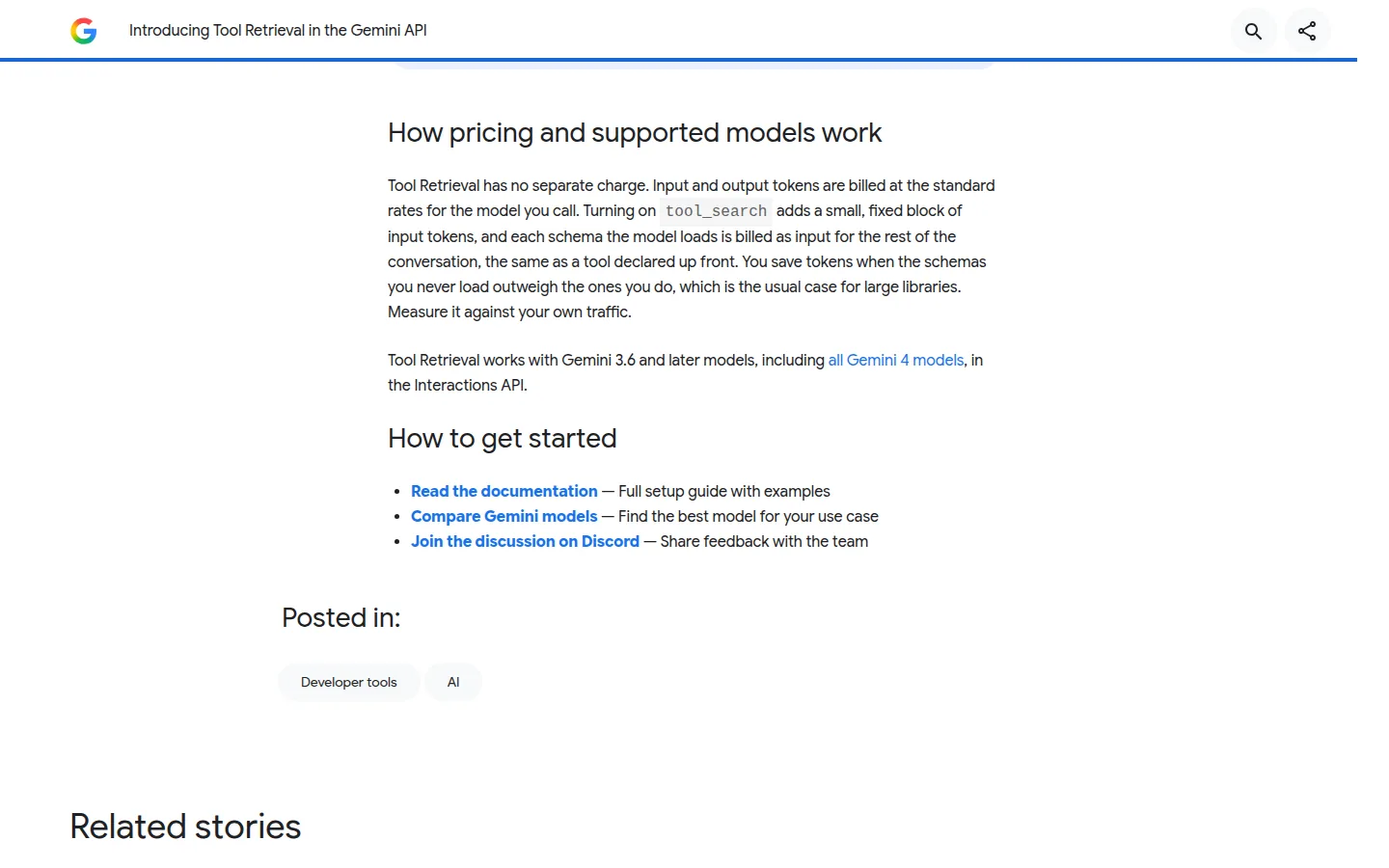
Model support is where the two documents drift apart. The announcement says “Gemini 3.6 and later models, including all Gemini 4 models”. The documentation lists six model codes and nothing else: gemini-4-carbon, gemini-4-neon, gemini-4-hydrogen, gemini-4-argon, gemini-3.8-flash and gemini-3.6-flash. Outside that list, a request returns deferred loading is not supported for this model. A team on a model between the two statements has to test rather than read.
On this page
What it changes for teams running large tool libraries
The documentation gives one threshold: fewer than 20 stable tools, and static loading stays the right answer.
Past that, the arithmetic is worth writing down, because nobody checks it before switching. If the average schema costs S tokens, the fixed tool_search block costs N, and a conversation defers K tools while loading L of them, retrieval costs about N + L × S per turn against K × S for static loading. It pays for itself when the schemas never loaded outweigh the ones that are, which is Google’s sentence turned into a condition: (K minus L) × S above N.
Three consequences follow, none of them announced.
The first is that L only goes up. A loaded schema stays in context until the conversation ends, so a long agent that explores widely ends up carrying most of its library, plus the fixed block and the search steps. The saving belongs to short, narrow sessions.
The second is that the network payload does not shrink. The Interactions API does not persist tool declarations between turns: the full tools array, deferred tools included, is required on every request. The feature removes billed input, not bytes on the wire. Anyone sold on a latency story should measure it.
Where the saving actually sits
The gain is not a property of the feature. It is a property of the share of a library a conversation never touches. A registry of 300 tools where 15 are called is the case this was built for; an agent with 25 tools that calls 20 of them pays the block and the search steps for nothing.
The third is a trap the documentation flags itself. A tool named in the system instructions or in another tool’s output should not be deferred. If it is, the model may call it without searching, and the next request fails with Server side tool call context must be circulated. In a stateless setup, every tool_search_call and tool_search_result step has to be replayed unchanged.
What Google does not publish
No percentage, no accuracy comparison, no benchmark, no named customer and no general availability date. The documentation also does not give the size of the fixed tool_search block, the one number needed before the condition above can be calculated.
The Neural Minute take
The interesting part is that Google published no number, and the documentation explains why: there is no general number to publish.
Take a week of traffic, count the distinct tools each conversation loads, and compare with the declared library. If the loaded set is a small fraction of the total, this cuts your input bill.
Our reservation is the surface: a preview on one endpoint, in a beta API, with the documentation warning that it may change before general availability and a model roster that does not match the announcement. On a production agent that means planning a migration, and the failure modes above surface in long conversations, not in a first test.
For readers comparing consumer plans, note what this is not: an API feature billed per token, so it does not touch the tiers priced in our Google Gemini review. The question is not how many tools the agent has, it is how many a typical conversation opens.
Sources
- Introducing Tool Retrieval in the Gemini API, Google, published November 19, 2026, read on November 22, 2026. Source for the launch date, the request changes, the pricing statement and the model sentence quoted above.
- Tool retrieval, Gemini API documentation, ai.google.dev, read on November 22, 2026. Source for the loading modes, the six model codes, the errors, the limitations and the full tools array requirement.
- The token wording quoted is Google’s own. No independent measurement was published with the preview.