Neural Minute may earn a commission if you buy through our links. It doesn’t change our verdicts. How we test · How we make money
ChatGPT is the best AI for writing essays: it gave us a thesis, a full outline and an MLA works-cited list, and all three of its sources were real. Perplexity is the pick for finding sources, and Grammarly for polishing a draft you wrote. We checked nine sources from three tools, and every one existed.
Which AI should you pick for your essay?
Best overall
ChatGPT, for students who want a plan they can write from. In our test it returned a thesis, a five-paragraph outline and 3 real sources out of 3, with two DOIs that matched on Crossref. It scores 8.7 out of 10 on our grid.
Best free pick for sources
Perplexity, for the research stage. On the free plan it gave 3 real sources out of 3, including a 2024 review with mixed findings that you can use for the counterargument.
Best for polishing a draft you wrote
Grammarly, for the last pass. The free plan fixes grammar and spelling, formats citations in APA, MLA or Chicago, and includes 100 AI prompts a month. Its Authorship report shows which sentences you typed.
How do the seven essay tools compare?
| Tool | Our score | Best for | Entry price | Free option | Key fact | Watch out |
|---|---|---|---|---|---|---|
| ChatGPT Visit site | 8.7/10 | A full essay plan: thesis, outline and works-cited list | Free; Plus $20/mo | Yes | 3 of 3 sources real in our test (two DOIs matched on Crossref), with an MLA works-cited list | Paywalled journals: you may only reach the abstract |
| Perplexity Visit site | 7.8/10 | Finding real sources, including evidence against your thesis | Free; Pro $17/mo billed yearly | Yes | 3 of 3 sources real in our test, one a 2024 review with mixed findings for the counterargument | No grammar checker or citation formatter |
| Gemini Visit site | 7.4/10 | Outlines with statistics you can quote | Free; Google AI Pro $19.99/mo | Yes | 3 of 3 sources real in our test; the 60% figure it quoted matched the Pew article | Relied on reports and press releases more than peer-reviewed studies |
| Claude Visit site | 6.7/10 | Feedback on a long draft | Free; Pro $20/mo ($17/mo billed yearly) | Yes, capped every 5 hours and every week | Up to 1M tokens of context and 5 projects on the free plan | No message count: a long session can stop mid-draft |
| Grammarly | 6.0/10 | Polishing a draft and proving you wrote it | Free; Pro $12/mo billed yearly | Yes, grammar, tone and 100 AI prompts a month | Free citation generator (APA, MLA, Chicago) and Authorship report on Free and Pro | Does not find sources or plan the essay |
| Jenni AI | 5.8/10 | Research papers with a citation library | Free; Plus $12/mo on annual billing | Yes, 10 autocompletes a day and 5 AI requests | Unlimited citations in 10,000+ styles; searches 200M+ papers | Autocomplete writes sentences for you: check your school's policy |
| QuillBot | 5.0/10 | Rewording your own sentences | Free; Premium $8.33/mo billed yearly ($19.95 monthly) | Yes, limited paraphraser and grammar checker | Paraphraser, grammar checker, summarizer and a free citation generator | Rewrites text; does not plan or research |
Prices checked on each vendor’s pricing page on Nov 26, 2026. Tool names link to our full review when we have one. Scores come from our scoring grid below.
Did the AIs invent sources?
Not in our test. Fake citations are the classic risk with AI essay help, so we asked ChatGPT, Gemini and Perplexity for “3 real, verifiable sources, each with author, year, title and a working URL”, then opened every link and looked up every DOI on Crossref.
| Tool | Sources given | Checked | What stood out |
|---|---|---|---|
| ChatGPT | Pew Research Center (2024); Beland and Murphy, Labour Economics (2016); Glass and Kang, Educational Psychology (2019) | 3/3 real: the Pew page loads, both DOIs match on Crossref | An MLA works-cited list and a warning that the two studies were not about US high schools |
| Gemini | Pew Research Center (2024); Common Sense Media (2023); UNESCO GEM Report (2026) | 3/3 real: all three pages load with the titles given | Quoted a 60% figure on enforcement that matches the Pew article |
| Perplexity | Beland and Murphy, LSE (2015); UNESCO (2023); Campbell et al., scoping review (2024) | 3/3 real: LSE and UNESCO pages load, the DOI matches on Crossref | Added a review finding the evidence for bans is mixed, to use in the counterargument |
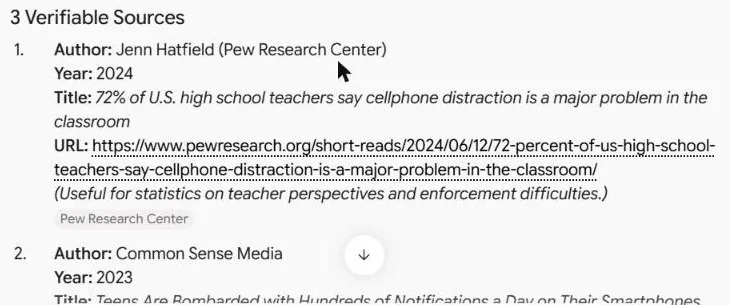
Accounts used: free plans for Gemini and Perplexity, our regular ChatGPT account.
One test is not a guarantee. Ask for URLs or DOIs every time, open them, and read at least the abstract before you cite a source.
Which prompt gets an outline with sources you can check?
Tested in ChatGPT, Gemini and Perplexity · Nov 26, 2026
I am writing a [length] argumentative essay for [class or level]: [your question]. Give me a thesis statement, a 5-paragraph outline, and 3 real, verifiable sources I can cite, each with author, year, title and a working URL. Do not invent sources.
We used this prompt for a high school essay on phone bans in schools. Swap in your own question, then check each source the way we did: open the link, and paste any DOI into Crossref.
How did we score each tool?
Each tool gets a score out of 10 on five criteria that matter for an essay. The final score is the weighted average, and the order of this page follows it.
| Tool | Real sources (30%) | Outline and feedback (25%) | Editing and citation format (15%) | Keeps the work yours (10%) | Free plan (20%) | Final score |
|---|---|---|---|---|---|---|
| ChatGPT | 9 | 10 | 8 | 7 | 8 | 8.7 |
| Perplexity | 10 | 7 | 5 | 5 | 9 | 7.8 |
| Gemini | 8 | 8 | 6 | 5 | 8 | 7.4 |
| Claude | 6 | 8 | 8 | 5 | 6 | 6.7 |
| Grammarly | 3 | 4 | 10 | 10 | 8 | 6.0 |
| Jenni AI | 6 | 6 | 8 | 3 | 5 | 5.8 |
| QuillBot | 3 | 3 | 9 | 6 | 7 | 5.0 |
- Real sources (30%). Can the tool hand you sources that exist and fit the topic? For ChatGPT, Gemini and Perplexity the score comes from our test: each gave 3 real sources out of 3. Perplexity gets 10 because it added a review that argues the other side. ChatGPT gets 9 for two peer-reviewed studies with matching DOIs and a note on what they do and don’t prove. Gemini gets 8 because it leaned on reports more than studies. Claude (6) has web search on its free plan, and Jenni AI (6) can search more than 200 million papers; both are scored from documentation. Grammarly and QuillBot (3) format citations but don’t find sources.
- Outline and feedback (25%). Does it help you plan and improve the essay? ChatGPT (10) wrote the fullest outline in our test and has a study mode that asks questions instead of handing over answers. Gemini (8) and Perplexity (7) also returned a thesis and outline. Claude (8) is scored on its documented features: projects for your readings and room for long documents.
- Editing and citation format (15%). Grammarly (10) checks grammar, spelling and tone and formats APA, MLA and Chicago citations. QuillBot (9) pairs a paraphraser and grammar checker with a citation generator. Jenni AI (8) offers more than 10,000 citation styles. ChatGPT (8) produced a ready MLA list in our test.
- Keeps the work yours (10%). Does the tool help you stay inside your school’s rules? Grammarly (10) records how the essay was written and can check for plagiarism and AI text on Pro. ChatGPT (7) has study mode. QuillBot (6) has an AI detector and plagiarism checker. Jenni AI (3) is built around autocomplete that writes the next sentence for you.
- Free plan (20%). Perplexity (9) and Gemini (8) handled our full request on free plans. ChatGPT (8) has a free plan with unlimited text chats. Grammarly (8) includes grammar checks, the citation generator and Authorship for free. QuillBot (7) limits its paraphraser and grammar checker on the free plan. Claude (6) caps free use every five hours and every week. Jenni AI (5) allows 10 autocompletes a day and 5 AI requests.
ChatGPT: best for a full essay plan
Who it’s for: high school and college students who want a thesis, a structure and a starting reading list in one answer.
- The most complete answer in our test. It returned a thesis, a five-paragraph outline and a works-cited list already formatted in MLA.
- Sources that checked out. All three were real: a Pew Research Center page that loads, and two journal articles whose DOIs matched on Crossref.
- It flagged its own weak spot. ChatGPT warned us that the two studies were not about US high schools, which is the kind of caveat a teacher looks for.
- Study mode. Available on every plan, it guides you with questions and feedback instead of writing the answer, and it can work from notes or readings you upload.
Limits. Two of its three sources were journal articles, and journals often sit behind a paywall, so you may only reach the abstract. Uploads and other tools are limited on the free plan, with no message count given.
Price (checked Nov 13, 2026, in our review). Free. Go is $8 a month. Plus is $20 a month, or $16.67 a month billed yearly.
Pick it if you want one tool for the plan, the sources and feedback on your draft. Skip it if you only need to find sources: Perplexity does that for free. Read our ChatGPT review.
Perplexity: best for finding real sources
Who it’s for: anyone at the research stage who needs sources to read and cite, including ones that disagree with the thesis.
- Sources are the product. Perplexity attaches links to its answers by default, so checking is one click.
- It found the other side. Besides an LSE study and a UNESCO report, it added a 2024 scoping review that found the evidence for phone bans is mixed. That is ready material for a counterargument paragraph.
- It did this on the free plan. All three sources were real, and the DOI matched on Crossref. It read 15 sources in about 3 seconds.
Limits. It is a research tool first: there is no grammar checker or citation formatter. The free plan keeps pushing its paid agent feature.
Price (checked Nov 12, 2026, in our review). Free. Pro is $17 a month billed yearly. Verified students and teachers pay $10 a month for Education Pro.
Pick it if your problem is “I need three sources by tonight.” Skip it if you want help with structure or style. Read our Perplexity review, or see the best AI for research for paper-only tools.
Gemini: best for statistics you can quote
Who it’s for: students who write in Google Docs and want numbers from well-known organizations to back a point.
- Quotable figures. Gemini cited a 60% figure on how schools enforce phone rules. We opened the Pew article and the number matched.
- Clean references. Each source came with an author, year, title and full URL, and all three pages loaded with the titles given.
- It worked on the free plan. You need a Google account and nothing else.
Limits. It relied on reports and press releases more than peer-reviewed studies: Pew, Common Sense Media and UNESCO. If your teacher wants journal articles, add one from Perplexity or ChatGPT. The free plan’s context window is 32,000 tokens, so very long readings won’t fit.
Price (checked Nov 26, 2026). Free. Google AI Plus is $4.99 a month and Google AI Pro is $19.99 a month.
Pick it if you want statistics from sources a teacher will recognize. Skip it if the assignment requires scholarly articles. Read our Gemini review.
Claude: best for feedback on a long draft
Who it’s for: college students working on longer papers who want comments on structure and argument across the whole draft.
- Room for long documents. Claude’s current models take up to 1 million tokens of context, enough to hold a full draft and several readings in one conversation.
- Projects keep your material together. The free plan includes up to 5 projects, where you can store the assignment brief and your sources.
- Web search is on the free plan. Claude can look things up online while it reviews your argument.
Limits. Free use is capped every five hours and every week, and Anthropic gives no message count, so a long editing session can stop mid-draft. Claude was not part of our source check, so verify any reference it gives you.
Price (checked Nov 26, 2026). Free. Pro is $20 a month, or $17 a month billed yearly ($200).
Pick it if you have a draft and want a tough reader. Skip it if you need a predictable amount of free use during finals week. Read our Claude review.
Grammarly: best for polishing and proving the work is yours
Who it’s for: students who write their own essays and want clean grammar, correct citations and a record of how the essay was written.
- Grammar and tone on the free plan. Free covers spelling and grammar mistakes, tone detection and 100 AI prompts a month.
- A free citation generator. It formats full and in-text citations in APA, MLA or Chicago style.
- Authorship. Available on Free and Pro, it tracks your writing in Microsoft Word, Google Docs or the Grammarly editor and labels text as typed, pasted or AI-assisted. Only you can share the report.
- Checks before you submit. Pro adds plagiarism detection and AI-text detection, plus full-sentence rewrites and 2,000 AI prompts a month.
Limits. Grammarly doesn’t research your topic or find sources: it formats the ones you bring. Sentence rewrites and plagiarism checks need the paid plan.
Price (checked Nov 26, 2026). Free. Pro is $12 a month billed yearly.
Pick it if you wrote the draft and want it clean and defensible. Skip it if you are still looking for a thesis or sources.
Jenni AI: best for writing with a citation library beside you
Who it’s for: college and graduate students writing research papers who want their PDFs, citations and draft in one editor.
- A library next to the draft. You can drag in PDFs, import from Zotero or Mendeley, or search more than 200 million papers.
- Citation styles. Citations are unlimited on every plan, in more than 10,000 styles, and the library exports to .ris, .bib and .csv.
- Document reviews. A review scans the whole document and flags problems with citations and writing quality.
Limits. The free plan is tight: 10 AI autocompletes a day, 5 AI requests and 10 PDF uploads, and it exports body text only. Autocomplete writes sentences for you, which many school policies don’t allow, so check the rules before you turn it on.
Price (checked Nov 26, 2026). Free. Plus is $12 a month and Pro is $29 a month on annual billing.
Pick it if you manage dozens of sources for one paper. Skip it if you write a five-paragraph essay: a chatbot and a citation generator are enough.
QuillBot: best for rewording your own sentences
Who it’s for: writers, including non-native English speakers, who have the ideas down and want smoother sentences.
- A paraphraser and grammar checker. Both are available for free with limited access.
- Free extras. The citation generator (APA, MLA and Chicago), the AI detector and the translator are free.
- A summarizer. It condenses a long reading into its key points, which helps when you are sorting sources.
Limits. QuillBot rewrites text; it won’t plan an essay or find sources. Paraphrasing a source without citing it is still plagiarism, so keep the citation when you reword.
Price (QuillBot’s pricing FAQ, read Nov 26, 2026). Free. Premium is $8.33 a month billed yearly ($99.95), or $19.95 month to month.
Pick it if your sentences are the problem, not your ideas. Skip it if you already use Grammarly: the two overlap.
What about Jasper, Copy.ai and other AI essay writers?
Many lists for this search rank Jasper, Rytr, Writesonic and Copy.ai first. We left them out because they are built and priced for marketing teams, not students. Jasper Pro is $59 a month billed yearly. Copy.ai’s paid plan is $29 a month, or $24 billed yearly. Writesonic’s plans start at $79 a month billed yearly and now center on search visibility for brands.
One-click essay generators have a second problem: sources. A 2023 study in Scientific Reports checked 636 citations that ChatGPT wrote into short literature reviews. It found that 55% of the GPT-3.5 citations and 18% of the GPT-4 citations were fabricated (Walters and Wilder, 2023). An essay you didn’t write, with references you didn’t open, is the easiest kind for a teacher to catch.
How do you choose an AI for essay writing?
Match the tool to the stage you are stuck on.
- No thesis yet: ChatGPT or Gemini. Ask for three thesis options and the strongest objection to each.
- No sources yet: Perplexity, with the prompt above. Ask for a URL or DOI for every source.
- A draft that needs work: Claude or ChatGPT for comments on structure, then Grammarly for grammar and citations.
- Clumsy sentences: QuillBot or Grammarly Pro.
- A long research paper: Jenni AI, or the paper tools in our research guide.
Three mistakes to avoid. Don’t pay first: every tool here has a free plan, and Gemini and Perplexity did the whole job in our test without a subscription. Don’t cite a source you haven’t opened. And don’t paste a generated paragraph into your essay: it reads differently from your own writing, and you can’t defend it when asked.
How should you use AI on an essay without cheating?
- Use it to plan: thesis options, an outline, the strongest counterargument.
- Use it to find sources, then read them yourself. Cite what the source says, not what the AI says it says.
- Write the paragraphs yourself, then ask for feedback on clarity and structure.
- Follow your school’s policy on AI use, and say how you used it if your teacher asks.
How we scored these tools
The scores rest on four things. First, our hands-on test: one essay request sent to ChatGPT, Gemini and Perplexity, with all nine sources opened and every DOI looked up on Crossref. Second, each tool’s official pricing and feature pages, read on Nov 26, 2026. Third, our own reviews of ChatGPT, Perplexity, Gemini and Claude. Fourth, a published study on fabricated citations. Claude, Grammarly, Jenni AI and QuillBot are scored from their documentation, not from a test of ours.
Questions about AI for writing essays
Which AI is best for writing essays?
ChatGPT is the best AI for writing essays overall: in our test it produced a thesis, a five-paragraph outline and three real sources with an MLA works-cited list. Perplexity is better for finding sources, Gemini for statistics you can quote, and Grammarly for cleaning up a draft you wrote yourself.
Does AI make up sources?
It can. A 2023 study found that 18% of GPT-4 citations and 55% of GPT-3.5 citations were fabricated. In our test none of the nine sources was fake, because we asked for real sources with URLs and checked each one. Always open the link and look up the DOI before you cite.
Is there a free AI for essays?
Yes. Gemini and Perplexity handled our full request, a thesis, an outline and three sources, on their free plans. ChatGPT and Claude have free plans too. Grammarly checks grammar and formats citations for free, and QuillBot offers a free paraphraser with limits. You can plan, research and polish an essay without paying.
Can teachers tell if an essay was written by AI?
Often, yes. The signs are a style that doesn’t match your earlier work and sources you can’t discuss because you never read them. Detection software exists but only judges the final text. The safer route is to write the essay yourself and keep a record of your process, which Grammarly’s Authorship report does.
Is using AI to write an essay plagiarism?
It depends on your school’s policy, and many treat submitting AI-written text as your own as academic dishonesty. Using AI to brainstorm, outline, find sources or check grammar is allowed in many classes, but not all. Read the syllabus, ask your teacher if it is unclear, and say how you used it.
Is Grammarly or QuillBot better for essays?
Grammarly is better for most students: its free plan checks grammar, formats APA, MLA and Chicago citations and records your writing process with Authorship. QuillBot is better if rewording is your main need, since its paraphraser is the core of the product. Premium costs $8.33 a month billed yearly, against $12 for Grammarly Pro.
More guides: see every best AI for ranking and our AI tools for students.
Update log
Nov 26, 2026: guide rebuilt around our source-checking test of ChatGPT, Gemini and Perplexity, with seven tools, a scoring grid and one section per tool.