Neural Minute may earn a commission if you buy through our links. It doesn’t change our verdicts. How we test · How we make money
NotebookLM is the best AI for studying: it turned one page of our notes into 25 flashcards in about 40 seconds, for free. Gemini built a practice quiz from the same notes and got every answer right. ChatGPT works best as a tutor that asks one question at a time. To remember things for months, add Quizlet or Anki.
Which AI should you study with?
Three picks cover most students. We ran all three on the same notes. The full ranking of seven tools, with scores, follows below.
Best overall · 9.0/10
NotebookLM, for anyone who studies from their own notes, slides and PDFs. It is free with a Google account, and it made 25 flashcards from our notes in about 40 seconds. Every answer points back to your source.
See NotebookLM plansBest free practice test · 8.3/10
Gemini, for the night before an exam. It built an interactive 10-question quiz from our notes in under 25 seconds, and all 10 answers checked out. Gemini is free with a Google account.
See Gemini plansBest for students who need a tutor · 7.6/10
ChatGPT, for talking a topic through. With one prompt it quizzed us one question at a time, waited, and corrected our wrong answer before moving on. It has a free plan, and Plus costs $20 a month.
See ChatGPT plansHow do the seven study tools compare?
| Tool | Our score | Best for | Entry price | Free option | Key fact | Watch out |
|---|---|---|---|---|---|---|
| NotebookLM Visit site | 9.0/10 | Turning your own notes into flashcards, quizzes and audio | Free; Google AI Plus $4.99/mo for higher limits | Yes: 100 notebooks, 50 sources each | Made 25 flashcards from our 285-word notes in about 40 seconds, with Know and Don't know piles | Answers only from your sources, and has no spaced-repetition schedule |
| Gemini Visit site | 8.3/10 | A quick graded practice test from your notes | Free; Google AI Plus $4.99/mo; Google AI Pro $19.99/mo | Yes | Built a 10-question interactive quiz from our notes in under 25 seconds; all 10 answers correct | The quiz lives in a chat, not in a deck with scheduled reviews; 32,000-token context on the free plan |
| ChatGPT Visit site | 7.6/10 | A tutor that asks, waits and corrects | Free; Go $8/mo; Plus $20/mo | Yes | Quizzed us one question at a time and corrected our wrong answer before moving on | The session lasts as long as the chat: no flashcard deck to review later |
| Quizlet | 6.9/10 | Ready-made and shared flashcard sets for common courses | Free with ads; paid plans $9.99 to $44.99 on the US App Store | Yes, with ads | Over 60 million users; builds study sets from pasted or uploaded notes, with spaced repetition and practice tests | Shared sets are written by other users: check them against your notes |
| Anki | 6.8/10 | Memorizing thousands of facts over months | Free on computers and Android; $24.99 one time on iPhone | Yes | Schedules each card for when you are about to forget it; handles decks of 100,000+ cards | No built-in AI: you write or import the cards |
| Mindgrasp Visit site | 6.4/10 | Turning recorded lectures, slides and videos into study material | Scholar $12.99/mo or $99.99/yr; Premium $14.99/mo or $131.99/yr (US App Store) | Free trial only | Takes PDFs, slides, YouTube links, audio and live recordings; returns notes, flashcards, quizzes and an AI tutor | Subscription required after the trial; no price list on its website |
| Khanmigo | 5.5/10 | Guided help in school subjects, without getting the answer | $4/mo or $44/yr; free for teachers | For teachers only | Guides you with questions instead of answers, on Khan Academy's lessons in math, science, coding and humanities | US residents only, 18+ to sign up; does not work from your own class notes |
Prices checked on each vendor’s pricing page on Nov 26, 2026. Tool names link to our full review when we have one. Scores come from our scoring grid below.
What did each tool do with the same notes?
Tested on Nov 26, 2026 with the same 285-word notes in all three tools.
| Tool | What it made | Time | What we checked |
|---|---|---|---|
| NotebookLM | 25 flashcards, with Know and Don’t know piles | About 40 seconds | Questions came from the notes; you flip with the space bar and move with the arrows |
| Gemini | 10-question interactive quiz (6 multiple choice, 4 true or false) with an answer key quoting the notes | Under 25 seconds | All 10 answers correct against the notes |
| ChatGPT | A tutor: one question, waits, corrects, next question | A few seconds per turn | We answered “the next sentence” on purpose; it replied that the model predicts the next token, not the next sentence |
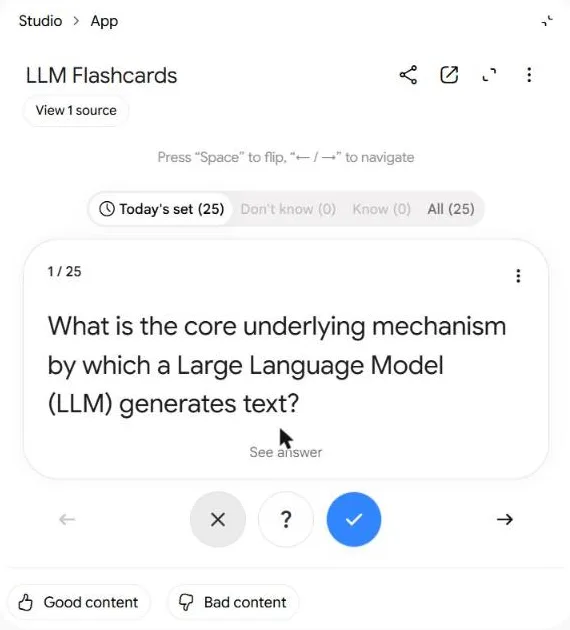
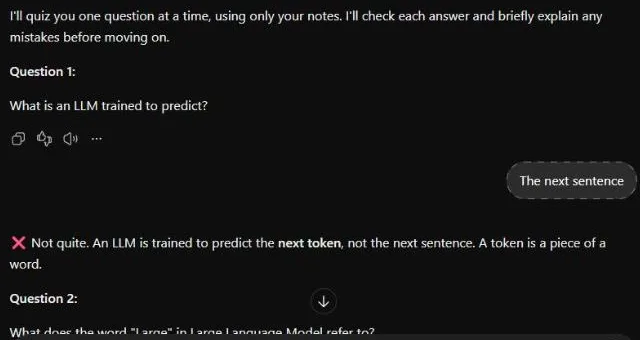
Our take. The three tools do three different jobs. NotebookLM gives you a deck you can come back to. Gemini gives you a graded test in one prompt. ChatGPT gives you a conversation that catches what you got wrong. We ran ChatGPT on our ChatGPT account.
Which prompt turns ChatGPT into a study tutor?
Tested in ChatGPT · Nov 26, 2026
Be my study tutor. Quiz me on my notes below, one question at a time. Wait for my answer, tell me if I am right, explain briefly when I am wrong, then ask the next question. Only use my notes. MY NOTES: [paste your notes]
“Only use my notes” keeps the questions on what your teacher covered. The same notes and prompts are in our AI projects for beginners, with a starter file to download.
How does each tool score for studying?
We scored the seven tools on five criteria that decide whether a study tool helps you pass. Each score is out of 10. The final score is the weighted average, rounded to one decimal.
| Tool | Practice from your notes (30%) | Answers you can check (20%) | Long-term review (20%) | Cost for a student (20%) | Proof (10%) | Final score |
|---|---|---|---|---|---|---|
| NotebookLM | 10 | 9 | 6 | 10 | 10 | 9.0 |
| Gemini | 9 | 9 | 5 | 9 | 10 | 8.3 |
| ChatGPT | 8 | 8 | 4 | 9 | 10 | 7.6 |
| Quizlet | 8 | 6 | 8 | 6 | 5 | 6.9 |
| Anki | 3 | 8 | 10 | 9 | 5 | 6.8 |
| Mindgrasp | 9 | 6 | 6 | 4 | 5 | 6.4 |
| Khanmigo | 4 | 7 | 4 | 8 | 5 | 5.5 |
Practice from your notes (30%). Can the tool turn your own material into flashcards, quizzes or questions? NotebookLM gets 10: 25 flashcards from our notes in about 40 seconds, plus quizzes and audio from the same sources. Gemini gets 9 for a 10-question interactive quiz in under 25 seconds. Mindgrasp gets 9 on its feature list: it takes PDFs, slides, YouTube links, audio and live lecture recordings, and returns notes, flashcards and quizzes. ChatGPT gets 8: it quizzed us well, but one question at a time inside a chat. Quizlet gets 8 because it builds a study set from typed, pasted or uploaded notes. Khanmigo gets 4 because it tutors on Khan Academy’s lessons, not on your class notes. Anki gets 3: it has no built-in AI, so you write or import the cards.
Answers you can check (20%). A wrong flashcard is worse than no flashcard. NotebookLM answers only from your sources and points to the passage: 9. Gemini’s answer key quoted our notes, and all 10 answers were right: 9. ChatGPT caught our deliberate wrong answer, but it can also draw on general knowledge unless you tell it not to: 8. Anki gets 8 because the cards are the ones you wrote. Khanmigo gets 7: it runs on GPT-4 and is built to guide you, not to answer for you. Quizlet and Mindgrasp get 6: shared Quizlet sets are written by other users, and Mindgrasp’s feature list does not mention source citations.
Long-term review (20%). Passing a final means seeing the same card again in three days, then in ten. Anki is built for this and schedules each review for when you are about to forget: 10. Quizlet lists spaced repetition, adaptive Learn rounds and retention tracking: 8. NotebookLM keeps your deck with Know and Don’t know piles, but has no review schedule: 6. Mindgrasp saves each session to a library: 6. Gemini’s flashcards and quizzes open in a side panel and can be shared by link: 5. ChatGPT and Khanmigo keep a chat history, not a deck: 4.
Cost for a student (20%). NotebookLM is free for up to 100 notebooks: 10. Gemini and ChatGPT both have a free plan, and Anki is free on computers and Android, with a one-time $24.99 iPhone app: 9 each. Khanmigo costs $4 a month: 8. Quizlet is free with ads, and its paid plans run from $9.99 to $44.99 on the US App Store: 6. Mindgrasp needs a subscription after a free trial, from $12.99 a month: 4.
Proof (10%). NotebookLM, Gemini and ChatGPT get 10 because we ran them on the same notes and show the results above. The four others get 5, based on their official feature lists and prices.
NotebookLM: best for studying from your own notes
Who it’s for. Any student with lecture notes, slides or PDFs who wants practice material without typing cards by hand.
Why it’s on the list.
- It was the fastest route to a deck. One page of notes became 25 flashcards in about 40 seconds. You sort each card into Know or Don’t know as you go.
- It stays inside your sources. NotebookLM answers only from what you upload, and each answer points to the passage it came from. The questions match your course, not the internet.
- You can tune the deck. Before generating flashcards or a quiz, you choose easy, medium or hard, ask for fewer or more cards, and describe the topic to focus on.
- The free plan is large. 100 notebooks with 50 sources each, and one source can hold 500,000 words. A full semester fits.
Limits. It will not fill gaps in your notes: if your notes skip a topic, so will your flashcards. And there is no spaced-repetition schedule, so you decide when to review.
Price. Free. Higher limits come with Google AI Plus at $4.99 a month. Checked Nov 26, 2026.
Pick it if you have notes and want flashcards, a quiz or an audio summary tonight. Skip it if you have no material yet and need the subject explained from scratch.
Read our full NotebookLM review.
See NotebookLM plansGemini: best for a quick practice test
Who it’s for. The student who wants to know, right now, how much of the chapter has stuck.
Why it’s on the list.
- One prompt, one graded quiz. From our notes it built 10 interactive questions (6 multiple choice, 4 true or false) in under 25 seconds.
- The answers were right. All 10 matched our notes, and the answer key quoted the line each answer came from.
- The quiz is a real tool, not a text list. Quizzes open in a side panel with a Hint button. When you finish, Gemini shows your strengths and focus areas, and a More questions button extends the test.
- It also makes flashcards and study guides. Start your prompt with “Create flashcards about” or “Create a study guide about” and attach your file.
Limits. Your quiz lives in a chat, not in a deck that schedules reviews. The free plan reads 32,000 tokens at a time, which is tight for a long textbook chapter. And you cannot share quizzes from a school Google account.
Price. Free. Google AI Plus is $4.99 a month and Google AI Pro $19.99. Checked Nov 26, 2026.
Pick it if you want a fast self-test from pasted notes. Skip it if you need to review the same cards over several weeks.
Read our full Gemini review.
See Gemini plansChatGPT: best for a tutor that questions you
Who it’s for. Students who learn by explaining out loud and being corrected.
Why it’s on the list.
- It held the tutor role. With the prompt above, it asked one question, waited, judged our answer and moved on. It never dumped the whole quiz at once.
- It caught a wrong answer. We answered “the next sentence” on purpose. It replied that a language model predicts the next token, not the next sentence.
- Study mode is built in. Type @study in the message box, or tap + and choose Study. ChatGPT then guides you with questions instead of handing over the answer, and it accepts class notes, PDFs and photos of problems.
Limits. The session lasts as long as the chat. You get no deck to review next week. OpenAI also says study mode can make mistakes and may sometimes give a direct answer, so keep “Only use my notes” in your prompt.
Price. Free; Go $8 a month; Plus $20 a month. Checked Nov 26, 2026.
Pick it if you understand a topic better after being questioned on it. Skip it if you mainly need to memorize terms: a flashcard tool does that better.
Read our full ChatGPT review.
See ChatGPT plansQuizlet: best for ready-made sets and group study
Who it’s for. High school and college students in common courses, where someone has already made a set for the same textbook.
Why it’s on the list.
- It has the audience. Quizlet reports over 60 million users. For a standard course, a set probably exists before you type a word.
- It now builds sets from your material. Type, paste or upload notes and it creates a study set. You can also record or upload a lecture and get a study guide and flashcards.
- It covers review. Its feature list includes spaced repetition, adaptive Learn rounds, practice tests and retention tracking.
Limits. The free version shows ads, and Quizlet Plus is a paid subscription. A shared set is only as good as the classmate who wrote it, so check it against your notes before you trust it.
Price. Free with ads. Paid plans are listed from $9.99 to $44.99 on the US App Store. Checked Nov 26, 2026.
Pick it if your class uses a popular textbook or you study with friends. Skip it if your material is unusual, or you want a free tool with no ads.
See Quizlet plansAnki: best for long-term memorization
Who it’s for. Students who must retain thousands of facts for months: medicine, law, languages.
Why it’s on the list.
- It schedules your memory. After each card you rate how well you remembered. Anki then shows the card again when you are most likely to forget it.
- It is free where students work. The computer version is free on Windows, Mac and Linux, the Android app is free, and syncing between devices is free.
- It scales. Anki states that it handles decks of more than 100,000 cards, with audio, images and scientific notation on the cards.
Limits. Anki has no built-in AI. You write the cards, import a shared deck, or generate questions elsewhere and paste them in. The official iPhone app costs $24.99, once.
Price. Free on computers and Android; $24.99 one time on iPhone. Checked Nov 26, 2026.
Pick it if your exam is months away and the volume is huge. Skip it if the test is on Friday: you will not get the benefit of the schedule.
A combination that works: generate questions in NotebookLM or Gemini, keep the ones you find hard, and put those into Anki.
See Anki downloadsMindgrasp: best for recorded lectures and videos
Who it’s for. Students whose courses live in recordings, slide decks and YouTube videos more than in written notes.
Why it’s on the list.
- It takes almost any format. PDFs, slides, YouTube videos, audio files and web links. You can also record a live lecture.
- One upload, five outputs. Each study session produces notes, a summary, flashcards, quizzes and an AI tutor you can question about the material.
- Sessions stay organized. Your sources and everything generated from them are saved to a library, one session per lecture or chapter.
Limits. It is the only tool here with no lasting free plan: after the free trial you need a subscription. And its website shows no price list, which makes it harder to budget than the others.
Price. Scholar $12.99 a month or $99.99 a year; Premium $14.99 a month or $131.99 a year, as listed on the US App Store. Checked Nov 26, 2026.
Pick it if you have hours of lecture recordings to turn into notes. Skip it if your material is already text: NotebookLM does that part for free.
Read our full Mindgrasp review.
See Mindgrasp plansKhanmigo: best for guided help in school subjects
Who it’s for. School students, and parents who want a tutor that will not do the homework for their child.
Why it’s on the list.
- It refuses to give the answer. Khan Academy’s own line is “Khanmigo never gives you the answer.” It asks you questions until you get there.
- It is tied to real lessons. The tutoring runs on Khan Academy’s content in math, science, coding, history and the humanities.
- It is cheap, and parents can see inside. $4 a month or $44 a year. A parent account can add children and read their chat history.
Limits. It works from Khan Academy’s lessons, not from your teacher’s slides. You must live in the United States and be 18 or older to sign up; younger students need a parent or guardian to create the account.
Price. $4 a month or $44 a year. Free for teachers. Checked Nov 26, 2026.
Pick it if you are stuck on a concept in a standard school subject. Skip it if you need practice on your own course material.
See Khanmigo plansHow do you choose the right AI for the way you study?
Start from your problem, not from the tool.
| If your problem is | Use | Why |
|---|---|---|
| Memorizing definitions from your notes | NotebookLM | 25 flashcards from one page in about 40 seconds |
| A practice test the night before | Gemini | 10 graded questions in under 25 seconds |
| You read it but do not understand it | ChatGPT | It questions you and corrects you, one step at a time |
| Remembering for a final in three months | Anki | It schedules each card for when you are about to forget |
| A common course with a standard textbook | Quizlet | A shared set probably exists already |
| Hours of recorded lectures | Mindgrasp | It turns audio and video into notes, flashcards and quizzes |
| Homework in math or science, without getting the answer | Khanmigo | It guides you with questions for $4 a month |
Two free tools are enough for most students: NotebookLM to build the material and Gemini to test yourself. Add Anki if the exam is far away.
Mistakes to avoid.
- Letting the AI use the whole internet. Tell it to use only your notes, or use a tool that does this by design. Your exam covers your course, not the average of the web.
- Reading instead of answering. A summary feels like studying. A quiz is studying. Pick the output that makes you produce an answer.
- Trusting a card you did not check. Ask for the answer key with quotes from your notes, as Gemini gave us, and compare.
- Paying before you hit a limit. Our whole test fit in three tools that each have a free plan. Upgrade when a limit stops you, not before.
- Using it on graded work without asking. Quizzing yourself is studying. Handing in AI text is a different thing. Check your school’s policy.
We left a few popular names out of the ranking. Claude and Perplexity are strong for writing and research, which we cover in AI tools for students. RemNote and Notion are note-taking apps first. Otter records lectures but does not quiz you.
How we scored these tools
We gave the same 285 words of notes to NotebookLM, Gemini and ChatGPT on Nov 26, 2026, and recorded what each one made, how long it took and whether the answers were right.
Quizlet, Anki, Mindgrasp and Khanmigo are scored from their official feature lists, help pages and US prices, checked on Nov 26, 2026. They were not part of our hands-on run, which is why they score lower on proof.
We also used our own reviews of NotebookLM, Gemini, ChatGPT and Mindgrasp.
Our notes were short and about one topic. A 40-page chapter will take longer and may expose limits we did not hit.
Scores are weighted averages of five criteria, and the ranking follows the scores.
Questions about AI for studying
What is currently the best AI for students? NotebookLM, for most students. It is free, it works only from the notes and PDFs you upload, and it turned one page of our notes into 25 flashcards in about 40 seconds. Pair it with Gemini for practice tests, and with ChatGPT when you need a concept explained step by step.
What is the best AI study tool for free? NotebookLM. The free plan allows 100 notebooks with 50 sources each, and includes flashcards, quizzes and audio summaries. Gemini and ChatGPT also have free plans, and Anki is free on computers and Android. You can build a complete study routine without paying anything.
Which AI is best for which study task? Use NotebookLM for flashcards from your notes, Gemini for a quick graded quiz, ChatGPT for tutoring, Anki for long-term memorization, Quizlet for shared sets, Mindgrasp for recorded lectures and Khanmigo for guided homework help. Most students only need the first two.
Can AI make flashcards from my notes? Yes. NotebookLM made 25 from one page of our notes in about 40 seconds. Before generating, you can set the difficulty, ask for more or fewer cards, and name the topic to focus on. Gemini, Quizlet and Mindgrasp also build flashcards from uploaded material.
Is NotebookLM free for students? Yes. Anyone with a Google account can use it at no cost, with up to 100 notebooks and 50 sources per notebook. Paid Google AI plans, from $4.99 a month, raise those limits. Most students will not need them for a normal course load.
Is it cheating to study with AI? No, not when you use it to quiz yourself on your own notes. That is the same as using flashcards. Using AI to write graded work is different, and the rules vary by school and by teacher. Read your syllabus or ask before you use it on an assignment.
More guides: every best AI for ranking, and AI tools for students for writing and research.
Update log
Nov 26, 2026: guide rebuilt with a scoring grid and a section per tool; Anki, Khanmigo and Mindgrasp added. The test of NotebookLM, Gemini and ChatGPT on the same notes is unchanged.
Nov 26, 2026: guide written with our test of NotebookLM, Gemini and ChatGPT on the same notes.