Neural Minute may earn a commission if you buy through our links. It doesn’t change our verdicts. How we test · How we make money
To benchmark your brand’s AI citations, ask four AI engines the same 20 buyer questions three times each in one week, then count how often each brand is named. The free sheet below does the rest: presence rate, share of voice and a noise threshold, so you know which gaps against your competitors are real.
The setup for each engine follows its official help pages, read in November 2026. The filled sheet uses four invented brands to show the math; it contains no real AI results. Our own small run, on real answers, is in this section.
What do you need to benchmark AI citations by hand?
You need a spreadsheet, free accounts and about half a day. The full run is 20 questions on 4 engines, 3 passes each: 240 answers to read and log. If each one takes you a minute, that is four hours of work, and nothing to pay.
- Download the blank benchmark sheet (CSV): 240 rows already laid out by engine, question and pass. It opens in Google Sheets, Excel or Numbers.
- Download the filled example (CSV): the same sheet completed for four invented invoicing brands, so you can check your formulas against ours.
At the end you will have five numbers for your brand and for each competitor:
- Presence rate. The share of answers that name the brand.
- Share of voice. The brand’s mentions as a share of all tracked brands’ mentions.
- Link rate. The share of answers that link to the brand’s own site.
- Top cited domains. The sites the engines use as sources, which become your outreach list.
- Noise threshold. The smallest gap you can trust with this many answers.
The whole method fits in one line: same questions, same week, same country, three passes, and three separate things counted in each answer. The rest of this guide explains each choice.
How do you run the benchmark, step by step?
Fix everything before the first question: the brands, the 20 questions, the four engines and their settings, and the week. Then run the passes and log each answer the same way. Changing a question or a setting halfway makes the numbers impossible to compare.
Step 1: Pick your brand and 2 or 3 competitors
Choose the brands a buyer would really weigh against yours, not the biggest names in the industry. Write each brand exactly as the engines write it, plus its website domain. You will count the name and the domain separately. Four brands in total keeps the sheet readable.
Step 2: Write 20 fixed questions, spread across four types
Write the questions a buyer asks before choosing, and never put your own brand name in them. A question that names you will almost always mention you, which inflates your score. Spread the 20 questions like this:
| Question type | How many | Pattern | What it tells you |
|---|---|---|---|
| Category | 8 | “Best [product] for [buyer or use]” | Whether you make the shortlist when someone is ready to choose |
| Problem | 5 | “How do I [task your product solves]?” | Whether engines connect you to the need, before any product is named |
| Comparison | 4 | “Best alternatives to [competitor]”, “[competitor 1] vs [competitor 2]” | Whether you are offered as the other option |
| Buying | 3 | “How much does [product] cost?”, “Is [product] worth it for [buyer]?” | Whether you appear when price is the deciding factor |
Take the wording from real life: sales calls, support tickets, Reddit threads and the “People also ask” box on Google. If you are short of ideas, this prompt drafts 40 candidates in any assistant. Keep the 20 that sound like your buyers.
Prompt: draft candidate questions
Act as a buyer in the United States researching [product category]. List 40 questions this buyer would type into an AI assistant before choosing a product. Group them: 16 category questions ("best ... for ..."), 10 problem questions ("how do I ..."), 8 comparison questions about [competitor 1], [competitor 2] and [competitor 3] (alternatives and head-to-head), and 6 buying questions (price, fees, "is it worth it"). Never mention [my brand]. Write the way a person talks, one question per line.
Once the list is final, paste it into the Question column and do not touch it again. Next quarter you will rerun the same 20.
Step 3: Set up each engine so nothing personal leaks in
Assistants adapt to you. Your chat history, saved memories and location can all change which brands come back, so turn personalization off and keep the same settings for every pass.
| Engine | How to get a clean answer | Where the sources are |
|---|---|---|
| ChatGPT | Open a new chat, select Temporary chat, and choose Unpersonalized if the option appears. Then select + in the message box and Web search. | Open the ••• menu under the answer and select View sources, or use the Sources button when there is one. |
| Perplexity | Turn on Incognito before you ask. Memory and past searches stay off in that mode. | Numbered citations in the answer, each linking to its source. |
| Gemini | On gemini.google.com, click Temporary chat next to New chat. Temporary chats do not give personalized responses. | Links shown with the answer, when Gemini gives any. |
| Google AI Overviews | Search on google.com in a private browser window, signed out. Log the AI Overview at the top of the results, not the AI Mode tab. | The link cards and link icons inside the overview. |
Sources: OpenAI help center (Temporary chat, web search), Perplexity help center, Gemini Apps Help and Google Search Central.
Three details matter here.
- Turn web search on in ChatGPT. Without it, ChatGPT may answer from its training data alone, and you get no links to count.
- Keep AI Overviews and AI Mode apart. Google’s own documentation says the two may use different models and techniques, so their answers and links differ. Pick one. This guide uses AI Overviews because they appear in ordinary searches.
- Write down the model or mode. The “Model or mode” column holds what the screen shows: the model name in the picker, and whether search was on. A free account and a paid one can run different models, so use the same account every time.
Step 4: Run three passes in the same week, from the same country
Ask every question three times per engine, each time in a new chat, on three different days of the same week. Stay in one country for the whole run. ChatGPT, for example, may use an approximate location based on your IP address to shape search results, so a VPN that hops between countries changes the answers.
Three passes are the minimum because AI answers are not stable. In SparkToro’s 2026 research, run with 600 volunteers, the odds of getting the same list of brands twice for the same prompt were under 1 in 100 in the cases shown. The same research found that how often a brand shows up across many runs is a fair measure. That is exactly what you are building: a rate, not a ranking.
The same week matters too. Models and search indexes change, and a benchmark spread over a month mixes old and new behavior. A simple rhythm: pass 1 on Monday, pass 2 on Tuesday, pass 3 on Wednesday.
Step 5: Log three things separately in each answer
For each answer, record the brand mention, the link to your site and the cited domains in separate columns. They measure different things. An engine can recommend you by name without linking to you, or cite your blog post without recommending your product.
| Column | What to write |
|---|---|
| Date, Engine, Model or mode, Country | The conditions of the run. Fill them once per pass and copy down. |
| Question ID, Question, Question type, Pass | Already laid out in the sheet: Q01 to Q20, passes 1 to 3. |
| Answer shown (yes/no) | “no” when the engine gave no AI answer. This happens mostly on Google, where an AI Overview does not appear on every search. |
| Brand mentioned (yes/no), one column per brand | “yes” if the answer text names the brand, wherever it appears. A brand that only shows up in the source list is not a mention. |
| Position among named brands | 1 if your brand is the first tracked brand named, 2 if second, and so on. Empty if absent. |
| Link cited (yes/no) and cited URL | “yes” if a source or inline link points to your own domain, and which page. |
| Cited domains | Every domain in the sources, separated by semicolons: review sites, forums, media, competitors. |
| Notes | Anything odd: a wrong price, an outdated product name, a negative remark. |
Use Ctrl+F on the brand name instead of skimming, and decide your rules once. Does a misspelling count? Does a parent company count? Write the rule in the Notes of the first row and apply it to every brand, yours and theirs.
On this page
- 01What do you need to benchmark AI citations by hand?
- 02How do you run the benchmark, step by step?
- 03What does a small real benchmark look like?
- 04How do you calculate presence rate and share of voice?
- 05How big must a gap be before it counts?
- 06What should you do with the results?
- 07When should you pay for an AI visibility tool?
- 08Which mistakes skew a manual benchmark?
- 09Questions about benchmarking AI citations
- 10Update log
What does a small real benchmark look like?
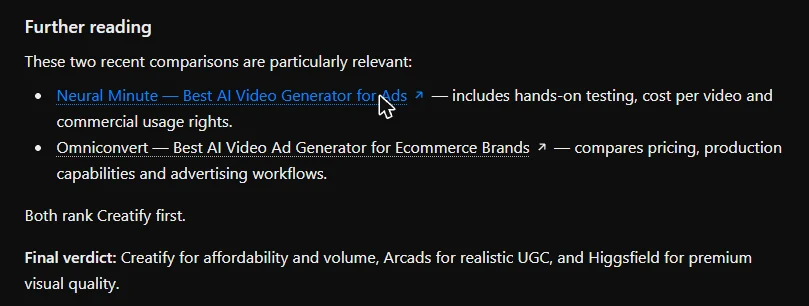
We ran a short version of the method on our own niche, AI video ad generators: 3 buyer questions on ChatGPT (temporary chat, web search on), Perplexity and Google, one pass, on Nov 26, 2026: 9 answers to log. Creatify was named in 8 of them, Arcads in 7, and our own site was linked once.
For Google we logged AI Mode, because it answers every question while an AI Overview does not always appear. In your own run, pick one of the two and keep it, as step 3 says.
| Question | Engine | Brands named, in order | Sources shown | Neural Minute |
|---|---|---|---|---|
| What is the best AI video ad generator for a small ecommerce brand? | ChatGPT | Creatify, Arcads, MakeUGC, Higgsfield, HeyGen, Topview | 8: the six vendor sites, omniconvert.com, neuralminute.com | Linked, not named in the ranking |
| Perplexity | Creatify, Arcads, Photoroom, HeyOz, Topview | 10: omniconvert.com, analyticsinsight.net, arcads.ai (2), photoroom.com (2), heyoz.com (2), shhots.ai, rankite.com | Absent | |
| Google AI Mode | Creatify, InVideo, Tagshop, CapCut, Canva | 2: two Reddit threads | Absent | |
| Creatify vs Arcads: which is better for UGC video ads? | ChatGPT | Arcads, Creatify | 2: arcads.ai, creatify.ai | Absent |
| Perplexity | Arcads, Creatify | 10: sprites.ai, designkit.com, avastudio.com, genyad.com, creatify.ai, fastlane.ai, shhots.ai, hyperfx.ai, itechguides.com, omniconvert.com | Absent | |
| Google AI Mode | Creatify, Arcads | 1: one Reddit thread | Absent | |
| How much does it cost to make AI UGC video ads? | ChatGPT | HeyGen, Creatify, Higgsfield, Runway, Arcads | None | Absent |
| Perplexity | Arcads, Creatify, Higgsfield, MakeUGC, Billo | 10: aliteq.com, knowlify.com (3), anglr.co, motionbox.io, sync.so, manymotions.com, arcads.ai, ugcstars.com | Absent | |
| Google AI Mode | No brand named | 2: vibiz.ai, theinfluencer.ai | Absent |
Three things this small run already shows, and that your sheet will show for your niche:
- A link is not a mention. ChatGPT linked our comparison as further reading without naming us in its ranking. Logged our way, that is link cited “yes”, brand mentioned “no”: 1 answer in 9, or 11%.
- Each engine reads different sources. Perplexity showed 10 sources per answer, mostly vendor blogs and comparison pages. Google AI Mode leaned on Reddit threads. ChatGPT went to the vendors’ own sites. One domain, omniconvert.com, appeared in 3 of the 9 answers: that is the kind of page to study, or to be listed on.
- The question type changes who gets named. The cost question brought no brand at all on Google AI Mode, and no source on ChatGPT. The “Creatify vs Arcads” question names both brands by design: without it, Creatify is in 5 answers of 6 and Arcads in 4 of 6. Count your versus questions apart from the rest.
With one pass and 9 answers, the margin of error is about 33 points. Only the widest gaps clear it, such as Creatify (8 of 9) against HeyGen (2 of 9); the gap between Creatify and Arcads does not. Treat the rest as a first look. The full run, 3 passes on 20 questions, is what turns a first look into a baseline.
How do you calculate presence rate and share of voice?
Presence rate is the answers that name a brand divided by the answers collected. Share of voice is one brand’s mentions divided by the mentions of all tracked brands. Presence tells you how visible you are; share of voice tells you how the attention is split.
| Metric | Formula | In Google Sheets or Excel |
|---|---|---|
| Presence rate | Answers naming the brand ÷ answers shown | =COUNTIFS(I:I,"yes",J:J,"yes")/COUNTIF(I:I,"yes") |
| Presence rate on one engine | Same, limited to that engine’s rows | =COUNTIFS(B:B,"Perplexity",I:I,"yes",J:J,"yes")/COUNTIFS(B:B,"Perplexity",I:I,"yes") |
| Share of voice | Brand mentions ÷ mentions of all tracked brands | =COUNTIF(J:J,"yes")/(COUNTIF(J:J,"yes")+COUNTIF(K:K,"yes")+COUNTIF(L:L,"yes")+COUNTIF(M:M,"yes")) |
| Link rate | Answers linking to your domain ÷ answers shown | =COUNTIFS(I:I,"yes",O:O,"yes")/COUNTIF(I:I,"yes") |
| Named first | Answers where you are the first tracked brand ÷ answers naming you | =COUNTIF(N:N,1)/COUNTIF(J:J,"yes") |
Column letters match both CSV files: I is “Answer shown”, J to M are the four brands, N is the position, O is the link. For a competitor, swap J for K, L or M.
Divide by answers shown, not by questions asked. If Google shows no AI Overview for a search, your brand was not ignored; there was nothing to be in.
A worked example with four invented brands
This example is fictional. Fictibooks, Mockledger, Samplepay and Demobill do not exist, and we made up every answer in the sheet to show the math. Imagine you are the marketing manager of Fictibooks, an invoicing app for freelancers.
The run has 240 rows. Google showed an AI Overview on 36 of its 60 searches, so the sheet holds 216 answers.
| Brand (fictional) | Answers naming it | Presence rate | Share of voice |
|---|---|---|---|
| Mockledger | 154 of 216 | 71.3% | 37.9% |
| Samplepay | 110 of 216 | 50.9% | 27.1% |
| Demobill | 86 of 216 | 39.8% | 21.2% |
| Fictibooks (you) | 56 of 216 | 25.9% | 13.8% |
The math for Fictibooks: 56 ÷ 216 = 25.9% presence. The four brands were named 406 times in total (154 + 110 + 86 + 56), so its share of voice is 56 ÷ 406 = 13.8%. Presence rates do not add up to 100% because one answer can name several brands. Shares of voice always do.
Now the same count per engine, which is where the picture changes:
| Presence rate (fictional data) | ChatGPT | Perplexity | Gemini | Google AI Overviews |
|---|---|---|---|---|
| Answers shown | 60 | 60 | 60 | 36 |
| Mockledger | 80.0% | 65.0% | 70.0% | 69.4% |
| Samplepay | 53.3% | 58.3% | 43.3% | 47.2% |
| Demobill | 46.7% | 41.7% | 35.0% | 33.3% |
| Fictibooks (you) | 21.7% | 45.0% | 8.3% | 30.6% |
Fictibooks is named in 27 of 60 Perplexity answers but only 5 of 60 Gemini answers. The overall 25.9% hides that spread. Two more numbers from the same sheet: Fictibooks’ own site is linked in 18 of 216 answers, an 8.3% link rate, and it is the first tracked brand named in 18 of its 56 mentions, or 32.1%.
Treat position with care. The order of brands in an AI answer changes from one run to the next far more than the list itself, so “named first” is a weak signal. Presence rate is the number to report.
How big must a gap be before it counts?
With 240 answers, treat any gap under 10 points between two brands as a tie. On a single engine, with 60 answers, the bar is 15 points. Below those thresholds you are mostly looking at the randomness of the engines, not at a real difference.
The thresholds come from the standard margin of error for a percentage: 2 × √(p × (1 − p) ÷ n), where p is the presence rate and n the number of answers. In the fictional example, Fictibooks has p = 0.259 and n = 216. That gives a margin of about 6 points either way. On ChatGPT alone (p = 0.217, n = 60), it is about 11 points.
We round those up because three passes of the same question are not fully independent. An engine that skips you once on a question tends to skip you again.
| Answers behind the percentage | Margin of error at worst (50% presence) | Gap to treat as real |
|---|---|---|
| 216 to 240 (all engines, 3 passes) | About 7 points | 10 points or more |
| 60 (one engine, 3 passes) | About 13 points | 15 points or more |
| 36 (an engine that often shows no answer) | About 17 points | 20 points or more |
Your sheet also lets you see the noise directly. Calculate your presence rate for each pass on its own. In the fictional example, Fictibooks scores 18.1% on pass 1, 31.0% on pass 2 and 28.8% on pass 3. Same questions, same settings, consecutive days, and a 13-point swing. Anyone who ran only pass 1 would have reported a much weaker brand.
Applied to the example:
- Overall, Demobill is ahead of Fictibooks. 39.8% against 25.9% is a 13.9-point gap, above the 10-point bar.
- On Perplexity, Fictibooks and Demobill are tied. 45.0% against 41.7% is 3.3 points, well inside the noise.
- On Perplexity, the gap to Samplepay is not proven. 13.3 points is under the 15-point bar. Rerun before you call it.
- On Gemini, the gap is real. 8.3% against 35.0% for the weakest competitor is 26.7 points.
What should you do with the results?
Read the results in three cuts: by question type, by engine and by cited domain. Each one points to a different job. The overall score is for your report; the cuts are for your to-do list.
- By question type. In the fictional example, Fictibooks appears in 38.6% of category answers but only 17.9% of problem answers and 15.2% of buying answers. Engines know the product exists but do not connect it to the buyer’s problems or to price. That calls for how-to content and a clear public pricing page.
- By engine. A brand strong on Perplexity and nearly absent on Gemini, like Fictibooks, should compare the sources each engine cites. The gap usually sits in which sites each one reads.
- By cited domain. Count how often each third-party domain appears in answers where you are absent. In the example, one invented magazine site is cited in 67 of the 160 answers that leave Fictibooks out. A site like that is your first outreach target: it already shapes the answers, and you are not on it.
- By consistency. For each question and engine, count how many of the three passes named you. In the example, Fictibooks is named in all three passes for only 2 of 73 question and engine pairs, and at least once in 39. Questions where you appear one time in three are the closest wins.
Also read your Notes column. A wrong price or a retired product name repeated across engines is worth fixing at the source before you chase more mentions. For checking what an engine says against its sources, our Perplexity review and ChatGPT review show how each one handles citations, and the best AI tools for research guide compares them side by side.
Then save the file with the date in its name. That file is your baseline. Rerun the same 20 questions next quarter and compare, using the same thresholds: a move of less than 10 points overall is not a trend yet.
When should you pay for an AI visibility tool?
Pay when the manual run stops answering your questions: you need more than 20 prompts, weekly trends, several countries, or you spend more than half a day a month on copy and paste. Until then, the manual benchmark gives you the same core numbers for free.
| Manual benchmark | Paid tracker | |
|---|---|---|
| Cost | $0 and about four hours per run | From $29 a month |
| Volume | 240 answers per run | Thousands of answers a month |
| Frequency | Once a quarter is realistic | Weekly or daily, automatic |
| Engines | The 4 you run by hand | Up to 10, depending on the tool |
| Best at | A first baseline, learning what the answers actually say | Trends over time, alerts, reports for your boss |
| Weak at | Trends, scale, other countries | Nuance: you read numbers instead of answers |
Our guide to the best AI visibility tools scores 10 of them. Two fit a team coming from a manual benchmark:
- LLMrefs, 9.1/10, our top pick. One $79-a-month plan tracks 500 prompts on 10 engines, refreshed weekly. That is 25 times your 20 questions.
See LLMrefs plans - Otterly.AI, 8.9/10, the cheapest start. Plans begin at $29 a month for 16 prompts, close to the size of your manual list.
See Otterly.AI plans
Do the manual run first even if you plan to buy. You will arrive at the free trial with a tested question list, a baseline to check the tool’s numbers against, and a clear idea of which engines matter for your category.
Which mistakes skew a manual benchmark?
Most bad benchmarks fail on consistency, not on math. These are the errors that change the result the most.
- Running each question once. One answer is one draw from a lottery. Three passes is the floor.
- Asking from your everyday account. An assistant that remembers you work for the brand is not a neutral judge. Use temporary or incognito modes.
- Putting your brand in the question. “Is [your brand] good?” measures what engines say about you, not whether they think of you. Keep those questions in a separate list.
- Editing the questions between runs. A reworded question is a new question. If you must change one, restart its history.
- Counting a source link as a mention. Your domain in the sources and your name in the answer go in different columns.
- Stricter rules for competitors than for yourself. If a misspelling counts for you, it counts for them.
- Reporting a 4-point lead. Under the noise threshold, two brands are tied. Say so.
Questions about benchmarking AI citations
Our take. A manual benchmark is the right first step for any marketing manager who has not measured AI visibility yet. It costs an afternoon, and reading 240 answers teaches you more about how engines describe your category than a dashboard will. Its limit is time: it shows where you stand this week, not where you are heading. If the baseline shows AI answers matter in your market, move to a tracker for the trend.
How many prompts do you need to benchmark AI visibility? Twenty fixed questions, run three times on each engine, are enough for a first manual baseline. That gives 240 answers and a noise threshold of about 10 points. Entry plans of paid trackers follow from 16 to 500 prompts; more prompts narrow the margin and let you compare topics. Start small and keep the same list between runs.
Which AI engines should you track first? Start with ChatGPT, Perplexity, Gemini and Google AI Overviews. They are free to query and each shows its sources in a different way. If time is short, keep the two where your buyers are most likely to ask questions, and still run three passes on each instead of spreading thin.
How often should you rerun an AI citation benchmark? Once a quarter is realistic by hand, plus one extra run after a big launch or a wave of press coverage. Use the same 20 questions, settings and country each time. If you need a monthly or weekly trend, that is the point where a paid tracker earns its price.
What is a good AI share of voice? There is no standard figure, because every benchmark uses its own questions and brands. Judge yours against the competitors in your own sheet. With four tracked brands, an even split is 25% each. Being clearly above or below that line, by more than the noise threshold, is what matters.
Can Google Search Console show your AI Overview citations? Not separately. Google counts appearances in AI Overviews and AI Mode inside the overall “Web” search type of the Performance report, mixed with classic results. You cannot filter them out, which is why a prompt benchmark like this one is still needed to see where you are cited.
What is the difference between an AI mention and an AI citation? A mention is your brand name in the text of the answer. A citation is a link to a page used as a source. You can get either without the other, so the sheet tracks them in separate columns. The Neural Minute glossary defines the other terms used in AI search.
More step-by-step guides are in our tutorials section.
Update log
Nov 28, 2026: guide published with the blank benchmark sheet, the fictional worked example and our own 9-answer run.
Spotted an outdated price or an error on this page? Request an update. Want us to cover another tool? Suggest a review.