Neural Minute may earn a commission if you buy through our links. It doesn’t change our verdicts. How we test · How we make money
Yes, you can make a watchable AI drama series with Higgsfield: we produced an 8-episode vertical K-drama, 45 to 55 seconds an episode, with Seedance 2.5 on Higgsfield’s API generating the picture, the Korean voices and the lip movements in one pass. The full season cost about $270 in estimated API spend, roughly $34 an episode, and the last six episodes were generated in under seven hours. Making it was the easy part; earning from it is not, and this case study shows both, with our real costs, our prompts and the monetization routes that exist in 2026.
Watch the method in video
Our method in video, to go with this article: the same pipeline from prompt to finished episode, including the lip-sync pass and what we had to fix along the way.
Going through our link supports us at no extra cost, and that is what lets us keep publishing hands-on tests: our full Higgsfield review, the pricing and credits breakdown, and step-by-step tutorials on Kling 4.0, Seedance 2.5, Nano Banana Pro, face swap and earth zoom on the platform.
What AI drama did we make?
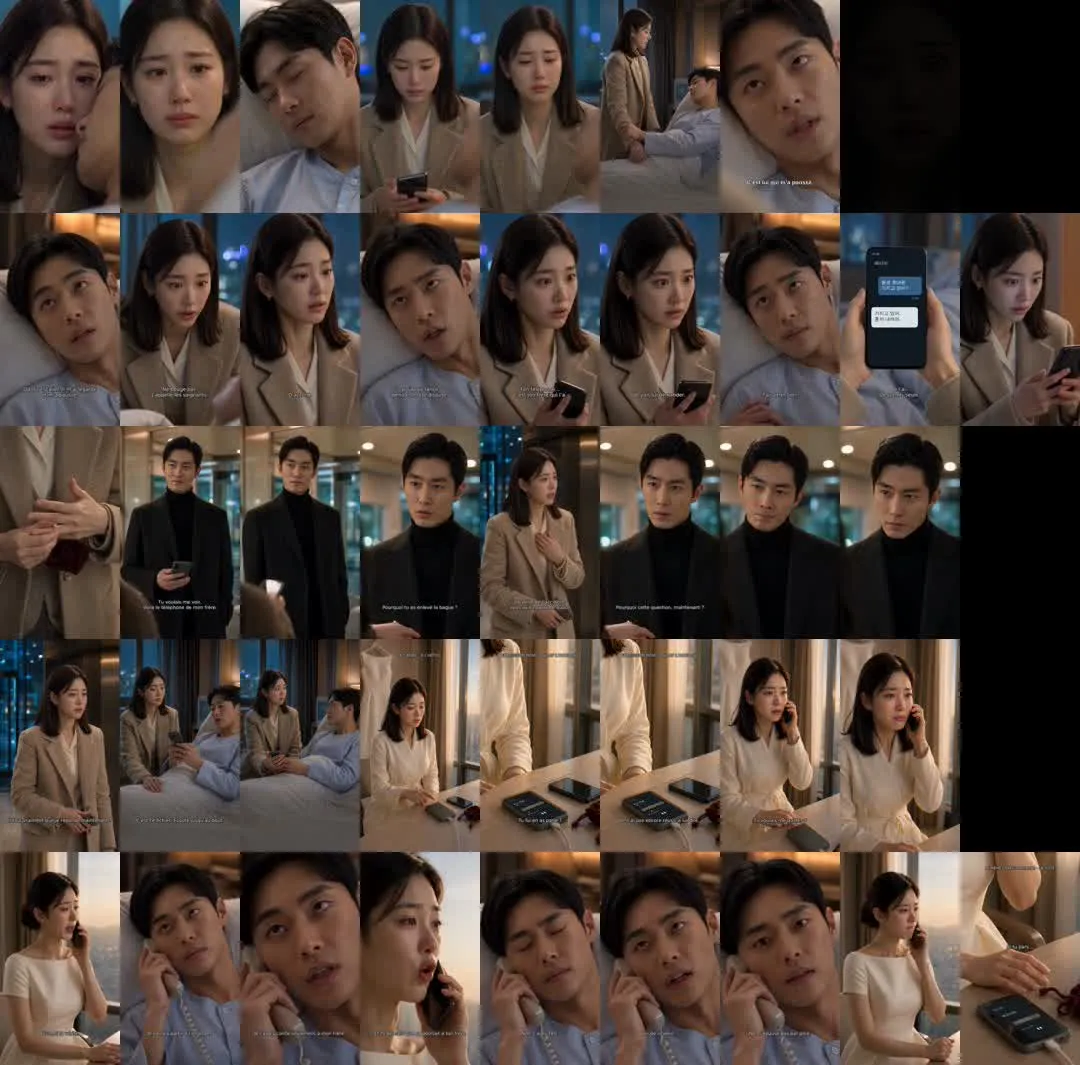
A romantic thriller called Demain, j’épouse ton frère (“Tomorrow I marry your brother”), made for our sister site kdrama.fr, which publishes K-drama news in French. The brief: 8 episodes, vertical 9:16, 45 to 60 seconds each, Korean dialogue with burned-in French subtitles, fictional adult characters only. A woman visits her ex-fiancé in a coma the night before she marries his older brother; he wakes up and tells her who pushed him. Each episode opens on a hook in the first three seconds and ends on a question.
The season was produced between Sep 24 and Oct 4, 2026. All eight episodes are online on kdrama.fr, and the pilot went out as a Facebook Reel. We also made the first three episodes of a second series, Signe le divorce, with the same pipeline.
On this page
- 01Watch the method in video
- 02What AI drama did we make?
- 03How much does an AI drama episode cost?
- 04How do you make an AI drama series, step by step?
- 05What prompts did we use?
- 06What went wrong, and what we would do differently?
- 07Can Higgsfield’s Short Drama studio do it for you?
- 08How do you monetize an AI drama?
- 09Did our AI drama make money?
- 10Is making AI dramas with Higgsfield worth it?
- 11Questions about AI dramas
- 12Sources
- 13Update log
How much does an AI drama episode cost?
About $34 per finished episode of 45 to 55 seconds, in our case, and almost all of it is video generation. These are the estimates our pipeline reserved through the API before each job, rejected takes included, not invoices.
| Episode | Estimated cost | What it includes |
|---|---|---|
| E01, pilot (45 s) | $29.05 | $24.50 of generation plus $4.55 of corrections |
| E02 (55 s) | $26.37 | video, keyframes, audio checks |
| E03 to E08 (6 episodes) | $214.20 | 46 shots across E02 to E08, retakes included |
| Season of 8 | $269.62 | about $33.70 per episode |
The unit price behind it: Seedance 2.5 in 720p was billed at $0.4622 per generated second through the API in October 2026, about $2.31 for 5 seconds. Keyframe images from gpt-image-2 cost about 2 cents each in practice. Speech-recognition and audio checks cost cents per call.
If you work in Higgsfield’s web app instead of the API, you pay in credits. On our Plus account on Nov 25, 2026, 5 seconds of Seedance 2.5 with sound cost 35 credits in 720p and 80 in 1080p, while Kling 4.0 cost 18.75 credits in 1080p and MAGI-2 12.5. At the Plus list price of $59 for 1,200 credits, our season’s $270 would be about 5,500 credits, by our arithmetic. Our hands-on Higgsfield review details every credit price we measured, and the Higgsfield pricing page has the current plans.
How do you make an AI drama series, step by step?
Our pipeline has eleven steps, and a person approves each one that costs money. It is not an automatic factory: it is a production line with gates.
- Contract. Fix the format before writing: length per episode (45 to 60 s), aspect ratio (9:16), language, subtitles, budget ceiling.
- Concepts. A language model (ChatGPT in our case) proposes three original concepts; a human picks one.
- Season, bible and scripts. The model writes the season arc, a character bible and every script in French and Korean. A second model pass reviews the Korean lines.
- Storyboard. Each episode becomes 5 to 8 shots of 4 to 18 seconds, in a
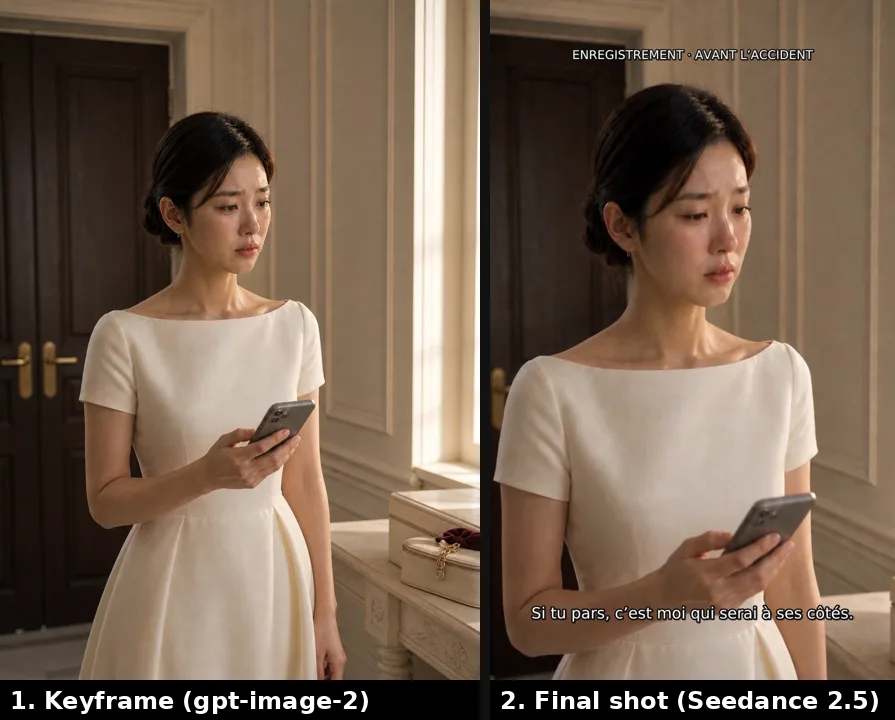
shots.jsonfile; a script checks that the total lands between 45 and 60 seconds. - Keyframes. Two or three reference images per episode lock the faces, clothes and sets (gpt-image-2, 1024 × 1536). On Higgsfield, Nano Banana Pro or Soul 2.0 can do this step.
- Video with dialogue. Each shot is generated with Seedance 2.5 in reference-to-video mode, 720p, 9:16, with audio on: the model performs the Korean lines with lip movement. One shot took 2.7 to 5.7 minutes to generate on episode 6.
- Rush checks. Every file is decoded in full, sampled frame by frame, transcribed with Whisper and checked by an audio model for clipped words.
- Edit. ffmpeg assembles the shots, keeps each audio line whole, adds French subtitles, original music and loudness at -18 LUFS.
- Poster. An AI artwork with the title set in code, not generated, so the text is always clean.
- Final check. Length, format and a checksum, so the same file is never published twice.
- Publication and measurement. Native upload to Facebook, an episode page on kdrama.fr, an email alert, then analytics.
What prompts did we use?
Short, physical and specific. Here are trimmed extracts from the real production files; the full prompts run to a page each.
Episode rules, given to the script model:
“45 to 60 s per episode, hook between 0 and 3 s: an action, a confession or an anomaly, no intro card. Dramatic progression, a reversal and a partial payoff per episode, then a precise question that calls the next one.”
Keyframe of one shot:
“Original fictional adult Korean woman, exact identity from first reference and exact ivory boatneck gown from second reference. Single cinematic medium waist up frame… She holds a matte grey phone low in her left hand. No text, no logo, photorealistic scene.”
Video shot with dialogue (Seedance 2.5):
“Photorealistic Korean drama, same original cast, native synchronized Korean speech, 9:16, entire face visible, chest-up, no music or voiceover. Three separate dialogue beats with short clean pauses… From 8 s his eyes narrow, voice serious without shouting, one small step toward her.”
Poster artwork:
“Ultra-realistic cinematic photograph, 50mm lens… faces sharp in the upper two thirds, lower third deliberately dark to receive the title. No text, no letters, no logo. Fictional adult actors, no lookalike of a real person.”
Two rules made the biggest difference: describe what the face and the hands do, second by second, and never ask the model to write text inside the picture.
What went wrong, and what we would do differently?
- One long take beats many short shots for a pilot. Our first episode was a single 30-second Seedance 2.5 generation with the shot list written into the prompt, plus a 23-second second take referenced to the first one’s voice. It looked more natural than our later shot-by-shot episodes. We switched to shot by shot only to keep continuity across episodes.
- Continuity is the real cost. Faces, coats and rings drift between generations. Keyframes for every new set, and a written continuity file, cut the retakes.
- Do not trust lip sync blindly. We check every line with speech recognition and an audio model, not with a native Korean listener, so we do not claim phoneme-perfect sync.
- Never speed up a voice to fit the timing. A clipped syllable is the first thing viewers notice. Cut the picture, not the line.
- Keep text out of generations. Titles, phone screens and subtitles are added in the edit.
Can Higgsfield’s Short Drama studio do it for you?
That is its promise, and it is new. In November 2026, Higgsfield opened Short Drama as an early preview: you upload a script (TXT, Markdown, DOCX or PDF), it splits it into episodes, scenes and characters, you choose vertical or widescreen and a style, it creates a cast that keeps the same face in every episode, and you generate 1 to 4 drafts per clip before finishing in 1080p, by hand or with an autopilot agent. It also runs from Claude through the Higgsfield MCP server with a /short-drama command that shows the plan and its price before generating.
We built our season before it existed, on the API, so we have not tested the studio yet. It targets exactly the two hard parts of our pipeline, the shot breakdown and cast continuity. Our guide to connecting the Higgsfield MCP server to Claude covers the setup.
How do you monetize an AI drama?
There are five routes, and none pays automatically. Each platform judges originality, and all of them want AI content disclosed.
- YouTube. AI-made videos can earn through the YouTube Partner Program, but YouTube’s rules on “inauthentic content” remove channels built on mass-produced, repetitive or template videos, judged at channel level. A series with its own story, characters and editing is the opposite of that, but a channel pumping out near-identical episodes is at risk. YouTube also requires you to disclose realistic altered or synthetic content at upload; the label itself does not change reach or eligibility.
- Facebook. Content monetization is by invitation, from the Professional Dashboard. Meta’s March 2026 guidance rewards original content, meaning material the creator produced, and reduces the reach of reposted content. A drama you generated and edited yourself is original under that wording.
- TikTok. The Creator Rewards Program pays for videos longer than one minute, with follower and view thresholds. Most microdrama episodes are under a minute, so a TikTok strategy needs longer cuts, such as two episodes joined, or a series built at 60 to 90 seconds.
- Licensing to drama apps. Vertical drama is a large market: Media Partners Asia, quoted by Deadline in August 2026, forecasts ReelShort at $1.05 billion of revenue for 2026. These apps commission and license series; an AI studio can pitch a finished pilot and a season plan. That is a business-to-business deal, not a passive income.
- Your own site. Episodes on your own pages build an audience you own (email list, ads, sponsors), and a making-of page like this one can earn affiliate commissions on the tools used.
Did our AI drama make money?
Not yet, and we prefer to say so. The season is published free on kdrama.fr, without ads, the first four episodes without an account, and the pilot ran as a Facebook Reel. We have not applied it to a partner program, licensed it to an app or put a sponsor on it, so there is no revenue figure to report. What we can report is the cost side: about $34 an episode, and a season produced in about ten days, from Sep 24 to Oct 4, 2026. The next step we would take is a pilot pitch to a vertical drama app, because that route pays for the season up front; this page will be updated with the outcome.
Is making AI dramas with Higgsfield worth it?
For a creator who already has an audience or a distribution plan, yes: a season at about $270 is cheap enough to test a format, and Seedance 2.5 on Higgsfield handles picture, voice and lip movement in one generation. For someone hoping that the platforms will pay for volume, no: YouTube’s rules point the other way, and the real money in vertical drama is in apps that license series. Start with one pilot, measure retention, and only then produce a season.
Start your pilot on Higgsfield
Questions about AI dramas
What is an AI drama? A scripted series whose picture, and often voices, are generated by AI models, usually in vertical episodes of one to two minutes, the format of apps like ReelShort and DramaBox.
Which AI model is best for drama dialogue? We used Seedance 2.5 because it generates speech and lip movement with the picture, in Korean in our case. In our model test, Kling 4.0 followed a visual prompt best for less, but our drama scenes relied on dialogue.
How long does one episode take? On our pipeline, a 45 to 55 second episode needed 5 to 8 generated shots of 3 to 6 minutes each, plus checks and edit; six episodes were generated in under seven hours.
Can YouTube monetize AI dramas? Yes, if the channel offers original, non-repetitive work and you disclose realistic AI content. Mass-produced template videos are excluded from the Partner Program.
Do I need to code? Our pipeline used scripts, but Higgsfield’s Short Drama studio and its web app need no code; the studio was in early preview in November 2026.
Sources
- Neural Minute production files of the series, September 24 to October 4, 2026: cost ledger, generation logs, scripts and prompts
- Neural Minute test on a Higgsfield Plus account, Nov 25, 2026 (credit prices)
- Higgsfield Short Drama and Short Drama in the MCP, read Nov 25, 2026
- YouTube channel monetization policies and YouTube disclosure of altered or synthetic content
- Meta, Rewarding Original Creators on Facebook, March 2026
- TikTok, Creator Rewards Program
- Deadline, ReelShort on course to reach $1BN revenue in 2026, August 2026
Update log
Nov 25, 2026: first publication of the case study.
Nov 26, 2026: added the video walkthrough and the corresponding source link.
Spotted an outdated price or an error on this page? Request an update. Want us to cover another tool? Suggest a review.