
OpenAI’s developer guide for GPT-6.2 Astra and Sol opens its prompting section with an instruction that reads like the reverse of the usual template. Revisit the words “be concise” in your system prompt, it says. Astra is more direct by default than the models it replaces, so a line that once rescued a rambling answer now only removes detail.
What was actually released
A documentation page, and two API changes sitting under it. The page is the “Using GPT-6.2” guide in OpenAI’s API documentation: a prompting section built around four behaviors OpenAI says it observed in the two models, each with a sample prompt to copy, and a migration section that lists the parameters that changed. Nothing in it is a new model. Astra and Sol shipped on November 17, 2026, and the guide is the document that tells a team how to work with them.
| Behavior | What OpenAI says the model does | The instruction it recommends |
|---|---|---|
| Writing style | More concise and direct by default than earlier models | Revisit instructions like “be concise” in the system prompt |
| Task completion | When intent is unclear, it may propose a next step and wait for confirmation | Give it room to make reasonable, reversible assumptions and keep working |
| Coding style | Writes more efficient code than its predecessors | Describe the project conventions and the behavior existing callers rely on |
| Frontend design | Needs the look spelled out | Specify the imagery and the typography it should use |
Then comes the part that changes a running application rather than a sentence.
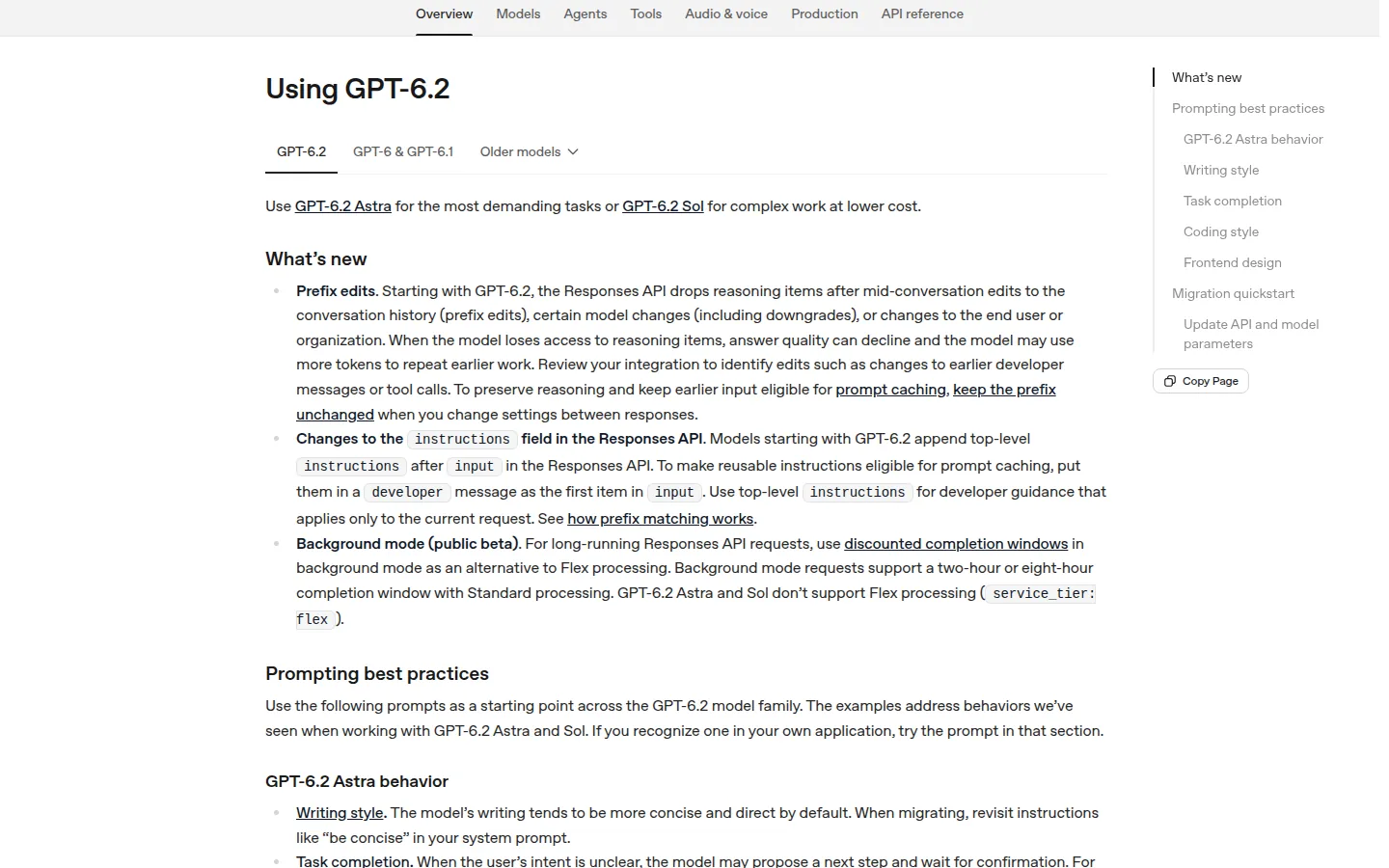
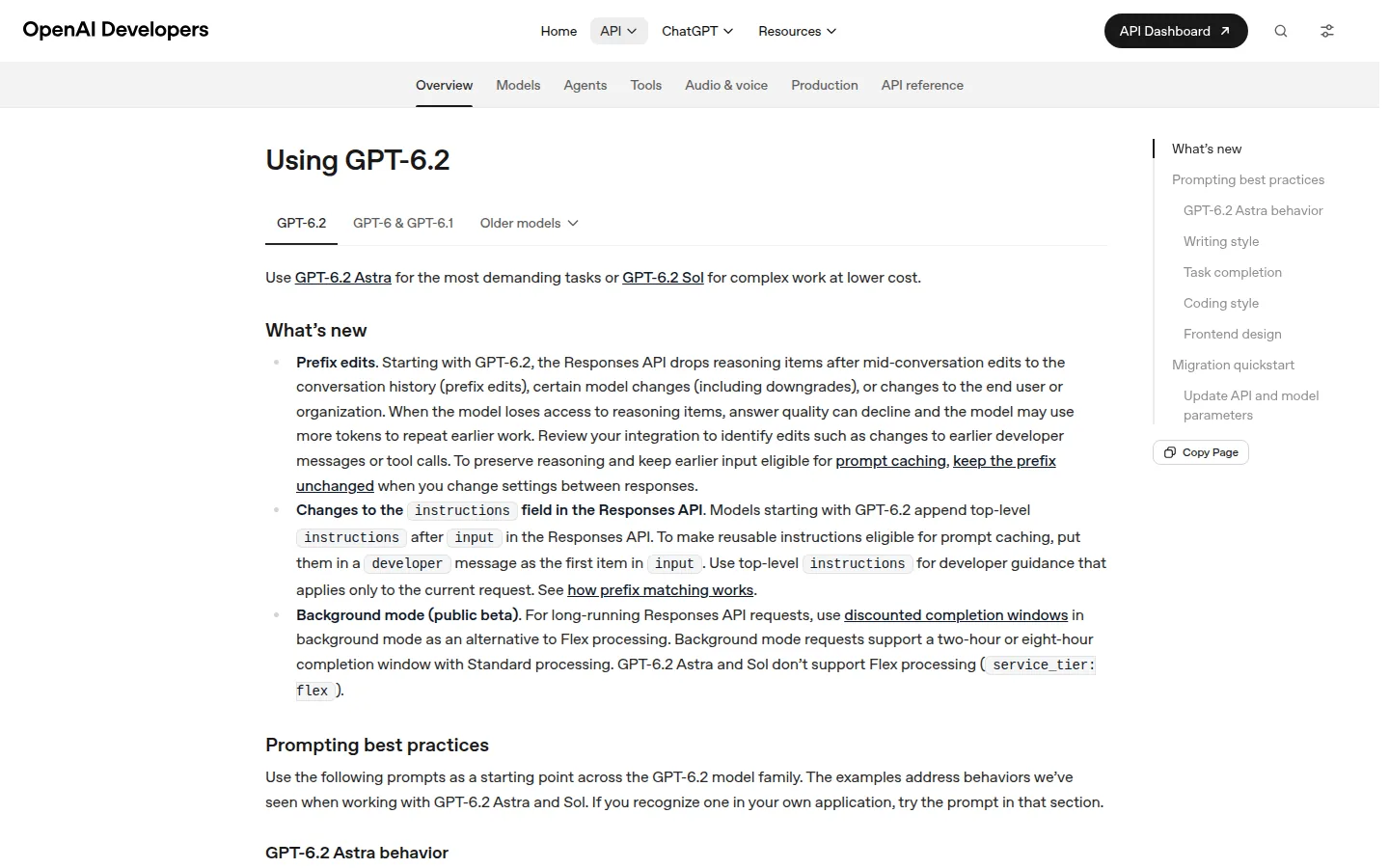
The first item is prefix edits. From GPT-6.2 on, the Responses API drops the model’s reasoning items when an earlier part of the conversation is edited, when the model changes in certain ways, or when the end user or organization changes. When the model loses that material, the page says, answer quality can decline and the model may use more tokens to repeat work it had already done.
The second is where instructions live. Models from GPT-6.2 append top-level instructions after input, so reusable developer guidance belongs in a developer message as the first item of input if a team wants it to stay eligible for prompt caching.
Three lines that touch a running application
temperature,top_pandlogprobsare omitted on GPT-6.2 Chat Completions requests, so a wrapper that sets them needs a code change, not a prompt change.- Stable instructions move from the top-level
instructionsfield into the firstdevelopermessage, or they stop being eligible for caching. - Tool calling requires the Responses API. Chat Completions still answers, but without tools.
What the claim rests on
The four behaviors are not measured. The page introduces its examples as “the behaviors we’ve seen when working with GPT-6.2 Astra and Sol” and calls the prompts “a starting point”. There is no task set, no sample answer before and after, no token count, and no evaluation next to the advice.
So the statement that Astra is more direct by default is an observation, not a result. A team that deletes a “be concise” line is trusting the judgment of the vendor that also sells the tokens. That is not a reason to doubt it: fewer output tokens is the desirable direction for both sides. It is a reason to test it, because nothing on the page shows the line doing harm.
When migrating, revisit instructions like “be concise” in your system prompt.
What can be checked is the rest of the page. The parameter changes are explicit, they are repeated in the migration notes, and OpenAI’s changelog dates the two models to November 17, 2026.
What the page does not publish
No date or revision history on the guide itself, no measurement of the four behaviors it describes, and no example of an application that got worse after the switch. A team auditing its prompts cannot tell from the page what changed after November 17.
On this page
What it changes for teams building on the API
Three costs, in the order they appear on a migration.
The first is the parameter list. Any request builder that sets temperature or top_p has to drop them for GPT-6.2. On a codebase where those values were tuned by trial, the tuning pass is now dead weight, and the harness that produced it needs to be told before it starts writing settings that are no longer read.
The second is the cache. The instructions change is the one that reaches an invoice: with stable text pinned in a developer message at the start of input, the repeated prefix stays cacheable; the moment the prefix moves, the discount moves with it. On OpenAI’s rate card, read on November 21, 2026, cached input on Astra is $0.40 per million tokens against $8 standard, so cached input on Astra costs a twentieth of the standard rate.
| Model | Input | Cached input | Output |
|---|---|---|---|
| gpt-6.2-astra | $8.00 | $0.40 | $40.00 |
| gpt-6.2-sol | $2.00 | $0.10 | $10.00 |
| gpt-6-astra | $10.00 | $1.00 | $50.00 |
| gpt-6.1-sol | $2.00 | $0.10 | $10.00 |
Standard rates in dollars per million tokens, read on OpenAI’s pricing page on November 21, 2026. The cached input rate is the one a migration can quietly lose.
The third is earlier turns. An application that rewrites its own history, or swaps a model mid-conversation, now loses reasoning items without an error. The failure is quiet: answers get thinner and the bill goes up. That is a tracing problem more than a prompting problem, and it is where the first hour of a migration belongs.
The Neural Minute take
The line worth keeping from this page is not the one about brevity. It is the caching rule, because it is the only instruction that changes a number on an invoice rather than the tone of an answer.
Our reading is that “be concise” was never a capability, it was a correction for a model that padded. Astra is built to be short, so the correction now subtracts. The page says revisit; most teams will read delete. That gap is where a careful team tests instead of rewriting: one prompt, two settings, the same ten tasks, and the length and detail written down before anything ships.
What we would push back on is the documentation. The guide has no date, no changelog entry of its own, and no note on what changed since launch. For anyone keeping an audit trail of prompts, that is a weak reference, and it is worth saving the version you built against, the same way you would save a rate card read on a given day. We did that here, on November 21, 2026.
For context, GPT-6.2 arrives three weeks after OpenAI’s GPT-6.1 Terra launch, which was priced at $1 per million input tokens, and the guide’s migration list assumes a team either runs on the Responses API or is moving to it, since tool calling now requires it. If you work from our ChatGPT review, the section to reread before a migration is the API one, not the chat interface.
Sources
- Using GPT-6.2, OpenAI API documentation, page read on November 21, 2026: https://developers.openai.com/api/docs/guides/latest-model
- The same page, What’s new and Migration quickstart, for the prefix-edit behavior and the parameter list: https://developers.openai.com/api/docs/guides/latest-model#whats-new
- Standard rates read on OpenAI’s pricing page on November 21, 2026: Astra at $8 input, $0.40 cached input and $40 output; Sol at $2, $0.10 and $10, per million tokens: https://developers.openai.com/api/docs/pricing
- OpenAI API changelog, which dates GPT-6.2 Astra and Sol to November 17, 2026: https://developers.openai.com/api/docs/changelog