What each one charges
| Plan | Price | Where the figure comes from |
|---|---|---|
| Claude Free | $0 | Anthropic pricing page, 19 November 2026 |
| Claude Pro | $17 a month billed annually, $20 monthly | Anthropic pricing page, 19 November 2026 |
| Claude Max | $100 a month | Anthropic pricing page, 19 November 2026 |
| Claude Ultra | $200 a month | Anthropic pricing page, 19 November 2026 |
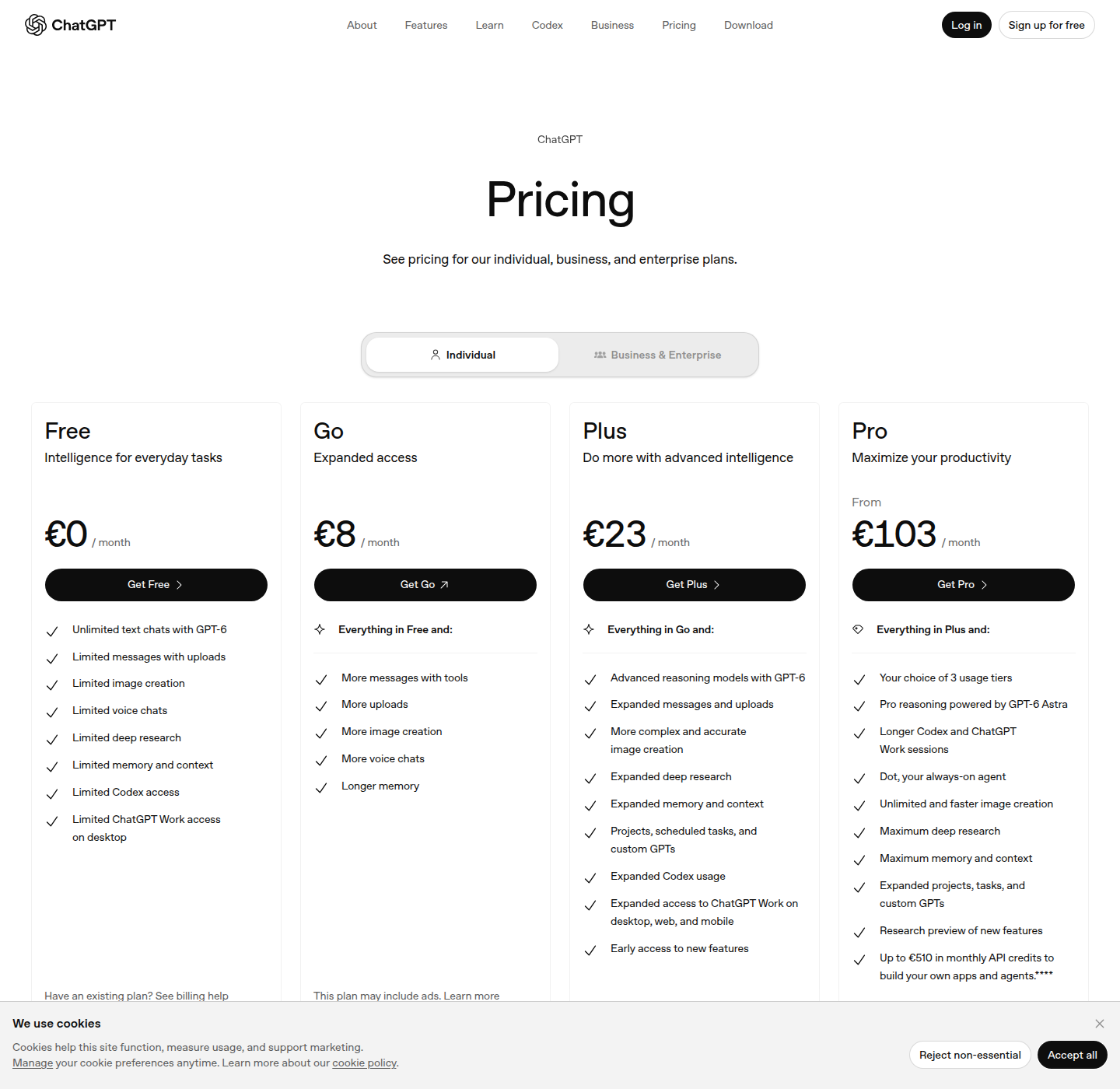
| ChatGPT Free | 0 € | OpenAI pricing page, European pricing, 19 November 2026 |
| ChatGPT Go | 8 € a month | OpenAI pricing page, European pricing, 19 November 2026 |
| ChatGPT Plus | 23 € a month | OpenAI pricing page, European pricing, 19 November 2026 |
| ChatGPT Pro | from 103 € a month | OpenAI pricing page, European pricing, 19 November 2026 |
Anthropic quotes in dollars and excludes tax. OpenAI quoted in euros on this page and sets the amount by country, so a reader elsewhere sees different figures for the same plan. Compare the checkout, not the headline, and never mix the two currencies in one budget.

Where Claude wins
Long context is the first one. Anthropic’s own comparison lists a context window of up to one million tokens on every paid tier, which is the difference between feeding a contract and feeding the summary of a contract. In practice you notice it when a question depends on page 60 of a PDF.
The second is writing that survives an edit. Claude’s default register is flatter and less list-shaped than ChatGPT’s, which matters if the output goes to a client rather than into your own notes. The third is Claude Code, which the vendor’s table includes from the Pro tier upward: a terminal agent that reads your repository and proposes diffs, rather than a chat window you paste files into.
The trade-off is breadth. Claude does not sell an image generator, and its consumer app is narrower than ChatGPT’s on third-party integrations.
Where ChatGPT wins
Variety. The same subscription covers text, image generation, voice, file analysis and a large catalogue of connected apps, which is why a team that does ten different small jobs tends to standardise on it. When one person has to produce a slide, a caption and a reply to a customer in the same hour, switching tools costs more than the subscription.
Distribution is the second advantage. ChatGPT is the default assistant on many phones and in many offices, so the training cost of adopting it is close to zero. Claude asks your team to change a habit; that is a real cost and it belongs in the decision.
A one-afternoon test
Take three tasks from last week, not three invented ones. A document you had to summarise, a piece of code you had to change, and a message you had to write. Run each one in both tools with the same prompt and the same source file. Score them on three things only: did you have to re-explain the context, did you have to rewrite the output, and did the tool stop halfway.
Whichever tool needs fewer corrections on your own material is the one to pay for. If the answer is different for two of the three tasks, keep the cheaper plan on the one you use for writing and put the other on a monthly plan you can cancel after the project.
Frequently asked questions
**Is Claude better than ChatGPT for coding?** For reading an existing repository and proposing changes, Claude Code is the more direct tool because it runs in your terminal. For generating a small script from a description, both are adequate and the difference comes from your prompt, not the model.
**Can I use both?** Yes, and many people do: one paid tier for daily work and the free tier of the other for occasional checks. Paying for two entry tiers costs roughly the price of one mid-range tier, so only do it if the second tool earns its place in the test above.
**What about the free tiers?** Both are usable for evaluation and neither is a substitute for a paid tier on long work, because the limits arrive in the middle of the task. Use them to run the test, then pay for the winner.