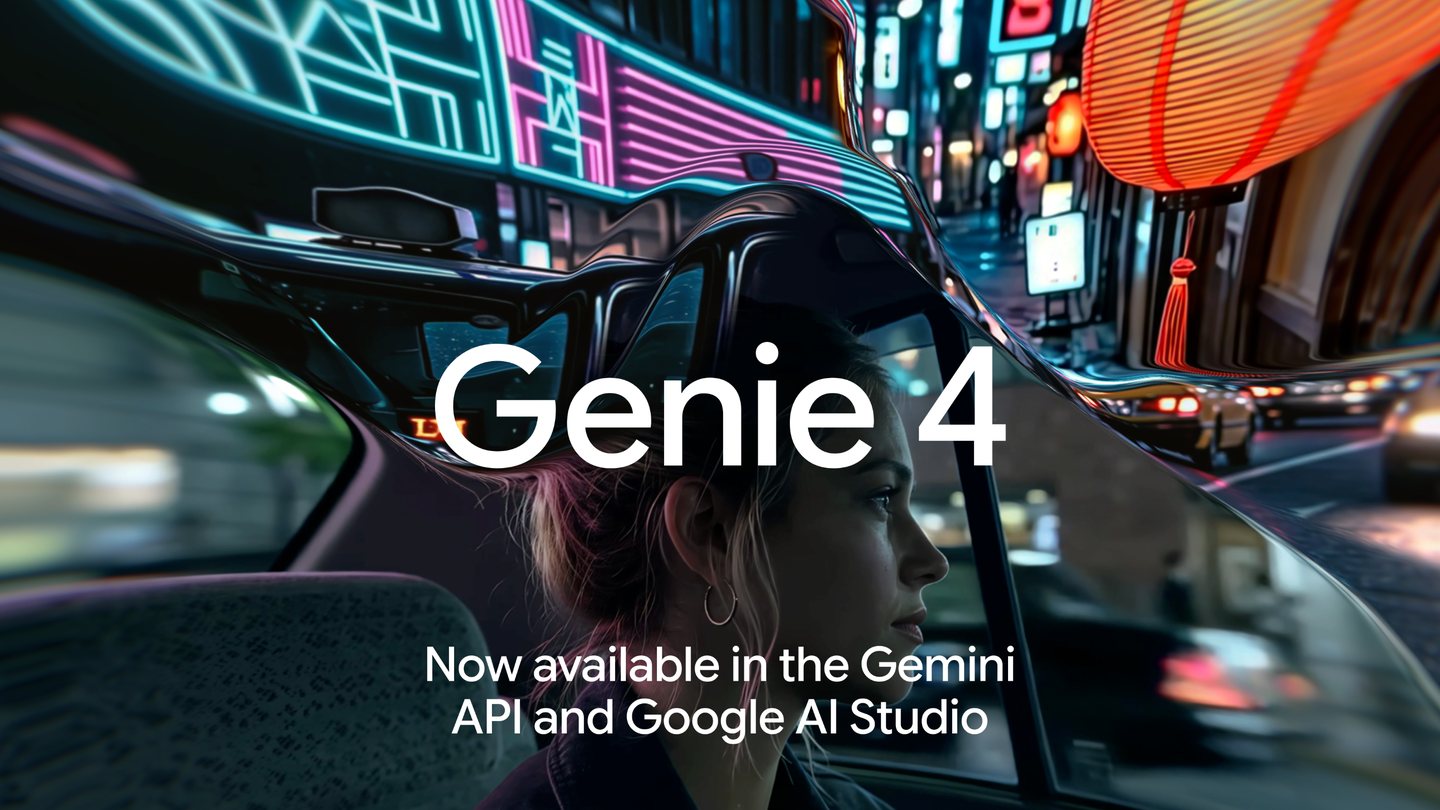
Google opened Genie 4 to developers on November 19, 2026, a day after it reached Google AI Ultra subscribers in Project Genie. The developer path runs through the Interactions API and Google AI Studio under the model ID models/genie-4. It is not free, it is not global, and it ends after two minutes.
Genie 4 is a world model, not a video model: you start a session, move through a scene with the keyboard, and change it with a sentence while it runs.
What was actually released
A session is seeded with a text prompt, a single 16:9 image, or both. It streams frames and reacts to two inputs: movement from WASD or the arrow keys, and text sent mid-stream to change weather, lighting, an object or an event. Audio arrives with the image, from ambient sound to dialogue, and Gemini reasoning sits in the loop between planning steps, Google says.
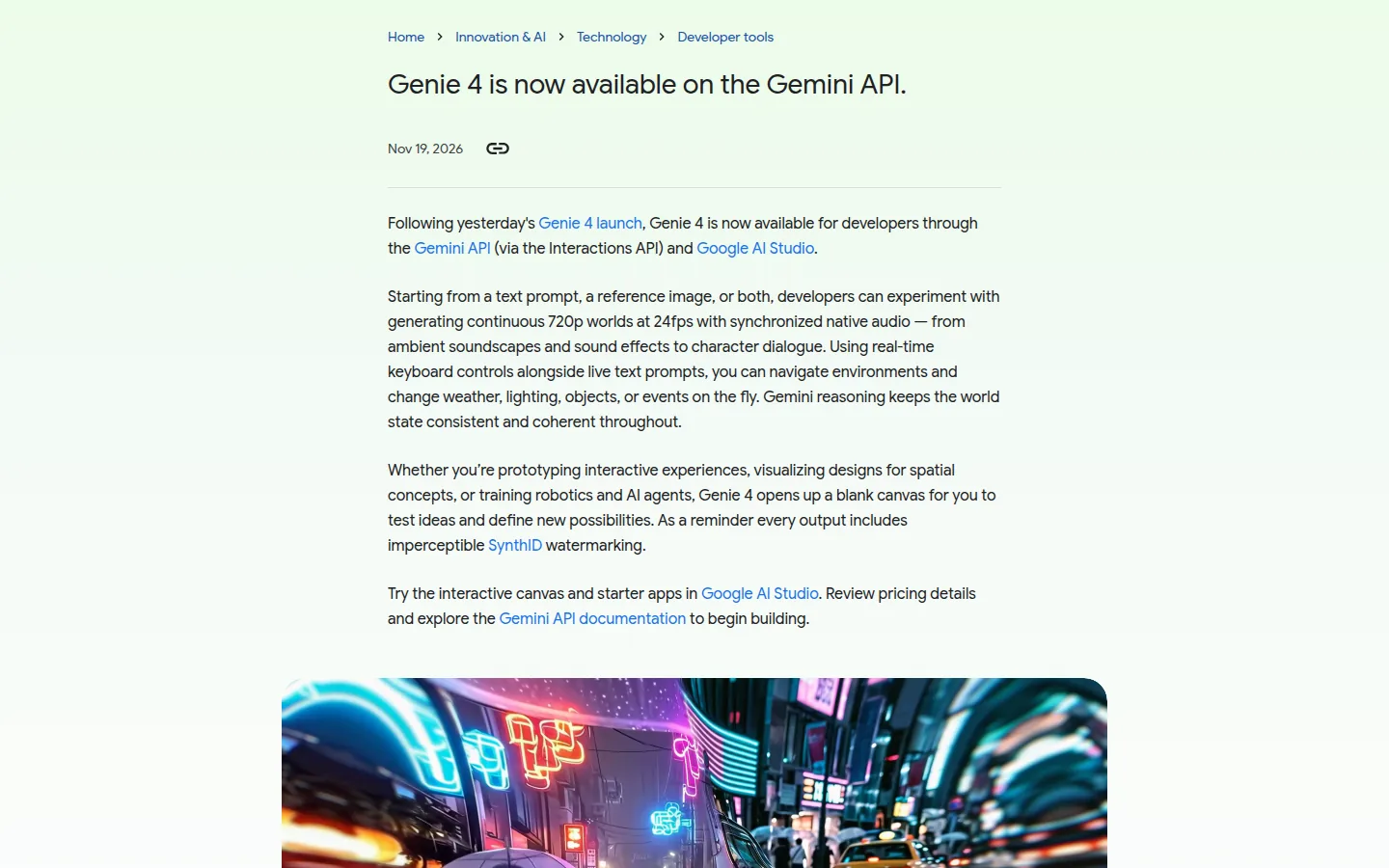
Google documents the whole lifecycle, from minting a single-session token that keeps the long-lived key out of the browser to closing the interaction. Named uses are prototyping interactive experiences, visualizing spatial designs, and training robots and agents. Every output carries SynthID.
| What Google publishes | Figure |
|---|---|
| Output | 1280×720, 16:9, 24 fps, 48 kHz stereo audio |
| Billing unit | 240 video output tokens per frame, 5,760 per second |
| Effective price | About $0.10 per second, about $6.05 per minute |
| Session length | Stability degrades past 60 to 90 seconds, hard cap 120 |
| Serving region | US data centers only, no EU or APAC endpoint |
| Control latency | 0.2 to 0.5 seconds per key press, 1 to 2 for text |
What a session costs before you write code
- Input is $1.50 per million tokens for text or a reference image, text output $9.00, video output $17.50 with audio folded in.
- No free tier, no Batch API, no Flex inference and no Priority inference for this model.
- At the hard cap of 120 seconds, one session bills about $12.10, and the meter runs server-side.
What the claim rests on
The announcement claims continuous worlds and coherence maintained by Gemini reasoning. The reference documentation published alongside it qualifies both, which makes the pair more useful than either page alone.
Genie 4 simulates frames over a rolling temporal window rather than maintaining a persistent 3D scene graph.
That sentence is the product. Looking away from an object for eight seconds or more, or turning a full 360 degrees, can shift landmarks, doors and buttons, and visual stability degrades past 60 to 90 seconds before the 120 second stop. Readable text deforms over time and object counts drift across camera pans. There is no world to return to: every session restarts from a prompt or a still image, and resumption across completed interactions is not supported.
The audio claim is real but narrow: stereo at 48 kHz is bundled into the video token rate rather than sold separately, and Google still lists audio accuracy as ongoing research.
What is missing is a measurement. Neither the November 19 post nor the model card published on November 18 puts a number against Genie 3: the card calls the gain significant on photorealism, movement and steering, in words. Nothing in either page comes from a run outside Google, and we have not run a session, because the model needs a paid key and serves from the United States only. Every figure here is a Google setting, not our measurement.
What Google does not publish
No benchmark score against Genie 3, no technical report attached to either post, no date for an endpoint outside the United States, none for portrait output or a configurable frame rate, no session resumption on the roadmap, and no price ceiling per session.
On this page
What it changes for developers building on the Gemini API
Three things decide whether Genie 4 is usable this quarter.
The first is the billing shape. This model is metered by the second, and closing a browser tab detaches the transport without stopping server-side generation. A client that loses its socket keeps paying. The fix is a complete() or a cancel() on every exit path, error ones included, and a visible timer for the user. For a kiosk left open overnight, that is the difference between a $12 experiment and a $12,000 month.
The second is geography. Frames are served from US data centers only, and Google warns that round-trip latency above 150 ms makes keyboard steering feel delayed. A European or Asian product is a latency problem before it is a design problem.
The third is the box. Genie 4 accepts text, one 16:9 image and keyboard or camera events. It does not take live microphone or webcam input, does not do function calling, does not do Search grounding, does not return structured outputs and cannot resume an interaction. A team that wants tools on top is building that layer itself.
The comparison inside Google’s own catalog is the useful one. A fixed 720p clip from Gemini Omni 1.2 Flash bills at about $0.07 per second, roughly $0.70 for a ten second clip. Genie 4 at $0.10 is about 45 percent more per second than a fixed clip, and in exchange the output answers to a keyboard. Whether the premium is worth it depends on whether the interaction is the product.
The Neural Minute take
The most valuable document here is not the announcement but the reference page, which contradicts it on the one word that matters. A continuous world that stops at 120 seconds and moves its landmarks when you turn around is not a place to host anything. It is a simulator rented by the second, priced accordingly.
If a feature needs a place a user returns to, with its own state, Genie 4 cannot hold it today. If a feature is a one minute demo or a short robot training episode, $6.05 a minute is a legible cost that undercuts building an equivalent simulator, and it comes with a documented input protocol instead of a promise.
The asymmetry worth flagging: this launch is precise in its small print and vague in its headline. Price per second, no free tier, US only, no tool calling, no resumption. Those are the lines a budget is built from, and all of them are published. What is not published is any evidence that the worlds hold up when someone other than Google drives them, and we have not driven one.
What would change the verdict is a persistent session, an endpoint outside the United States, and one measured comparison against Genie 3 with a method attached. Until then: budget by the second, close every session explicitly, and treat the two minute cap as the shape of the product.
Sources
- Google, “Genie 4 is now available on the Gemini API.”, November 19, 2026, for availability, seed options and named uses: https://blog.google/innovation-and-ai/technology/developers-tools/genie-4-in-gemini-api/
- Google, “Genie 4 is now available”, November 18, 2026, for the subscriber rollout and the Genie 3 changes: https://blog.google/innovation-and-ai/models-and-research/google-deepmind/genie-4-now-available-project-genie/
- Google, Gemini API reference, “Interactive world generation with Genie 4”, linked from the announcement and read on November 19, 2026, for resolution, frame rate, session cap, serving region and the rolling window limitation.
- Google, Gemini Developer API pricing, Genie 4 section, same date, for the input and output rates.
- Our own reading, November 19, 2026: the effective price and the comparison with Gemini Omni 1.2 Flash are computed from those rates, at 240 video tokens per frame and 5,792 per second for 720p clips. We did not run a session. The wider Google stack is in our Gemini review.