OpenAI published the announcement on October 30, 2026, and it carries two things: a recurring Community Safety Report, and further limits on what ChatGPT tells minors about weapons. The report is a promise with a date, not a document you can read today, and the teen limits are narrower than the headline suggests.
What was actually released
The first item is a commitment to publish. OpenAI says the report will explain how its models are trained to detect, investigate and respond to community safety issues, with anonymized examples, new mitigations, policy changes and data. The first edition is slated for early 2027 and covers the second half of 2026, with updates every six months after that.
The second item tightens policy for every user. ChatGPT will give less detailed answers about past mass attacks and their perpetrators, even when that information is available elsewhere, and will restrict reconstructions of those attacks, including details about the weapons and equipment used and how they were obtained, plus comparisons on scale of harm that could amplify an attacker’s notoriety. This applies regardless of age or stated reason.
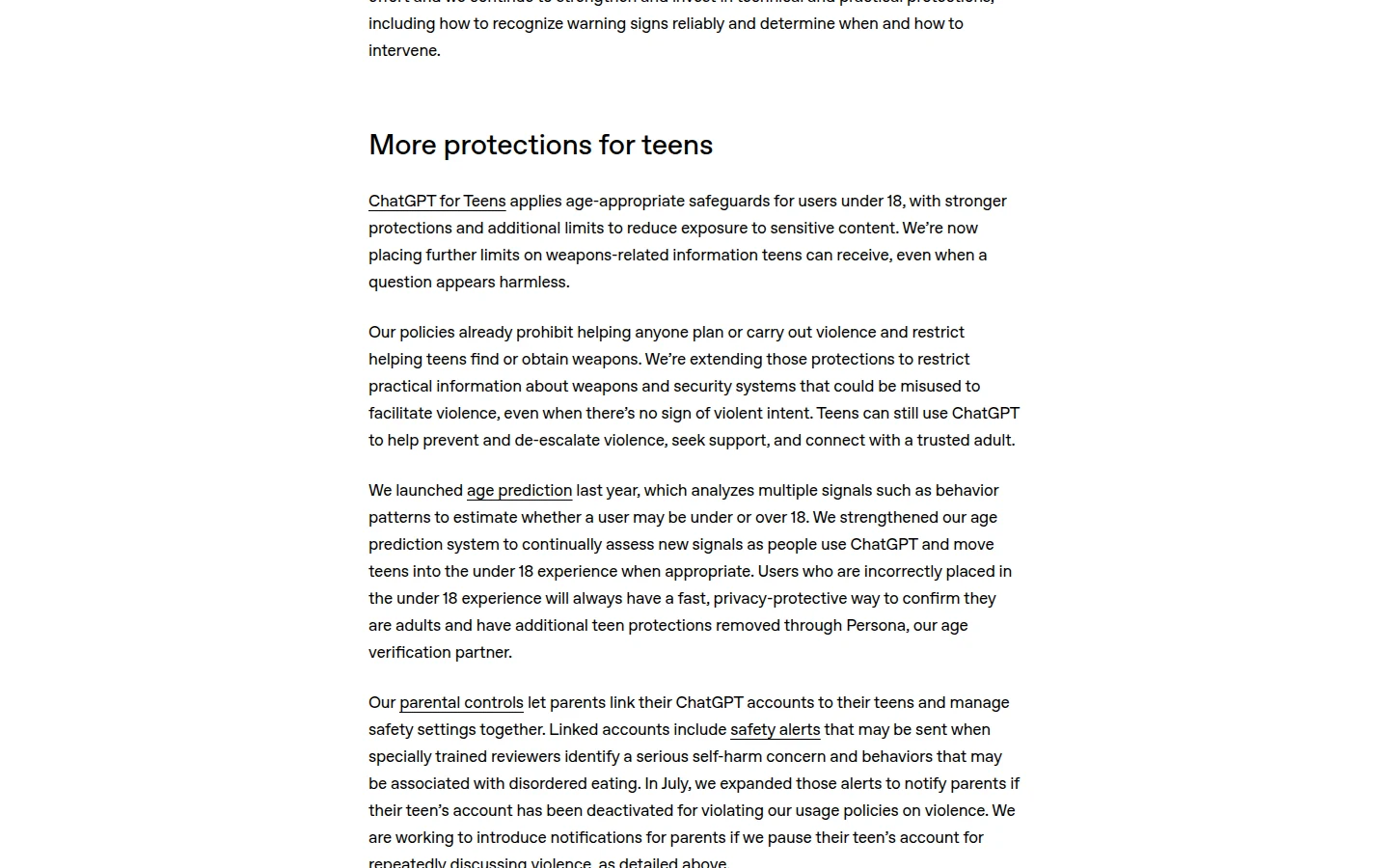
The third item concerns accounts ChatGPT believes belong to someone under 18. Teen accounts already could not get help finding or obtaining weapons; the restriction now extends to practical information about weapons and security systems that could be misused, even when there is no sign of intent and the question looks harmless. Teens keep access for prevention, de-escalation, and reaching a trusted adult.
The fourth item changes the shape of a conversation rather than a rule. Building on the warning-sign summaries introduced in May, ChatGPT will answer more conservatively when recent chats suggest possible violence, and more tightly still when it predicts a user is under 18. When a conversation shows fixation on violence, the model will be able to end the chat on its own, and repeated endings may lead to a temporary account pause.
| Change | Who it applies to | Status in the post |
|---|---|---|
| Less detail on past attacks, no weapon reconstruction | All users, any age, any reason | Stated as policy |
| Limits on weapon and security-system detail | Accounts predicted or confirmed under 18 | Next few weeks |
| Chat fixating on violence ends itself | All users | Being built |
| Community Safety Report | Public | Early 2027, for the second half of 2026 |
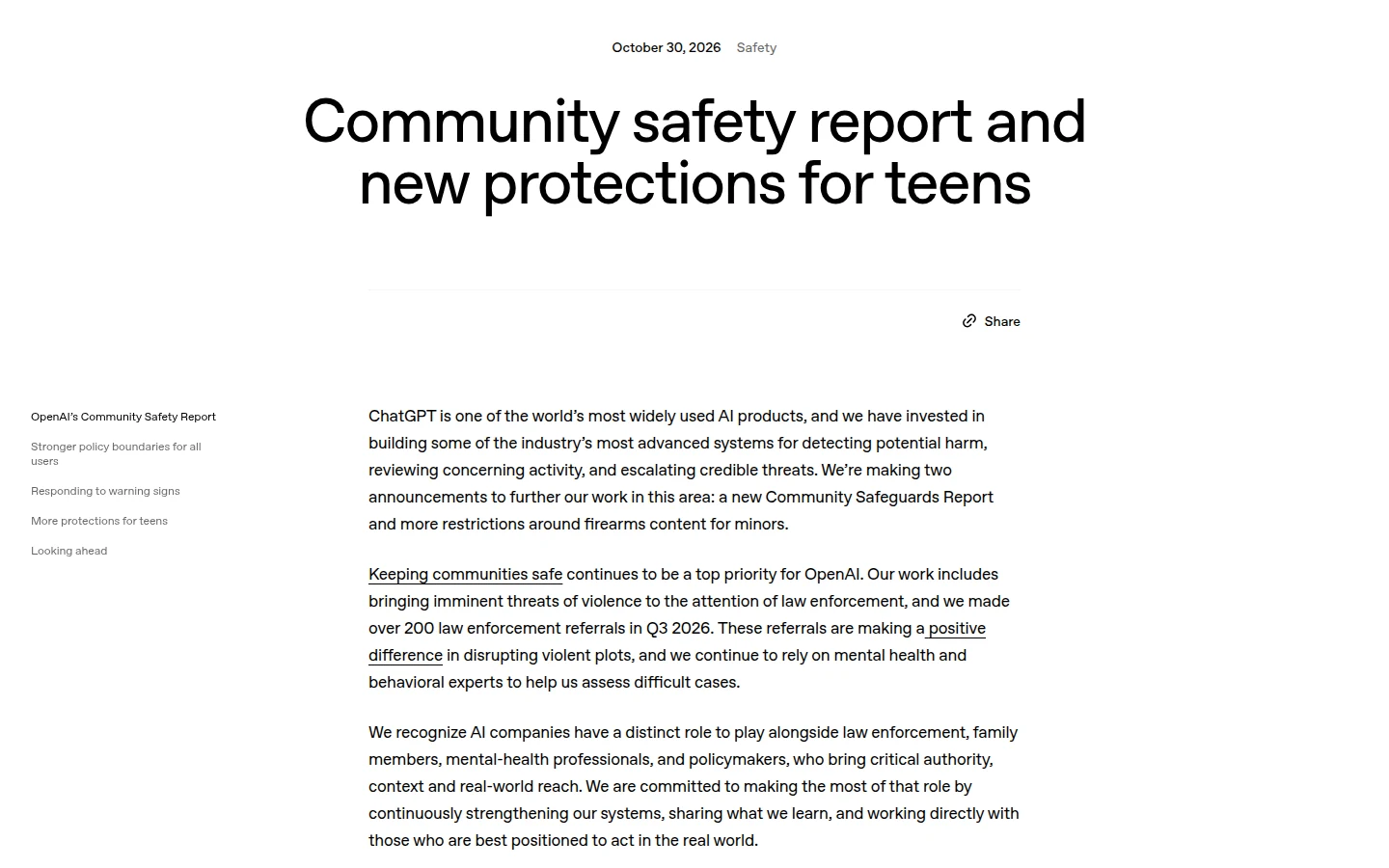
One number appears in the post, and it is an activity count rather than a result: OpenAI says it made over 200 law enforcement referrals in the third quarter of 2026.
What the claim rests on
The referral count measures how often OpenAI contacted law enforcement, not what happened next. There is no denominator, no count of the conversations reviewed, and no follow-up on whether any led to an investigation.
The report is deferred by design. Its first edition covers a period ending December 31, 2026 and appears in 2027, and the post names no methodology, no outside reviewer and no list of data fields. Until then, the claim that the safeguards work rests on OpenAI’s own description of them.
The same gap runs through the teen limits. The post does not publish the text of the policy it changed, a count of how often the restriction triggers, or how often it stops a legitimate question. It says age prediction was strengthened and gives no error rate, the number a household would want, since a false positive moves a young adult into the teen experience and a false negative leaves a teenager outside it.
What the post does not publish
No count of chats ended by the violence check, no false-positive rate for age prediction, no number of accounts paused, no text of the policy change, no named auditor for the report, and no route for contesting a pause. The only correction path is for adults wrongly placed in the teen experience, who can confirm their age through Persona.
What actually binds here
Two things are checkable. The rollout has a window, the next few weeks, and the report has a date, early 2027. The rest is a description of intent.
On this page
What it changes for parents of teen accounts
The teen experience is now harder to avoid and harder to read from outside. Age prediction reassesses signals as an account is used, so a teenager can land in the under-18 experience without anyone changing a setting, and an adult can be placed there by mistake, with a Persona age check as the correction.
The parental controls are the part a household can act on now. Linked accounts receive alerts when reviewers identify a serious self-harm concern or behavior associated with disordered eating, and since July those alerts also fire when a teen account is deactivated for violating the violence policy. Notifications for repeated pauses are still being worked on, so the useful step is linking the account before an incident rather than after one.
The auto-end behavior is the change most likely to be misread at home. A chat that stops mid conversation looks like a bug, and a pause after several of them looks like an outage; the post describes neither from the user’s side, so a parent who knows the mechanism can tell the difference and a teenager will assume the product broke.
The Neural Minute take
The sentence worth keeping is not the one about teens. It is the one that lets the model end a conversation by itself, because it changes the unit the safety system acts on: a filter acts on a message, an automatic ending acts on a session, and a session is what an application is built around.
That matters to anyone building on ChatGPT rather than chatting with it. If a workflow assumes a conversation runs to completion, a long intake, a recorded interview, a dialogue collecting a dozen fields, then a session that can be terminated mid-way is a failure mode to design for, and retry logic does not handle it cleanly: the account itself can be paused. Keep the sensitive stretch out of the consumer product, or save state at every turn.
For a household paying for a seat, the reading is different. Nothing here touches price, plan or limit, so the decision it informs is not which assistant is cheaper but which gives a parent a lever: linked accounts, alerts, and a documented way to correct an age guess.
We’re now placing further limits on weapons-related information teens can receive, even when a question appears harmless.
Our reservation is about the accounting. OpenAI has now committed twice in a month to safety work whose substance arrives later, the research deal with Poland’s NASK institute we covered in October and this report due in 2027, and both are more precise about the schedule than the result. A published date is the one promise a reader can hold a company to, and it is not evidence: file it as a claim about process.
What we would watch: whether the first edition publishes counts with denominators instead of anonymized examples, whether the teen restriction is measured against benign security questions, and whether a paused account gets a stated route to contest it. Until then, the most concrete effect is a chat window that can close on its own.
Sources
- Community safety report and new protections for teens, openai.com, published October 30, 2026: https://openai.com/index/community-safety-report-and-new-protections-for-teens/
- The referral figure, the report date, the six-month cadence and the rollout window are read on that page
- Related coverage on this site: OpenAI and Poland’s AI safety institute sign research deal