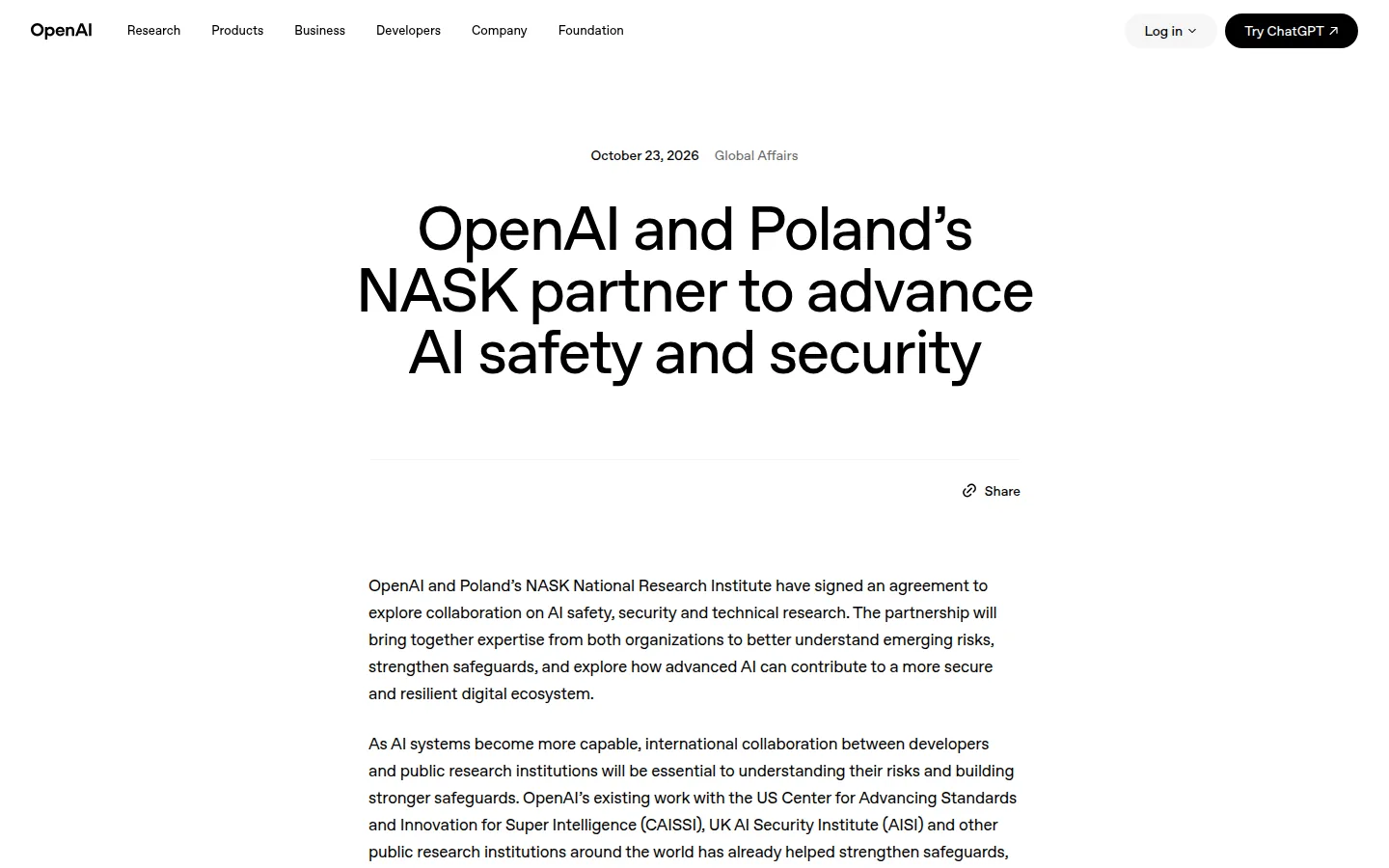
OpenAI and Poland’s NASK National Research Institute signed an agreement on October 23, 2026 to explore joint work on AI safety, security and technical research. The post names no budget, no duration and no deliverable. On the research side, the counterpart is NASK’s AI Safety Research Center, which serves as the Polish Artificial Intelligence Safety Institute.
What was actually released
Nothing ships. This is a research agreement between a frontier lab and a publicly funded institute, published as a single post filed under Global Affairs rather than under Research or Product.
The stated scope covers three activities: evaluating increasingly capable AI systems, identifying potential vulnerabilities, and strengthening safeguards. OpenAI frames the deal as an extension of work it already does with the US Center for Advancing Standards and Innovation for Super Intelligence (CAISSI) and the UK AI Security Institute. Both quotes in the post come from the two sides of the table, with no outside voice.
What the agreement actually covers
- Research collaboration between OpenAI and NASK’s AI Safety Research Center, not a product, a license or a commercial partnership.
- Three named activities: evaluating capable systems, finding vulnerabilities, strengthening safeguards.
- A stated link to OpenAI’s push for the US to work with other countries on technical standards for frontier AI.
The one concrete case in the post predates the agreement. In July, CERT Polska, a unit that operates inside NASK, gained access to OpenAI’s cyber-capable models through Daybreak. The team used those models to help find six vulnerabilities in MikroTik RouterOS, including flaws that could be combined to take control of affected devices without authentication. The vendor released fixes, and CERT Polska confirmed they prevented the attacks it had observed. That is the strongest evidence on the page, and it describes access granted three months before the signature, not a consequence of it.
What the claim rests on
Almost nothing in the post is a measurement. It is a statement of intent, signed by two organizations, and the vocabulary is careful: explore collaboration, better understand emerging risks, help strengthen safeguards. No number is attached to any of it.
The declared threat model is also generic. The post says international collaboration will be essential as systems become more capable, then lists what common approaches would allow: comparing evidence, assessing risks, testing safeguards, reporting incidents. Those are the goals of a standards process, not the output of one.
One sentence carries the argument, and it is about national context rather than about safety results: without national partners like NASK, global AI safety standards may remain detached from the realities in which AI is actually used. That is a claim about legitimacy, and it is defensible. It is not a claim about what the collaboration will find.
| Item | What the post says | What it leaves open |
|---|---|---|
| Budget | Nothing | Amount, term, which side pays |
| Staffing | Expertise from both organizations | Headcount, named researchers, dedicated team |
| Work plan | Evaluate, identify, strengthen | Workstreams, milestones, dates |
| Model access | July Daybreak access for CERT Polska | Whether the safety center gets comparable access |
| Output | Nothing named | Any evaluation, benchmark or report to be published |
What is not published
No amount, no term and no headcount. No work plan with dates. No commitment to publish findings, and no description of what access the safety center itself will get to OpenAI’s frontier models. The post also does not say whether the July Daybreak arrangement is extended, renewed or left as it was. Those are the four questions an outsider would ask first, and the page answers none of them.
So the agreement is a framework with no budget, no term and no named deliverable, and the only quantified item on the page is six RouterOS flaws found in July, before the agreement existed.
On this page
What it changes for AI teams in Europe
For anyone buying AI tools, this changes no price, no limit and no condition. None of OpenAI’s published plans is affected, and the agreement grants nothing to customers.
What it does change is where privileged testing sits. A cyber-capable model that finds real vulnerabilities in routers is not the model a company reaches through a standard API account. It reaches vetted defenders through a program like Daybreak, and the institutions that can test frontier systems in Europe are national ones: here a research institute that doubles as the country’s AI safety institute. If your team works on security in the EU, the practical route to that class of access runs through an institute, not through a procurement form.
That is the same structure we described when Anthropic gave six outside evaluators employee-like access to its systems: the useful capability is handed to a small set of testers first, and the rest of the market reads the write-up afterward, if there is one.
AI safety cannot be achieved in isolation.
That line comes from Radoslaw Nielek, director of NASK. It is also the best summary of what this agreement is: a claim that testing needs public partners, with the evidence of the testing still to come.
The Neural Minute take
Three public counterparts in one year, the US CAISSI, the UK AI Security Institute and now the Polish institute, is a pattern rather than a one-off. OpenAI is building a network of state-linked testers who see systems that customers do not, and it is doing so through bilateral agreements that are announced in a paragraph and published nowhere else.
For a buyer, that cuts both ways. Independent testing is the only signal that does not come from the vendor, so more of it is good. But an agreement is not a test. Until one of these institutes publishes an evaluation with a method, a date and a result, the arrangement is access, not proof, and it should not be read as a safety endorsement of any model.
The lesson worth keeping is narrower and more useful: the July work is what a real result looks like. Six vulnerabilities in a widely deployed router operating system, fixed by the vendor, confirmed by the team that found them. That took an institute with a mandate, engineers who knew the product, and access to a model built for the job. If the new agreement produces more of that, it will matter. If it produces a photo opportunity and a quote, the market will not be able to tell the difference for another year.
Our advice is to treat the announcement as a signal about access policy and nothing else. Ask the same four questions of any vendor that announces a safety partnership: who gets the models, what do they test, when is it published, and who can check it.
Sources
- OpenAI and Poland’s NASK partner to advance AI safety and security, OpenAI, October 23, 2026. The date is stated under the headline, and the page carries both quotes.
- Building standards for the next phase of AI, OpenAI, September 21, 2026. Cited by the announcement as the origin of the call for international technical standards.