
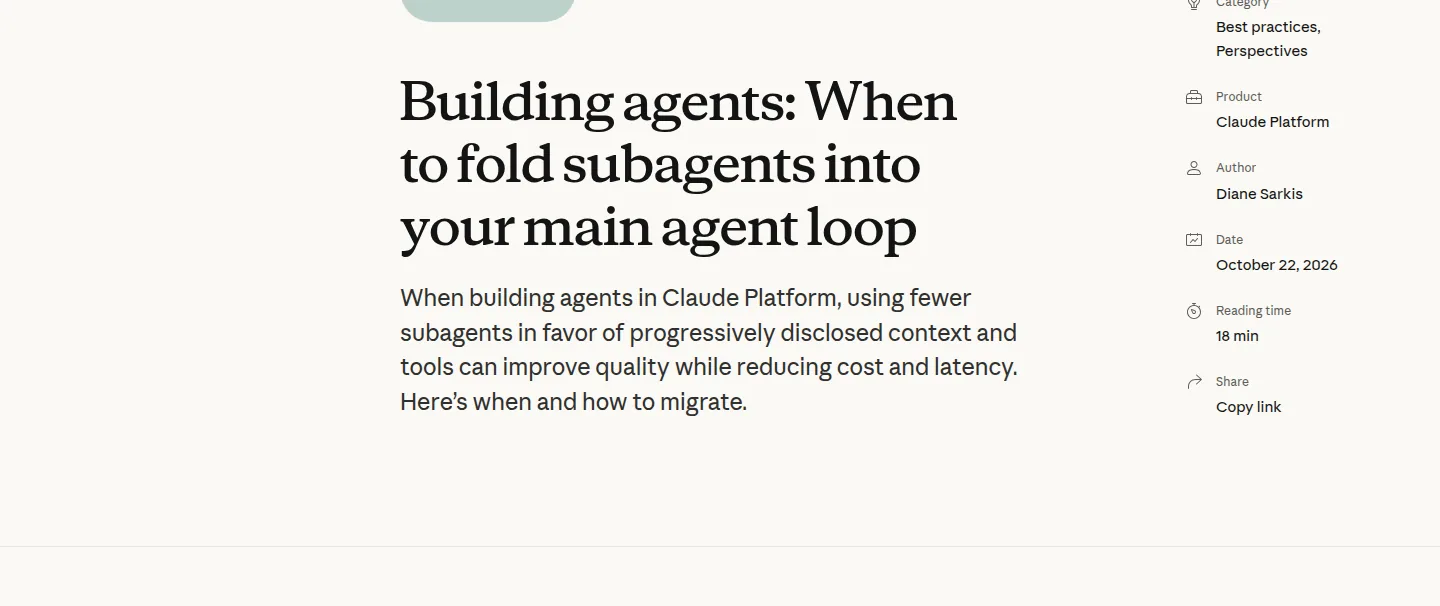
Anthropic published guidance on October 22, 2026 telling teams to test whether their specialist subagents can be folded into one main agent loop. The post comes from its Applied AI team and ships with a migration kit that runs the comparison before anything in production moves.
The recommendation inverts the architecture most enterprise teams built over the past two years: an intent classifier, a fixed pipeline, one subagent per domain, an orchestrator on top. Anthropic argues a single loop, with skills and tools loaded on demand, covers most of those cases more cheaply.
What was actually released
Not a model, and not a feature. A best-practice article by Diane Sarkis, plus a migration kit on the Anthropic GitHub account that chains four Claude API skills into one guided workflow: build-eval for a first eval set, prompt-audit for instructions written for older models, hillclimb to iterate on a skill against an eval, cost-optimize to profile where calls go. A demo runs on a mock system first.
The design it asks teams to move toward is narrow. One model and one context window running an open-ended tool loop, with turn and cost budgets and write gates set in the harness. Each turn, the model emits a batch of tool calls, the harness runs them in parallel and returns raw results to the same model, which decides the next step. It writes its plan on the first turn and revises it as results arrive.
Context stays loaded, moved into three places. Ordering and domain procedure become skills. Hard limits, approval gates and memory lookups become tools. Reference material such as policies and product specs sits in knowledge bases the agent queries through a search tool. The post advises against having code retrieve that context and paste it into prompts.
The trade is stated plainly: fewer context windows and fewer lossy handoffs, in exchange for one long context the agent manages itself.
The post keeps a door open, and this is the most useful part of it. Subagents still make sense in three cases: when a single loop shows measurable performance degradation from context bloat, when tasks genuinely run in parallel with context windows that can be discarded, or when one agent struggles to pick the right tool or receives conflicting instructions.
What the post asks a team to do
- Build an end-to-end eval before touching the architecture, owned by one central team. Ten golden examples are enough to start.
- Fold in one subagent at a time, then compare scores with and without it.
- Keep the subagent only if the folded version scores worse.
- Let the small central team own the system prompt and end-to-end quality, and make each team’s owner maintain its skills.
What the claim rests on
The quality claim, which is the load-bearing one, rests on a phrase. Anthropic says a single agent with skills “frequently outperformed” both the one-prompt-for-everything design and the subagent design across several enterprise deployments, often at lower cost and latency per task. No number accompanies it.
| Claim | What the post publishes | What it does not publish |
|---|---|---|
| Answer quality | “frequently outperformed” both designs across several enterprise deployments | how many deployments, the rubric, the scores, the tasks that flipped |
| Runtime | roughly 2x faster for one customer that compared its multi-agent harness with a single loop | which customer, workload size, run count |
| Prompt size | Claude Code’s system prompt cut by over 80% for more advanced models | the token counts before and after |
| Tool ceiling | tool choice tends to degrade past 30 to 50 tool definitions | where those two limits come from |
The only latency figure with a source is one customer’s own comparison, roughly 2x, and the post does not name it.
The post also publishes its own failure. When Anthropic tested folding on a sample support agent, latency fell, but the main agent started answering on its own instead of asking the shipping specialist for the delivery date, breaking a process that had been passing. The break showed up in one run out of two, which is why the post says to run each eval task twice.
What is not published
No eval set, no per-task cost figure, no comparison per model version, and no third-party replication. “Often at a lower cost and latency per task” is directional, not measured. The post names the models involved by generation (from Opus 4.5 onward) but does not say which one ran in the deployments it describes, so a team cannot check whether the result holds on the model it actually rents.
As models evolve, our understanding of how to best use them and guidance around best practice evolve as well. That makes any one architecture less important than the principle behind it: measure, change one thing at a time, and keep what holds up.
On this page
What it changes for teams paying for agents
The bill moves before the architecture does. A multi-agent setup pays twice for the same work: once when a specialist consumes its own context, once when it hands back a summary the next agent has to re-read. Anthropic’s argument is that progressive disclosure removes the reason the split existed, because the agent sees short descriptions of skills and tools and loads the full text only when needed.
For a team already running an orchestrator, the answer is smaller than a rewrite. Call subagents as tools rather than handing over the conversation, which keeps the main agent in front of the user, then fold one at a time, turning its prompt into a skill and its API calls into tools.
Two numbers matter in a vendor conversation. The 30 to 50 tool definition ceiling is where tool choice degrades, so a large catalog of tools is a design decision with a cost. And per-user permissions sit inside the tools, each one checking what the calling user may see and returning a refusal the model can read, rather than an agent per permission level.
The Neural Minute take
Take the guidance seriously, and discount the evidence in the same motion. A vendor arguing that buyers need less structure than they were sold is a rare position, and the three conditions for keeping a subagent are the most concrete thing in the post. But “frequently outperformed” is a claim with no denominator, and the one number behind it is a 2x runtime at a single customer, reported by the seller.
The timing matters more. Eight days before this article, Anthropic’s release notes added dynamic workflows to Claude Managed Agents, a way for one agent to write a program that runs many other agents in phases and combines what they return, which we covered in Anthropic adds dynamic workflows to Claude Managed Agents. Both offers are real: one sells the many-agent path as a flag, the other says most teams do not meet the conditions that justify it.
Read together, they describe a platform hedging, not a reversal: keep the orchestration capability, tell customers the single loop is the default because that is where the cheaper tokens are. The decision for a team is not which post is right, but whether it can produce the eval that would settle the question on its own traffic.
If someone proposes an orchestrator next week, ask for the eval set and the routing accuracy number before the diagram. A proposal without them is structure, and structure is what the vendor’s own engineers just argued against.
Sources
- Anthropic, Building agents: When to fold subagents into your main agent loop, by Diane Sarkis, published October 22, 2026.
- Anthropic, Multiagent orchestration, Claude Platform documentation.