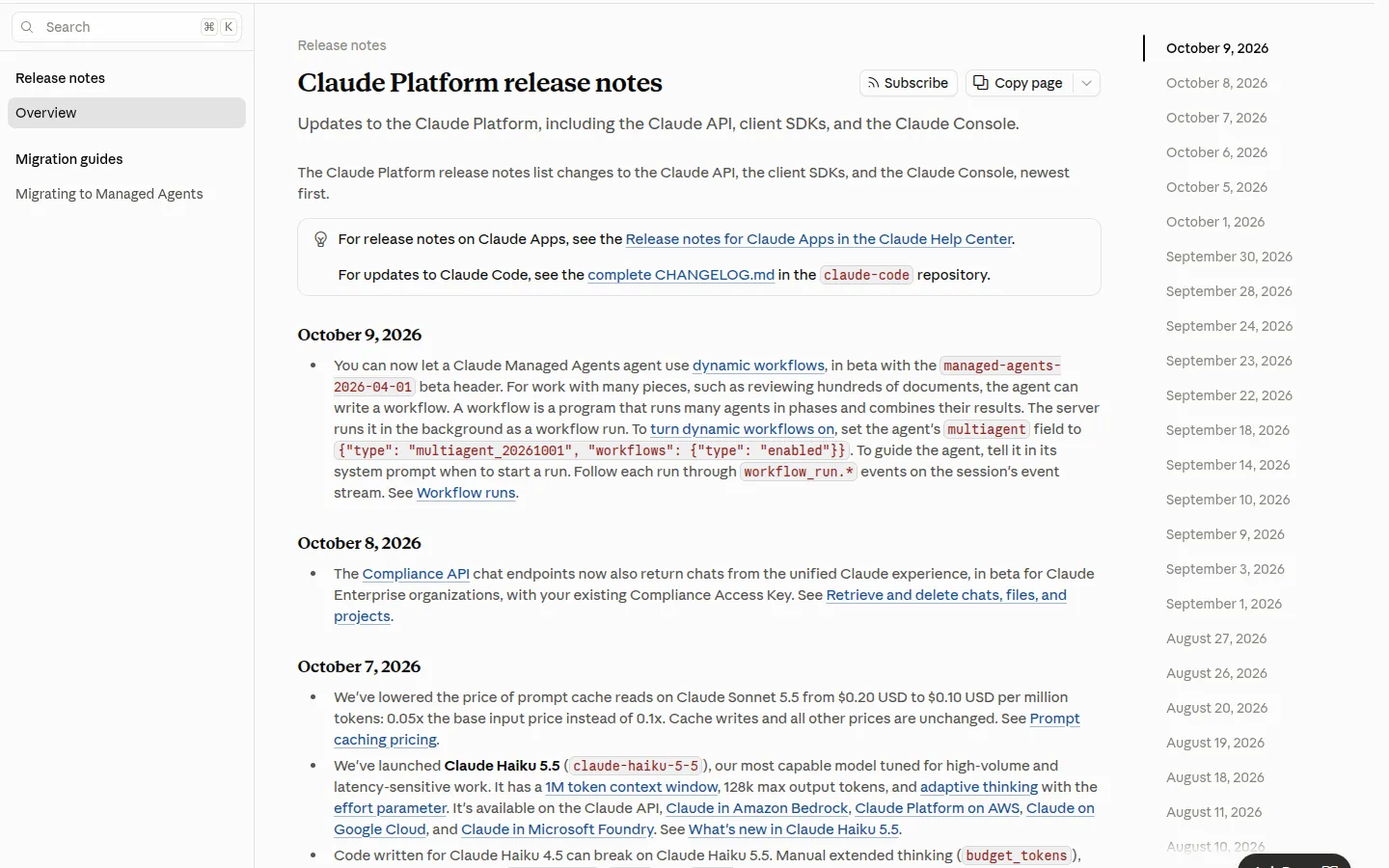
Anthropic added dynamic workflows to Claude Managed Agents in its platform release notes on October 9, 2026. The entry lets an agent write a program that runs many other agents in phases and combines what they return, and it ships in beta behind the managed-agents-2026-04-01 header.
What was actually released
Dynamic workflows are a third way for a managed agent to hand work to other agents. The agent can still delegate to subagents and still consult an advisor model, and it can now also write a workflow: a program that runs agents, collects what each one returns, and combines the results. The server runs that program in the background as a single workflow run.
Turning it on is a configuration change, not a new product. A developer sets the agent’s multiagent field to {"type": "multiagent_20261001", "workflows": {"type": "enabled"}}, and the agent then decides when to start a run, guided by its system prompt. Runs are followed through workflow_run events on the session’s event stream.
What changed, in one line
Before, the agent delegated by message and read each report back. With a workflow, it writes code that passes context and results from one agent to the next, which frees the main session to talk to the user and check in on a running workflow. The entry lists work with many pieces, such as reviewing hundreds of documents, as the case it is built for.
What the platform still gates is the shape of a run. Subagent delegation stays one level deep, and a session can hold at most 25 child threads at once, idle ones included, while threads started by a workflow or an advisor do not count against that number. The advisor stays a mid-turn consultation for the primary thread, billed at the advisor model’s rates.
What the claim rests on
The announcement is a release-notes entry, not a benchmark, so the numbers that carry weight are the limits the editor publishes about a run rather than any measure of what the agents produce.
| Limit the editor publishes | Value | At the limit |
|---|---|---|
| Threads working at once in one run | 64 | the run creates no more until one finishes, and the docs say the number can change |
| Agents a workflow starts over a run’s whole life | 1,000 | the run ends with a thread_limit_error, and retries can push the thread count higher |
| Runs open at once in a session | 10 by default | the server refuses to start another and returns a max_workflow_runs_error |
| Run lifetime | 24 hours by default | the run ends with a timeout_error |
Those four figures come from the seller’s own documentation, not from an independent test. The 64 is explicitly not guaranteed, and the 1,000 counts agents over the whole life of a run, not agents working at the same moment. A headline that says 1,000 agents run in parallel describes the outer ceiling of a run, not its steady state.
A run has no price of its own: the tokens its agents spend are billed like the rest of the session, at each model’s rates, and a session budget is the only published ceiling on the total.
What the entry does not publish
There is no benchmark of a workflow’s output against a single agent, no per-run price, no general availability date, and no figure for what a large workflow costs in practice. The docs say every agent in a run spends tokens and recommend setting a session budget, which is a warning about cost rather than a number for it. The 64-thread figure is described as one the API does not guarantee.
On this page
What it changes for teams buying AI agents
Orchestration stops being a separate product to buy or build and becomes a setting on a managed platform. A team that was weighing an orchestration layer, or paying an engineer to hold one together, is now offered the same capability as a beta flag next to the model it already rents.
The control that decides whether an agent can be left unattended is now a budget. Every open run pauses when the session budget is reached, and the session reports idle with budget_reached, which puts the spend decision with whoever set the budget rather than with whoever started the run.
The ceilings are the part a buyer models. 64 agents working at once, 1,000 over a run’s life, 10 runs a session, 24 hours a run: those four numbers decide whether a job fits inside one run or has to be split, and they are published before the buyer commits.
The same question shows up in our own notes on the agent tools we track. Our read of the Gemini agent Google Cloud launched this week turned on a hard spend cap that pauses a project, a different answer to the same problem of who stops the meter.
The Neural Minute take
None of the 17 tools in our base is Claude Managed Agents, so we hold no verified price of ours against this release. That is worth saying plainly: what a workflow costs sits on the vendor’s side of the table, and our note on it stays empty because Anthropic published no per-run figure to fill it with.
The buying question shifts from which model is cheapest to whether the agent stops on its own, and at what number.
Seen from the low end of the market we do track, where pricing already arrives as a meter, dynamic workflows are the same trade pushed up the stack. The orchestrator a buyer used to assemble from parts is now a flag, and the meter moves underneath it. For anyone who bought a separate orchestration tool this year, the part that changed is not the price of the tool but the fact that the platform now competes with it.
The model price moves we covered this week, Haiku 5.5 at $0.10 per million input tokens, matter for the same buyer: an agent that writes its own workflows is a buyer of tokens at whatever rate the run’s models charge, and the run’s limits are what cap how many of them it can spend.
Sources
- Claude Platform release notes, Anthropic, entry dated October 9, 2026: https://platform.claude.com/docs/en/release-notes/overview
- Workflow runs, Claude Platform documentation, limits table read on October 9, 2026: https://platform.claude.com/docs/en/managed-agents/workflow-runs
- Multiagent orchestration, Claude Platform documentation, read on October 9, 2026: https://platform.claude.com/docs/en/managed-agents/multiagent-orchestration
- The beta header, the configuration field, the run limits, and the billing note are read on those pages on October 9, 2026, and reproduced as the vendor’s own statements, not as independent measurements