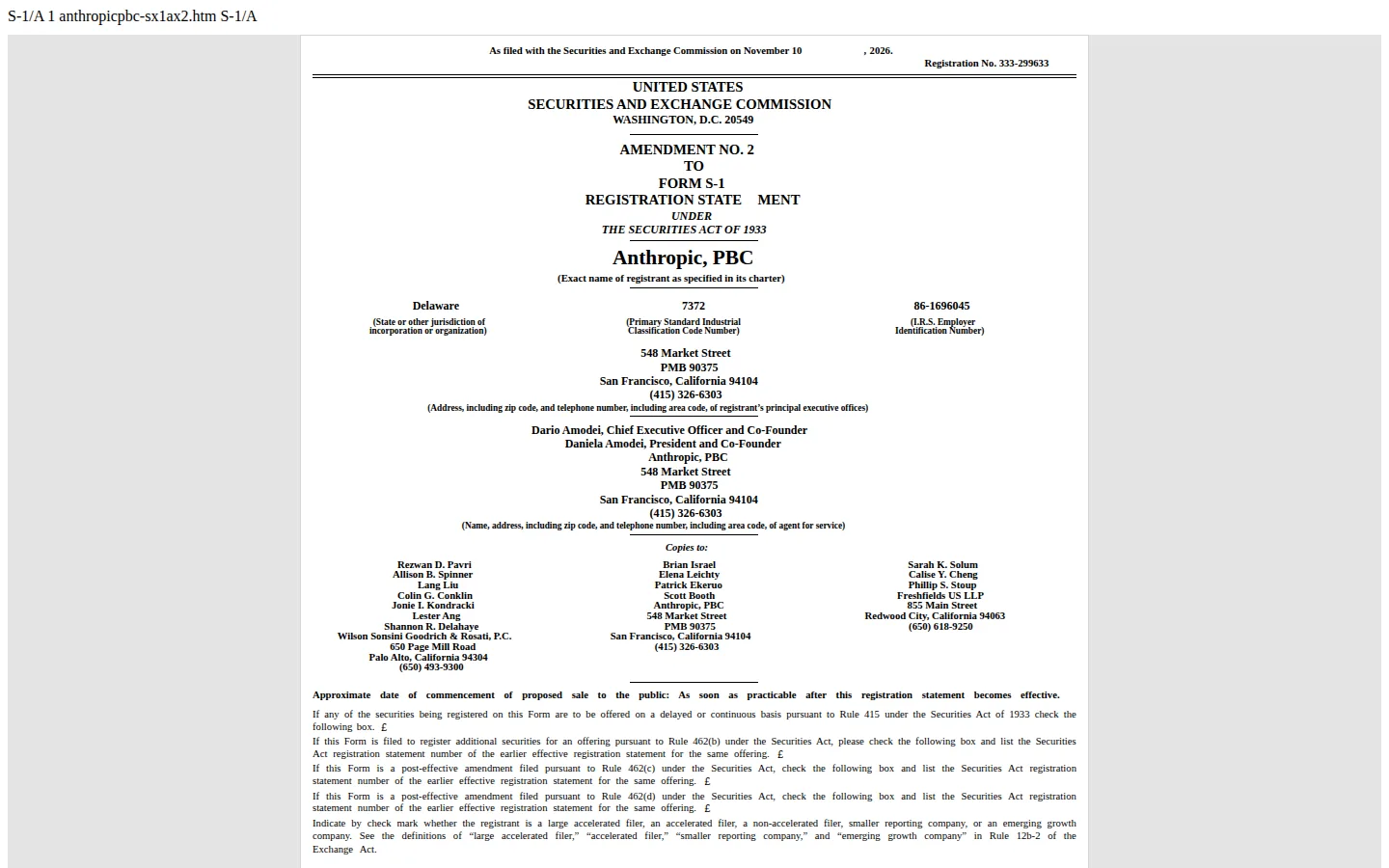
Anthropic put a price on its own listing on November 10, 2026. Amendment No. 2 to its S-1, filed with the US Securities and Exchange Commission, sets an estimated initial public offering price of $70.00 to $78.00 a share for 825,000,000 shares of Class A common stock, for the Nasdaq Global Select Market under the ticker ANT. The October filing left both cover fields blank. Both now carry numbers.
What was actually released
Nothing shipped. No model, no price change, no feature. What landed is a registration statement amendment, a preliminary prospectus dated the same day, and an investor website launched on November 10 with a founders’ letter and a factsheet.
The structure carries more than the range. Of the 825,000,000 shares, 801,351,354 are new and 23,648,646 come from selling stockholders, who keep what their shares raise. The underwriters hold an option on 123,750,000 more shares from the company, 15% of the base deal. Alongside all of it, seven companies have agreed to buy $26.0 billion of Class N common stock at the same price per share, a placement that closes only if the offering closes.
| Term | Figure |
|---|---|
| Price range | $70.00 to $78.00 a share |
| Class A shares offered | 825,000,000 |
| New shares from Anthropic | 801,351,354 |
| Shares from selling stockholders | 23,648,646 |
| Underwriters’ option | 123,750,000 shares |
| Concurrent private placement | $26.0 billion of Class N |
| Net proceeds at $74.00 | about $84.6 billion |
The buyers in that placement are the companies Anthropic buys from. At the $74.00 midpoint, Google and NVIDIA take 135,135,135 shares each for about $10.0 billion apiece, AMD 33,783,783 shares for $2.5 billion, Broadcom, Micron and Microsoft 13,513,513 shares each for $1.0 billion, and TSMC Partners 6,756,756 shares for $500 million. Class N stock carries the same economic rights as Class A without voting rights, and the filing states these shares carry no underwriting discount and no lock-up.
What the claim rests on
The figure that travels with this deal is $64 billion, and it is arithmetic rather than a disclosure. 825,000,000 shares at the top of the range come to $64.35 billion before fees, our calculation from two numbers on the cover. The document commits to less than that, and the gap between the headline and the filing is where an enterprise buyer should look.
| Number | What it counts | Where it comes from |
|---|---|---|
| $64.35 billion | 825,000,000 shares at $78.00, gross, before fees | Our arithmetic |
| $26.0 billion | Class N placement, outside the offering | The filing |
| $84.6 billion | net proceeds at $74.00, offering and placement together | The filing |
| $3.8 billion | RSU tax withholding inside those proceeds | The filing |
| $1.02 trillion | implied value of 13,086,672,591 economic shares at $78.00 | Our arithmetic |
Three lines matter more than the total. The company’s own shares raise between $56.1 billion and $62.5 billion, and the secondary portion, about $1.75 billion at the midpoint, never reaches Anthropic. Net proceeds of about $84.6 billion include the $26.0 billion placement and, at the midpoint, $3.8 billion reserved for tax withholding on employee RSUs, computed at an assumed 50.90% rate. The rest goes to general corporate purposes, compute and infrastructure first.
The value of the company is not in the document. Class A shares outstanding after the offering and the placement come to 7,427,991,791 and Class N to 5,658,680,800, and both carry economic rights. At $78.00 that implies about $1.02 trillion, before options and RSUs, our arithmetic on the filing’s own counts, against about $916 billion at the bottom of the range. It is an inference rather than a published figure, and the top of the range is the case that matters, because a listing is priced there only if demand takes it there.
It is currently estimated that the initial public offering price per share will be between $70.00 and $78.00.
Demand is the part no reader can check. The amendment carries no coverage figure and no measure of how many times the book is subscribed. It quantifies one thing: the $26.0 billion placement, and up to $303 million that some directors and entities affiliated with them have indicated they would spend at the IPO price, in a paragraph that calls those indications non-binding.
What the document does not publish
- No demand figure. Whether the offering is oversubscribed, and by how much, is not in the filing.
- No final price, no allocation and no delivery date. The cover reads “on or about” and leaves the date blank.
- No valuation. Every figure above $900 billion in this article is our arithmetic on share counts the filing gives.
A Japanese prospectus filed on November 12 registers a public offering by book building of $3.0 billion to $3.5 billion, not yet effective. The listing is American and the sale is not: six other jurisdictions are named as offering markets.
On this page
What it changes for teams paying for AI
Every number here will be republished quarterly. Anthropic ran the first half of 2026 at an 85% gross margin on $16.3 billion of revenue, with research and development at 60% of revenue, which we covered when the first amendment landed. A buyer holding a renewal quote now has a public reference for what the vendor’s compute costs it.
The supply relationship now has equity on both sides. The seven companies in the placement build Anthropic’s compute: Google’s cloud, NVIDIA’s accelerators, AMD’s chips, Broadcom’s networking, Micron’s memory, Microsoft’s cloud and TSMC’s foundry. They buy at the IPO price, without a lock-up, in shares that convert to Class A only on a sale to an unaffiliated third party. When those supply contracts come up again, both sides hold part of the same cap table.
For a team signing a multi-year agreement, the filing puts $146.6 billion of liquidity at September 30, 2026, cash, short-term investments and undrawn credit together, against $84.6 billion of net proceeds, so the raise is not about survival. The range is an estimate of the price, not a fact about the business.
The Neural Minute take
The number to watch is not $64 billion. It is $26 billion. The placement is worth about two fifths of the offering itself at the midpoint, and about 30% of the money raised once the offering and the placement are added together. It comes from seven suppliers, and it carries no underwriting fee because it is not underwritten. A raise described as public demand is, for close to a third of the cash, a set of contracts with the companies that sell Anthropic its compute. That is the most unusual line in 300 pages, and it is not on the cover.
Our coverage adds a check the filing cannot make. In October we reported that the S-1 carried no price and no share count, and days later that both fields were still blank. They are filled now, which makes three weeks a sequence: a company, an audited account, then a price.
What we watch next is the final price against the top of this range: a deal at $78.00 supports the $1.02 trillion implication, one at $70.00 does not. Then the first quarterly report, where gross margin and compute commitments meet a deadline for the first time. For anyone choosing a tool today, none of this changes a monthly invoice. What changes is that the vendor’s price list now has a shareholder base, and a public company defends a price list differently.
Sources
- Anthropic, PBC, Amendment No. 2 to Form S-1, filed November 10, 2026: sec.gov
- Free writing prospectus carrying the Japanese prospectus, filed November 12, 2026: sec.gov
- Our coverage of the S-1, October 27, 2026: neuralminute.com
- Our coverage of the first amendment, November 2, 2026: neuralminute.com