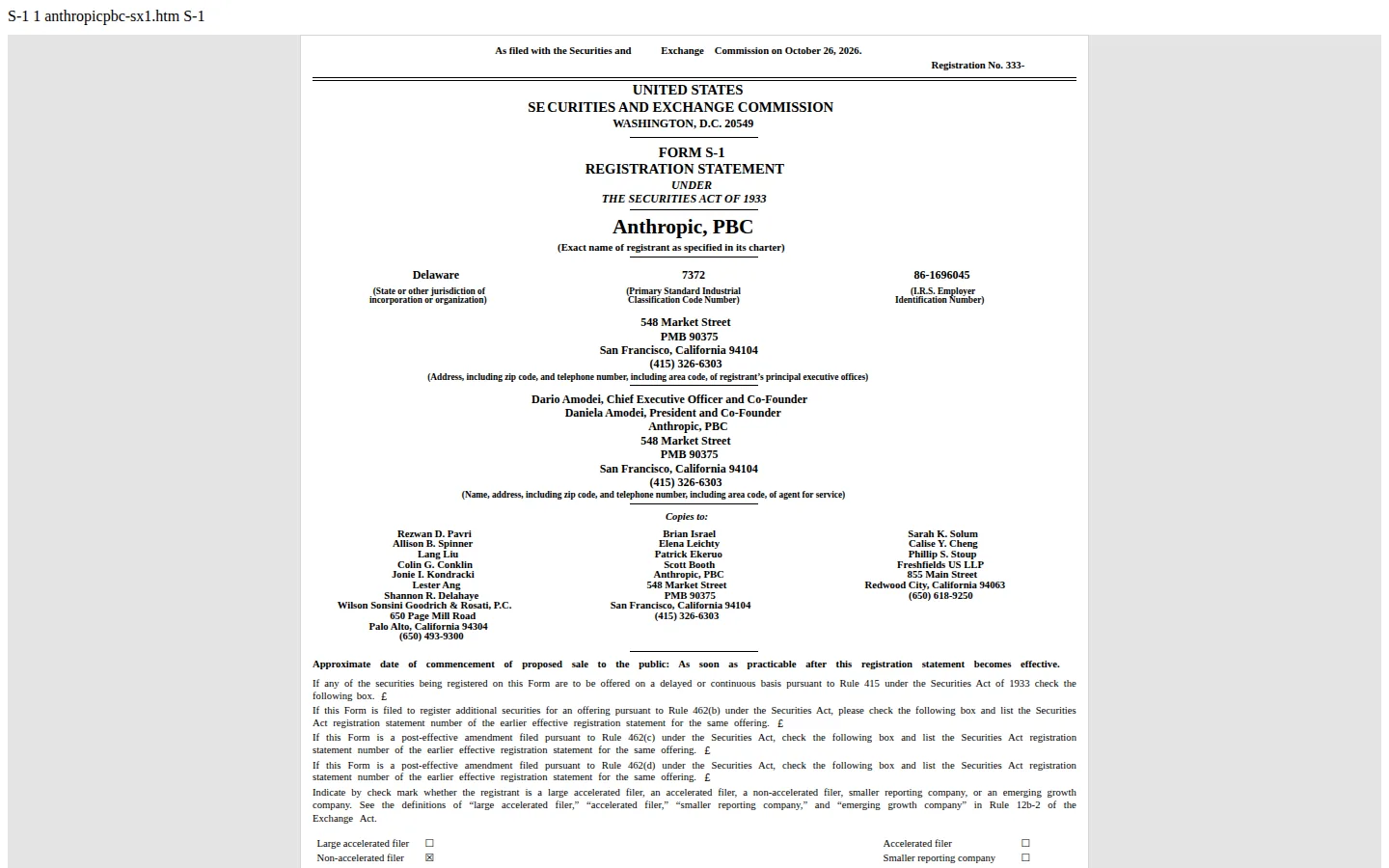
Anthropic filed a registration statement with the US Securities and Exchange Commission on October 26, 2026, and with it published the first audited account of how the company behind Claude makes and spends money. The document is a Form S-1 for a Nasdaq listing under the ticker ANT, with no price and no share count, so the raise has no size. It carries more than 300 pages of numbers that until this week were estimates.
What was actually released
Nothing shipped. No model, no price change, no feature: a registration statement, its exhibits, and the financials behind them.
Anthropic registers as a public benefit corporation, and one Class T share held by its Long-Term Benefit Trust elects a majority of the board, which makes it a controlled company under Nasdaq rules. The accounts are audited to December 31, 2025 and unaudited for the six months to June 30, 2026, the period every figure below turns on. The cover carries a date anyone can check: “As filed with the Securities and Exchange Commission on October 26, 2026.” The capture above is that cover, read on October 27, 2026.
The three numbers
- Revenue of $16.3 billion for the six months to June 30, 2026, against $1.2 billion a year earlier.
- Gross margin of 85% on that revenue, from minus 95% for the full year 2024.
- An operating loss of $693 million, against $2.1 billion in the same six months of 2025.
What the claim rests on
Revenue is the least interesting line in the filing. The one that says what kind of business this is sits a row below.
| Period | Revenue | Cost of revenue | Gross margin | Operating loss |
|---|---|---|---|---|
| 2024 | $386M | $752M | minus 95% | $2,980M |
| 2025 | $4,585M | $2,773M | 40% | $8,060M |
| H1 2025 | $1,163M | $1,019M | 12% | $2,135M |
| H1 2026 | $16,286M | $2,380M | 85% | $693M |
Cost of revenue, mostly compute for customer workloads by the filing’s own description, grew 2.3 times between the first half of 2025 and the first half of 2026. Revenue grew 14 times. Gross margin ran from minus 95% in 2024 to 85% in the first half of 2026, and that swing took six quarters.
Where the money went explains the loss.
| Line | H1 2025 | H1 2026 | Change |
|---|---|---|---|
| Cost of revenue | $1,019M | $2,380M | 2.3x |
| Research and development | $1,850M | $9,741M | 5.3x |
| Sales and marketing | $239M | $3,808M | 15.9x |
| General and administrative | $190M | $1,050M | 5.5x |
| Total operating expenses | $3,298M | $16,979M | 5.1x |
Research and development took 60% of revenue in six months, which is what an 85% gross margin is for. Sales and marketing grew 15.9 times, slightly faster than revenue, so growth is being bought at the same rate on a much larger base.
The net loss has to be separated from all of that: $80.7 billion for the six months, of which $72.4 billion is the change in fair value of convertible notes and SAFEs, a mark that follows Anthropic’s valuation rather than cash leaving the company. The $80.7 billion net loss includes $72.4 billion of non-cash convertible note marks, which is why the $693 million operating loss is the line to compare against revenue.
Customers spending $100,000 or more on a trailing twelve-month basis went from more than 950 to more than 11,900 in a year, and net revenue retention was approximately 900% at September 30, 2026. Both are Anthropic’s own definitions, on a base that grew 12-fold, so retention describes a customer set that barely overlaps with last year’s.
Then the disclosure that matters outside an investor deck. Enterprise users who skip Claude Code spend under $75 a month; the top 5% who use it spend about 20 times that, according to the three months to September 30, 2026. That is roughly $1,500 a seat, our arithmetic on their ranges, and a rare public number showing where agentic usage lands on an invoice. Prices per task fell meanwhile: about 40% on Opus 5.5 against Opus 5, and up to 45% on complex coding with Fable 5.1.
One line does not reconcile. Trailing revenue per employee of over $6.6 million on approximately 5,300 employees puts trailing revenue above $34.9 billion. The filing accounts for $19.7 billion of it, the twelve months to June 30, 2026. The gap implies close to $15 billion in the September quarter, which the document never states.
Our recent growth may reflect early-stage adoption dynamics, the nascency of the AI market, and rapid initial customer expansion that may not be sustainable over time.
What the document does not say
- No offering size and no price range. Both are blank on the cover, so no valuation can be computed from this filing.
- No run-rate revenue figure. The sentence that introduces the metric leaves a blank where the number goes, next to a measurement date of October 31, 2026, which is later than the filing date itself.
- No split between consumer subscribers and enterprise seats. Consumption brought 80% of revenue and subscriptions 20%, and that is as far as the disclosure goes.
On this page
What it changes for teams paying for AI
Seat price stops being the budget line. If the median enterprise user without coding agents sits under $75 a month and the top 5% with them near $1,500, a budget of $75 times headcount models the wrong curve, and the variance lands on the few who run agents.
Renewals signed before September are priced against models that no longer exist. A 40% cut in cost per task on Opus 5.5 means a contract carried from the spring pays for tokens at a rate the vendor itself has stopped quoting.
Committed spend buys a committed price list, per the filing’s account of enterprise contracts with minimum spend. That is the lever worth negotiating, and it cuts both ways: a multi-year minimum signed now is a bet on the roadmap of a company that lost $693 million on $16.3 billion of revenue in six months and says its growth rate will decline.
The Neural Minute take
The filing does not answer whether Anthropic is the best business in AI. It answers a narrower question: what an AI lab’s unit economics look like once they are forced into an audited format, which no other frontier company has.
Two readings are wrong in opposite directions. The $80.7 billion net loss is not a cash problem: $72.4 billion of it is a valuation mark on instruments that convert. But 14-fold revenue growth is not proof of a durable business either, and the sharpest page here is the risk factor quoted above, where Anthropic tells its own investors the growth may not last.
What the filing does prove is the margin. Minus 95% in 2024 meant every dollar of revenue cost more than a dollar of compute to serve. Eighteen months later the same line is 85%, with the compute bill growing 2.3 times against revenue growing 14 times. Whether frontier model companies can be businesses at all turns on that line, and its direction is now a public fact.
For our readers the weight is in the price curve, not the listing. Opus 5.5 landed in September at a cost per task about 40% below Opus 5, after Haiku 5.5 came in at $0.10 per million input tokens, which we covered when it shipped. A tool budget set in January is measured against a curve that has moved twice since.
What we watch next is the September quarter, where the arithmetic above leaves close to $15 billion unexplained, and the run-rate figure that is blank in this document.
Sources
- Anthropic, PBC, Form S-1 filed October 26, 2026: https://www.sec.gov/Archives/edgar/data/2130357/000162828026067168/anthropicpbc-sx1.htm
- Our coverage of Claude Haiku 5.5 pricing, September 2026: https://www.neuralminute.com/news/claude-haiku-5-5/
- Our coverage of Anthropic’s pledge of 5% of its shares, October 18, 2026: https://www.neuralminute.com/news/anthropic-says-its-committing-5-of-its-shares-to-a-public/