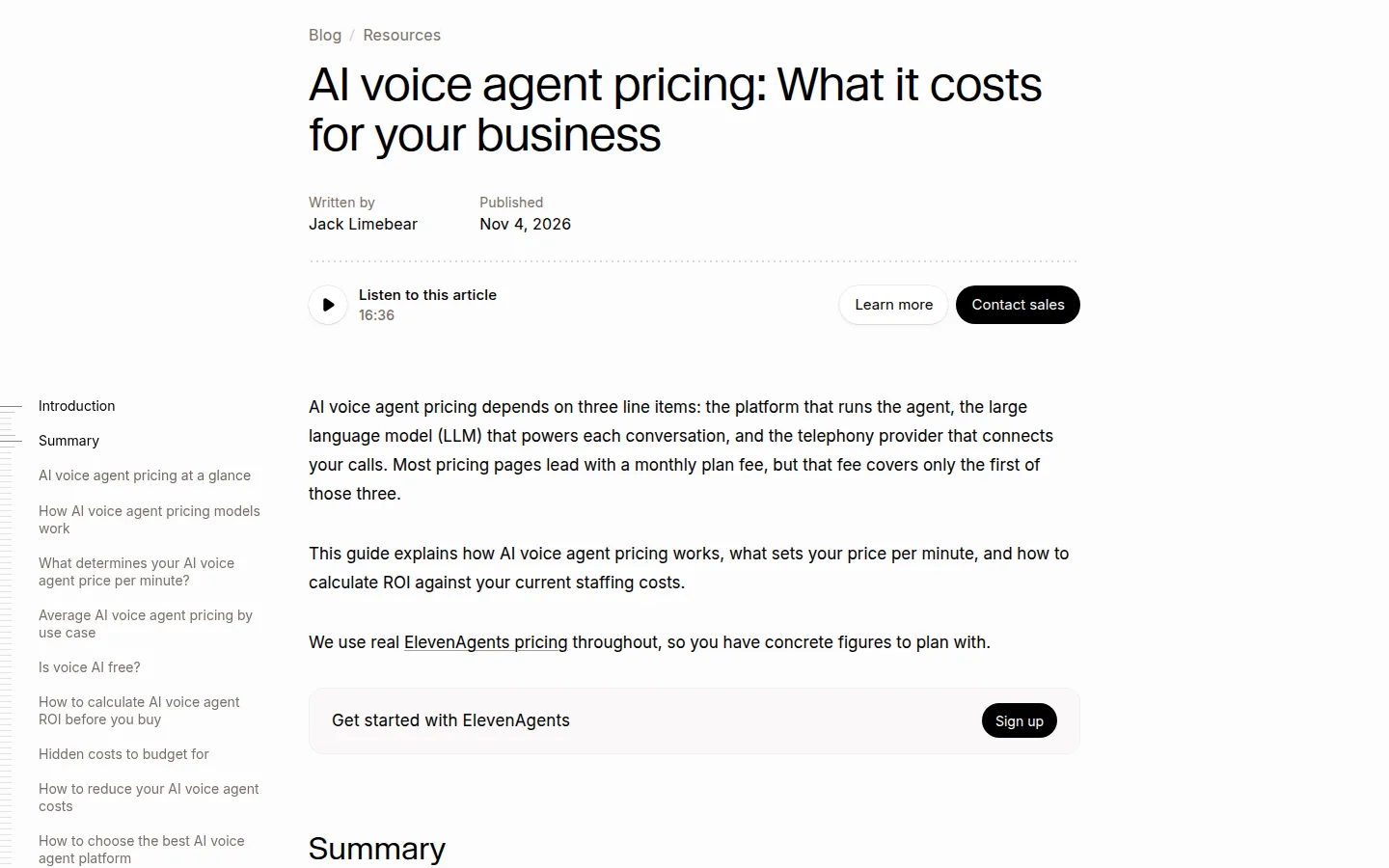
ElevenLabs published a pricing guide for AI voice agents on November 4, 2026, and it settles on a single rate: every paid ElevenAgents plan works out to $0.08 per platform minute. The page also names the other two lines in a call, LLM usage and telephony, says both are billed at cost, and prints no rate for either.
What was actually released
This is a guide, not a product launch. Jack Limebear, from the growth team at ElevenLabs, explains what a voice agent costs and ends up printing his employer’s rate card in detail: included minutes, concurrent call limit, features per tier.
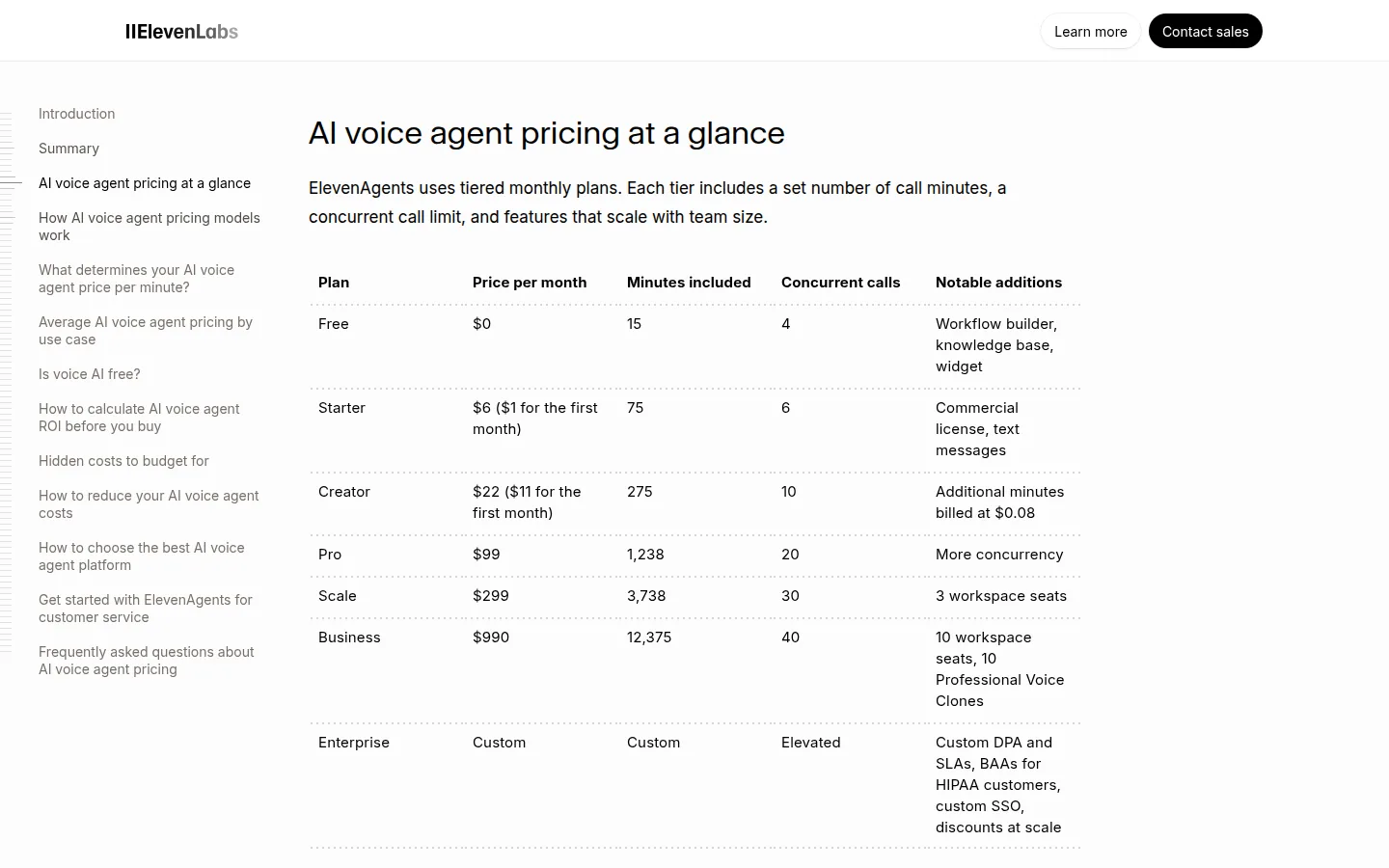
| Plan | Price per month | Minutes included | Concurrent calls | Minutes per dollar |
|---|---|---|---|---|
| Free | $0 | 15 | 4 | Not sold |
| Starter | $6, $1 for the first month | 75 | 6 | 12.5 |
| Creator | $22, $11 for the first month | 275 | 10 | 12.5 |
| Pro | $99 | 1,238 | 20 | 12.5 |
| Scale | $299 | 3,738 | 30 | 12.5 |
| Business | $990 | 12,375 | 40 | 12.5 |
| Enterprise | Custom | Custom | Elevated | Custom |
Divide any paid plan by its included minutes and the same figure comes back: $1 buys 12.5 platform minutes at every paid tier, from Starter at $6 to Business at $990. Additional minutes on Creator and above bill at that same $0.08, text messages cost $0.003 each, and prices exclude taxes. Volume discounts arrive only with Enterprise.
ElevenLabs also lists a burst rate of $0.16 per minute for call spikes beyond a plan’s standard capacity, and prices its receptionist product apart: Reception starts at $29 per month for 75 phone minutes, Plus at $79 for 275 and Premium at $199 for 1,000, with overage falling from $0.40 a minute on Basic to $0.22 on Premium.
The three numbers to keep
- $0.08 per platform minute on every paid plan, which is 12.5 minutes of call time per dollar
- $0.16 per minute once calls run past the plan’s standard capacity
- Reception is priced apart from the agent platform, from $0.39 down to $0.20 per included minute
What the claim rests on
A voice agent bill has three parts, and the guide says so in its own summary. Only the first carries a rate. LLM usage is billed at cost and telephony is passed through at cost, which is a statement about margin, not a price: nothing on the page says what a minute of a reasoning model adds, or what a carrier charges for a number and a call leg.
Your voice agent cost equals platform minutes plus LLM usage plus telephony, and the LLM and telephony costs are billed separately at cost.
That gap is measurable in the guide’s own example. It runs 8,000 calls of five minutes, so 40,000 minutes, against a loaded staffing cost of $40 an hour, or $26,667 a month. Platform minutes come to $3,200. At a 60% resolution rate a human team still absorbs $10,667, and the page stops at $12,800 net “before LLM and telephony costs”. Put the other way around: the platform line is 12% of the staffing bill, so an agent has to resolve 12% of calls to cover its minutes. The 60% is labeled an assumption, and at 30% the same model nets $4,800.
The second weakness is internal. The tier mapping assumes a four-minute call, which is how 1,238 minutes becomes “roughly 300 calls”. The worked example assumes five. On 8,000 calls that gap is 8,000 minutes and $640 of platform time, a fifth of that line, before the two lines nobody prices.
What the page does not publish
No per-minute rate for LLM usage. No per-minute rate for telephony, not even a sample total for a five-minute call. No definition of the resolution rate it tells you to measure, no Enterprise price, no annual rate. The one benchmark it offers is its own support desk: 65% of tickets resolved end to end across more than 22,000 tickets a month, self-reported, without a definition of “end to end”.
On this page
What it changes for teams budgeting a voice agent
The platform line is now computable before a sales call. What the ladder sells is capacity, not a cheaper minute: because minutes per dollar never move, the choice between tiers is a choice of concurrent calls and workspace seats, and the price per concurrent slot rises as you climb.
| Step up | Extra per month | Concurrent calls added | Minutes added | The same money in burst minutes |
|---|---|---|---|---|
| Starter to Creator | $16 | 4 | 200 | 100 |
| Creator to Pro | $77 | 10 | 963 | 481 |
| Pro to Scale | $200 | 10 | 2,500 | 1,250 |
| Scale to Business | $691 | 10 | 8,637 | 4,319 |
Read the last column as a break-even. Moving from Pro to Scale costs $200 a month and adds 2,500 minutes, while the same $200 buys 1,250 minutes at the burst rate. The upgrade beats burst only if peak overflow exceeds 1,250 minutes a month, so a center that spikes for a few hours at month end should pay $0.16 for those hours rather than the next tier all month.
The second lever costs nothing. Conversations through the web widget or inside an app skip carrier charges entirely, so a call that never reaches the phone network has no telephony line and no number to rent.
Do not budget a receptionist at $0.08 a minute. Reception’s plans work out to $0.39, $0.29 and $0.20 per included minute, 4.8 times the platform rate at the low end, and the page does not say whether telephony sits inside those minutes. Three lines, one published rate, and the receptionist line is not the one at $0.08.
The Neural Minute take
Pricing pages usually bury the pass-through. This one names it, and prints the burst rate most vendors save for a sales call, so a buyer can compute one third of the bill from a public page instead of asking.
The catch is what that does to comparisons. $0.08 is a third of a bill, so the only figure that compares two platforms is cost per resolved conversation, and neither side publishes it. Anyone quoting $0.08 as the price measures a third of a bill against whole bills, and the same guide pushes buyers toward the line that varies most by recommending a different model per subagent.
Our arithmetic says the minute is rarely the deciding cost. In ElevenLabs’ own example the platform line is 12% of the staffing bill it replaces, so the number that moves money is the resolution rate. One point of resolution rate is worth about $267 a month there, and one minute of platform time is worth $0.08.
From today we treat this page as our reference for ElevenLabs, because the vendor prints the rate itself. What we hold it to is narrow: $0.08 a platform minute, $0.16 in burst, 12% to cover staffing before the two lines it will not price. Where willingness to trust voice stops is a question we already put to these same agents in our reading of the retail studies.
Sources
- AI voice agent pricing: What it costs for your business, ElevenLabs, published November 4, 2026, read the same day: https://elevenlabs.io/blog/ai-voice-agent-pricing-guide
- The date of the fact is that page’s date, not the age of the feed item that surfaced it
- Plan table, burst rate, receptionist plans and the 65% figure are ElevenLabs’ own statements, published without a method
- The 12.5 minutes per dollar, the price per concurrent slot, the burst equivalence and the call-length swing are our arithmetic on those numbers