
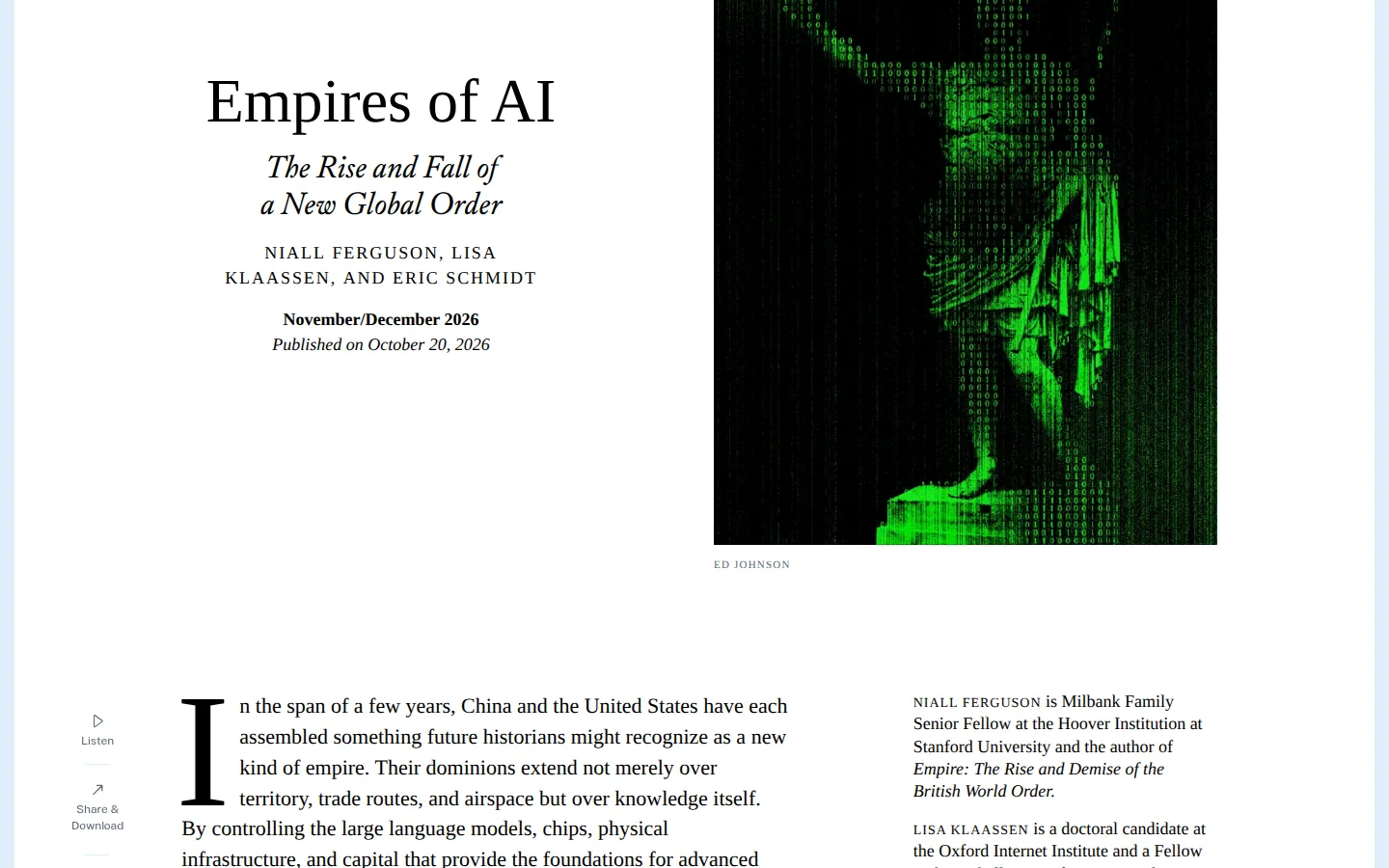
Eric Schmidt published an essay in Foreign Affairs on October 20, 2026 that names OpenAI and Anthropic as the modern counterparts of the Dutch and British East India Companies. It is written with the historian Niall Ferguson and Lisa Klaassen, and it runs in the November/December 2026 issue under the title Empires of AI. Nothing was launched and neither lab is quoted. What the essay offers is a frame, and it reads better as a risk register than as a forecast.
What was actually released
An argument, in two moves. The first is that artificial intelligence is an imperial technology rather than a commercial one: its frontier depends on measured quantities of energy, chips, minerals and capital, and its inputs are pulled from poorer countries while the finished model is sold back. The authors call that “the plantation economics of the chatbot age”.
The second move is the comparison that gave the essay its reach. They write that the chartered companies of the European imperial era “minted their own coins, fielded private armies, levied taxes, and bargained with kings as equals”, and then hand the role to the labs.
Like their East India predecessors, the leaders of the largest AI labs negotiate with presidents and cabinet secretaries.
| What the chartered companies did | What the essay says the labs do now |
|---|---|
| Minted coins, kept private armies, levied taxes | Command the talent, data, models and finance that advanced intelligence depends on |
| Bargained with kings as equals | Negotiate with presidents and cabinet secretaries |
| Held trade monopolies, defended them by force | Trade model access and compute for land, power, sovereign capital and regulatory accommodation |
The essay is explicit that these agreements are struck “on terms the company largely sets”, and it reads the May 2025 deals announced during Donald Trump’s visits to Saudi Arabia and the United Arab Emirates as “imperial concessions in all but name”. It also notes what the labs cannot do: they cannot move a chip or build a data center without state authorization, and export controls can throttle them at will. Each government holds a different leash.
The line that matters for a buyer
- The essay treats access to a frontier model as a concession granted by a company and a state, not as a product on a shelf.
- It describes firms building on “an interface that can be repriced or withdrawn overnight”.
- It gives one dated precedent: in June 2026 an order from the U.S. Commerce Department told Anthropic to suspend foreign nationals’ access to its two most capable models, and those models went dark worldwide within days.
What the claim rests on
Three kinds of material sit in the essay, and they do not weigh the same.
What is checkable: the figures and the chronology. The authors put capital expenditure committed by the largest technology firms in 2026 at more than $600 billion, which public filings can reconcile. They put U.S. interest payments at roughly $881 billion in 2024 against about $874 billion on defense, the crossover one of them calls the Ferguson limit. The Chinese buildout they describe, a five-year $295 billion state plan for data centers, is presented as a draft, not a budget.
What is analogy: the East India frame itself. Chartered companies organize facts about monopoly, state bargaining and chokepoints. They are not evidence that a trajectory repeats, and the authors concede the limit, writing that empires varied so widely that no single model fits all.
What is not published: the six-month lead the essay grants the United States in chatbots and software tools arrives without a method. The June order is given with a month and no document. The labor behind the plantation line is not measured, only described as “a few dollars an hour”. None of that makes the essay wrong. It makes it a case, and a case is what an essay is for.
What the essay does not give you
No order number or date beyond the month of June for the Anthropic restriction. No methodology for the six-month lead in chatbots and AI software tools. No list of which agreements were signed with which governments. No survey behind the wage figures for data labeling work.
On this page
What it changes for anyone paying for AI capacity
For a small team buying seats, API calls or an agent platform, the essay’s contribution is a change of threat model. The usual question is what a tool costs and whether the plan fits. The essay’s question is who can switch the tool off, and how fast.
The June precedent answers the second part. If an order can remove access to two flagship models worldwide within days, then any workflow that depends on a single lab has a failure point that is not technical, not negotiated, and not visible on the price page. No discount compensates for it.
The essay also puts a shape on the alternative. It describes what China offers as cheap and mostly open, and what the United States offers as expensive and mostly closed, and it argues that an empire of restricted technology attracts only those who can afford it and are permitted access. For a buyer that is a real second option, with its own costs: data residency, support, and a different set of export rules. Swapping one dependency for another is not diversification.
What we would act on, in order: keep a second provider wired up and tested on the same prompts, keep prompts and evaluations portable rather than stored inside one vendor’s console, and read the terms for the clause that allows access to be withdrawn. Notice periods and data export rights are the parts of an AI contract worth arguing about now.
The Neural Minute take
Most coverage of this essay will quote the colonial comparison and stop, because it is the quotable part. The comparison is the least useful thing in it. The useful thing is the pattern of chokepoints the authors lay out, and the fact that they apply it to both capitals rather than one.
Our reservation is about where the argument comes from. A former Google chief executive and a historian of empire are well placed to describe how labs bargain with governments, and they are also parties to the arrangement. The frame flatters a reader into thinking the danger is foreign, while the one dated example runs the other way: the restriction on Anthropic’s models came from Washington. We covered that relationship from the other side in Anthropic asking a full court to rehear a Pentagon supply chain ruling, and the two stories fit: the state that protects a lab can cut it off.
So we would use the essay as a checklist rather than a prophecy. Which of your tools is a single-vendor bet. Which would stop working if a model were withdrawn on a Friday. Which would keep working on open weights, and what that migration would cost. Those questions have answers today, and they do not depend on whether the American empire follows the British one.
Sources
- Empires of AI: The Rise and Fall of a New Global Order, Foreign Affairs, by Niall Ferguson, Lisa Klaassen and Eric Schmidt, published October 20, 2026: the essay
- The figures quoted are the authors’ own: more than $600 billion of 2026 capital expenditure, about $881 billion of interest against $874 billion of defense in 2024, and a draft $295 billion five-year plan for Chinese data centers.
- The June 2026 restriction on Anthropic model access is stated without a document attached, and appears here as the authors describe it.