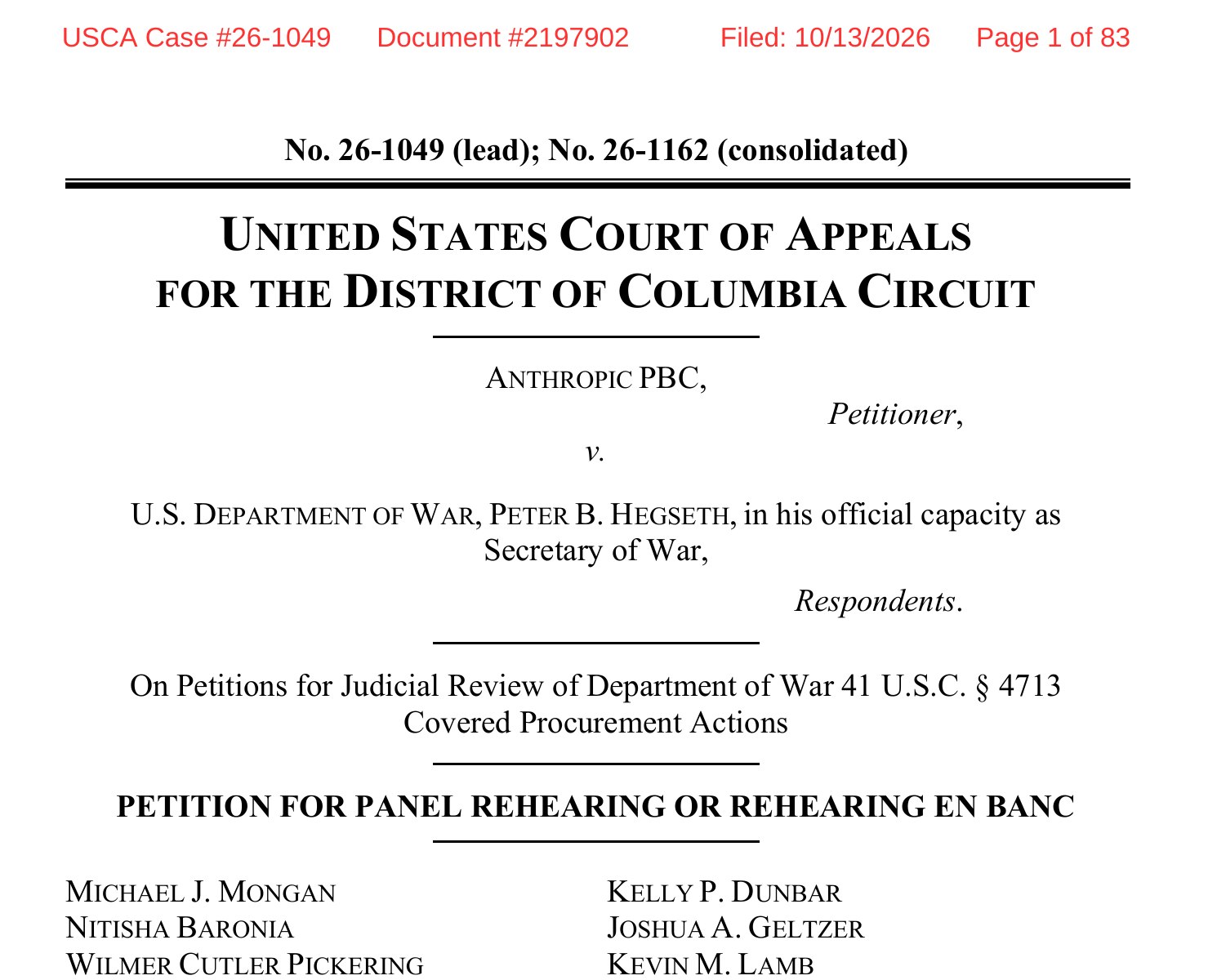
Anthropic filed a petition for panel rehearing or rehearing en banc in the U.S. Court of Appeals for the D.C. Circuit on October 13, 2026, asking the court to revisit the September 25 ruling that upheld the Department of War’s designation of the company as a national-security supply-chain risk. The petition runs 3,894 words by its own certificate of compliance, and the ruling it attacks was 2-1.
What was actually released
Nothing shipped. This is a legal filing, and the useful part is what it contains. The document is the petition for rehearing in No. 26-1049, consolidated with No. 26-1162, filed under Federal Rule of Appellate Procedure 40. It asks for two things at once: rehearing by the same panel, or rehearing by the full court.
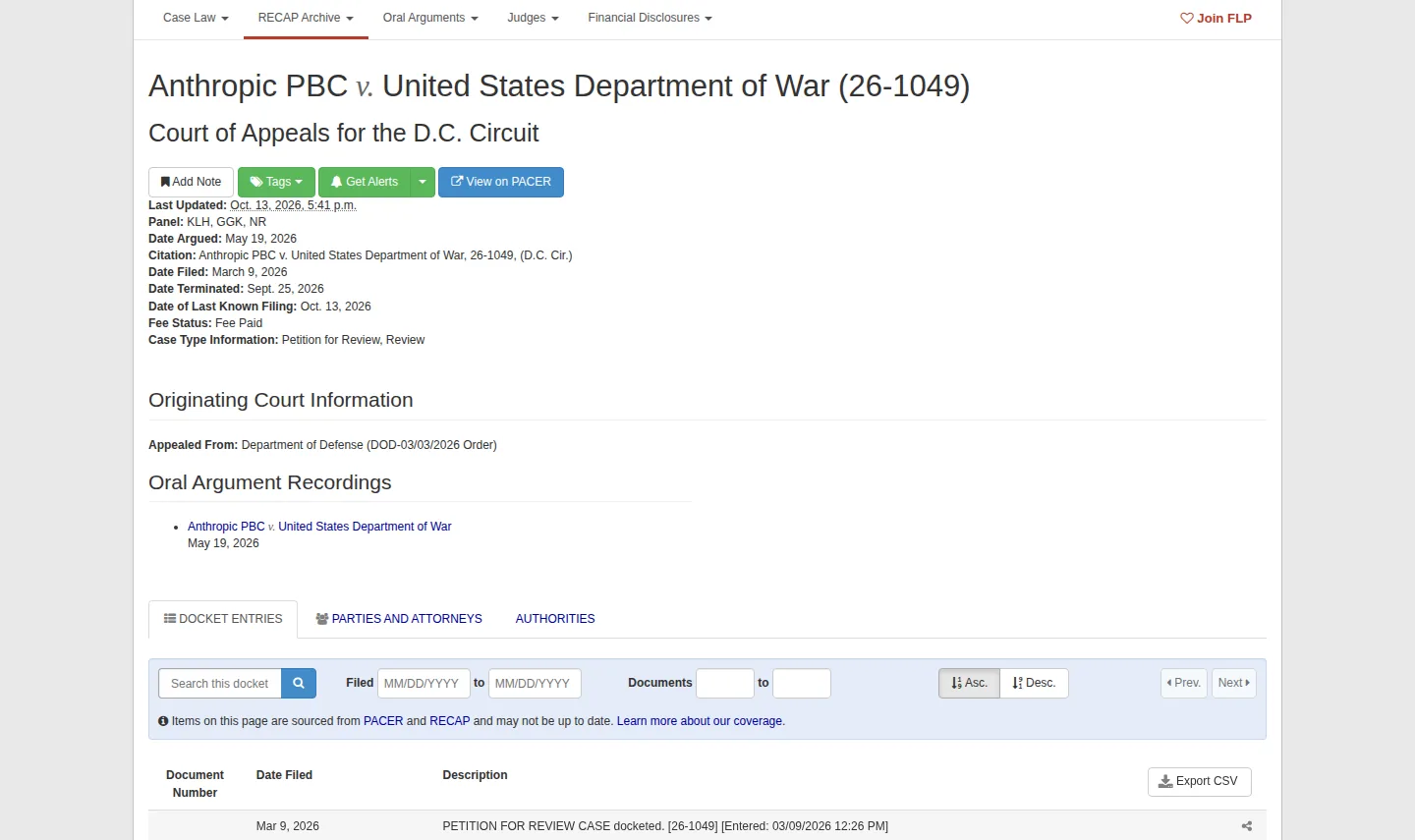
The decision it targets came from a panel of Judges Henderson, Katsas and Rao. Judge Katsas wrote the 43-page opinion for the court, Judge Henderson dissented in 8 pages, and a per curiam judgment denied review the same day. The clerk withheld the mandate, which is what keeps a case alive long enough to ask for rehearing.
| Item | Detail |
|---|---|
| Case | Anthropic PBC v. U.S. Department of War |
| Docket | No. 26-1049, consolidated with No. 26-1162 |
| Court | U.S. Court of Appeals for the D.C. Circuit |
| Argued | May 19, 2026 |
| Decided | September 25, 2026 |
| Vote | 2-1 to deny review |
| Petition filed | October 13, 2026 |
| Length | 3,894 words |
The petition raises four grounds. On statutory scope, it argues that the majority turned a law aimed at hostile foreign actors into one that reaches every contractor, because every contractor arranges, operates or controls its product. On process, it argues the court imported a harmless-error rule that Congress did not write into the review statute. On due process, it argues the circuit’s own precedent requires notice and a chance to respond before a national-security designation, absent a showing of particularized need. On the First Amendment, it argues the majority accepted that Anthropic engaged in protected expression and suffered adverse action, then found no link between them.
Anthropic says the District Court for the Northern District of California reached the opposite conclusion on a parallel designation issued by the same Secretary on the same day, finding direct evidence that the company’s speech was a substantial motive. The petition counts 15 amicus briefs in the case, including one filed by 149 former judges.
What the claim rests on
Start with what this document is. It is one side’s argument, written by the losing party, asking the same court to look again at the record it has already decided. It carries no new evidence and no new ruling. Everything below is what the petition asserts, together with the parts of the underlying decision it quotes.
The designation at issue was issued under 41 U.S.C. § 4713, after Anthropic declined to remove two contractual limits: one on mass surveillance of Americans, one on lethal autonomous warfare. The government’s original theory, that Anthropic could alter or shut off Claude after deployment, was abandoned in the district court, and Anthropic cites its own concession that once the model runs on classified systems the company cannot reach it.
The majority did not accept that Anthropic was a hostile party. It found no reason to doubt the company’s intentions, and still upheld the designation, on the reading that the definition turns on what Anthropic does, not why it does it. That reading is the center of the petition. If motive is irrelevant, the petition argues, every lab that ships a model with limits is exposed, and the statute has no limiting principle.
What the filing does not carry
No government response. The docket we read on October 14, 2026 shows the petition as the last entry, with nothing filed after it. No indication that the full court will take the case. No date for a decision. And no independent review of the sole number the petition certifies about itself, the 3,894 words.
On this page
What it changes for teams buying AI for government work
For a buyer, the important shift is not the case. It is the standard the case would set. Under the panel’s reading, a vendor’s decision to restrict how its model may be used counts as manipulating a covered article, and the vendor’s motive does not have to be shown. Safety commitments written into a contract stop being a feature a regulated customer can rely on and become a category of procurement risk.
Two practical consequences follow. First, concentration risk gets harder to wave away. If a single designation can remove a vendor from large parts of the defense industrial base, then a team that standardized on one lab’s model is carrying a risk it does not control and cannot test. Second, the due process argument matters even to buyers who never touch federal work, because it is about whether a designation can land without prior notice and a chance to respond.
The petition also notes that the circuit’s jurisdiction over this statute is exclusive, which leaves the panel’s decision as the last word short of the Supreme Court. That is the part to watch.
The Neural Minute take
The interesting fact here is not that Anthropic is fighting. It is that a statute built for Kaspersky and Huawei cases was used against an American lab over its own usage policy. The petition states that § 4713 had never been publicly used before this case, and that the broader supply-chain security law had been used once, against a Swiss company with Kremlin ties.
“Agree to the Secretary’s demands or risk being designated a national security threat.”
That line is Judge Henderson’s, quoted in the petition from her dissent, and it is the whole argument in one sentence. The panel’s reading requires no hostility and no bad motive, which is what makes the designation easy to impose and hard to overturn.
We have covered this company’s safeguards before, including its own account of four ways Claude took unintended actions. The distance between those two stories is the point: the same design decisions the company publishes as safety work are the ones the government treated as a supply-chain risk.
A rehearing petition is a long shot, and nothing in the record we read says the full court is inclined to take it.
What would change our read: a government response, an order granting or denying rehearing, or the court issuing the mandate, which would start the clock toward the Supreme Court. Until one of those lands, the September 25 decision stands.
Sources
- Anthropic PBC v. United States Department of War, No. 26-1049, docket, U.S. Court of Appeals for the D.C. Circuit, read on October 14, 2026: https://www.courtlistener.com/docket/72380208/anthropic-pbc-v-united-states-department-of-war/
- Petition for panel rehearing or rehearing en banc, filed October 13, 2026, 3,894 words, including the September 25 panel opinion and dissent in its addendum: https://storage.courtlistener.com/recap/gov.uscourts.cadc.42923/gov.uscourts.cadc.42923.01208897389.0.pdf