The vLLM Semantic Router team published Decision 3.0 on October 10, 2026: six open decision models, from a 0.59B edge build to a 26B flagship, all under Apache-2.0. They do not write answers. They return a probability per option.
What was actually released
Six models, published together on Hugging Face, spanning two orders of magnitude in size. All six descend from Qwen checkpoints and share one interface.
| Model | Parameters | Base checkpoint | Public suite | Video QA | Text median |
|---|---|---|---|---|---|
| d3 | 26.09B | Qwen3.8-27B | 65.45 | 77.4 | 55 ms |
| d3-flash | 8.39B | Qwen3.5-9B | 57.79 | 73.3 | 19.1 ms |
| d3-mini | 4.54B | Qwen3.5-4B | 54.90 | 70.3 | 17.5 ms |
| d3-nano | 2.21B | Qwen3.5-2B | 42.22 | 63.5 | 12.9 ms |
| d3-lite | 0.85B | Qwen3.5-0.8B | 36.93 | 59.3 | 13.1 ms |
| d3-edge | 0.59B | Qwen3.5-0.8B | 28.82 | 46.6 | 6.7 ms |
Publisher figures, read on October 11, 2026. Public suite is the Jev Decision Index 0.3 score on its public split, run by the publisher on the released weights. Video QA is the Perception Test validation set, described by the cards as internal.
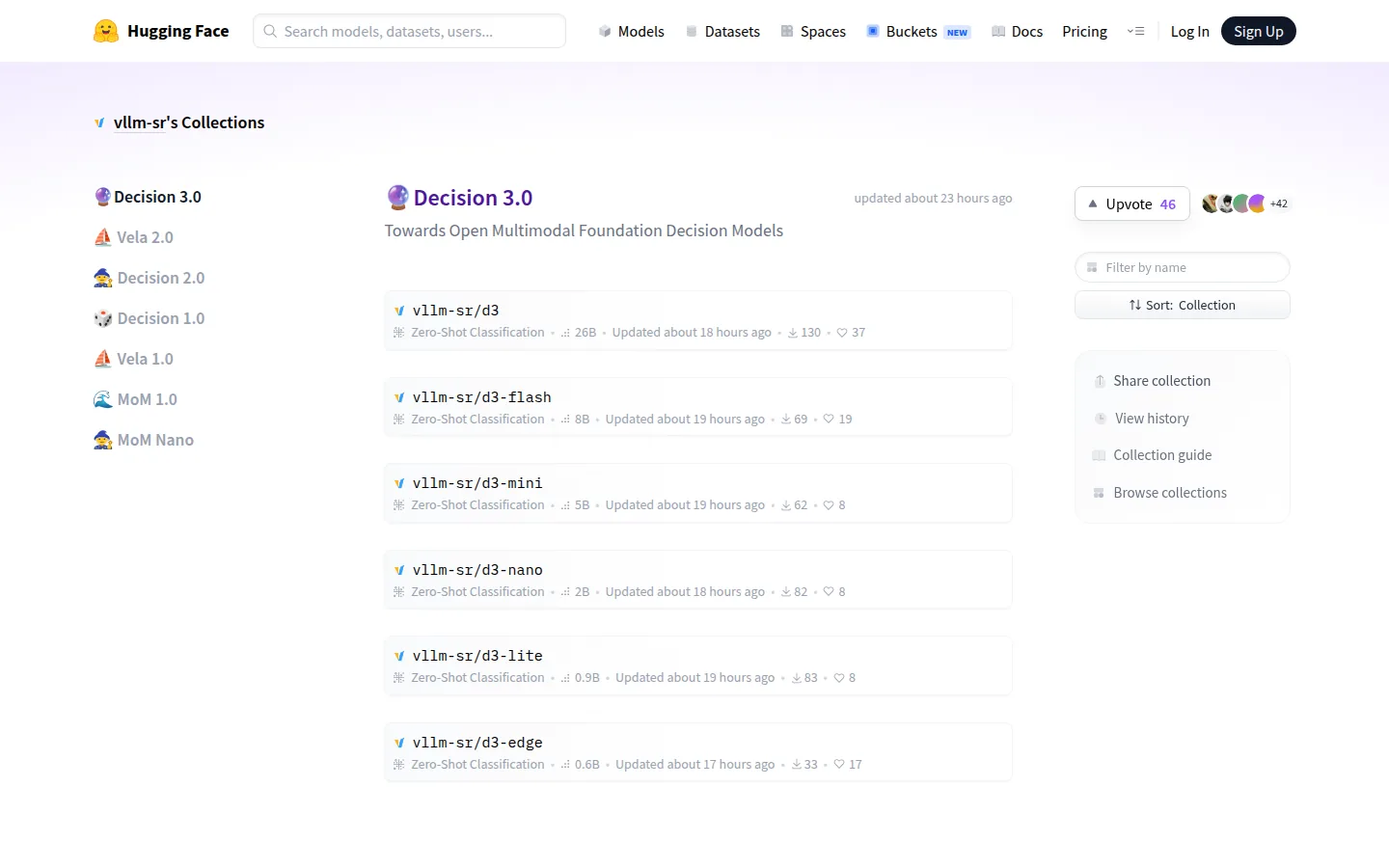
Decision 3.0 is the first release in this family to read images and video. Decision 2.0, published in September, takes text or JSON only, and its cards carry no vision tag.
One call carries everything: a state, optional images and videos, and a dictionary of questions. A question is a choice among criteria you supply, a yes or no, or a score. Every question sees every image in the request, and each answer comes back as a probability.
The limits the publisher states
- Images are read at up to 1.6 megapixels each.
- Videos are read at 2 frames per second, at most 32 frames per clip, each frame at up to 0.2 megapixels.
- Every measurement in the cards was taken on AMD Instinct MI325X hardware, one request at a time.
What the claim rests on
The headline figures are the publisher’s own runs, and the cards say how they were taken. Each score for a released model was measured with the official 0.3 kit on the released weights, with all 140,178 public requests answered and none reported as unsupported. That second part is worth more than the score: no request was skipped because the model could not handle it.
The rows a buyer will compare against are a different kind of number. The d3 card footnotes them as live board data, dated October 9 for vision and October 10 for text, while the released model was run with the official kit. The two kinds of figure sit in one table and were not produced the same way.
| Model | Index | Public | Same-skill | New domain |
|---|---|---|---|---|
| d3 | 64.7 | 65.5 | 62.8 | 56.6 |
| Perplexity Decider v1.1, 27B | 62.8 | 62.3 | 61.1 | 55.6 |
| Fastino GLiDE, no thinking, 28B | 60.2 | 59.1 | 59.5 | 52.9 |
| Jev | 60.1 | 58.0 | 58.0 | 55.0 |
| Torchcast Decision, 27B | 59.9 | 65.1 | 58.1 | 50.8 |
| Decision 2.0, 27B | 55.9 | 57.0 | 55.7 | 47.9 |
The Jev Decision Index 0.3.1 table from the d3 card, read on October 11, 2026. A second index version appears in the same card: the highlights quote 65.45 for d3 on the 0.3 suite, 0.75 points above the 0.3.1 figure here.
Two of those footnotes matter more than the table. The comparison with Decision 2.0 is the same kit on both sides, so the +8.5 claim is a like-for-like statement about the family. The comparison with Decider, GLiDE, Jev and Torchcast is not: those figures come from a board, not from a run the publisher made on release day.
What is not published
- No evaluation by anyone outside the project, on any of the six models.
- No per-area breakdown for the five smaller builds, and no vision or video figures beyond the Perception Test column.
- No context length in the specification tables, where the Decision 2.0 card listed 32,768 tokens.
- No latency under load: the medians are one request at a time, with no concurrency and no p95.
On this page
What it changes for a team paying per classification call
If a provider is billing you for small classification or routing calls, Decision 3.0 is a like-for-like replacement with a different bill. Apache-2.0 weights and no per-call fee move the cost to your own hardware, and the medians say what that hardware has to do: 6.7 ms for a text decision on the smallest build, 55 ms on the largest.
The interesting case is not the flagship. It is the cluster at 0.59B, 0.85B and 2.21B, where the public suite lands between 28.82 and 42.22. For a routing decision whose error is cheap, that trade is worth doing on your own machine. For a decision where a wrong answer costs a refund or a moderation miss, the same numbers say the opposite.
The video path is the newest and the least documented. Only the flagship card publishes a per-area breakdown, and the video figures are internal, so a team that wants frame-level decisions should treat the 46.6 to 77.4 range as a starting point to re-measure rather than a specification.
The Neural Minute take
Our reading is that Decision 3.0 is two products wearing one name. The 26B build is a decision model that now handles images and video and beats the previous generation on the publisher’s own index. The builds under 1B are infrastructure: they turn a per-call classification into a fixed cost, and they are honest about being less accurate.
Our arithmetic, then, and the reason to read the table rather than the headline. The spread inside the family is 36.6 index points, from 28.82 to 65.45. The margin over the nearest named competitor on the flagship is 1.9 points, and the margin over the previous generation is 8.5. Which size you pick matters far more than where the family sits on a board.
Two details in the publisher’s figures deserve a flag. d3-lite at 0.85B shows a slower text median than the 2.21B d3-nano, 13.1 ms against 12.9 ms, so these medians are not a size ordering to trust. And d3 scores 43.9 on the moderation benchmark in a vision table where most other rows sit above 70: near a trust and safety path, that is the row to test first, not the 71.6 vision index.
Give it an input (text or JSON, optionally with images and videos) and the questions you need answered: pick one of several options, say yes or no, or rate on a scale.
That sentence from the flagship card is what actually changed. A probability per option in one pass is what lets a router decide without paying for a generation, and adding images and video to that path is new for this family. The license, not the accuracy, is what changes the bill.
What we would ask before switching: our own prompts through the official kit, our own p95 instead of the published median, and the context limits the cards do not state. The measurement stays yours to make.
Sources
- Decision 3.0, the collection of six models published by the vLLM Semantic Router team, last updated on October 10, 2026: https://huggingface.co/collections/vllm-sr/decision-30-6aca5f47b0d942380f6e4a64
- d3, the 26B card, source of the tables, the vision rows and the medians, read on October 11, 2026: https://huggingface.co/vllm-sr/d3
- The five smaller cards, source of each build’s score and median: https://huggingface.co/vllm-sr/d3-edge
- Decision 2.0, the previous release of the same family, whose cards carry no vision tag: https://huggingface.co/vllm-sr/Decision-2.0-Vega-27B