Toast announced its Fall Release 2026 on October 6, 2026, adding Toast IQ Team, a new labor management package, and expanding Toast IQ Grow, the marketing package it introduced earlier in the year. The company counts more than 20 updates in the release and sells them as parts of one platform rather than as separate tools. Toast IQ Team is on sale now. Several of its new agents, and most of the new agents in Toast IQ Grow, ship in beta.
What was actually released
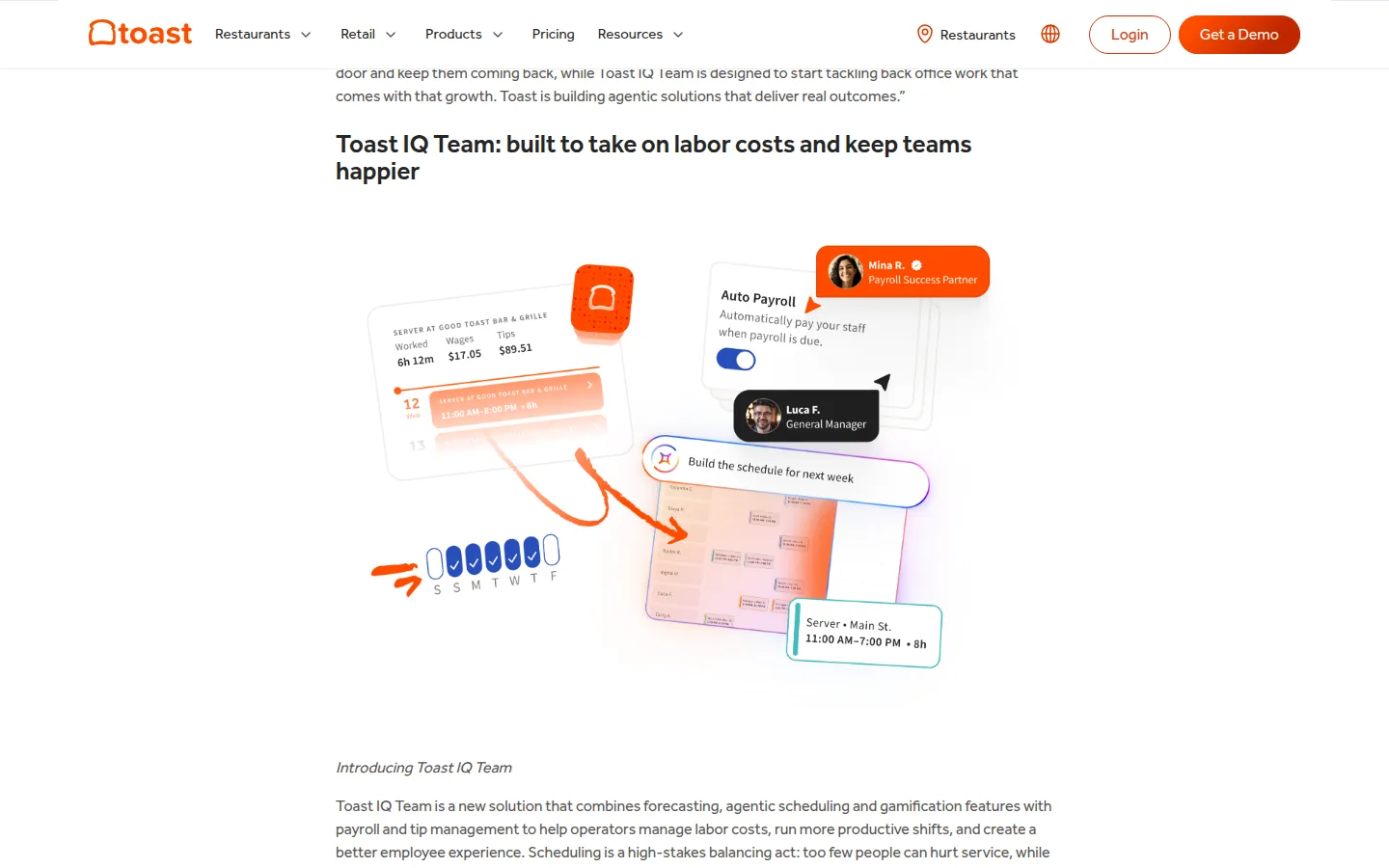
Toast IQ Team folds scheduling, payroll and tip management into one paid package. Three pieces are new. Sales forecasting reads a restaurant’s own point-of-sale history to project demand. The Scheduling Agent, in beta, builds a full schedule from employee availability, expected sales and overtime risk. Team Performance runs contests around high-margin menu items, with live leaderboards inside MyToast, the employee app. Around those sit a tips manager that automates tip pool math, payroll-linked health insurance and 401(k) plans, and Payroll Success Partners, a named human support team for payroll questions. Toast sells the package, not the agent: the product page markets software, an AI agent and human support together, at one price.
Toast IQ Grow keeps the agentic marketing stack it launched with and adds three agents. An SEO Agent, in beta, inspects a business’s online presence and its Toast data, then proposes fixes for what limits it in traditional and AI-driven search. A Reviews Agent prompts guests for public reviews at moments they already engage, such as an order confirmation, and routes unhappy guests to a private channel. An Offers Agent, in beta, recommends promotions against goals the operator sets. A Marketing Agent, already live, drafts email, SMS and social campaigns for approval. Two professional photo shoots a year are now part of the package.
Away from the two packages, Toast is testing agents for menu editing, phone answering and configurable tasks in its Test Kitchen, and it added Spanish, Simplified Chinese and Quebec French to Toast Web, the Toast IQ assistant and its handhelds and terminals.
Every figure below is one the announcement leads with, next to the basis Toast gives for it in its own footnotes.
| What Toast measured | Figure | Basis it gives |
|---|---|---|
| Overtime hours per employee, scheduling users against non-users | 41% lower | Toast internal data, July 2025 to 2026 |
| Total sales on featured menu items, contest restaurants | 10% average lift | Toast internal data, 96 contests, February to June 2026 |
| Alcohol sales during one contest, MugShots Bar and Grill | 14% lift | Customer and internal data, June 4 to 7, 2026 |
| Google reviews and five-star reviews, Tarka Indian Kitchen | 39% and 41% higher | Self-reported by the customer, two ten-week windows |
| Happiness at work, Toast users against other POS users | 92% against 74% | Toast survey, 90 and 486 employees, February to March 2026 |
| Operators experimenting with AI for business purposes | 86% | Toast survey, 676 decision-makers, April 3 to 20, 2026 |
What the claim rests on
Every performance figure in the release is Toast’s own. They come from Toast internal data, a survey Toast ran, or a customer’s self-report, each footnoted on the page. None of it is a controlled trial, and none of it is independently audited.
The comparison the announcement leads with, 41% fewer overtime hours per employee, sets restaurants already using the scheduling product against restaurants that do not. The two groups were not assigned at random, and Toast states in its footnote that the data does not account for its other offerings. The 10% sales lift on featured menu items averages 96 contests run between February and June 2026. The 14% alcohol lift at MugShots Bar and Grill covers four days, June 4 to 7, 2026, against the same period a week earlier. The Tarka Indian Kitchen figures, 39% more Google reviews and 41% more five-star reviews, are self-reported by the customer, and the owner is named and quoted in the release.
What the announcement does not carry
No price for Toast IQ Team or Toast IQ Grow, and no price for any of the new agents. Both product pages route the question to the general Toast plan page, which lists point-of-sale plans rather than these packages. No release date for the beta agents beyond early access. No retention terms for the sales, employee and guest records the agents read. And no independent measurement behind any figure in the table above.
On this page
What it changes for restaurant operators
For an operator, the change is not that a new agent exists. It is that agentic features are arriving inside back-office software a restaurant already pays for, next to payroll, tips and scheduling, rather than as a separate subscription to bolt on.
That bundling has a practical consequence. A scheduling agent reading the same sales data as the point of sale can build a schedule against real demand, which a standalone tool cannot do without an integration. The cost is that the data and the agents come from one vendor, so the exit cost rises with every module added.
Two things are worth checking before adding the package. First, which agents are in beta, and what happens to a schedule a beta agent produces when the operator edits it. Second, who owns the records the agents read, and what happens to them if the operator leaves.
We have written before about agents that overstate their own results, and the pattern to watch for here is the same: a figure that arrives with no method attached. That is the case with our report on agent self-reporting.
The Neural Minute take
The interesting part of this release is the packaging, not the agents.
Toast is selling labor management and marketing as a single package that includes a named human support team, at one price, with the AI living inside software the operator already runs. That is a different bet from shipping a chatbot: it puts the vendor on the hook for an outcome, not for a tool.
Our reservation is about the proof. The strongest figure in the release, 41% fewer overtime hours, compares two groups of restaurants that chose their own tools, and Toast says the comparison ignores its other offerings. Read it as a direction, not a measurement.
“We continue to build on our vision for the Toast IQ ecosystem to take on the heavy lifting for restaurants and retailers, especially in the heat of a busy shift.”
That is the claim in the company’s own words: taking on the work, not assisting with it. The release backs the first half well and the second half not at all, because none of the numbers come from a controlled test.
Two things would change our read. A published price for Toast IQ Team, so an operator can weigh it against the scheduling tools it replaces, and an overtime figure from a matched or randomized comparison. Until then, this is a product announcement with a vendor’s numbers attached, which is normal and should be read as such.
No price for Toast IQ Team or Toast IQ Grow appears in the release.
Sources
- Toast Fall Release 2026, the announcement, Toast, published October 6, 2026: https://pos.toasttab.com/news/toast-fall-release-2026
- Toast IQ Team product page, read on October 13, 2026: https://pos.toasttab.com/products/toast-iq-team
- Toast IQ Grow product page, read on October 13, 2026: https://pos.toasttab.com/products/toast-iq-grow
- Toast plan page, read on October 13, 2026, for what it does and does not publish: https://pos.toasttab.com/pricing