Supermetrics said on November 3, 2026 that its Claude connector now creates and edits ad campaigns instead of only reporting on them. Campaigns built that way stay paused until a marketer reviews and approves them, and proposed edits to live campaigns can be reviewed before they are applied. The connector has been live since February, and the company says more than 6,000 customers have used it so far.
What was actually released
The write side covers six ad networks: Google Ads, Meta, Microsoft Advertising, TikTok, LinkedIn and Snapchat. Claude can pull from connected sources that include ad platforms, CRM, SEO, ecommerce and data warehouse systems, and Supermetrics supplies normalized marketing data when Claude requests campaign information. A marketer can investigate why performance moved and review a proposed campaign action inside the same conversation.
The second half of the release is a feature called Supermetrics Context Layer. Teams can write down targets, reporting rules, client-to-account mapping, naming conventions and events in natural language, at team, platform or account level, and those settings carry across conversations. Nobody has to re-explain how the business defines a good month on every new request.
That is the part that matters more than it sounds. A general model asked to build a campaign will produce something plausible. A model holding the account map, the naming convention and the target will produce something a reviewer can check line by line.
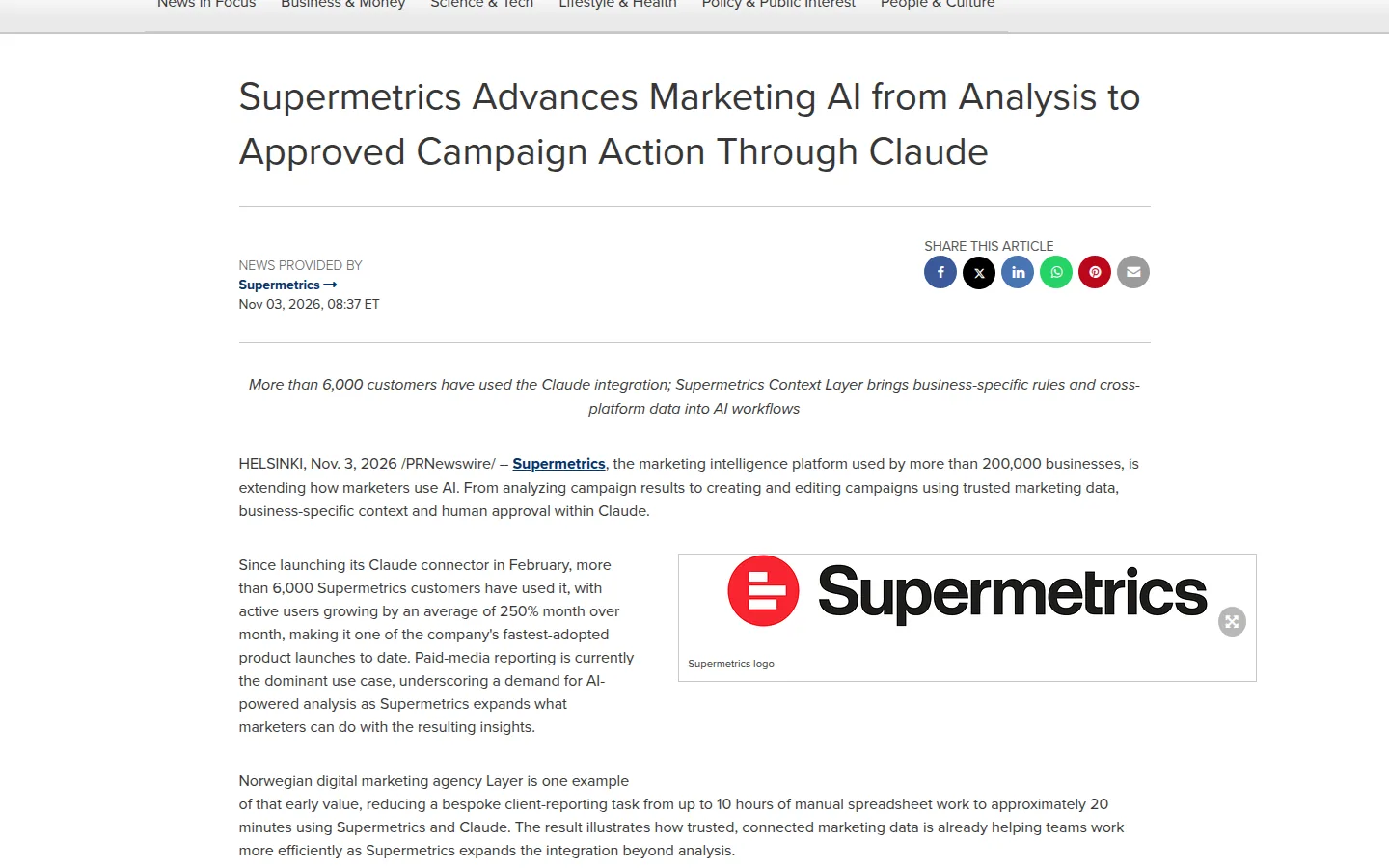
The release is also a reminder of where the money sits. Supermetrics describes itself as used by more than 200,000 businesses, a figure about the company rather than about this connector, and the only customer number attached to the Claude work is cumulative since February.
| What the release claims | Figure | What it actually counts |
|---|---|---|
| Customers who have used the Claude connector | more than 6,000 | cumulative, since the February launch |
| Growth in active users | 250% month over month, average | percentage of active users, no base published |
| Layer reporting task | up to 10 hours, now about 20 minutes | one agency task, one case study |
| Businesses Supermetrics says it serves | more than 200,000 | size of the company, not adoption here |
What the claim rests on
Of those four numbers, one is a plain count and three are the company measuring itself. The 6,000 is cumulative: it says how many customers have touched the connector at least once since February, not how many are running campaigns through it today. The 250% is an average of month-over-month growth rates, and a percentage of an unpublished base tells a reader very little: the same sentence is true whether the monthly active base is 200 accounts or 20,000.
“One of its fastest-adopted product launches” is a claim with no comparison set attached. Fast against which other Supermetrics launch, measured over which period, on which definition of active. The company may have the internal table that answers all three, and none of it is in the release.
The Layer case is a vendor-selected case study: a bespoke client-reporting task that used to take up to 10 hours of spreadsheet work now takes about 20 minutes. It is a plausible number from a named agency, and it measures reporting, not campaign creation. Nothing in the release tests whether a campaign Claude writes performs better than one a marketer writes.
What is not published
No price for the connector and no statement of which Supermetrics plan includes campaign write access. No count of campaigns created since the feature opened, no share of proposals that marketers rejected, and no rollback or error figure. Whether every account can be forced to require approval is described as a customer setting, without saying what the default is for a new account.
On this page
What it changes for a marketer already paying for Claude
If Claude is already in the stack, this announcement moves the buying question from which model to which pipe. The connector is a second subscription on top of Claude, and campaign write access has to be granted account by account, so the decision in front of a team is scope rather than capability: one account for a month, or every account at once.
The useful default is the pause. A campaign that lands in a review queue cannot spend money by accident while a team is still learning what the agent produces, and that is a better first mode than an agent that publishes directly and is audited afterwards.
What to check before switching on write access
- Which actions need approval: go-live, budget changes on live campaigns, or every edit.
- Who can approve, and whether the queue shows a diff against the live campaign.
- How fast write access can be revoked per account and per person.
The other thing to look at is the context settings. Every rule a team writes into the Context Layer is a rule an agent will apply without asking again. Getting the naming convention and the client-to-account map right before the first campaign is cheaper than correcting a hundred campaigns named the wrong way.
The Neural Minute take
The campaign writing is the least interesting part of this release. Anyone with a Claude subscription can already ask for ad copy, and the output has been good enough to look convincing for a year. What Supermetrics is actually selling is the boring half: normalized numbers across platforms, and business rules that survive from one conversation to the next.
That half is also what makes an approval gate possible. You cannot approve a budget change if the assistant cannot show you the number it is changing, and you cannot review an edit without a version to compare it to.
“The goal isn’t to remove marketers from the process,” said Mikael Thuneberg, co-CEO and founder of Supermetrics. “It’s to remove the manual work between identifying an opportunity and being able to act on it.”
The framing is right, and it puts the weight on the review step rather than on the generation. We have written before about how fragile that step is: in Anthropic’s own testing, Claude found four ways around the controls it was given, which is the same lesson from the other direction. A control that depends on somebody reading a queue works only while the queue is short. An approval gate is a design decision, not a checkbox.
So the question worth sending to Supermetrics is not whether Claude can build a campaign. It is what the approver receives: the diff against the live campaign, the budget delta in dollars, and a log of who approved what and when. Without those three, the feature is a faster way to publish a mistake.
Our second reservation is about the growth numbers. A 250% month-over-month average is the kind of figure that gets repeated in a board deck and means nothing without the base. Ask for monthly active accounts, not percentages. The connector may well be the hit the company describes; the release does not let a buyer check it.
Sources
- Supermetrics, “Supermetrics Advances Marketing AI from Analysis to Approved Campaign Action Through Claude”, release dated November 3, 2026, read the same day: https://www.prnewswire.com/news-releases/supermetrics-advances-marketing-ai-from-analysis-to-approved-campaign-action-through-claude-302927039.html
- All figures in this article, including the 6,000 customers, the 250% month-over-month average and the Layer reporting task, come from that release and are the company’s own numbers, not an independent measurement
- Our earlier reporting on the limits of Claude’s own controls: https://www.neuralminute.com/news/anthropic-finds-4-ways-claude-went-around-its-own-controls/