
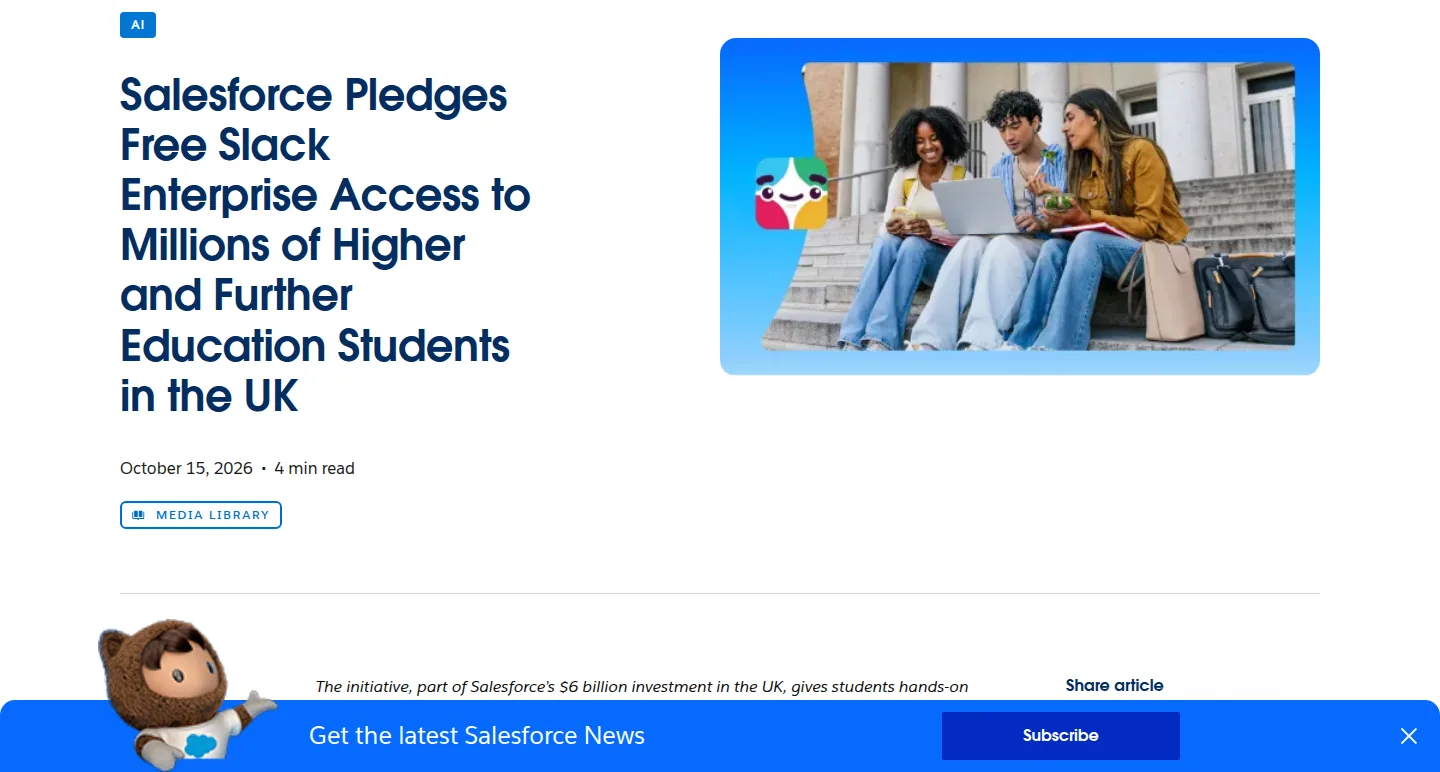
Salesforce announced on October 15, 2026 that colleges and universities in the UK will get Slack Enterprise at no cost for their students, with Slackbot included. The company calls the pledge a global first and puts its reach at millions of higher and further education students. It sits inside the $6 billion Salesforce committed to its UK business through 2030, and it follows the expanded London campus the company opened in May 2026.
What was actually released
Students get a seat on Slack Enterprise, the tier Slack sells to companies, and Slackbot, the assistant Salesforce made generally available in January 2026. Slackbot answers plain-language questions from the files and discussions a workspace already holds. Institutions can also place AI agents in channels to handle student services queries, coordinate study groups or help academic research teams. No new model ships with this announcement: the product is already on sale, and what changes is who pays for it.
Every institution keeps full administrative control, sets its own permissions and guardrails, and Salesforce states that student data stays compliant with UK data regulations and is never used to train external AI models. That last sentence carries more weight than anything else in the release, and it is written as a promise on a marketing page rather than as a term in a contract. The release gives no schedule, no seat count and no list of the colleges and universities taking part.
The figures the release leans on come with very different levels of backing, and the page separates them far less clearly than this table does.
| What the release states | Figure | Where the page points for it |
|---|---|---|
| UK workers who receive no AI training | 61% | A poll hosted outside the Salesforce site |
| Young people in the UK classed as NEET | 1 million | A UK government report |
| Investment the pledge sits inside | $6 billion through 2030 | An earlier Salesforce release |
| Organizations using Slack worldwide | More than 200,000 | Salesforce’s own count |
| Students trained by Future Trailblazers since early 2026 | 14,500 | Salesforce’s own program |
What the claim rests on
The two figures that carry the argument are not Salesforce’s own research. The 61% comes from a poll the release links to on a site outside its own, and the 1 million young people classed as NEET, meaning not in education, employment or training, comes from a UK government report. Neither is published on the release page, so a reader who wants to check either one has to leave it. The 200,000 organizations and the 14,500 students are Salesforce’s own counts, which nobody outside the company can audit.
The reach claim is the softest part of the announcement. Millions is a pledge, not an enrollment: the page names no institution and no seat count. The headline promises millions, the visual Salesforce publishes with it is filed as 6 million UK students, and nothing on the page reconciles the two numbers. The outcome behind the whole scheme, whether graduates actually get hired, is written as an aim rather than a measurement: a stronger talent pipeline and preparation for the modern workplace, with no baseline, no metric and no evaluation design.
What the release does not publish
No list of participating colleges and universities, no start date, no seat count, and no eligibility rules beyond the two student groups it names. No method for the 61% figure on the page that uses it, and no source for the 1 million figure beyond a link out to a government report. No price for what a student or an institution pays when the arrangement ends.
On this page
What it changes for buyers of workplace AI
For anyone who pays for workplace software, this reads as distribution before it reads as education. Slack Enterprise is the tier companies buy seats on, and training a generation on it at the moment they learn to work puts the product in place long before an employer runs a comparison of assistants. That is cheaper than advertising and harder to undo, because the habit arrives with the graduate rather than with a request for proposals.
The consequence for a buyer sits in the negotiating position rather than in the price. What students learn now shapes what a hiring manager expects in three years, and an expectation that arrives with a workforce is expensive to argue with. This is an old play run on a newer product: free seats where people learn, paid seats where they go on to work.
We covered the same pattern at consumer scale when Egypt’s communications ministry and Google opened a free year of Google AI Plus to university students, and our report on the Egypt program has the details. The UK case differs in one respect that matters: it hands over an enterprise tier with administrative controls, which is a much harder thing to walk back than a consumer subscription that expires on its own.
Two checks are worth making before treating this as a skills program. The first is what happens to a student’s workspace and its history at graduation, since the release protects data from model training and says nothing about what the institution or the vendor keeps. The second is whether institutions get anything they could not already buy, or whether this is a discount with a press release attached.
The Neural Minute take
The sentence that matters here is not about free access. It is the promise that student data is never used to train external AI models. That line is in the release because it is the first question every college will ask, and the same question now opens every enterprise AI deal. The free seats are the easy part. The training-data term is the part to hold Salesforce to.
“Young people will define the next decade of UK business, and it’s imperative that students across all disciplines are able to learn to use AI responsibly.”
That is Zahra Bahrololoumi, who runs Salesforce UK and Ireland, in the release’s own words. It is a fair ambition and it is not measurable as written, which is the shape of the whole announcement: a company that can count seats and students is publishing neither count.
Our reservation is the one we keep making about vendor numbers. Nothing here has a baseline. The 61% and the 1 million come from somewhere else, the 14,500 students is Salesforce counting its own program, and the outcome the pledge is really about, whether graduates find work, has no published design at all. The company also keeps the rules: every institution gets administrative control, which means every institution also takes on the work of deciding what its students may do with the assistant.
Two things would change our read. A list of participating institutions with seat counts, and an evaluation with a baseline and a date. Until then this is a well-aimed distribution pledge carrying one sentence worth quoting back at the company the next time it sells an AI assistant into a workplace.
Sources
- Salesforce UK press release, “Salesforce Pledges Free Slack Enterprise Access to Millions of Higher and Further Education Students in the UK”, published October 15, 2026: https://www.salesforce.com/uk/news/press-releases/2026/10/15/slack-education-announcement/
- “Free Slack Enterprise for UK Students”, the participation page the release links for colleges and universities, Salesforce UK, read on October 15, 2026: https://www.salesforce.com/uk/slack/education/
- “Salesforce Announces the General Availability of Slackbot”, published January 13, 2026, for what Slackbot is: https://www.salesforce.com/uk/news/press-releases/2026/01/13/slackbot-announcement/
- “Salesforce Deepens Commitment to UK AI Innovation, Increases Investment to $6B”, published September 16, 2025, for the investment the pledge sits inside: https://www.salesforce.com/uk/news/press-releases/2025/09/16/united-kingdom-investment-announcement/