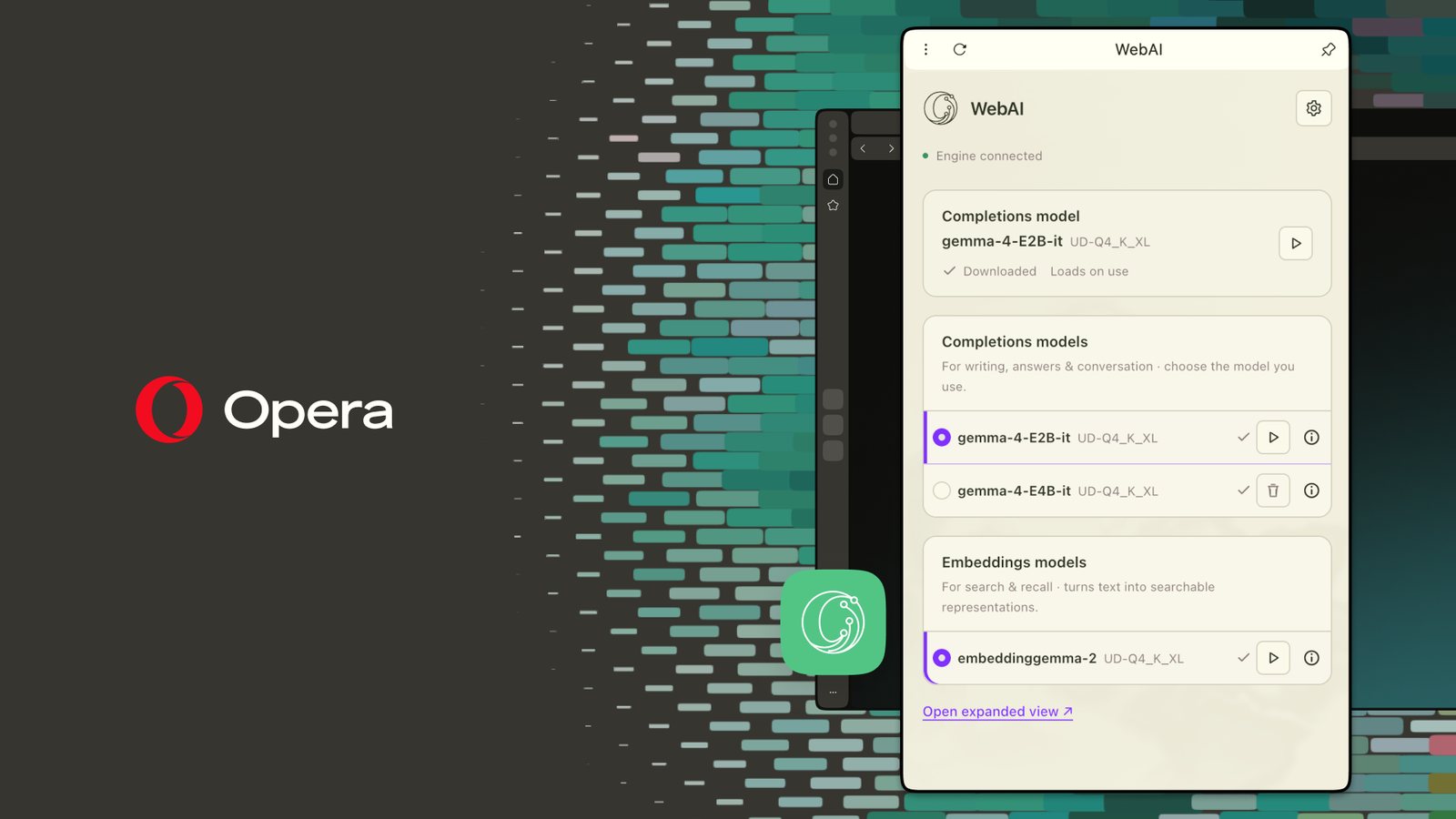
Opera began shipping local AI models inside its browsers on October 27, 2026, with the first capabilities arriving as an opt-in early preview in Opera One and Opera GX and Opera Neon promised to follow. The feature, WebAI, runs models on the machine in front of the user instead of sending every request to a cloud provider, and Opera presents it as the first step of a longer push.
What was actually released
Opera describes WebAI as a proposed web standard, backed by companies such as Google and Microsoft, that lets websites and browser extensions use AI hosted through the browser. Its implementation is model-agnostic and built around open models. At launch, users can reach models from Google and Apple, including Google’s Gemma and, on Macs, Apple’s on-device foundation model.
Turning it on is a setting rather than an install: Settings, then Opera AI, then Enable Web AI API, which downloads a compatible model and can take a few minutes. Nothing is downloaded until the user switches it on, there is no separate app, no local server and no API key to obtain, and site-specific permissions decide which websites may reach the local model.
The developer surface is a set of browser APIs. The release names three, Prompt, Decision and Semantic Embeddings, for generating text, classifying information and understanding how pieces of content relate. Opera’s Web AI page adds Summarizer, Writer, Rewriter, Translator and Proofreader, each with a playground that runs in the browser.
What ships with the preview
- Local inference built into the browser, so no cloud round trip for the request itself
- Models from Google and Apple, including Gemma, plus Apple’s on-device model on Macs
- Eight APIs listed across the release and the Web AI page
- Six example extensions that Opera calls idea starters, not features
Opera also shipped HTML-in-Canvas the same day: live web pages inside 2D and 3D scenes, aimed at games and at Opera GX, with demos that run without setup.
What the claim rests on
The release is specific about what the browser does and quiet about how well it does it. Support stops at 64-bit Windows PCs with Intel or AMD processors and at Macs with Apple silicon.
| Platform | WebAI early preview |
|---|---|
| 64-bit Windows PC, Intel or AMD | Available |
| Mac with Apple silicon | Available |
| Intel-based Mac | Not available |
| Linux | Not available |
| Windows on Arm | Not available |
The two Opera pages describing the launch disagree on where it is live. The release, dated October 27, 2026, says the first capabilities are available in Opera One with GX and Neon to follow. The developer post on Opera’s Next site, dated October 22, 2026, says the preview runs across Opera One, Opera GX and Opera Neon. A reader who wants to test on GX cannot tell which to believe.
Nothing quantitative is published: no model size, no disk footprint for the download, no memory requirement, no tokens-per-second figure and no benchmark against the cloud models the same browsers already call. That performance depends on the hardware is true of every local model, and it is the only statement on speed.
A lot of what people want from AI doesn’t need a data center. Your laptop can already do it, without sending your data anywhere.
The sentence is Krystian Kolondra’s, Opera’s EVP of Browsers and AI, and it carries the argument. The privacy half has the same shape. Opera says the content the local AI processes does not need to be sent to a cloud provider, which is true of the inference step, and says nothing about what the six example extensions do with the text they read. For a feature sold as data that stays on the device, the paths off the machine are the part buyers want first.
What Opera does not publish
No model list with versions, no disk or memory figures, no speed measurement, no accuracy comparison against the cloud models the browser already uses, no date for GX and Neon, no statement on what the example extensions send. The standard is described as backed by Google and Microsoft, but the release links to Opera’s own pages, not to the proposal.
On this page
What it changes for people paying for AI tools
The bill changes shape before it changes size. Cloud models charge per token, and our records are small but never zero: Anthropic priced Haiku 5.5 at $0.10 per million input tokens and Google opened Gemini 4 Argon at $2 per million. Local inference removes the per-request line and moves the cost into hardware the user already owns, with no account to create and no key to rotate.
That makes three kinds of work free at the margin: classification, rewriting and short summarization of text already on screen. Opera’s examples point at the same list, sorting tabs, flagging clickbait, spotting job posts, ranking articles by relevance, quizzing the reader on a page. None needs a frontier model, and all of them run up a metered bill when an extension calls a paid API on every page load.
The ceiling does not move. Nothing in the release shows that a model small enough for a laptop matches a frontier model on extraction or instruction following, and the APIs are described by what they do, not by how reliably. A team that moves a paid pipeline onto WebAI on the cost argument alone trades a known bill for an unmeasured error rate.
The platform list is the harder constraint: Linux, Windows on Arm and Intel Macs are excluded, which covers a large share of developer laptops and nearly every CI runner.
The Neural Minute take
The important line in this release is not the model, it is the meter. Browsers are the cheapest distribution channel in software, and Opera is using one to hand out inference that nobody bills for at the request level. If the same standard arrives in Chrome and Edge, the floor under API pricing for small, repetitive text work drops to the price of the laptop.
For a one-person operation running content and lead automation, the realistic move this week is narrow. Take the one text task you repeat every day, the classification of a feed item or the rewrite of a headline, and run it through WebAI on a supported machine against your own review bar. If the output survives, that task leaves the metered bill. If it does not, you have spent an afternoon and learned that a free on-device model is a filter, not a writer.
Two things to watch: a published date for GX and Neon, where the consumer volume sits, and a model list with versions, because a local model that changes silently under an extension is a reproducibility problem for anyone who logs outputs.
Sources
- Opera doubles down on local AI, shipping models directly in its browsers, Opera Newsroom, published October 27, 2026, read the same day: https://press.opera.com/2026/10/27/opera-doubles-down-on-local-ai-shipping-models-directly-in-its-browsers/
- The date of the fact is that release’s publication date, not the age of the feed item that surfaced it
- WebAI: Local AI for the web, now in Opera, Opera’s developer post dated October 22, 2026, and the Web AI developer page, both read on October 27, 2026, for the API list and the extension examples
- Platform limits, the Apple and Gemma models and the Kolondra quote are as written on the release page
- Rates for the other models come from each vendor’s own page, read on the dates given in the linked actus