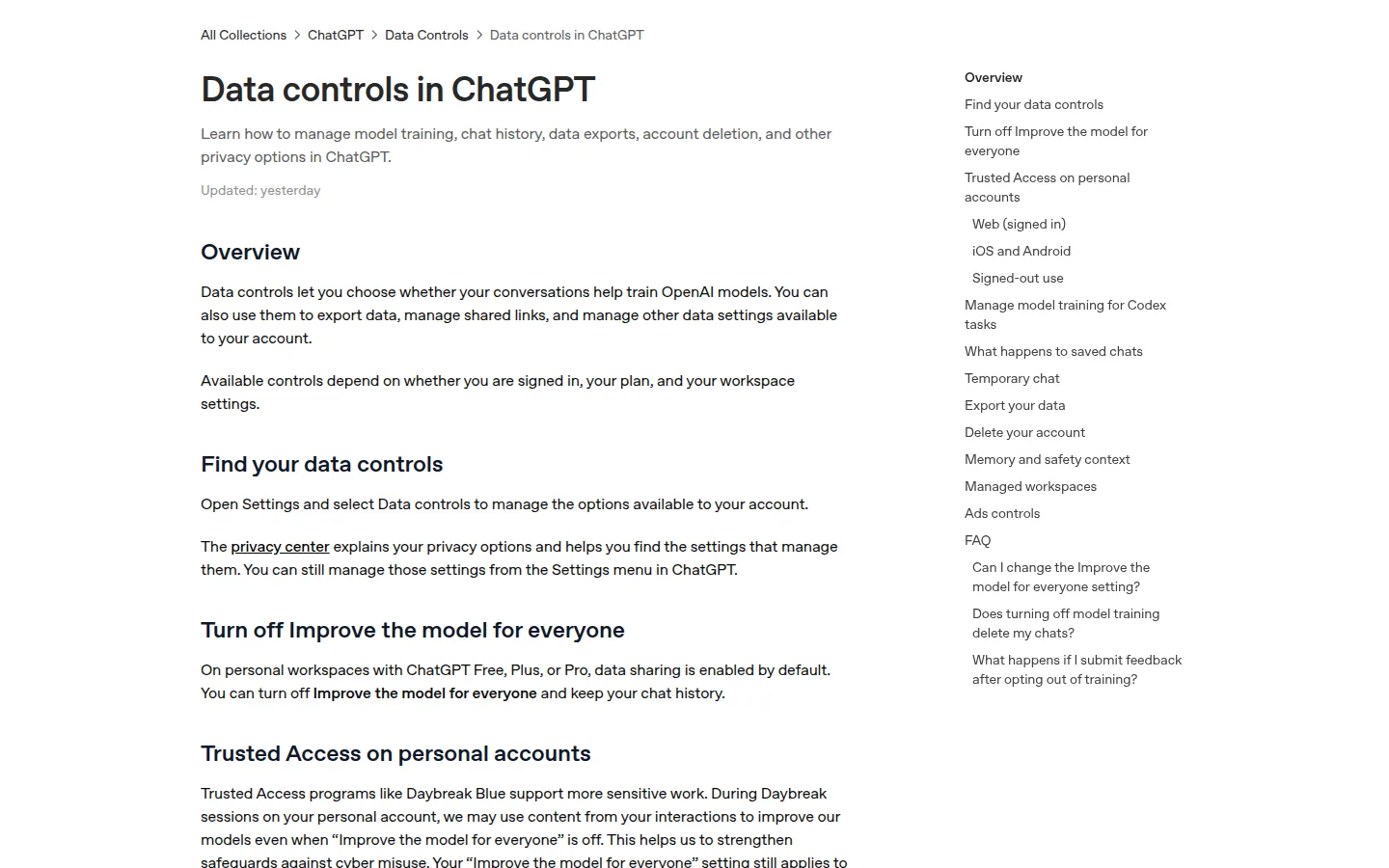
OpenAI rewrote a section of its ChatGPT data controls page on October 30, 2026, and the new text changes what happens to the most sensitive work its cybersecurity program handles. The section is titled “Trusted Access on personal accounts”, and it states that during Daybreak sessions on a personal account, OpenAI may use content from your interactions to improve its models even when “Improve the model for everyone” is off. We read the page on October 31, 2026, and compared it with copies the Internet Archive took on October 22 and on October 30. The clause was not there.
What was actually released
Nothing ships. There is no model, no price, no plan change and no announcement page: the change is a paragraph in a help center article about switching training off. For anyone running Daybreak Blue, that paragraph is the release.
Daybreak Blue is the lower of two access tiers in OpenAI’s Trusted Access for Cyber program, next to Daybreak Red. Blue keeps standard safeguards on most mainline models but reduces refusals for approved defensive work, and the program’s own overview page lists the workflows it covers: vulnerability triage, secure code review, malware analysis, detection engineering, incident response and patch validation. Individual access needs an eligible paid plan, Advanced Account Security and at least one hardware security key, which is a lot of ceremony for a program that now reads session content for training.
During Daybreak sessions on your personal account, we may use content from your interactions to improve our models even when “Improve the model for everyone” is off.
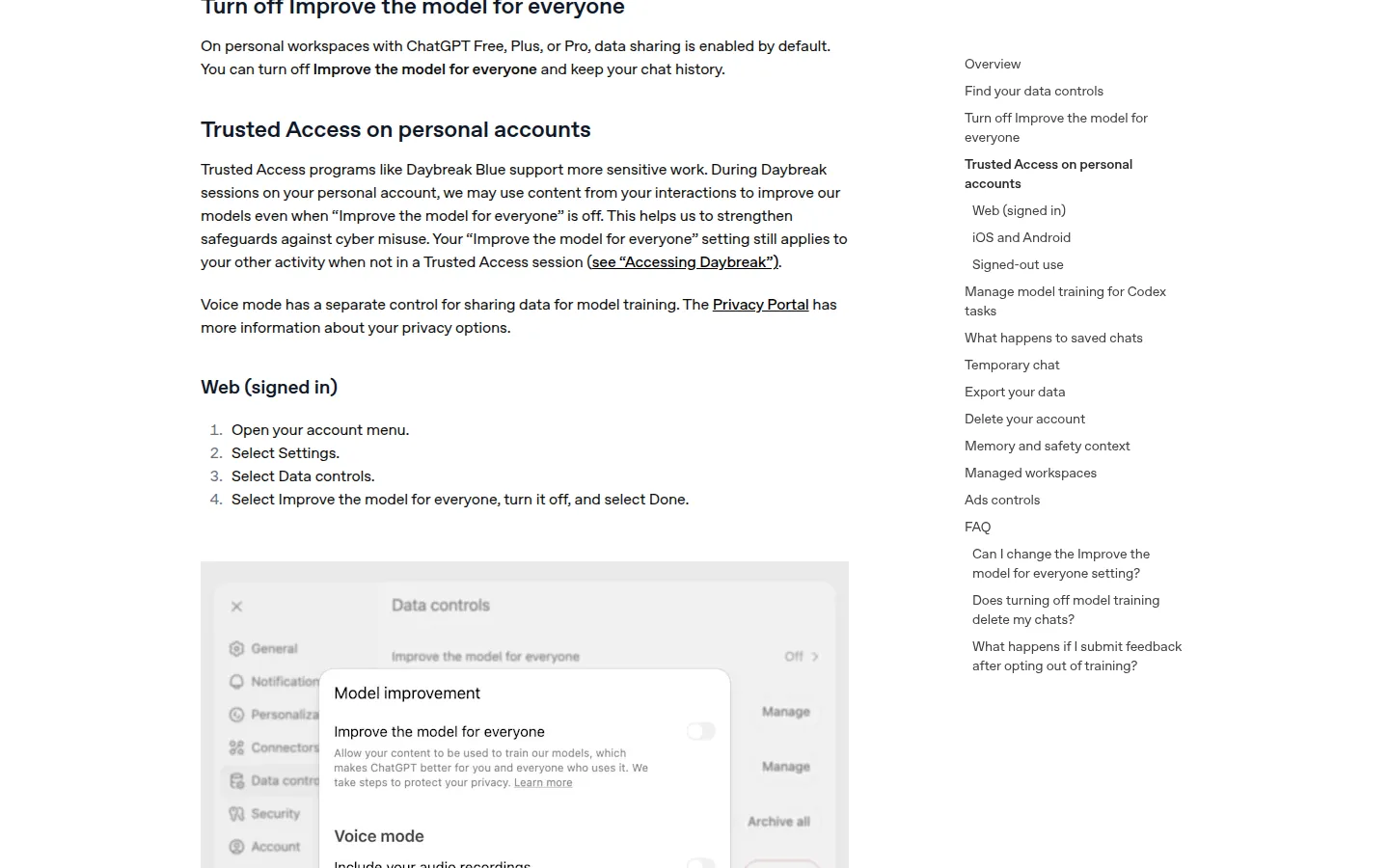
What the page now says, in three lines
- The exception sits inside the setting, not next to it: the same page says your “Improve the model for everyone” choice still applies to your other activity when you are not in a Trusted Access session.
- The qualifier is “personal account”, not “Daybreak”: managed workspaces and the API Platform keep their own defaults, listed further down that same article.
- The verb is “may”. Nothing is promised in either direction, and no volume, session type or start date is given.
What the claim rests on
A documentation edit is not a press release, and this one leaves no dated trace on the page itself. The live article carries a relative stamp, “Updated: yesterday”, as served on October 31, 2026. Nothing in it gives an absolute date, an effective date or a rollout schedule. What pins the change to October 30 is the archive, not the page: a copy captured on October 22, 2026 contains no mention of Trusted Access or Daybreak anywhere in the article, a copy captured on October 30, 2026 at 15:35 UTC still does not and still displays “Updated: 4 days ago”, and the section is there the next day. The program’s own overview page, stamped as updated three days before our read, says nothing about training.
| Copy of the page | Stamp shown on the page | Trusted Access section |
|---|---|---|
| Captured October 22, 2026 | Updated: 10 hours ago | Absent |
| Captured October 30, 2026, 15:35 UTC | Updated: 4 days ago | Absent |
| Read October 31, 2026 | Updated: yesterday | Present |
What OpenAI does not publish
- No effective date. The page does not say whether the clause covers sessions recorded before it went up.
- No opt-out of its own. The only control the page names is the setting the clause overrides, and no separate switch for trusted sessions appears anywhere on it.
- No scope. “Content from your interactions” is not defined, and nothing states what is filtered out before training.
- No retention answer. The Daybreak overview says approval does not grant Zero Data Retention by default and points readers to an OpenAI contact instead.
On this page
What it changes for a security team
Three things, and none of them is about model quality. First, account type becomes a data boundary. The same article states that OpenAI does not use ChatGPT Business, Enterprise, Edu or Healthcare workspace content to train models by default, and does not use API Platform inputs and outputs by default either. Daybreak Blue on a personal account is the one lane where the default now runs the other way. Second, identity checks are not data controls: a hardware key and a verified identity gate who gets in, not what leaves. Third, the workflow the program is sold for is the one where the text hurts most, since incident response and malware analysis sessions carry host names, victim detail and unpatched flaw specifics in the clear.
| Where the Daybreak work runs | What the same page says about training |
|---|---|
| Personal account, inside a Daybreak session | May be used even with the setting off |
| Personal account, outside a Daybreak session | The setting applies |
| ChatGPT Business, Enterprise, Edu, Healthcare | Not used by default |
| API Platform inputs and outputs | Not used by default |
| Codex, full environments | Separate “Include environments” setting |
Read that table as a routing decision rather than a policy debate. A team that already pays for Daybreak through an organization keeps its default. A researcher who applied as an individual, the only path open to individuals for Blue, and who works on customer systems, has moved the same work into the lane the clause covers. Our own reporting shows what lives in those sessions: Sophos cut threat investigation from about 38 minutes to 89 seconds on customer telemetry, and Block cut patch time to 18 minutes. Those are supplier figures, case-level and unaudited, and they still describe the shape of the work.
The account type, not the model, decides whether a session can feed training, and that is a five-minute administrative fix for a company and a structural problem for an individual.
The Neural Minute take
The policy itself is unremarkable: vendors train on what they can, and OpenAI still excludes its enterprise and API defaults. The part worth flagging is where the exception lives. Not on the Daybreak page a security team reads before applying, not in a changelog with a date, but inside an article about settings, under a heading most readers open only when they want to turn something off. A trust program whose data clause is filed away from the trust page is a trust program with an asterisk.
For anyone choosing where to run this work, the practical rules are short. Keep Daybreak on an organization workspace or an API project if the sessions touch customer data, because the default there still runs your way. Treat a personal Daybreak account as training data by default, whatever the toggle says. And read “may use” as “assume it is used”: the modal protects OpenAI, not you.
One limit, stated plainly. We read a policy page and two archived copies of it, and we compared text. We did not test the data flow, and we cannot see whether any session has been used. What is documented changed on October 30, 2026. What it produces in practice is unmeasured, and we will not dress a documentation edit up as a measurement.
Sources
- Data controls in ChatGPT, help.openai.com, stamped as updated on October 30, 2026, read on October 31, 2026: https://help.openai.com/en/articles/7730893-data-controls-in-chatgpt
- OpenAI Daybreak, Trusted Access for Cyber overview, help.openai.com, read on October 31, 2026, for the tiers, the approved workflows and the Zero Data Retention answer: https://help.openai.com/en/articles/20001258-openai-daybreak-trusted-access-for-cyber-overview
- Archived copies of the data controls page, Internet Archive, captured on October 22, 2026 and on October 30, 2026, compared with the live page on October 31, 2026