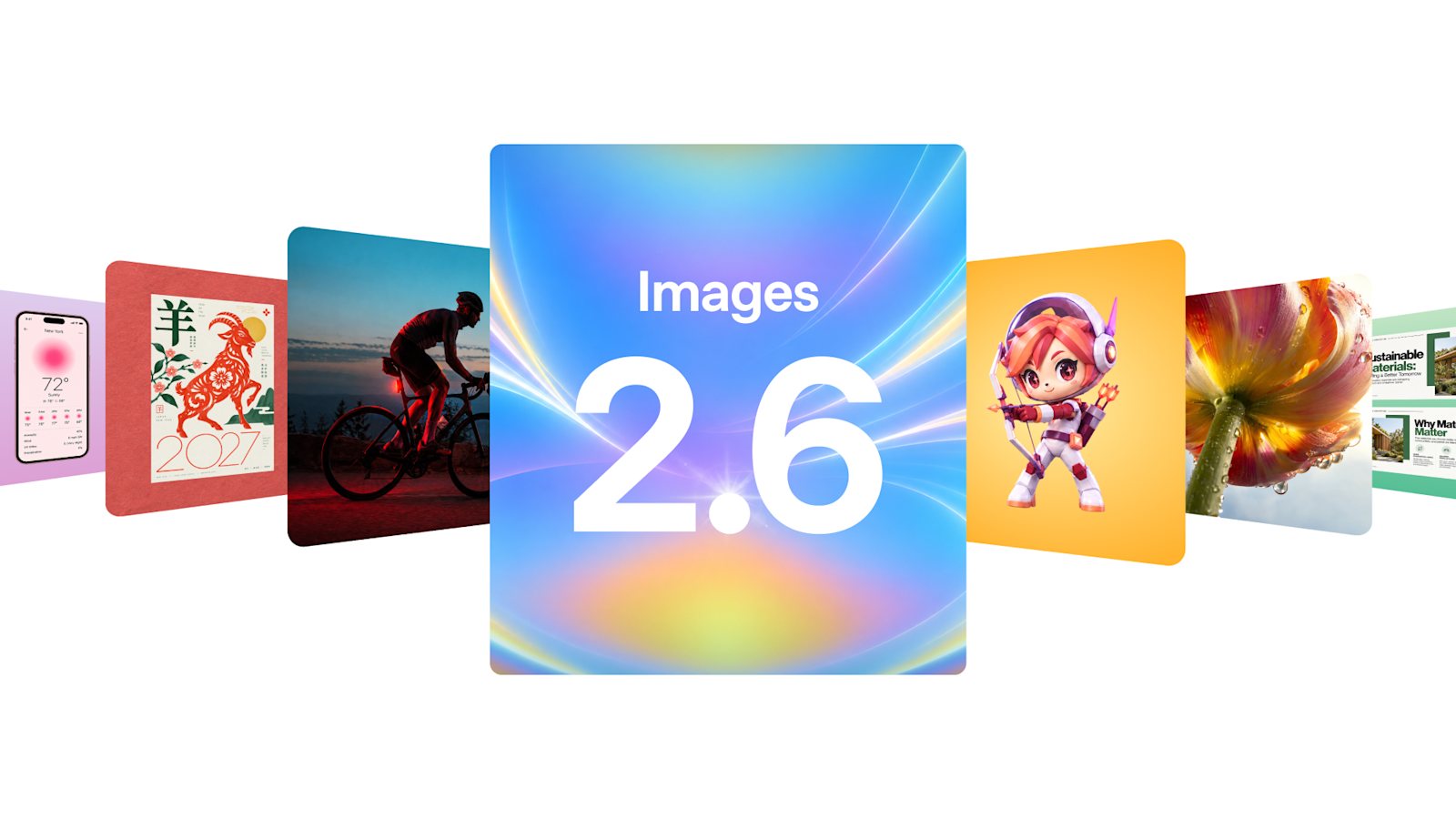
OpenAI published Images 2.6 on November 4, 2026, and shipped it the same day in ChatGPT, Codex and the API. The release adds GIF output, SVG export and a separate complexity setting, and OpenAI says the model generates images 50% faster than the one it replaces.
What was actually released
Images 2.6 is not a single model but a pair of API models under one name. GPT-Image-2.6 Flare is the fast one: at low quality it can return an image in as little as six seconds, and OpenAI credits it with better layout for posters and product imagery. GPT-Image-2.6 Sunburst is the quality one: it is meant for medium and high quality settings, where OpenAI says it holds characters, products and brand details together across a series of edits.
The two formats are the part most people will notice. GIF output turns a still into a looping animation, either from a prompt or from an image being edited, which covers a brand mascot, a product shot turned into a loop, and an animated storyboard. SVG export writes a vector file that goes straight to a website, an app or a print job without a redraw.
The third addition is a dial. A new complexity parameter controls how much planning the model does before it commits, separate from the quality setting that controls detail and fidelity. OpenAI recommends low complexity with whatever quality a workflow needs for most edits, and medium or high complexity for scenes with many elements or constraints.
Three settings instead of one
- Which model: Flare for drafts, Sunburst for finals.
- Which quality: low to high, and this is the setting that decides detail.
- Which complexity: how much planning the model spends before it draws.
Each of the three is billed, and the page prices none of them separately.
Images 2.6 is live globally in ChatGPT and Codex on every subscription tier, on desktop, mobile and web, and both API models are available today. OpenAI points to a system card for its safety evaluations.
What the claim rests on
The 50% figure has no published base. OpenAI does not say what it compared against, at which resolution or on which prompts, or whether the number holds for edits. The six seconds is narrower still: a low quality run on Flare, with no latency given for Sunburst at high quality, which is where most paid work lands.
Volume is measured, quality is not. OpenAI says 4 billion images a week are now created across ChatGPT, Codex and the API. That is a real number about scale, and it says nothing about whether the images hold together.
The GIF export comes with no cost model. The page describes a single prompt doing the work, without saying how many output tokens a six-frame animation consumes. For anyone budgeting a social pipeline, that is the number that decides adoption, and it is not there.
What is not published
No independent evaluation. No comparison of 2.6 against 2.5 on image quality. No latency at medium or high quality. No rate limits. No token cost for a GIF. No worked example of what the complexity setting does to a bill.
What can be checked is the price, and the price did not move. On the rate card OpenAI publishes, both 2.6 models sit at exactly the rates of the 2.5 models they replace.
| Model | Image input | Image output | Cached image input | Text input |
|---|---|---|---|---|
| gpt-image-2.6 flare | $8.00 | $30.00 | $2.00 | $5.00 |
| gpt-image-2.6 sunburst | $8.00 | $30.00 | $2.00 | $5.00 |
| gpt-image-2.5 flare | $8.00 | $30.00 | $2.00 | $5.00 |
| gpt-image-2.5 sunburst | $8.00 | $30.00 | $2.00 | $5.00 |
Rates per million tokens, from the pricing page OpenAI publishes, read on November 5, 2026. Image output dominates a generation: at $30 per million tokens it is 3.75 times the image input rate, and that is the line that moves a monthly bill.
On this page
What it changes for teams shipping visuals every week
The first change is that image generation stops being one call and becomes a route. Flare at low quality for the first three drafts, Sunburst at medium for the one that gets approved, and complexity turned up only on the frames with many elements. That is a pipeline decision, and it needs a look at the output before the invoice.
The second change is the format. A loop for a mascot or a reaction image used to be an editing job in a video tool. A GIF export removes that step for short loops, and it does not replace it for anything that needs sound, timing or fine gradients. SVG is the quieter one: vector output removes the redraw between a generated image and a printable asset.
The third is consistency, which is the claim worth testing. Holding a character or a product across a series of edits is the difference between one usable image and a set. OpenAI says Sunburst does it, the page shows no side-by-side against 2.5, so the test is yours. That is the same gap we found when Canva shipped its first image model: a resolution was published, the comparison was not.
The Neural Minute take
The number that matters here is not 50%. It is that the rate card is unchanged.
A model that renders twice as fast at the same price per token does not make images cheaper. It makes the loop shorter, which changes how a studio plans a day rather than what it pays OpenAI. Anyone selling this internally as a cost cut will be asked for the savings line, and there is not one.
GIFs are the native language of social media, and GPT-Image-2.6 lets every OpenArt creator speak it fluently from a single prompt.
That is a partner quote on the page, and the single prompt deserves a second look: the two example prompts OpenAI publishes for its GIF demo run to several hundred words each, with frame counts, camera position and a list of things to exclude. The format is now native. The prompt is not, and that is where the work moved.
Our reservation is the same one we had on every model launch this quarter: the headline gain is a percentage with no published base, and the settings that decide the bill are three dials with no cost table. The section titled Pricing and availability contains no price at all, which is a fair signal of how much of this release can be checked from the page that announces it.
Before a team routes production through Images 2.6, we would want two numbers the announcement does not give: the tokens a six-frame GIF consumes, and the latency of Sunburst at high quality, since that is the setting a final asset is made on. Without them, the honest comparison is to rerun your own prompts on both models and count the revisions, not the seconds. The SVG export is the one item we would move on now: if a workflow ends with someone tracing a generated image into a vector file, that task can leave the schedule today.
Sources
- Introducing Images 2.6, openai.com, published November 4, 2026: https://openai.com/index/introducing-images-2-6/
- API rate card, read on November 5, 2026: gpt-image-2.6 flare and sunburst at $8.00 per million image input tokens, $30.00 output and $2.00 cached, text at $5.00 and $1.25 cached, identical to gpt-image-2.5 flare and sunburst: https://platform.openai.com/docs/pricing
- The system card OpenAI references for safety evaluations, linked from the announcement page