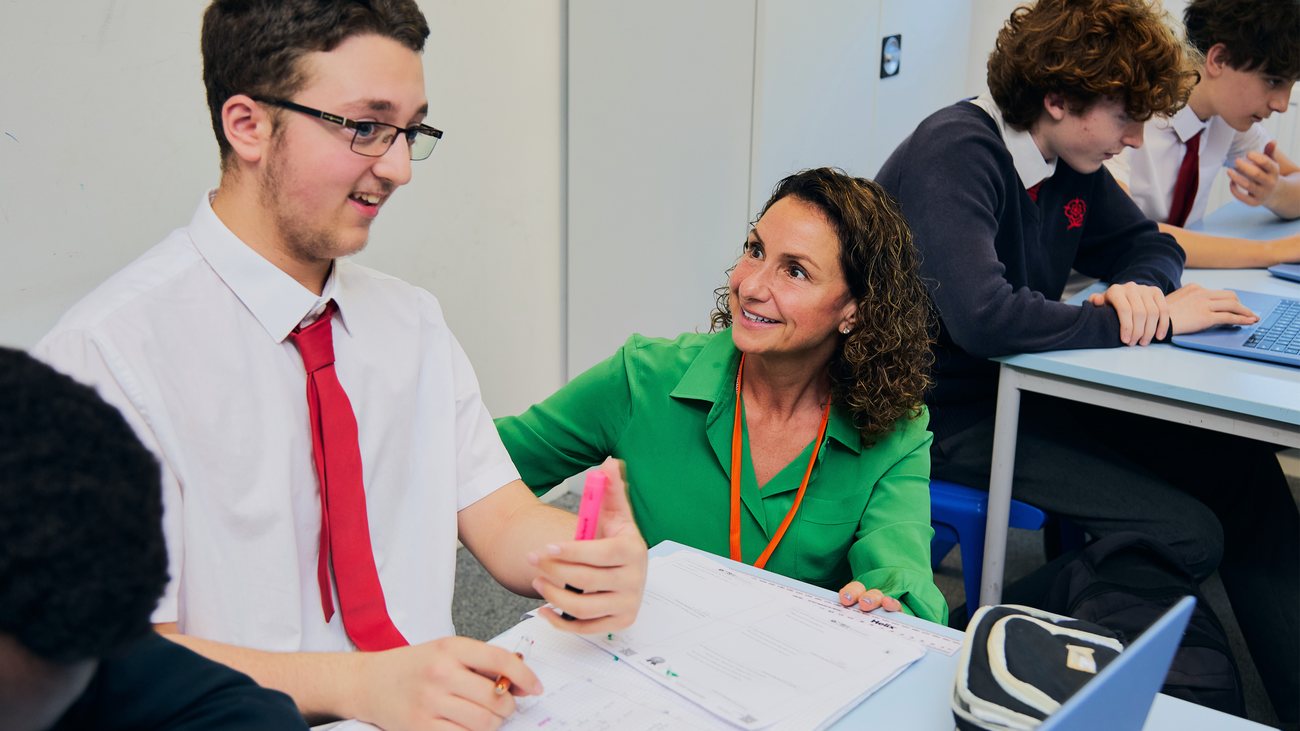
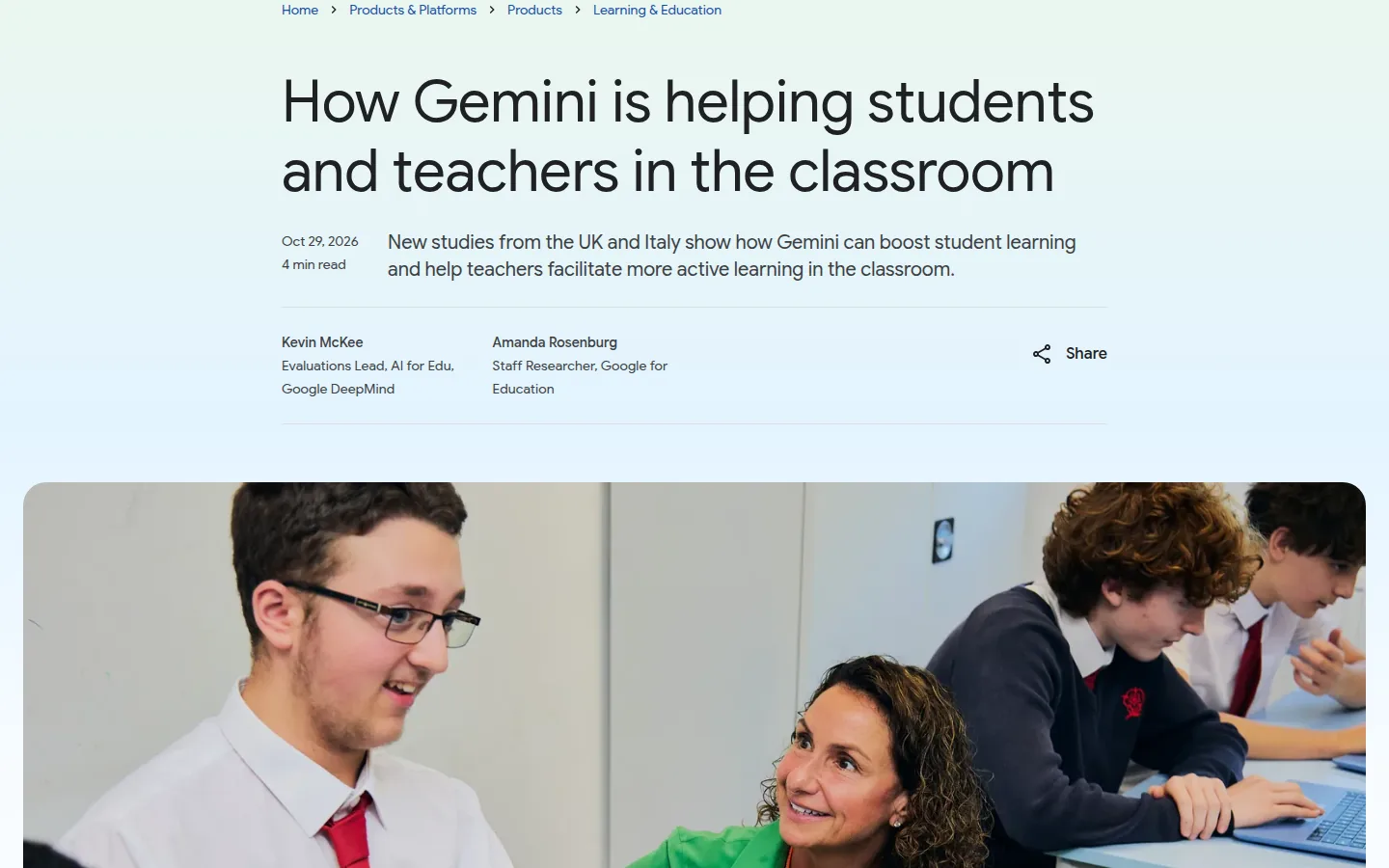
Google published two classroom studies on October 29, 2026, one from the United Kingdom and one from Italy, measuring what Gemini does in classrooms rather than on a benchmark. The UK arm is a 10-week randomized controlled trial with more than 1,100 students aged 12 to 15, and the Italian arm is a yearlong study across 31 schools. The finding low on the page is the one that matters: AI math tutoring matched human tutors on daily work, and the same students showed no gain on the standardized test.
What was actually released
Research findings, not a product. No model, plan or price changed. The post is signed by Kevin McKee, evaluations lead for AI in education at Google DeepMind, and Amanda Rosenburg, a researcher at Google for Education.
In the UK arm, students worked on Eedi’s platform. A wrong answer triggered one of three things: a static hint, help from a human tutor, or tutoring that combined Eedi’s pedagogical resources with Gemini, with human experts reviewing every AI response in real time before a student saw it. It tracked in-platform assignments, intermediate quizzes and independent STAR tests.
In Italy, Google worked with the Salesians of Don Bosco network and the Pontifical Salesian University in Rome for a year across 31 schools, 1,600 teachers and more than 24,500 students aged 13 to 18. That arm measured no test scores. It collected classroom activity and teachers’ own accounts of planning lessons with and without Gemini.
| Arm | Design | Scale |
|---|---|---|
| United Kingdom | 10-week randomized controlled trial, three support arms | More than 1,100 students, ages 12 to 15 |
| Italy | Yearlong study, lessons planned with and without Gemini | 31 schools, 1,600 teachers, more than 24,500 students |
The finding that holds
- AI math tutoring matched human tutors on daily work and quizzes. It did not beat them.
- On STAR standardized tests, no gain appeared over the same 10 weeks.
- In Italy, teachers who co-designed lessons with Gemini reported more participation, fewer front-of-class lectures and less strain.
What the claim rests on
Two numbers measure the model, not the students. Expert reviewers approved Gemini’s pedagogical responses 95% of the time, against 76% a year earlier in an exploratory study with Eedi, an improvement Google calls nearly 25%. Gemini guided instead of handing over answers in nearly 99% of sessions, and students worked the math themselves in more than 85% of their chats. Google says the guidance followed a prompt it supplied.
| Measure | With Gemini tutoring | Comparison |
|---|---|---|
| Expert approval of responses | 95% | 76% in the earlier study |
| Sessions guided, not answered | nearly 99% | no comparison arm |
| Problems solved per session | about 14 | 19 with static hints |
| STAR standardized tests | no gain | same 10 weeks |
The problem count explains the null result. Step-by-step tutoring costs more time per question than a static hint, so that arm covered fewer problems and less curriculum in 10 weeks. Google says it is exploring trials across a full academic year.
While the use of AI tutoring led to clear gains on daily classroom tasks and quizzes, these gains didn’t show up on STAR standardized test scores over the same trial period.
One line buried in the UK method limits every comparison: human experts reviewed every AI response in real time before a student saw it. The AI condition was supervised AI, carrying a staffing layer the study does not cost, and Google says as much: the support is comparable when used with human oversight. What the trial does not measure is the version a school would deploy, with no reviewer behind the answer.
The Italian arm is weaker evidence. It compares the same teachers’ reports on lessons planned with Gemini against lessons without it. The post describes no control group, no blinded observer and no independent measure of participation, and the 77% to 84% engagement figure is student reported. Large sample, consistent direction, self report.
What the page does not publish
What the human review layer cost, and whether 95% approval survives without it. An effect size for the STAR result. Any attrition figure for the 10 weeks.
On this page
What it changes for teachers and school buyers
If you decide whether a school or a tutoring program pays for an AI tutor, the useful reading is not that AI tutoring works. It is that it did not beat a human tutor on daily work, and did not move an independent test score in 10 weeks. For a buyer, that turns the case into a coverage and cost case, not a quality case. A tutor that matches a human per question at software prices is still a strong product. One sold as an upgrade on human teaching is not what this study shows.
Two numbers should shape a pilot. If your dashboard counts problems completed, the AI arm looks like a loss at about 14 against 19. If it counts pacing on the questions students did reach, the same data may read otherwise. Instrument problems per session and time on task before week one.
The behavior has to be tested as shipped. Google attributes the 99% guidance rate to a prompt it wrote, so an assistant deployed without that configuration is measuring something else. Google’s own list of 11 Gemini features students use most emphasizes study aids, not a tutoring mode with fixed behavior. And nothing here says what a student gets without a school license: our coverage of the free Google AI Plus year in Egypt and of the study features in Gemini Notebook found the same missing boundary.
The Neural Minute take
Both sentences belong to Google, so compare them. The summary above the fold says AI tutoring provides math support comparable to human tutors “for many students”. The description it serves to search engines is shorter and stronger: “Gemini tutoring matches human performance”. Further down, the body reports no gain on STAR standardized test scores. The word carrying the qualification at the top is “many”, and the null result is in no summary.
That gap is the story, and the pattern we keep meeting: the number a buyer needs, whether learning moves on a test the vendor did not write, sits in the body, while the sentence that gets repeated sits at the top. We are not reading the STAR result as a failure. A trial with a real gain on daily work, a null on a broad test and an explanation for the difference is more useful than a clean win.
What we cannot do is verify it. Every figure above is the one stated in the post, read on October 29, 2026, and the capture carries the date Google attached to it. What we add is the discipline: keep the comparison arm next to the result, and notice when a summary drops the arm that did not move.
The US version is still missing. Both studies ran in Europe, on a partner’s platform, with reviewers behind every AI answer, and neither says what that costs at district scale. The honest summary is this: the strongest public evidence that Gemini can tutor math at a human level inside a supervised trial, and the first from Google that it does not raise test scores on its own in 10 weeks.
Sources
- Google, published October 29, 2026: https://blog.google/products-and-platforms/products/education/impact-studies-uk-italy/
- The technical and Italian reports linked from that page are not quoted here; every figure comes from the post.
- Our coverage of Google’s list of Gemini features students use most: https://www.neuralminute.com/news/15-college-students-share-their-favorite-gemini-features/
- Our coverage of the study features added to Gemini Notebook, October 16, 2026: https://www.neuralminute.com/news/were-sharing-3-tips-to-study-smarter-with-gemini-notebook/
- Our coverage of the free Google AI Plus year in Egypt, October 12, 2026: https://www.neuralminute.com/news/egypt-google-free-ai-plus-students/