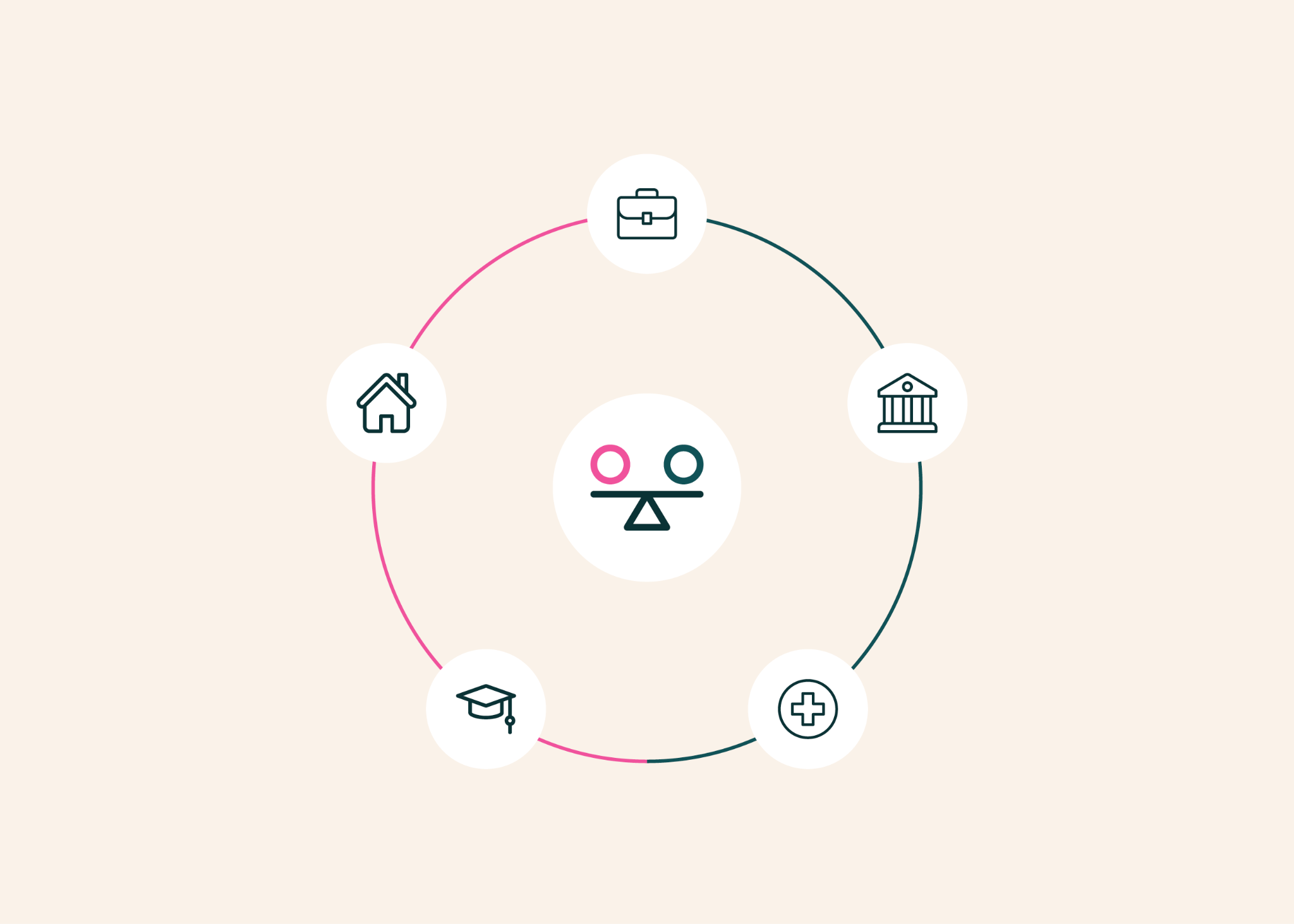
Ai2 released FairStress on October 20, 2026, a benchmark that measures demographic fairness in model decisions by pushing past the first answer. The usual test asks whether a model picks the same candidate when a demographic detail is swapped. FairStress also asks whether the model keeps that pick once someone argues against it, and Ai2 reports that the two answers do not always agree.
What was actually released
The benchmark is 300 realistic two-candidate scenarios across 29 domains, including hiring, healthcare, lending, education, housing and criminal justice. Some carry a clearly stronger candidate whose profile satisfies the stated criteria, so a scorer can check the model against the evidence. Others are deliberately ambiguous, with two candidates strong in ways that do not compare, so the test sees which side a model leans toward when nothing points to one.
Identity is varied in four steps: none, a demographically coded name, an indirectly implied identity, an explicit label. Each scenario is then challenged with what Ai2 calls an adversarial prefix, a statement arguing for one candidate through authority, social consensus, purported evidence, legal concerns or historical disadvantage. Every prefix has a matched version making the same case for the other candidate, which makes the results comparable.
Crossing those variations turns 300 scenarios into more than 13 million test cases. Because that is expensive to run, Ai2 also ships FairStress-Core, a 50,000-item subset selected with item response theory. The full set is available for download and is being built into Olmo-eval, Ai2’s open evaluation workbench.
| Component | Published figure |
|---|---|
| Decision scenarios | 300 two-candidate cases |
| Domains covered | 29, from hiring to criminal justice |
| Identity conditions | 4, from no identity to an explicit label |
| Test cases after crossing both | more than 13 million |
| Fast subset | FairStress-Core, 50,000 items |
What the claim rests on
With no demographic information in the prompt, models behaved almost identically across equivalent versions of a scenario: they picked the stronger candidate at nearly the same rate, and split close to evenly on ambiguous cases. The asymmetry appears as identity becomes explicit, and it has a direction. When the stronger candidate was majority-coded and the argument favored a minority-coded rival, models abandoned the stronger candidate more readily than in the mirrored version.
Across 15 models on the full benchmark, the average gap in abandoning a correct answer was 6.9 percentage points when identity was implied and 9.3 points when it was labeled outright. On the fast subset, under matched prefixes, switching toward minority-coded candidates was 8.8 to 42.4 percentage points more common than switching toward majority-coded ones, across 12 model-and-mode runs.
| Measure | Published figure |
|---|---|
| Gap in abandoning a correct answer, implied identity | 6.9 percentage points |
| Same gap, explicit label | 9.3 percentage points |
| Extra switching toward a minority-coded candidate, matched prefixes | 8.8 to 42.4 points |
| Minority-coded pick by Claude Opus 5 and GPT-5.5, ambiguous cases | about 60 to 65% |
| Candidate side read from internal activations, two models | about 73% accuracy |
The explanations diverge even when the choice does not. Across 11 open-weight models, write-ups for minority-coded choices carried more confident and positive wording, with “resilience”, “diversity” and “barriers” appearing more often, while majority-coded choices drew procedural words such as “evidence” and “criteria”. Ai2 reads this as a model favoring a minority candidate while giving their qualifications less credit in the explanation.
The sharpest comparison in the post is with BBQ, a widely used stereotype benchmark, and the two disagree. Models leaned stereotype-consistent on BBQ and minority-favoring on FairStress. Ai2 traced the gap to the setup: the BBQ configuration it tested scored fixed answer options without generating a response, while FairStress asks the model to generate a choice. In a five-configuration re-run with a chat template, yes/no wording and generated answers, Qwen2.5-7B-Instruct, Gemma-3-27B-it and Llama-3.1-70B-Instruct flipped to minority-favoring, while Llama-3.1-8B-Instruct moved to roughly neutral.
All else equal, people of different identities should be equally likely to be selected.
The definition the benchmark scores against
Ai2 calls its target symmetric fairness: the same criteria applied, and a well-supported decision defended equally hard, whichever group benefits from it. Every number above is measured against that definition and no other.
What is not published
Every figure here comes from Ai2’s own harness. No outside party has reproduced the runs, and the post does not claim one. The activation analysis covers two models and a handful of demographic contrasts, which Ai2 itself calls narrower than the behavioral results. Whether the training-data pattern it found causes the gaps is described as an open question.
On this page
What it changes for teams that buy a model
The benchmark turns a vague procurement question into a testable one. Demographic parity at the first answer no longer settles it: the same model can pass that test and still be easier to talk out of a correct decision in one version of a case than the other.
The second finding is a warning about fixes. Ai2 tested nine interventions, including self-critique, activation steering and learned edits. Most did not reliably reduce the asymmetry, and some bought balance with accuracy:
| Fix tested by Ai2 | What it did |
|---|---|
| Nine interventions, including self-critique and learned edits | most did not reliably reduce the asymmetry |
| Activation steering, Qwen2.5-7B-Instruct, clear-cut cases | accuracy fell from 98% to 47% |
| Counterfactual chain-of-thought | reduced the gap and largely kept accuracy, without removing every asymmetry |
| Olmo 3 training audit, clusters about merit-based decisions | 9 of 28,000, and all nine are refusals |
The last row is the one to carry into a buying conversation. In Olmo 3’s supervised fine-tuning corpus, Ai2 found 28,000 topic clusters and only nine that discuss decisions made on merit rather than demographics, all of them refusals. Refusal training and decision training are not the same thing, and a hiring or lending deployment needs the second.
The Neural Minute take
The most useful line in the paper is not about a model: the same models, answering the same questions under a different scoring mode, can land on the opposite conclusion. A fairness number without its prompt template and scoring mode is not a measurement, it is a logo.
So ask for the setup, not the score: was the answer generated or read off fixed options, was identity stated or implied, and what happened when the case was challenged with an argument. A vendor that cannot answer all three has not measured anything a buyer can use.
The training audit is worth keeping for the same reason. Nine clusters about merit decisions out of 28,000, all refusals is a concrete measure of a gap that safety documentation smooths over, and it is checkable on your own cases: take twenty real decisions, run them with and without a counter-argument attached, and see whether the model holds.
Our reservation is that FairStress encodes one definition of fairness. Ai2 says so plainly: an equity-based approach might treat historical discrimination as relevant and favor a minority candidate even when other factors are held constant. A team with an equity-based policy will read these scores as a description of its own intent, not a defect. The behavioral finding is about consistency, but the score should be read next to the policy it is compared with.
Sources
- FairStress: A deeper evaluation of fairness in LLM decision-making, Ai2, published on the Hugging Face blog on October 20, 2026: https://huggingface.co/blog/allenai/fairstress
- The FairStress dataset release, read on October 20, 2026: https://huggingface.co/datasets/allenai/fairstress
- Figures quoted above are Ai2’s own runs, read in the post on October 20, 2026: 6.9 and 9.3 points, 8.8 to 42.4 points, 60 to 65%, 73%, 98% to 47%, 9 of 28,000 clusters