NVIDIA published a roundup of European city deployments on October 14, 2026, describing how municipalities and their local partners are using its accelerated computing to build physical AI agents and digital twins. The post names ten software partners and lists work in Belgium, Finland, France, Italy, the Netherlands, Poland and Sweden, plus three projects in the United Kingdom. Its most detailed example is in France, where the Cote-d’Or department, Akila and ThinkDeep built operations agents across more than 500 public buildings, and the post says the work cut document search time from weeks to minutes and total operating costs by 10%, against a 30% target at scale.
What was actually released
The announcement is a partner roundup, not a product launch. Nothing new is on sale, and the post carries no price for anything it describes. What NVIDIA puts behind the deployments is its own software layer: Cosmos open models and the Metropolis blueprint for video search and summarization, which let an agent read camera video and flag a hazard; Nemotron open models, for reasoning and natural language; and the Omniverse libraries, which carry the digital twin. Cities buy the computing and the integration around those pieces through a system builder.
In the United Kingdom, the Liverpool City Region and the Island of Jersey are working with K2K on AI factories built for urban planning, mobility and public services, and Innovation City Belfast is exploring a pilot on smart mobility, citizen safety and event response. The post keeps one verb for all three: exploring.
In Italy, Galene.AI, Dell and TD Synnex are deploying a locally operated AI factory, starting with the municipality of Cinisello Balsamo and planning four more. The services named are real-time translation, citizen chatbots and help with procurement and funding, and the post says municipal data becomes reachable in seconds instead of hours, with governance staying local.
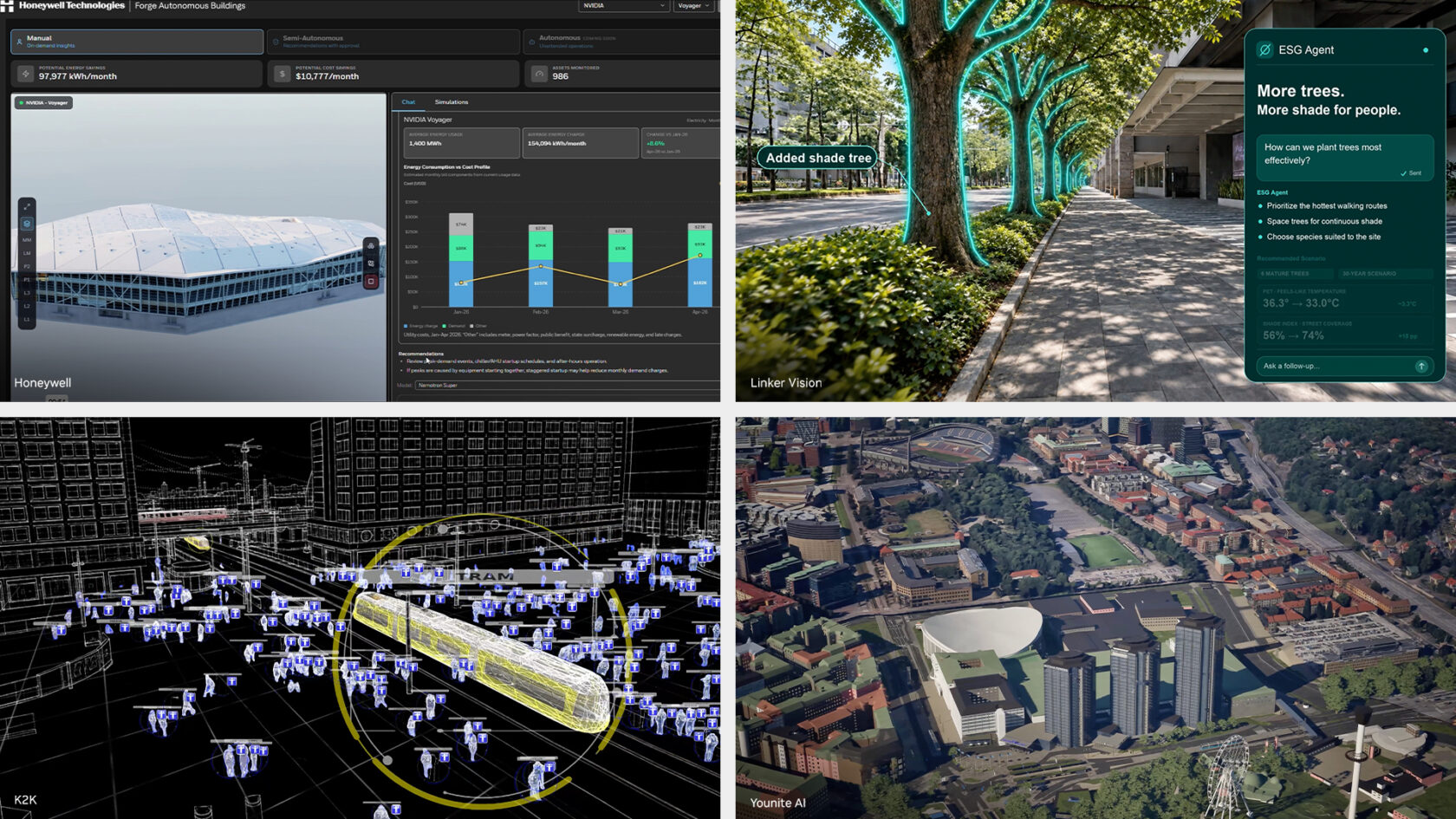
Elsewhere, Port Sud de France in Sete is working with ThinkDeep on an agentic platform for cargo and safety data and for hazardous materials. At the Port of Antwerp-Bruges, Milestone and Dell are testing agentic vision AI for oil spill warnings on synthetic training data. Younite is developing a digital twin for Gothenburg with Omniverse, for previewing event entrances, seating and crowd conditions. The post names Wroclaw in Poland as a next step, and it mentions Honeywell Forge Cognition at the Dubai Fairmont Hotel, outside the city programs.
| Where | Who runs it | What the post says it does |
|---|---|---|
| Cote-d’Or, France | The department, Akila, ThinkDeep | Agents across more than 500 public buildings: energy, compliance, safety and climate resilience |
| Milan region, Italy | Galene.AI, Dell, TD Synnex | A local AI factory from one municipality, four more planned: translation, citizen chatbots, procurement help |
| Port of Antwerp-Bruges, Belgium | Milestone, Dell | Agentic vision AI tested on oil spill warnings, with models trained on synthetic data |
| Gothenburg, Sweden | Younite | A digital twin for event entrances, seating and crowd conditions |
| Sete, France | ThinkDeep | An agentic platform over cargo and safety data, including hazardous materials |
What ships, and what a city has to build
- The models and blueprints are NVIDIA’s: Cosmos, Nemotron, the Metropolis video blueprint and Omniverse.
- The computing is packaged by Cisco, Dell Technologies, HPE, Lenovo and Supermicro into machines the city operates itself.
- The integration that ties agents to city systems is done by EY, Accenture and local partners.
What the claim rests on
Every number in the post comes from NVIDIA or from the partner running the project. The 10% cut in operating costs and the 30% target at scale are the Cote-d’Or project’s own figures, with no baseline, no measurement period and no method, and no third party has checked them. The claim about document search arrives without the starting figure, and the Milan claim about data in seconds instead of hours carries no service level. A reader cannot tell whether these are measured results or the projects’ expectations.
The status of each item says more than the numbers. K2K is exploring, Belfast is exploring a pilot, the Antwerp-Bruges work is a test, and the Gothenburg twin is described as providing previews rather than decisions. Only two items read as running rather than planned: the agents over 500 buildings in Cote-d’Or, and the Milan factory that starts with one municipality. The post does not say how many of the other projects have moved past a pilot, or when a resident would notice a change.
| What the post says | What it gives to back the claim |
|---|---|
| Operating costs down 10%, targeting 30% at scale | The project’s own figure: no baseline, no period, no method |
| Document search from weeks to minutes | No starting figure and no measurement period |
| Municipal data in seconds instead of hours | No service level, no measurement, no date |
| Oil spill warnings trained on synthetic data | A test in progress, with no results published |
What the announcement does not carry
No price, no contract value and no licensing terms for anything described. No count of projects in production against projects in a pilot. No independent evaluation of any agent named. No detail on data residency beyond the phrase locally operated.
On this page
What it changes for teams buying AI agents
The useful signal for a buyer is not the agents. It is the route they take to market and the requirement behind them. These systems reach a city through a system builder and an integrator, with the computing capacity stood up locally, which makes the decision a procurement one, taken once, covering hardware, models and support together.
The requirement the cities keep repeating is that data, models and operations stay local. That runs against the default cloud-first stack most AI tools are built on, and it changes what a product has to demonstrate before it can be sold into public work in Europe.
We have covered the other end of this, Google Cloud’s Gemini agent with hard spend caps, where the control buyers asked for was a limit on what an agent is allowed to spend. In both cases the feature that closes the sale is a constraint, not a model score.
The Neural Minute take
The agents are the visible layer. The commercial event underneath is local computing.
NVIDIA does not sell city software. It sells accelerated computing, and here it reaches European public buyers through partners who package that computing into machines a city runs itself. Read the post as an infrastructure announcement with an application layer on top, and the vocabulary inside it stops looking like marketing.
For European cities, scaling from pilots to everyday operations requires infrastructure that can process local data, customize models and run AI agents.
That sentence is NVIDIA describing its own business. Our rule for a figure like the 10% cut in operating costs is the one we applied in our report on agents that overstate their results: a number that arrives without a method is a direction, not a measurement. The agents are the visible layer, and the local computing is the commercial event.
What would change our read: a published price, an evaluation run by a city rather than by its supplier, or a count of projects that moved from pilot into production. Until then, this is a partner roundup with the vendor’s numbers attached.
Sources
- NVIDIA, the post cited here, published October 14, 2026: https://blogs.nvidia.com/blog/european-cities-agents-urban-operations/
- NVIDIA in Europe, the wider page it links to, read on October 14, 2026: https://blogs.nvidia.com/gtc-berlin-2026-news/
- Our report on agents that overstate their results, read on October 14, 2026: https://www.neuralminute.com/news/ai-agents-overstate-their-results-and-remain-far-from/
- Our report on a Gemini agent shipped with spend caps, read on October 14, 2026: https://www.neuralminute.com/news/google-cloud-gemini-agent/