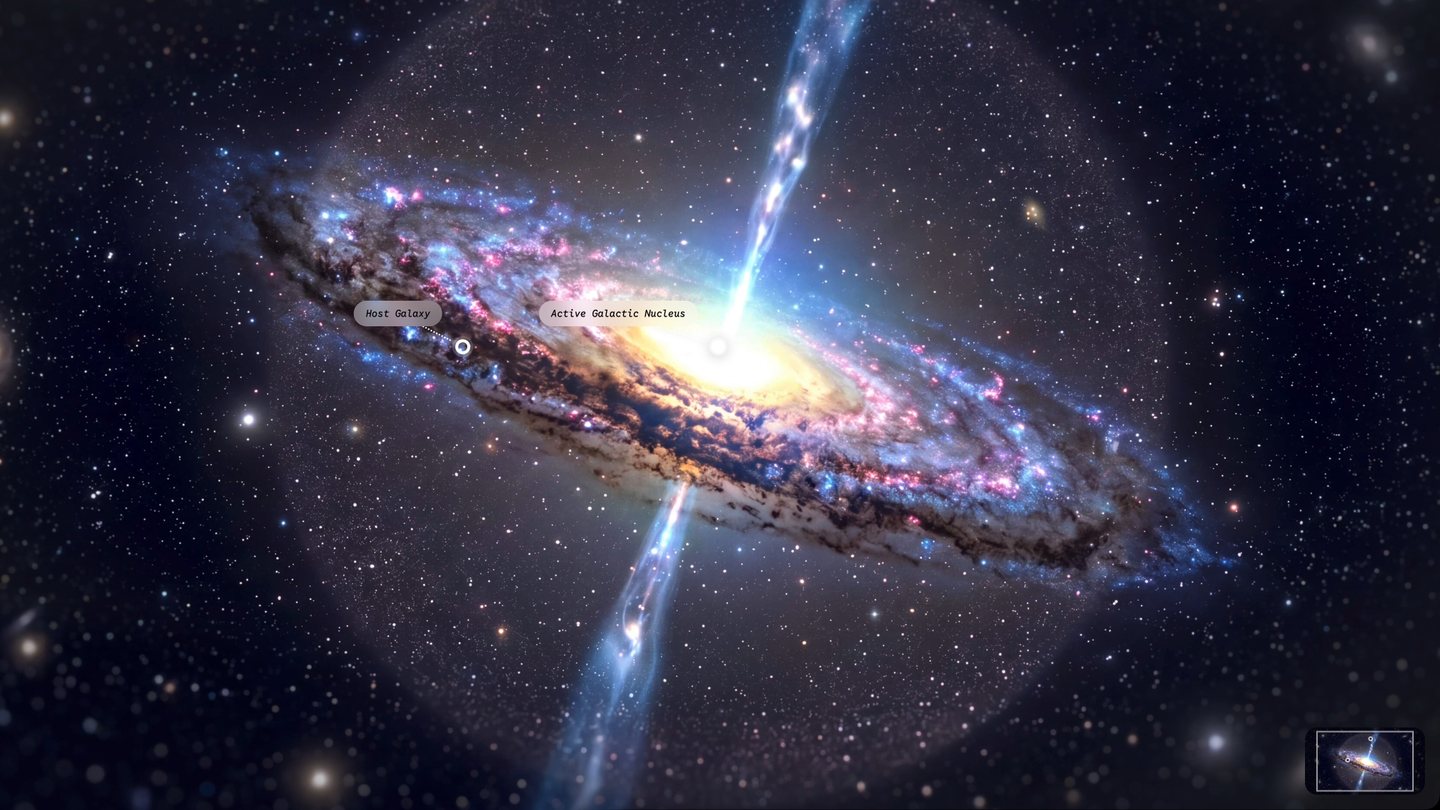
Google rolled out a library of immersive explorations inside the Gemini app on October 28, 2026. Each exploration opens a topic layer by layer, from microscopic systems to deep space, and the entry point today is the Gemini student hub, behind a button labeled “Try immersive explorations”. Google says the same scenes will reach a normal chat conversation, with no date attached.
What was actually released
What shipped is a library of scenes, not a new model, and the post describes the mechanic rather than the contents. Three examples are named: trade routes on the Silk Road, the inside of a jet engine, and the physics of lightning. Each one, in Google’s wording, unfolds into interactive and guided experiences, and tapping a label takes you deeper.
Two surfaces are involved and only one is live. The library sits in the student hub, which the post calls new. Access from inside a chat conversation is announced for later, and audio narration that walks a reader through each layer is announced for the same unspecified later.
| Where you find it | What the post says | Status |
|---|---|---|
| Gemini student hub | The exploration library, opened with “Try immersive explorations” | Live now |
| A Gemini chat | The same explorations, without leaving the conversation | Announced, no date |
| Audio narration | A voice walking through each layer | Announced, no date |
| Languages | English, Indonesian, Hindi, Brazilian Portuguese, French, simplified Chinese | Served in full, other languages get English only |
What the post states, read on October 28, 2026. Only the first row and the language row are true today: the two others are promises with no date anywhere in the source.
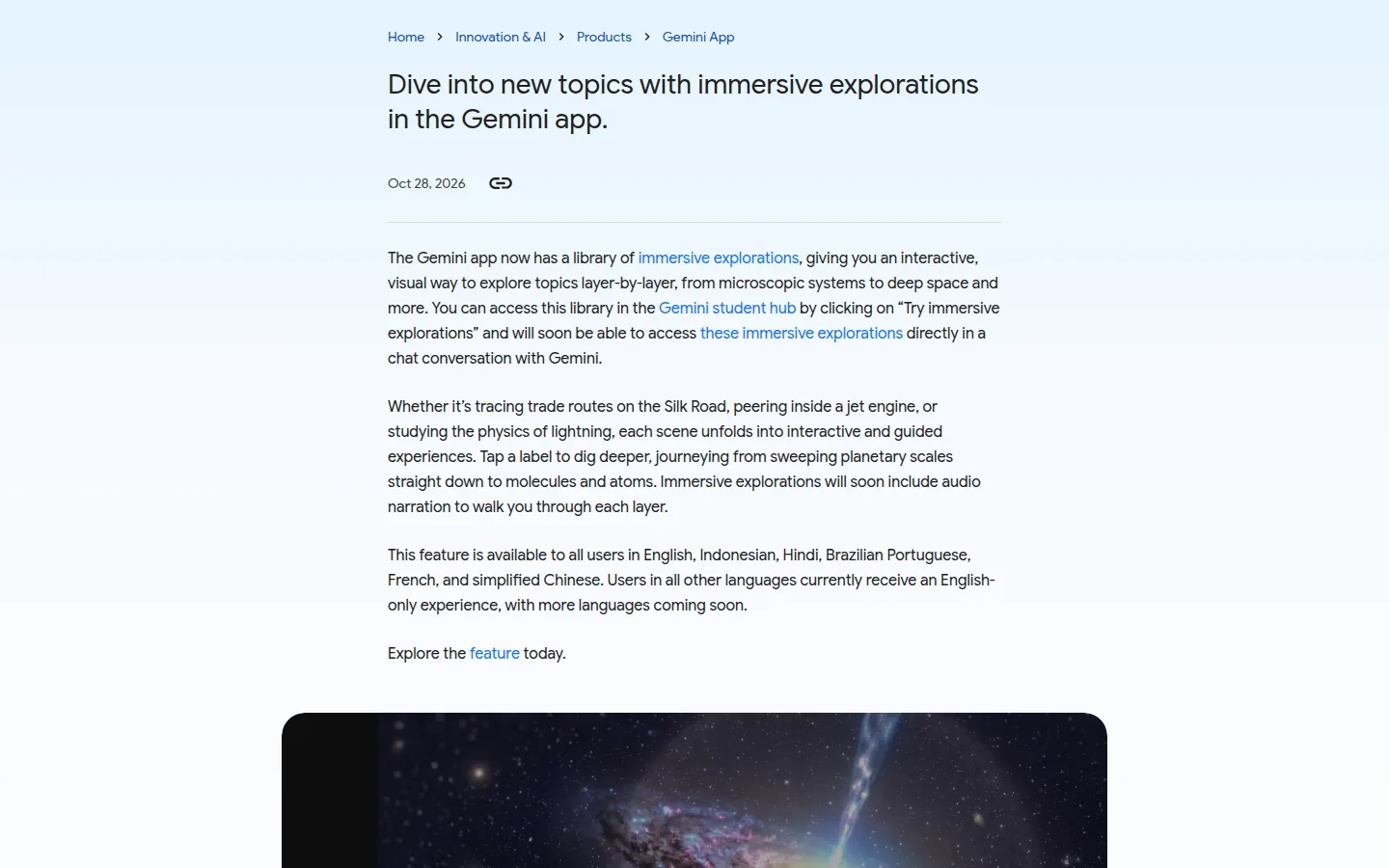
The availability line is the only part of the post that is fully specified. Six languages are served in full, and every other language gets an English-only experience, with more promised. That is a language list and not a country list: French is named once, and Brazilian Portuguese is named separately from Portuguese.
What the claim rests on
This is an announcement, not a measurement, and nothing in it is quantified. There is no count of how many explorations the library holds, no subject list beyond the three examples, and no description of what a scene contains at its deepest layer. A reader cannot tell from the post whether the shelf holds eight scenes or eighty.
Tap a label to dig deeper, journeying from sweeping planetary scales straight down to molecules and atoms.
That sentence is the whole mechanic, and it is the only description of the interface the post gives. It says a scene carries labels, that a label opens a layer, and that the layers nest. It does not say how many labels a scene carries, how deep a branch goes, or whether a layer can be bookmarked, exported, or handed to a class.
The availability sentence is the one claim a reader can test in a minute by opening the hub and looking. Everything else is a promise with a shape and no date: both chat access and audio narration are dated “soon”, which is not a date.
What the post establishes
The library is live in the student hub, behind one button. Six languages are served in full and every other language gets English only. Chat access and audio narration are announced, with no date and no detail on plans.
What the post does not publish
No count of explorations, no subject list beyond three examples, no device list, no country list, no date for chat access or narration, no statement on plans or price, no learning outcome, and no control for a teacher or a parent.
On this page
What it changes for someone choosing a study tool
Someone picking an AI study tool has had two shapes to choose from: a chat assistant you ask, and a video you watch. A layered scene is a third shape, because you navigate it. For revision that is the difference that matters: instead of replaying a whole video to reach the one part you missed, you go down two layers and stop.
The limits are as concrete as the gain. It is a destination, not a reflex: until chat access ships, using it means leaving what you were doing and walking to the hub. And for most of the world it is an English-only experience, which for a student revising in another language is the gap between a study aid and a demonstration.
The post says nothing about plans or tiers, so nothing here argues for or against a subscription on its own. What it argues for is a test: open the hub and search the subject you are revising this week. If the subject is not on the shelf, the feature is a demonstration for that student, whatever the quality of the three scenes named.
The Neural Minute take
We have watched this surface before. Google put 60-second study videos and quizzes into Gemini Notebook on October 16, 2026, and published the 11 Gemini features students use most two days ago. The pattern holds: education gets the feature first, the announcement leads with the experience, and the parts that decide daily use arrive afterward under the word soon.
What makes this launch interesting is the shape of the content, not its size. A layer-by-layer scene is the first Gemini study surface that is neither text nor video, and the mechanic rewards a specific habit: zoom out to see the frame, then in to the detail you missed. That is closer to how a good diagram works than to how a chatbot answers, and it pays off only once the scene is reachable from where the writing happens, which is the part still announced.
The catalog is the product here, and the catalog is the one thing the post does not describe. Three named examples in a post about a library is the tell: a library with a real catalog lists its subjects, or at least its count, and this one names a trade route, a jet engine, and a lightning bolt. Until a shelf appears, treat the feature as a careful demonstration, worth ten minutes from a student and worth nothing yet in a decision about which tool to pay for.
Sources
- “Dive into new topics with immersive explorations in the Gemini app.”, Google, published October 28, 2026: https://blog.google/innovation-and-ai/products/gemini-app/immersive-explorations-student-hub/
- The three example scenes, the availability list, the two surfaces, and the two undated promises are read on that page on October 28, 2026.
- Earlier coverage of the same surface: the Gemini Notebook study features and the features students use most.