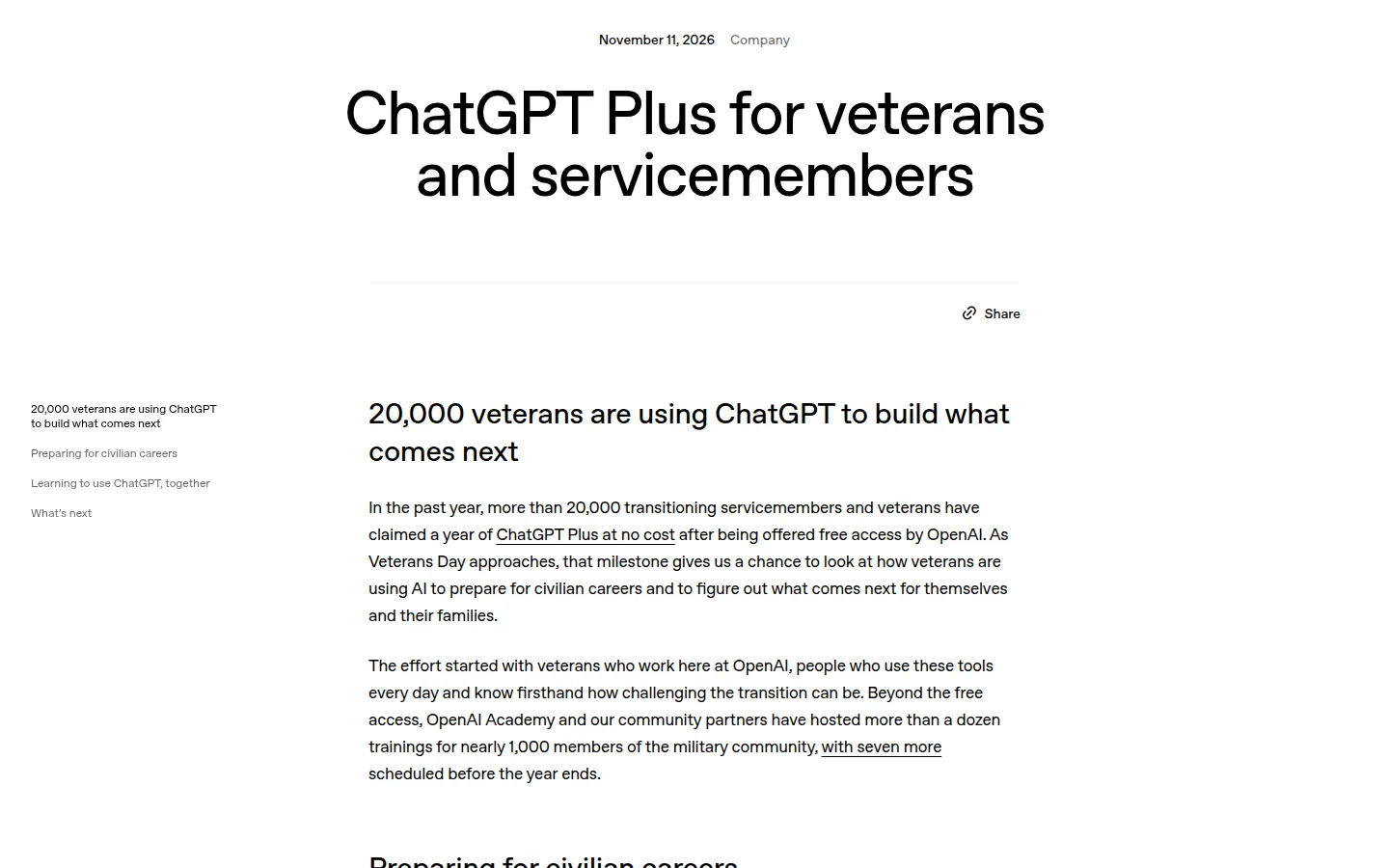
OpenAI said on November 11, 2026 that more than 20,000 transitioning servicemembers and veterans have claimed a free year of ChatGPT Plus since the company opened the offer. The post is a Veterans Day update: a claim count, a training tally, three veteran testimonials and five events still on the calendar. It is not an announcement of new terms.
What was actually released
Nothing in the product changed with this post. The offer it refers to was announced on November 10, 2025, and it is narrow: U.S. servicemembers and veterans within 12 months of retirement or separation can get a year of ChatGPT Plus at no cost, checked through a third-party identity verification service. The 2025 page also lists what comes with it, namely the latest models and features, 100 example chats written by OpenAI veterans, and a getting started video hosted on OpenAI Academy.
What is new on November 11 is the accounting. OpenAI says more than a dozen trainings have run with OpenAI Academy and community partners for nearly 1,000 members of the military community, with seven more scheduled before the end of the year. Two workshops are given a size: nearly 100 veterans and active-duty servicemembers in Reston, Virginia, and more than 80 Legionnaires at the American Legion national convention in Louisville, Kentucky.
The post also points at two free resources, an online veterans collection on OpenAI Academy and the 100 chats, and lists the five events left this year.
| Date | Event | Where |
|---|---|---|
| November 12, 2026 | NPower session | St. Louis |
| November 14, 2026 | Veterans Forge and Wounded Warrior Project | Nashville |
| November 17, 2026 | 30-minute virtual session | Online |
| November 19, 2026 | NPower session | Dallas |
| November 21, 2026 | NPower session | San Antonio |
The offer, as the two posts describe it
- More than 20,000 claims in twelve months, by OpenAI’s own count
- A year of ChatGPT Plus at no cost for U.S. servicemembers and veterans within 12 months of separation, as stated on November 10, 2025
- Access gated by an identity check run by a third party, SheerID in the 2025 announcement and ID.me in the 2026 post
What the claim rests on
The 20,000 is a cumulative number reported by the company that benefits from it. The post gives no denominator: how many people applied, how many were turned down by the identity check, how many of the claimed accounts are still in use, and how many will renew at month 13. A claim is not a user, and a user is not a renewal.
The three testimonials are named and specific. Air Force veteran Tilak Bhatnagar used the free year to prepare a dozen interviews and took a role at a tech company. Sadarian Bell, also Air Force, started planning a year before leaving the service and rehearsed out loud in voice mode with nearly a decade of military healthcare experience to translate. Navy veteran Kelli Ramirez published two books through Kindle Direct Publishing. Each is a plausible use of the tool, and none of them measures an outcome: no time to hire, no salary, no comparison with veterans who did not use it. A testimonial shows the tool was used, not that it changed the result.
“It has genuinely become my career coach,” Sadarian said, though he also learned to recognize when he had had enough help and could trust his own judgment.
The training numbers hold together, which is worth saying when a company rounds. Nearly 1,000 people across more than a dozen events is under 100 per event, and the two events given a size, 100 and more than 80, sit on either side of that average.
One detail the post changes without comment is the verification vendor. The 2025 announcement names SheerID and calls its platform permission-based. The 2026 post thanks ID.me for helping servicemembers and veterans access the free-year offer. Both are identity checks, and the post does not say whether one replaced the other, whether both run in parallel, or why the switch happened.
What the post does not publish
- How many applications the identity check refused, and what share of claims turned into regular use
- Whether the 12-month window still governs a claim made today, since the 2026 post never restates eligibility
- What an account costs at month 13, because no price appears in either post
- The terms a reader would want to check, since the claim page at chatgpt.com/veterans-claim returns a sign-in wall before showing anything
On this page
What it changes for transitioning servicemembers
If you are within 12 months of separation, this is the cheapest route to Plus that OpenAI has published for that group, and the claim is the step that starts it. The post does not say when the twelve months begin to run, so treat the claim date as the date that matters and write it down, because the anniversary is the only date in this story that is yours.
The uses the post documents are the ones worth copying: rewriting military experience in civilian language, rehearsing interviews out loud with voice mode, getting plain-language explanations of benefits and forms, and planning housing, education and relocation in one thread that keeps its context.
The event calendar is the part you can skip. The 100 chats and the Academy collection are online and free, and the November 17 virtual session is the only item on the list that runs in 30 minutes without travel. For anyone outside the eligible group, the shape of the offer is the one that keeps coming back: a free period, a defined group, and an identity check in the middle. Our AI chatbots directory tracks the same pattern across assistants, and the news hub carries the cases where a vendor extends a free tier to a new group.
The Neural Minute take
A free year is a subscription with a dated decision inside it. The number that decides whether it was worth anything is not the 20,000 and not the price today, but the price at month 13, when the habit is installed and the default is to keep paying. Claim it if it applies to you, then set a reminder 30 days before the anniversary, and before that date ask yourself whether you would buy the paid tier at full price. The value of the offer is decided in month 13, not in the year it is free.
The identity gate is the part that fails in practice. Every program of this shape we have looked at puts a third party between the offer and the account, and that step rejects people over address mismatches, name formats and missing documents. Two verification vendors in twelve months suggests the gate is a product decision that gets swapped, not a constant. If you are helping someone claim, do the verification first, while there is still time to appeal a refusal.
What would make this a better story next Veterans Day is a retention figure instead of a claim count, and the terms of the offer on the page that announces the milestone rather than only on a claim page behind a login. A post that leads with a number and then sends the reader to a sign-in wall answers the question a reader has with the one thing a reader cannot check.
Sources
- ChatGPT Plus for veterans and servicemembers, OpenAI, November 11, 2026. The claim count, the training tally, the testimonials, the event dates and the mention of ID.me.
- Free ChatGPT for transitioning U.S. servicemembers and veterans, OpenAI, November 10, 2025. The eligibility window, the contents of the free year, and the mention of SheerID.