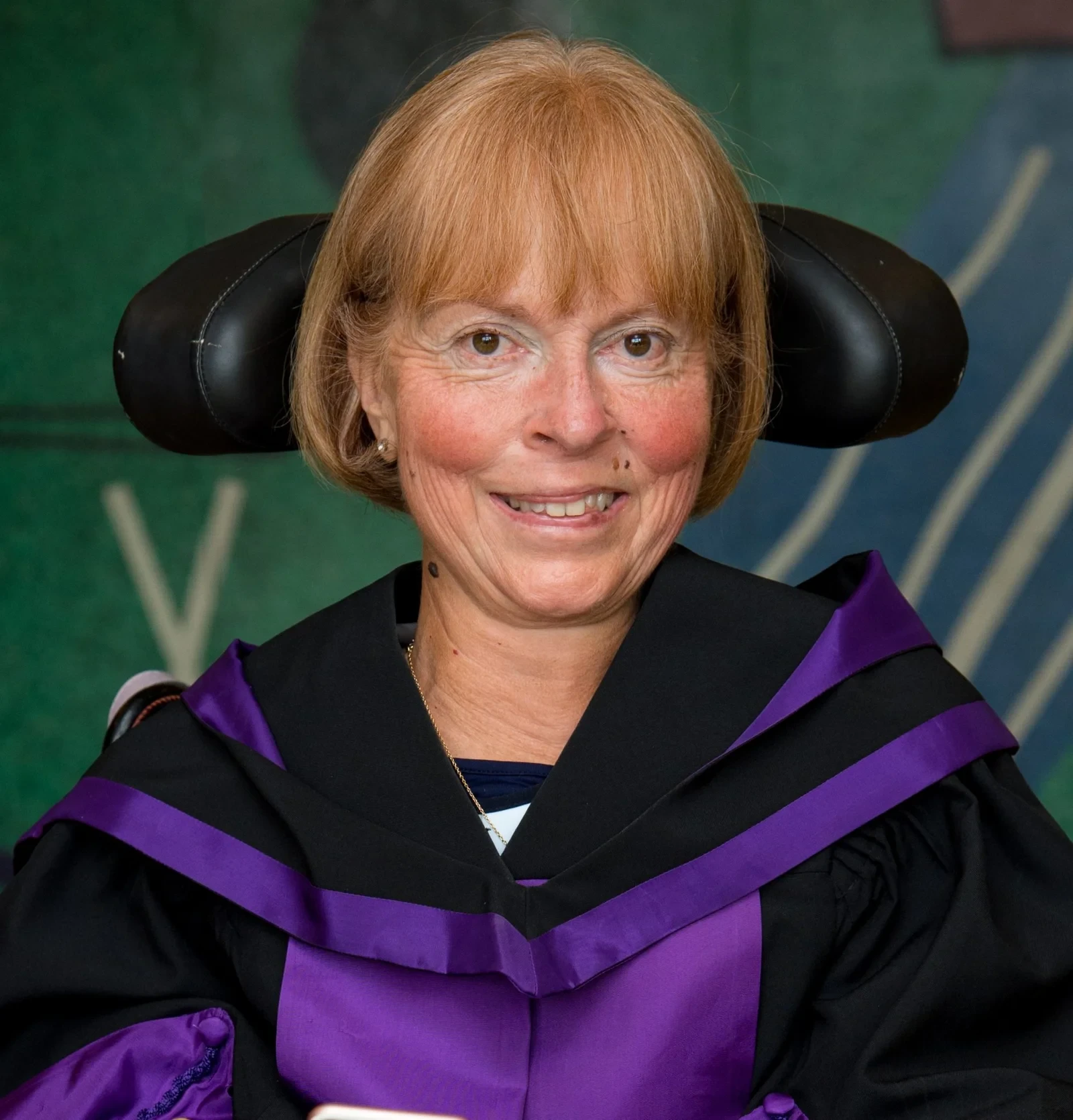
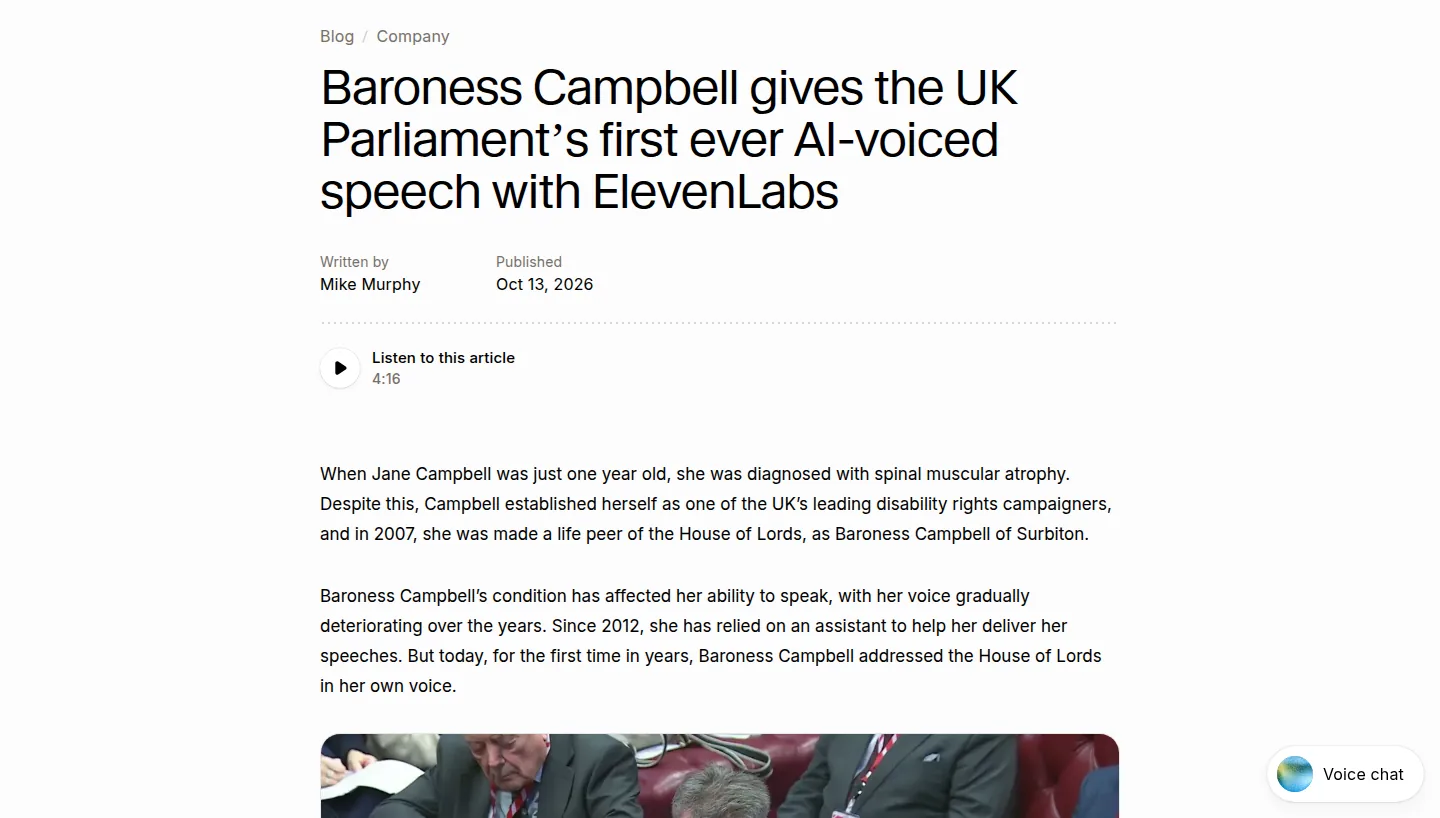
Baroness Campbell of Surbiton addressed the House of Lords on October 13, 2026, speaking in a voice rebuilt with software from ElevenLabs, the company said in a post published the same day. She spoke during the Second Reading of the Health Bill. According to the page, it is the first time a peer or a member of the UK Parliament has addressed either house with an AI-generated voice.
What was actually released
ElevenLabs published a case study rather than a product launch, and the part worth copying is the mechanism and the setting, not a new model.
Jane Campbell was diagnosed with spinal muscular atrophy at one year old and became a life peer in 2007. Her voice has deteriorated over the years, and since 2012 an assistant has read her speeches for her. The page says she found the voice cloning tool on her own, uploaded old recordings of herself, and built a model that reproduces the tone, rhythm and pitch of her original voice. She then generated an audio version of the speech with the text-to-speech tool and played it through an assistive device in the Chamber. Her own recordings, her own words, played from a device in the room.
The second half of the page is what turns this into a parliamentary first rather than a demo. In 2012 the House of Lords Procedure Committee allowed her assistant into the Chamber to read for her, departing from a rule dating to 1707 that barred non-peers from crossing the bar and speaking. The speech on October 13 is, on the publisher’s account, the second accommodation the Committee has granted her so she could take part in proceedings.
| Date | What the page says happened |
|---|---|
| 1707 | A rule bars non-peers from crossing the bar and speaking in the House |
| 2007 | Jane Campbell becomes a life peer, Baroness Campbell of Surbiton |
| 2012 | The Procedure Committee lets her assistant read for her in the Chamber |
| October 13, 2026 | She speaks in her own recreated voice at the Second Reading of the Health Bill |
Timeline as given by ElevenLabs on the page, read on October 13, 2026, and not a citation of the parliamentary record.
Her speech dealt with Personal Health Budgets, the funds allocated to individuals in England for treatments, equipment and personal care. She argued that they must stay accessible to the disabled people who rely on them, and be extended to others who could benefit. The Lord Speaker, Lord Forsyth of Drumlean, is quoted in support of the arrangement.
I used AI to speak my own words, not to put words into my mouth. The speech, the arguments and the views are entirely mine.
That is Baroness Campbell, quoted on the page, and it is the sentence that separates this from a novelty.
What the claim rests on
The first-in-Parliament claim comes from the publisher, not from the parliamentary record. The page quotes the Lord Speaker’s approval and describes the accommodation, but it links no Hansard entry, no order paper and no committee decision. For a first of this kind, that is the difference between a documented event and a reported one, and the claim travels on the company’s word.
Two other claims are softer than they read. The page says the Baroness delivered her speech with an emotional valence she has not been able to use in decades, which is not a measurement of anything and can only come from the speaker herself. And the scale figure is the company’s own count: the page says the technology has been used to restore the voices of more than 11,000 people who lost their voice through injury or illness, and that the company has committed to help one million people living with voice loss. There is no method, no audit and no breakdown by cause, language or country.
| Figure | What the page says | Basis |
|---|---|---|
| 11,000 | voices restored with the technology | ElevenLabs’ own count, no method |
| 1 million | people with voice loss the company will help | a commitment, not a result |
| 1707 | rule against non-peers speaking in the House | cited by the publisher, record not linked |
| 2012 | first accommodation granted to the Baroness | the publisher’s account |
What is not published
No audio file of the speech. No independent measure of how intelligible the recreated voice is. No terms covering the recordings used to build it: how long they are kept, who can access them, and how the voice model is revoked after the speaker’s death. For a voice, those are the terms that decide the risk.
The number to keep
The figure that matters here is not 11,000. It is 1707. A rule the House had to bend for one member has stood for three centuries, and it bent again on October 13.
On this page
What it changes for buyers of AI voice tools
This is the cleanest shape voice cloning takes: the person consented, supplied her own recordings, and controlled the output. Buyers rarely get that shape. For a broadcaster, a hospital, a university or any company producing audio in someone else’s voice, the hard questions all sit downstream of how real the audio sounds.
The first is custody. If your recordings train a model, you need to know where the clips live, how long they stay, who can listen to them and what happens to the model when the arrangement ends.
The second is revocation. Voice rights do not expire with a contract, and a family inherits an interest in a reconstructed voice. Any deal should say in writing who can switch the model off, and what happens to the audio already generated.
The third is disclosure. A public institution that lets an AI voice speak on the record has taken a position on whether the audience is told, and who answers for a bad generation.
The Neural Minute take
The interesting thing here is not that a cloned voice sounded convincing. The interesting thing is that an institution changed its rules twice, once for an assistant and once for a model, and the second change is the one with consequences.
Accessibility is where AI voice tools get their clearest justification. The case is strong precisely because the speaker owned the voice, wrote the words and carried the argument. Nothing on the page suggests anyone outside the two parties verified any of it, and a first of this kind will be cited by people who never read it.
So the practical lesson for anyone buying is to move the question away from quality and toward custody. Ask what evidence the vendor will hand you when the arrangement ends: a deletion receipt, an access log, a signed consent from the person whose voice it is. Ask who can revoke the voice, and what happens to the clips afterward. If the answer is a demo link, the accent is the least of your problems.
We have seen ElevenLabs before on this site, in a different role, when it shipped AI call detection for business calls. The company is now on both sides of the same question, identifying synthetic voices in a call and supplying one in a chamber, which is worth remembering the next time a vendor promises that provenance is solved.
Sources
- The page published by ElevenLabs, read on October 13, 2026, with the speech account, the timeline and the quotes: https://elevenlabs.io/blog/first-ever-ai-voiced-speech-uk-parliament
- The same page is the source for the count of 11,000 restored voices and the commitment to help one million people, both given as the company’s own figures without a stated method