Aveni opened File Check to wealth and advice firms on November 16, 2026. The Edinburgh vendor does not sell it as a chat window that answers questions about a file. The page describes a review layer that takes the whole case, scores it against the firm’s own check questions, and hands compliance a sign-off record. The number that carries the pitch is not the time saved. It is coverage: every case read, instead of the sample.
What was actually released
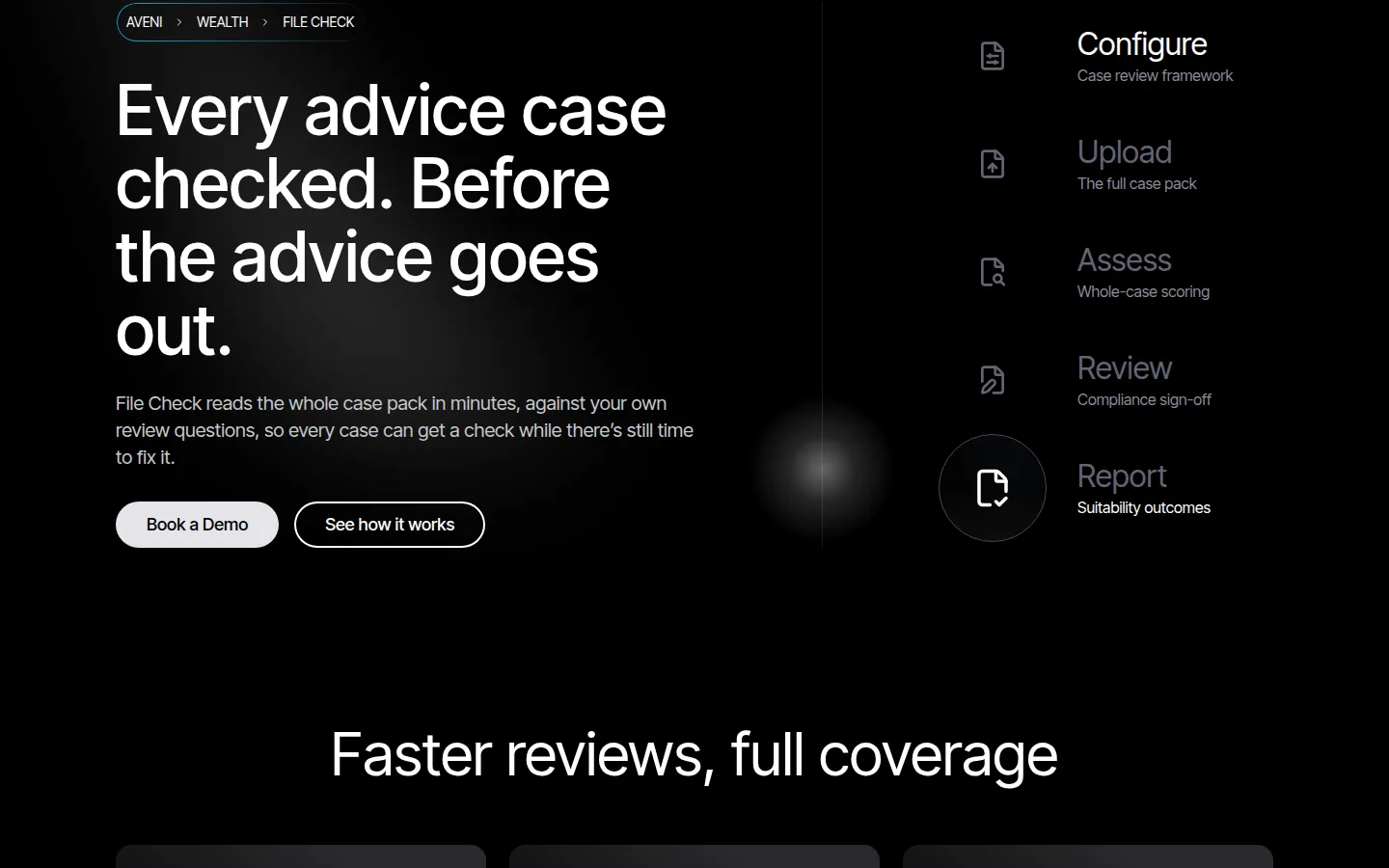
Five steps, printed on the page as Configure, Upload, Assess, Review and Report. A compliance team writes its checks in plain language: suitability rationale, capacity for loss, vulnerability indicators, Consumer Duty and tax wrapper logic, with no engineering ticket in the loop. File Check then reads the full pack, which the page puts at 30 to 40 documents, alongside call recordings, as one case rather than as separate touch points.
The output is a whole-case score, a set of flags with the document or the exchange behind each one, and an audit record of what was tested, what was found and who approved it. The page also sells a second use: every assessed file becomes evidence for advisor competency reviews, which moves a training and competence program off impressions and onto cited findings.
Three figures sit in a row at the top of that page.
| Figure on the page | What it describes |
|---|---|
| 20 minutes | Time to review one file, presented against 1.5 hours of manual review |
| 30 to 40 | Documents in a typical case, read together as one case |
| 100% | Target coverage of cases checked before the advice is executed |
The page breaks the product into three stages, and the status of each one is where the reading gets interesting.
| Stage | When it runs | Status shown on the page |
|---|---|---|
| AI Self-Check | Before execution, the advisor checks their own case | Coming next |
| Compliance Check | Before execution, routed by triage rules | Live, triage rules coming next |
| Post-execution assurance | After execution, selection rules pick a second look | Live, no repeat checks |
The reading is attributed to FinLLM, Aveni’s own family of language models for UK financial services, named on the page as the engine. Nothing on the page states a price, a per-file cost, or a market outside the United Kingdom.
What the claim rests on
The 20-minute figure and the 1.5-hour baseline are both the vendor’s, printed side by side on the vendor’s own page, and they arrive with no method. No count of files reviewed, no hit rate on real defects, no false positive rate, no named firm with its own numbers attached. On a page that ends by asking for a demo, those are the four things a buyer cannot test before signing.
“100% target coverage” carries its own warning word. Target is a plan. The page does not say what share of cases a live customer checks today, and it does not say what happens to the flags nobody resolves.
What is not published
No price, no per-file cost, no measured precision or recall, no count of files processed, no availability date outside the UK, and no customer quoted with numbers. The page closes by inviting a conversation.
The status column is the other caveat. The step that decides which cases can skip a human, triage by advice type, advisor competency and track record, is listed as coming next. So is the advisor self-check. What ships today reads the file and scores it. What makes reading every file affordable is the routing, and the routing is still on the roadmap. Until it lands, the volume of flags still lands on a reviewer.
Coverage is not accuracy
A tool that reads every file turns a sampling problem into a triage problem. That is progress, and it is a different claim from finding more errors. The page measures how much is read, not how much is found.
On this page
What it changes for teams paying for review AI
For a buyer, the unit of the decision moves from the sample to the case. The question to put to a trial is not how fast the tool reads. It is what the tool does on files the firm already signed off and later found a problem in. Run fifty of those through it, count what it catches and what it flags wrongly, and the 20 minutes become a secondary figure.
The shape is familiar from legal work. Sullivan and Cromwell built an agreement reviewer on Codex to read contracts and cite what it relied on, and Microsoft moved 20 legal skills into Copilot for the same reason: a pass over every document is where the hours go. Aveni applies that pattern to a case pack that mixes documents and calls, which is harder, because a mismatch between what was said and what was written is the defect that matters.
For a firm outside the UK, the rule layer is the whole question. The checks named on the page are built around Consumer Duty, vulnerability, suitability and conduct, which are FCA categories. The page says compliance teams write their own assessments in plain language, so another rule set is a configuration job in theory. Ask for one working assessment built on your own rules before the pilot starts.
The Neural Minute take
Every advice case checked. Before the advice goes out.
That is the strongest line Aveni has written, and it is the right promise for this category. Compliance review has always been rationed by hours, and a model that reads 40 documents without fatigue attacks the rationing directly.
Our reservation is that the promise and the proof are not the same object. Reading every file and scoring it can produce the feeling of assurance at a volume no human can re-check. If a score is wrong on a case, nobody catches it by sampling, because there is no sampling left. A confident score on every case is a larger risk than a cautious sample, until the error rate is published.
So we would treat the 20 minutes as the least interesting number on the page. The interesting one is missing: how often the tool is wrong, in both directions, on files where the firm already knows the answer. Ask for that before the demo, ask on your own files rather than on a reference set, and ask what a flag costs to clear, because a reviewer who spends ten minutes on each of forty flags has bought nothing. Our first coverage on agent mistakes came to the same conclusion: an agent that invents a reason for a refund is worse than one that stops to ask, and the report is what separates them.
The second question is data, since the input is a customer’s full financial life. The Aveni page argues that no real customer data is needed for testing, which is true for a sales demo and not automatically true for production. Ask where the files sit, who can read them, and how long they are kept.
Sources
- File Check, aveni.ai, product page read on November 16, 2026: https://aveni.ai/wealth/file-check/
- The figures quoted here, 20 minutes per file, 1.5 hours of manual review, 30 to 40 documents per case and 100% target coverage, are read on that page, not from any third party
- The stage table, including the coming-next status of triage rules and the advisor self-check, is read on the same page on the same day
- The launch date of November 16, 2026 comes from UK trade coverage published that morning
- Related Neural Minute coverage: https://www.neuralminute.com/news/sullivan-cromwell-agreement-analyzer/ and https://www.neuralminute.com/news/microsoft-copilot-for-legal/ and https://www.neuralminute.com/news/ai-agents-chasing-a-465-train-refund-invented-excuses/