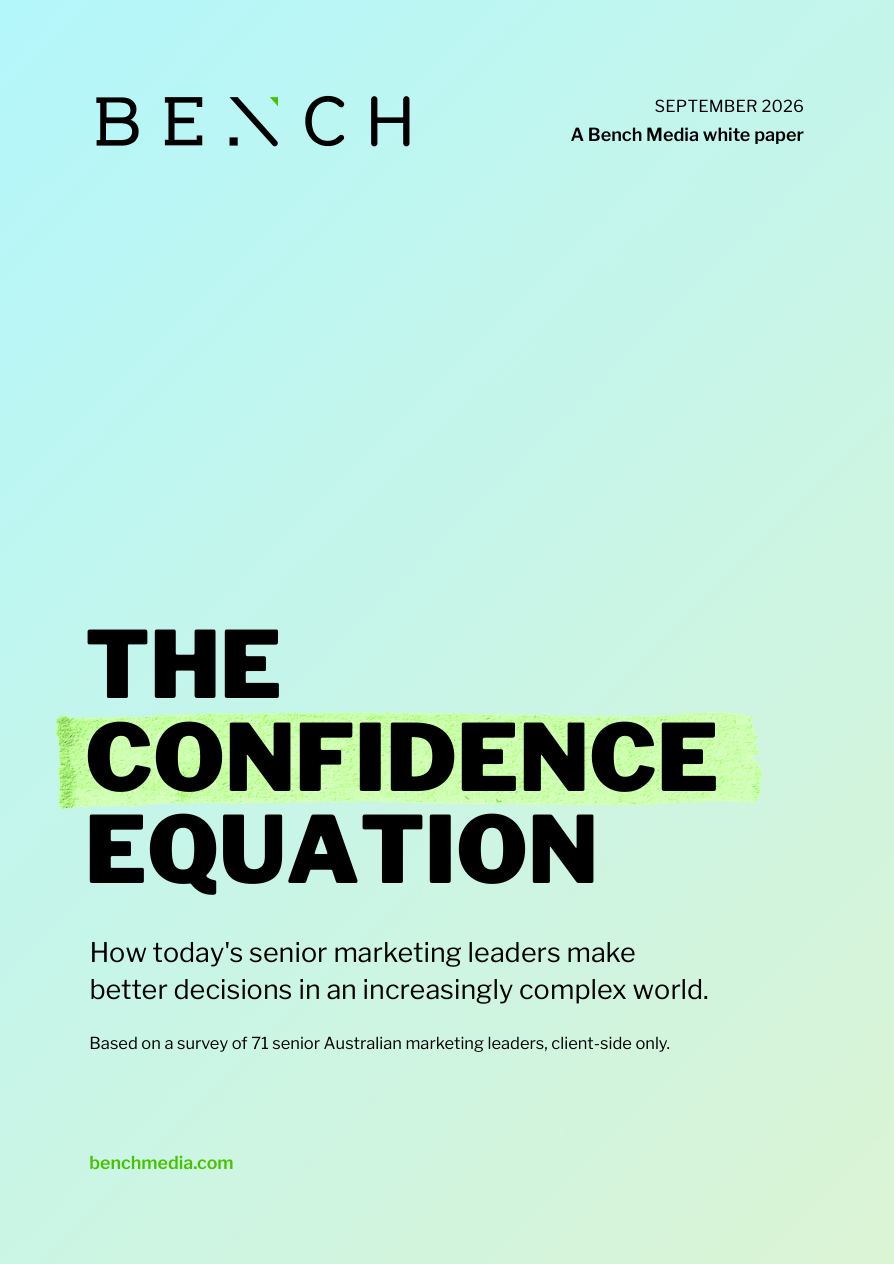
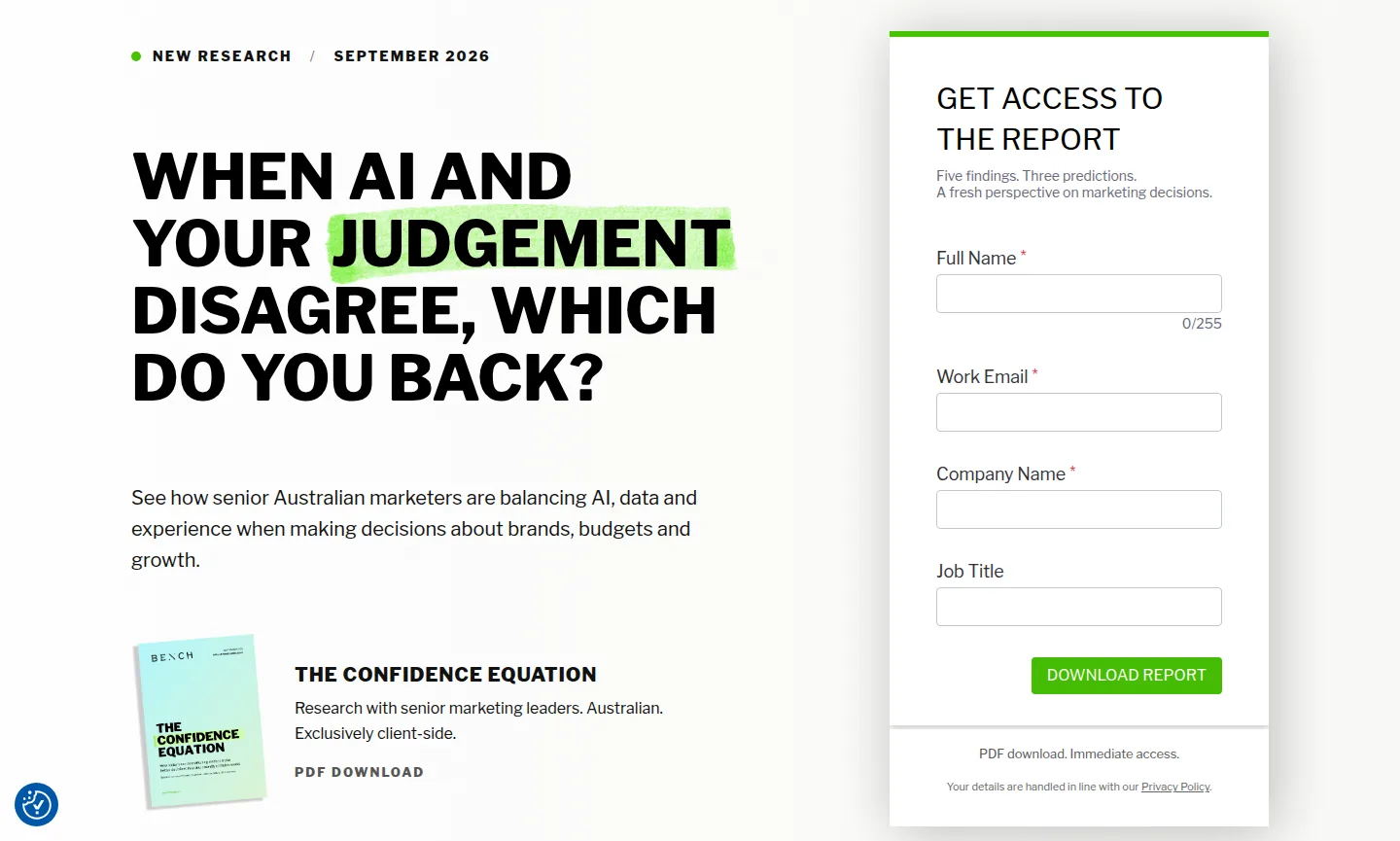
Bench Media published research on how senior Australian marketing leaders weigh AI against their own judgment. The report, The Confidence Equation, is served behind a download form, and the open page in front of it leads with three numbers: 90% say decision-making has become easier over the past year, 48% say AI has made them more confident in their decisions, and 38% say they accept AI-generated strategic recommendations without human review.
What was actually released
A research report from Bench Media, an independent media agency in Sydney, built on what the company describes as exclusively client-side senior marketing leaders in Australia. The group is narrow by design: 65% of the sample are marketing directors or CMOs, 35% are heads or vice presidents of marketing, and the budgets they manage run from under $1 million to more than $50 million.
The report is organized around three questions: what builds confidence, where trust needs a second look, and when human judgment leads. Bench Media names Bench Lens, its research unit, as the one that ran the study, and the page carries a short perspective from Michelle Wee, General Manager of Marketing at Hisense.
What the company chose to put on the open page is the three figures above. The rest of it, including the question wording, the response rate and the breakdown by type of AI output, sits inside the report.
What the claim rests on
The three figures are self-reports from a survey, and the open page does not publish the base they are calculated on. That is the first thing a buyer should notice. A 38% of an unknown number of people is not a quantity anyone can weigh against anything else.
What can be checked is narrow and clear. The sample description, the split between director-level and head-level roles, the budget range, the three headline figures, and the fact that the company’s own research unit ran the study are all on the page.
| Item | Figure | Where it comes from |
|---|---|---|
| Say decision-making has become easier over the past year | 90% | The open page |
| Say AI has made them more confident in their decisions | 48% | The open page |
| Say they accept AI-generated strategic recommendations without human review | 38% | The open page |
| Share of the sample who are marketing directors or CMOs | 65% | The open page |
| Sample size | Not given | Inside the report |
| Fieldwork dates | Not given | Inside the report |
The page is dated October 5, 2026 and labels the research September 2026. The gap between what a company publishes and what a reader needs in order to act is not a small one here: a 38% without its base cannot be compared with anything, including a later wave of the same study.
Ultimately, confidence comes from knowing when to trust the technology, and when to trust yourself.
That is Michelle Wee, General Manager of Marketing at Hisense, quoted on the page Bench Media published.
What is not published
No sample size, no fieldwork dates, no question wording and no margin of error on the open page. The page says that methodology and research limitations are inside the report, and the report is behind a download form, so none of it can be checked from outside. A number a team plans around should come with its base.
The pair of numbers worth keeping
90% say decision-making has become easier, and 38% accept AI-generated strategic recommendations without human review. Both come from the same sample, and together they describe a group that got more comfortable with AI and less careful about it in the same year.
On this page
What it changes for someone buying an AI tool
If you are the person who signs off on an AI subscription, this survey is describing your own routine. The respondents are in Australia and the study is small enough that we should be careful about extending it too far, but the pattern it names is not regional: a recommendation arrives, it reads confidently, and nobody opens the file behind it.
Three things follow, and none of them costs money.
Name the reviewer. A recommendation nobody has to defend is a recommendation nobody has checked. The fix is a person and a date, not a policy page.
Ask for the base before the decision rather than after it. For a survey, that means the sample size and the fieldwork dates. For a model or a tool, it means the benchmark, the date it was run and the harness it was run on. The question is the same in both cases, and so is the answer when it is missing.
Test the shortlist. If a tool is going to hold a budget line for a year, the cheapest hour you will ever spend is the one where you put the two finalists on the same task and watch them fail. That is the difference between a recommendation and a check, and more than a third of the people making the calls say they are skipping the second one.
The Neural Minute take
We run two kinds of page on this site, and we label each one. A research review reads only what a company puts in writing, on the date shown at the top of the page, and carries no score because no test was run. A hands-on review buys the plan, gives every tool in a group the same job, and publishes between six and ten screenshots including at least one failure. The labels exist for the reason this survey illustrates: a claim and a check are different things, and the difference should be visible on the page rather than left to the reader to work out.
The same standard applies to an AI tool that recommends an AI tool. When an assistant proposes a plan, a price or a limit, that output is a claim without a cited source until somebody asks for one, and a percentage with no base underneath it is not a finding. It is a feeling with a decimal point.
We would rather hold a page back than publish a number we cannot trace, which is why our own pages say when a price could not be verified. That rule is not generosity toward the reader. It is the only way the rest of the numbers on this site stay worth reading.
The survey leaves one question open, and it is the one worth asking of a team rather than of a study: the last AI recommendation somebody acted on, who checked it, and what would have changed if it had been wrong.
Sources
- The Confidence Equation, Bench Media, page dated October 5, 2026, read on October 12, 2026: https://benchmedia.com/the-confidence-equation-report/
- The three headline figures, the sample split and the report’s three questions, read on that page on October 12, 2026
- The report’s methodology and research limitations: inside the report, behind the download form, not read by us
- How Neural Minute tests AI tools, and what the two review labels mean: https://www.neuralminute.com/how-we-test/