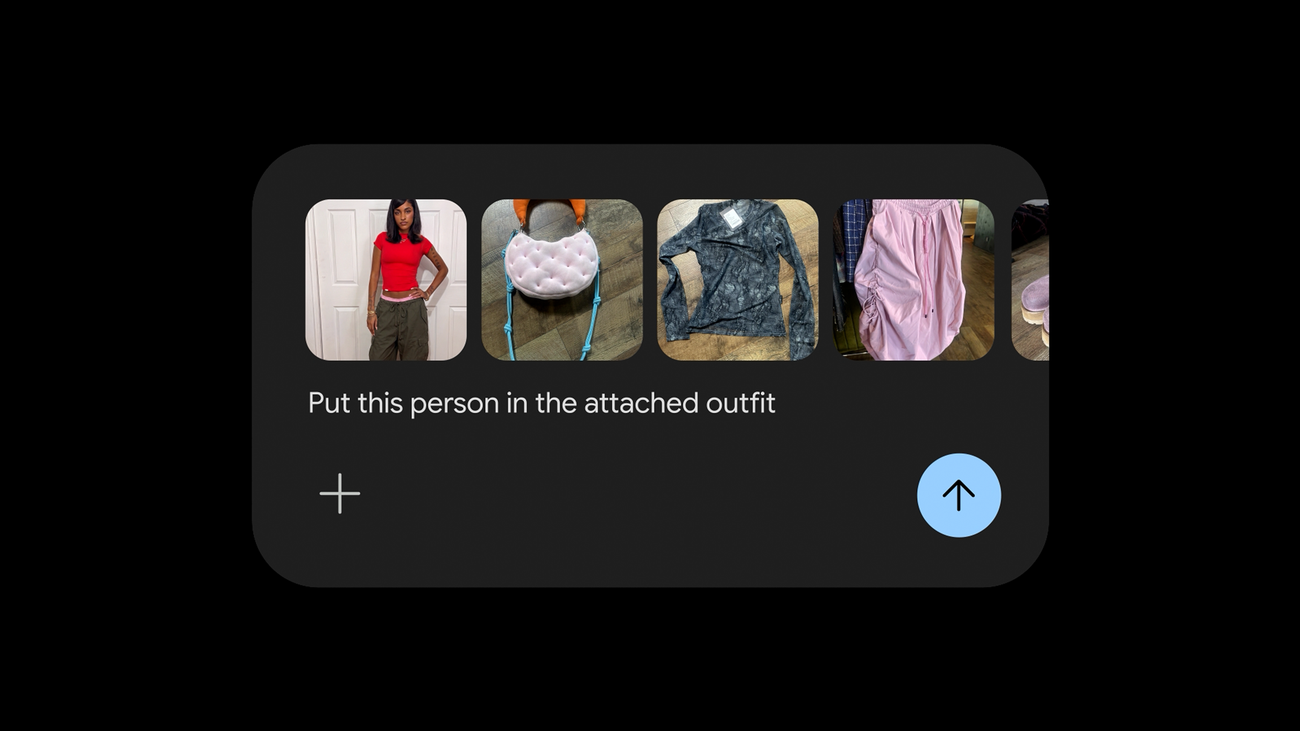
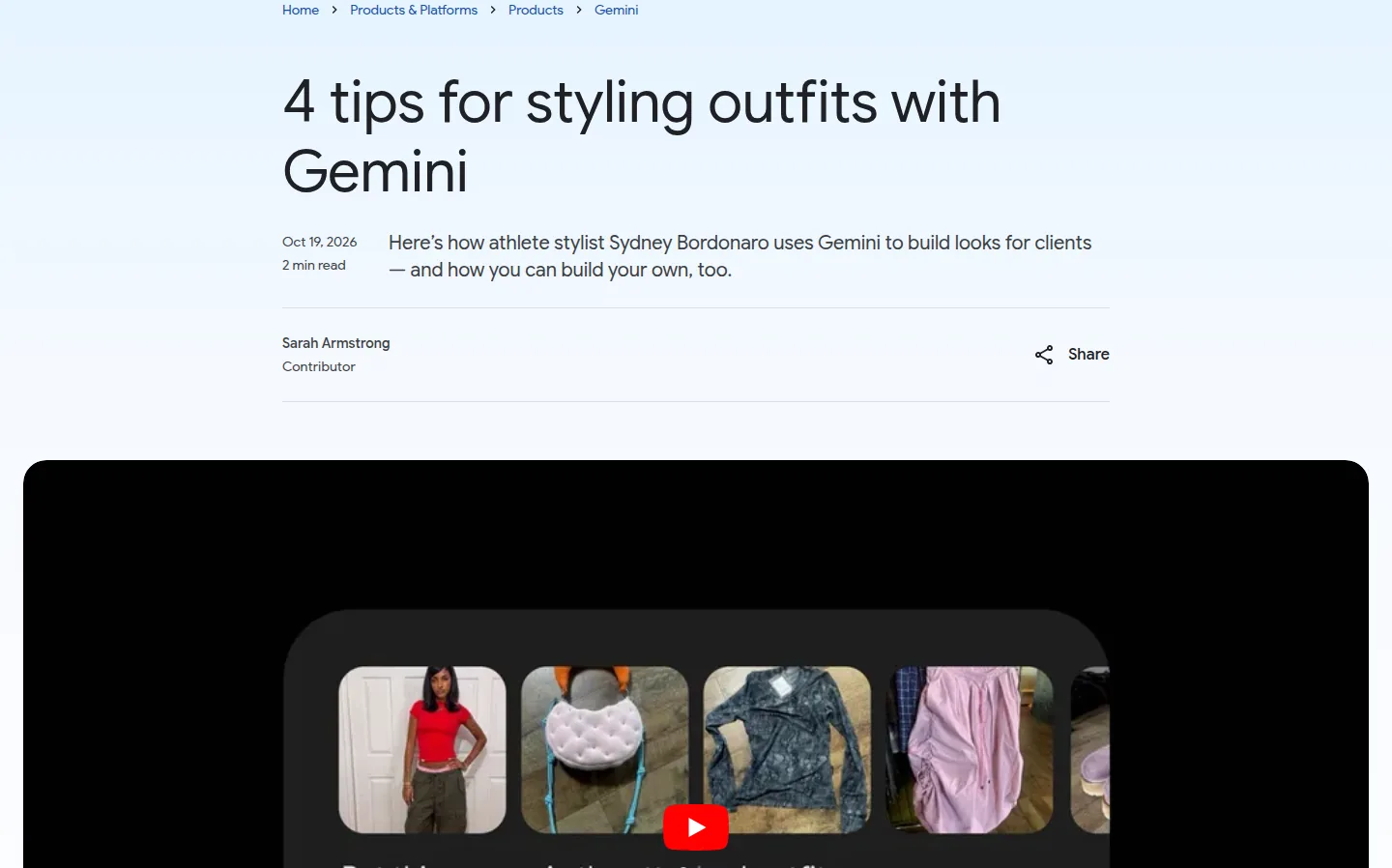
Google published a post on October 19, 2026 that walks through four ways athlete stylist Sydney Bordonaro uses Gemini to sell an outfit before it ships. The piece is signed by contributor Sarah Armstrong, filed under the #GeminiOnTheJob series, and it is about image work rather than text: a photo of the client, screenshots of the clothes, and one combined picture showing the look on the person. No model name, no plan tier and no rate appear anywhere on the page.
What was actually released
The post is not a feature announcement. It is a set of instructions on top of image editing Gemini already offers, wrapped in a client story: Bordonaro styles athletes spread across the country, in-person fittings are rare, and a jacket on a hanger does not show a client how the outfit reads on her.
The four steps, as the page states them:
| Tip | What the post tells you to do | What the page does not say |
|---|---|---|
| Visualize the look | Upload a photo of yourself next to screenshots of the items, and Gemini combines them into one image | How many images an account can send, and at what size |
| Swap one piece | Ask for a single change in plain language, such as keeping the outfit but switching the jacket to dark denim | Whether the rest of the render stays identical between edits |
| Get a second opinion | Send the finished picture to the client or a friend before committing | Whether the person receiving it needs an account to open it |
| Rescue an outfit | Photograph a stain and ask for cleaning steps using what is already in the room | Whether the answer is checked against the garment care label |
What a reader can act on today
- Four prompts that all start from an image the reader supplies: a selfie, a product screenshot, or a photo of a stain.
- One instruction per change instead of a rewritten prompt, which is the step that saves the most time.
- A share step, so the render leaves Gemini and lands in a message thread.
- The stain route, which turns the app into a search box for a problem in front of you.
What the claim rests on
The case for the product is a sales argument, and it is the only claim in the post with a mechanism behind it. A client who cannot picture the outfit says no, and a render that shows the outfit on her turns a maybe into a yes.
A photo of a jacket tells a player nothing about how the outfit actually looks on them, and when they can’t see the idea, it’s easy to say no.
That sentence is the thesis, and it is a claim about persuasion, not about image quality. Nothing on the page says how close the render sits to the garment that arrives, which is the only test that would settle the question: a look that sells and a look that lies are the same picture until the box is opened.
There is no figure anywhere in the post. No number of clients, no share of looks approved on the first render, no time saved per fitting, no before and after. The stylist is a person Google selected, her workflow is reported by Google, and the evidence offered is a testimonial.
What Google does not publish
- Which plan carries the four steps, between the free tier, Google AI Plus and Google AI Pro.
- The model behind the edit, since the post names none.
- Whether an uploaded photo of a face is stored, for how long, and whether it can be deleted.
- Any per-day limit on image generations, and any output resolution.
- Any rule on using a render of a real person commercially.
- The countries where the four steps work as described.
A second gap sits in the format. A tips post cannot establish that a feature exists in a given account, only that it exists somewhere. The only way to know is to open Gemini and run the second tip.
On this page
What it changes for someone paying for an AI subscription
The subscription market for consumers has moved onto images. Our read of the free Google AI Plus year for Egyptian students on October 12, 2026 listed images through Nano Banana among what that plan carries, next to Gemini Notebook and 400 GB of storage. When image editing of a person’s own photo becomes the demonstration Google puts in front of a consumer, it is because that is the feature the tier is now sold on.
On the developer side, our Gemini 4 Argon coverage recorded a public rate of $2 per million input tokens and $10 per million output tokens, with no published end date. On the consumer side, four days of blog posts have produced no line saying where the free tier stops. A published rate card on the API and no plan boundary on the app is the gap a subscriber pays for blind.
For anyone weighing a plan this week, the useful move is a test rather than a purchase: take one photo and one garment screenshot, run all four steps, and count how many edits land before the app refuses or drops a detail. That count is the real feature list of whatever tier the account sits on.
The Neural Minute take
What is new here is not the outfit. It is the input. This is the first consumer framing in which the picture a user uploads is a picture of themselves, and the value comes from the model holding the face steady while replacing the clothes. That is a different product from text generation: the output is a synthetic image of a real, identifiable person, and the post’s only reassurance is that the client keeps looking like herself.
Three things would have to be on the page before we would point a stylist or a shopper at this. A named model, so the render can be compared across updates. A published per-day cap, so the reader knows whether they are buying a feature or a demo of one. A retention line for the uploaded photo, because that is the question a professional handling images of other people cannot answer from a blog post. An edit that puts a real person in clothes they never wore needs a retention line before it needs a price.
We can also see the pattern from our own coverage. On October 16, 2026, three days before this post, Google published three study features for Gemini Notebook in the same tips format, with no plan list attached either. Same publisher, same week, same silence at the point where a buyer needs a boundary. That is a habit, not a coincidence, and we will keep counting it.
Sources
- Google, “4 tips for styling outfits with Gemini”, published October 19, 2026 and signed by Sarah Armstrong, for the four tips, their example prompts and the sentence quoted above: https://blog.google/products-and-platforms/products/gemini/stylist-outfit-tips-gemini/
- The same page, read on October 19, 2026: the client story, the wording of each tip and the video filed with it
- Our own reading, October 19, 2026: the page carries no model name, no plan list, no per-day limit, no retention line, no commercial use rule and no country list
- Our Gemini 4 Argon coverage, October 13, 2026, for the $2 and $10 per million token rates: https://www.neuralminute.com/news/gemini-4-argon-frontier-model/
- Our Gemini Notebook coverage, October 16, 2026, for the earlier tips post: https://www.neuralminute.com/news/were-sharing-3-tips-to-study-smarter-with-gemini-notebook/
- Our Egypt Google AI Plus coverage, October 12, 2026, for what the free plan carries: https://www.neuralminute.com/news/egypt-google-free-ai-plus-students/