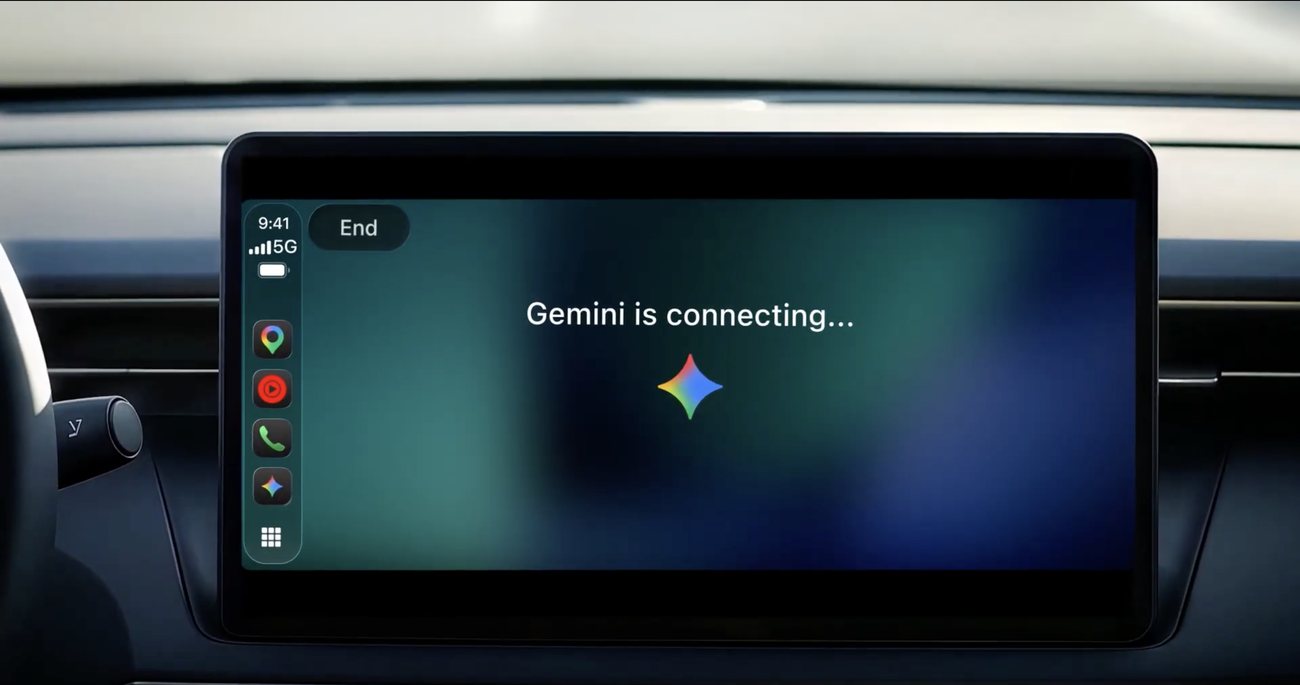
Google put the Gemini app on Apple CarPlay on November 11, 2026, globally and for every Gemini user on iOS, across all supported Gemini Live languages. It is the third car surface Google has opened in a month, after Android Auto and cars with Google built-in, and the first that reaches iPhone drivers. The post announces no new model.
What was actually released
A CarPlay app, not a new model and not a new subscription tier. The driver taps a Gemini icon on the CarPlay screen or side rail, picks up a recent chat or starts a fresh one, and talks. Google describes the exchange as interruptible in both directions: add a detail mid-answer, change the subject, pause when an exit needs attention.
The four advertised uses are audio-first tasks that used to need a phone in hand: the calendar and a meeting rehearsal before arriving, unread email and long threads read through the Workspace connection, a lunch spot in a named downtown, and thinking out loud, illustrated with a Q4 pitch rehearsal against a skeptical VP. Everything spoken syncs to the Gemini app on the iPhone, so the notes are in chat history when the driver parks.
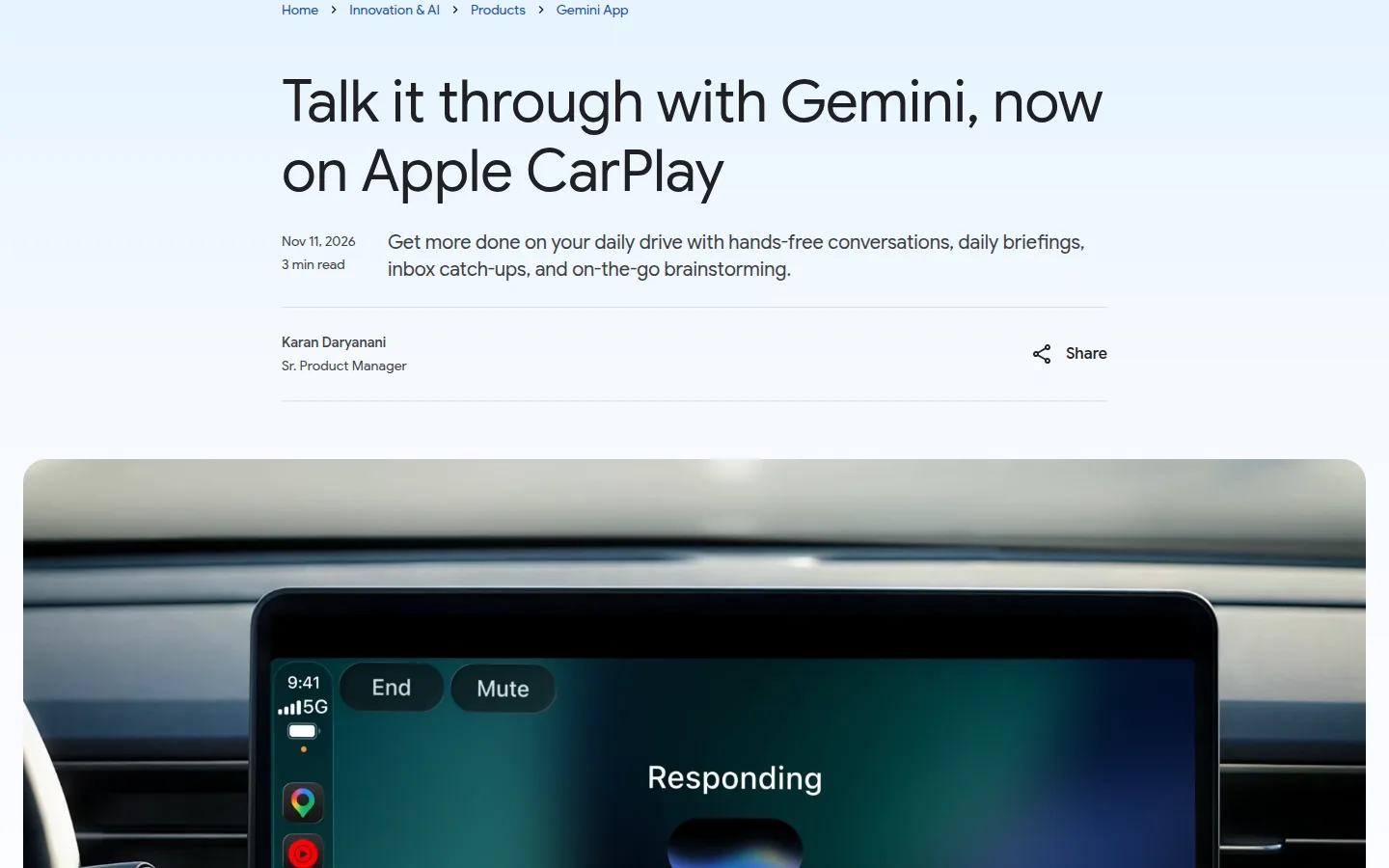
The perimeter is stated on the page, which matters more than the demos because it decides who gets the feature today.
| Question | What Google states |
|---|---|
| Where it runs | Apple CarPlay, from November 11, 2026 |
| Who gets it | All Gemini users on iOS, in every supported Gemini Live language |
| Markets | Global, no country list published |
| Before first use | Latest app, microphone permission on, Gemini Live used once on the phone |
| What it can read | Gmail, Google Calendar and the rest of the Workspace connection |
| Where the chat goes | Syncs to the Gemini app on the iPhone |
| What is restricted | Daily Brief must be enabled, and is off for under 18, the EEA and Nigeria |
What to remember
- The entry point is an icon on the CarPlay display, not a system voice button.
- No paid tier, no add-on and no price is attached to the feature.
- Every exchange lands in the Gemini chat history the driver reads later.
What the claim rests on
The evidence is a set of examples, not a measurement. Four scenarios and eight sample prompts show what the assistant is meant to do, and nothing about how often it does it. There is no response time for an in-car request, no accuracy figure for the calendar and email lookups, no count of supported cars or head units, and no safety or distraction study, which is the number a reader wants first for a product used at highway speed.
The one quantity in the post is the commute: Google writes that for millions of people it averages about an hour behind the wheel. It arrives with no source, country or year, so it frames the product rather than measuring it.
A quiet car cabin is one of the best places to think out loud.
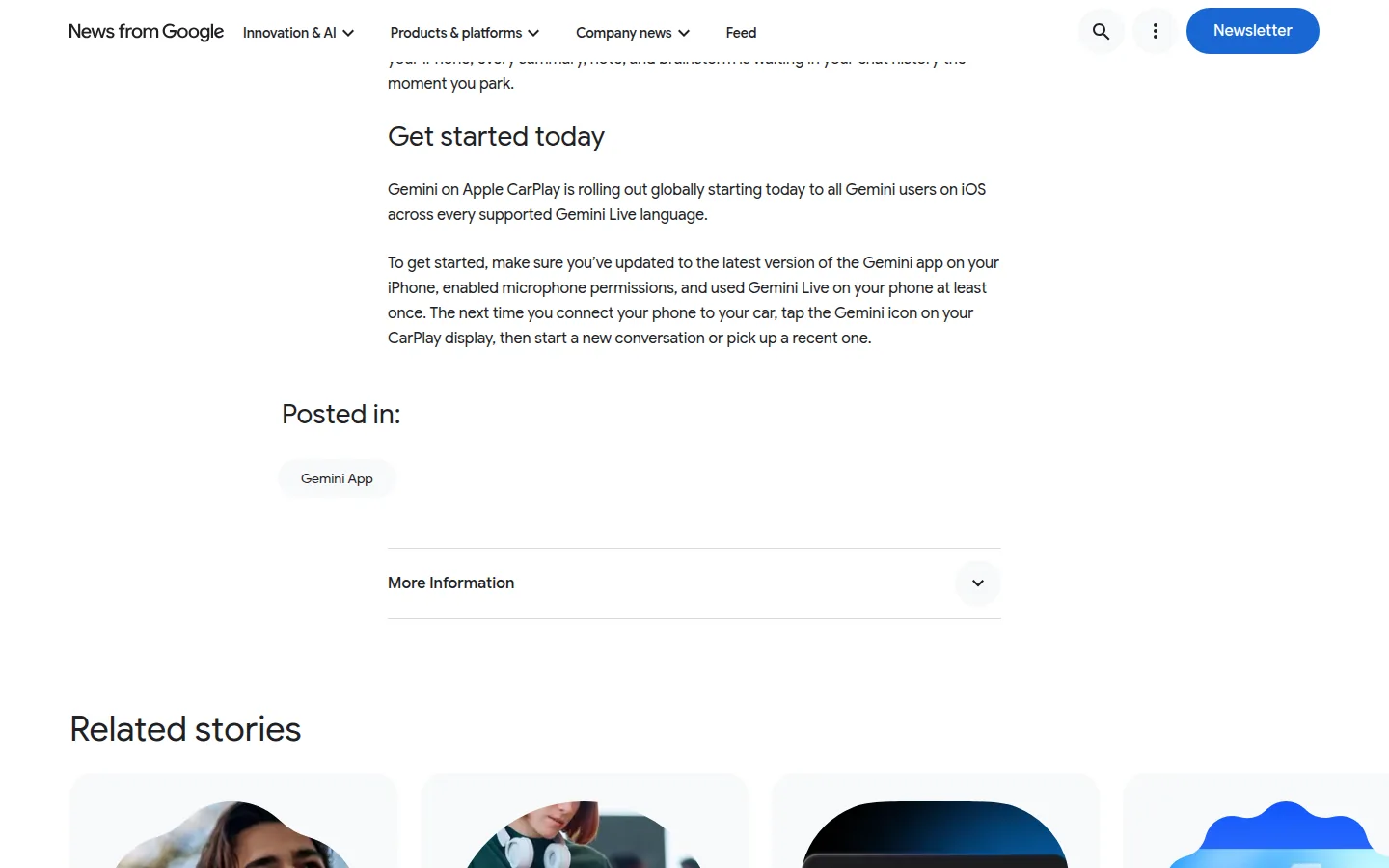
What the page does state precisely is the way in and the sync, and any reader with a car can test both: icon, permission, one prior phone session, shared chat history.
What is not published
Nothing names the model that answers in the car, says how long spoken audio is kept, or whether a CarPlay conversation is stored as Gemini Apps activity the way a typed prompt is. There is no list of supported vehicles, no required CarPlay or iPhone version, no note on cellular data use, and no word on how the app coexists with the car’s own assistant.
On this page
What it changes for anyone paying for Gemini
This release asks nobody to upgrade. Google says the app is rolling out to all Gemini users on iOS, which means the car is not a place where a subscription buys anything extra, and readers waiting to see what a paid tier adds got another feature that does not answer the question.
The friction sits before the first conversation. Three conditions have to be met at once and each one fails silently: an updated app, microphone permission, and at least one earlier Gemini Live session on the phone itself. A driver who has only typed into Gemini gets an icon that does not do what the announcement describes. The setup happens on the phone, never in the car.
The third is the Workspace link. Reading email and calendar by voice is what makes this matter for work, and it is the part with a carve-out: Daily Brief must be switched on, and the footnote says it and similar personalization features are unavailable to users under 18 and to users in the European Economic Area and Nigeria. Note what that footnote no longer says. The October page for Personal Intelligence in cars excluded the United Kingdom and Switzerland as well. Today they are not excluded, so the restriction has narrowed from four named markets to two.
The fourth is the record. Conversations sync to the iPhone, which Google presents as continuity, and which means the car becomes a microphone pointed at your work in progress. A pitch rehearsed on the drive is a chat thread in the same history as everything else, with no screen in the car to review it on and no retention rule published for it.
The Neural Minute take
We covered the first car surface on October 20, when Google opened Personal Intelligence to Android Auto, and the two posts read differently side by side. October was about a permission layer: what Gemini may read about you. November is about distribution: which cars the app may sit in. Distribution is the harder problem for Google, because the iPhone is not its platform and the only thing it can ship there is an icon the driver has to choose.
That choice is the story. Gemini on CarPlay is a destination tapped from a grid, while the car’s own assistant keeps the voice button. Google’s reach on iOS therefore depends on a habit, and habits in a moving vehicle are settled in the first week. The three setup steps are exactly the friction that kills a habit before it forms, which is why this rollout will likely look slower in practice than “all Gemini users on iOS” suggests.
For a reader deciding what to pay for, the answer does not move. This is a free app on a platform Google does not own, tied to a Google account, with no capacity to buy. What it changes is the cost of leaving: once a driver has heard a calendar read back on the commute, the untailored assistant in the next rental car feels broken, and that feeling is what Google is installing.
Two things we will watch. The first is whether the UK and Switzerland stay out of the Daily Brief footnote now that the list has narrowed, since a restriction that shrinks between two posts on one product is usually a rollout decision. The second is retention, because a third car surface with the same silence about stored audio makes it a pattern rather than an oversight.
Sources
- Gemini is now available on Apple CarPlay, Google, published November 11, 2026. The page read here for the release, the scenarios, the setup steps, the global scope and the Daily Brief footnote.
- Personal Intelligence brings Gemini to cars globally, Google, published October 20, 2026. Used only to compare the market exclusions between two Google posts.