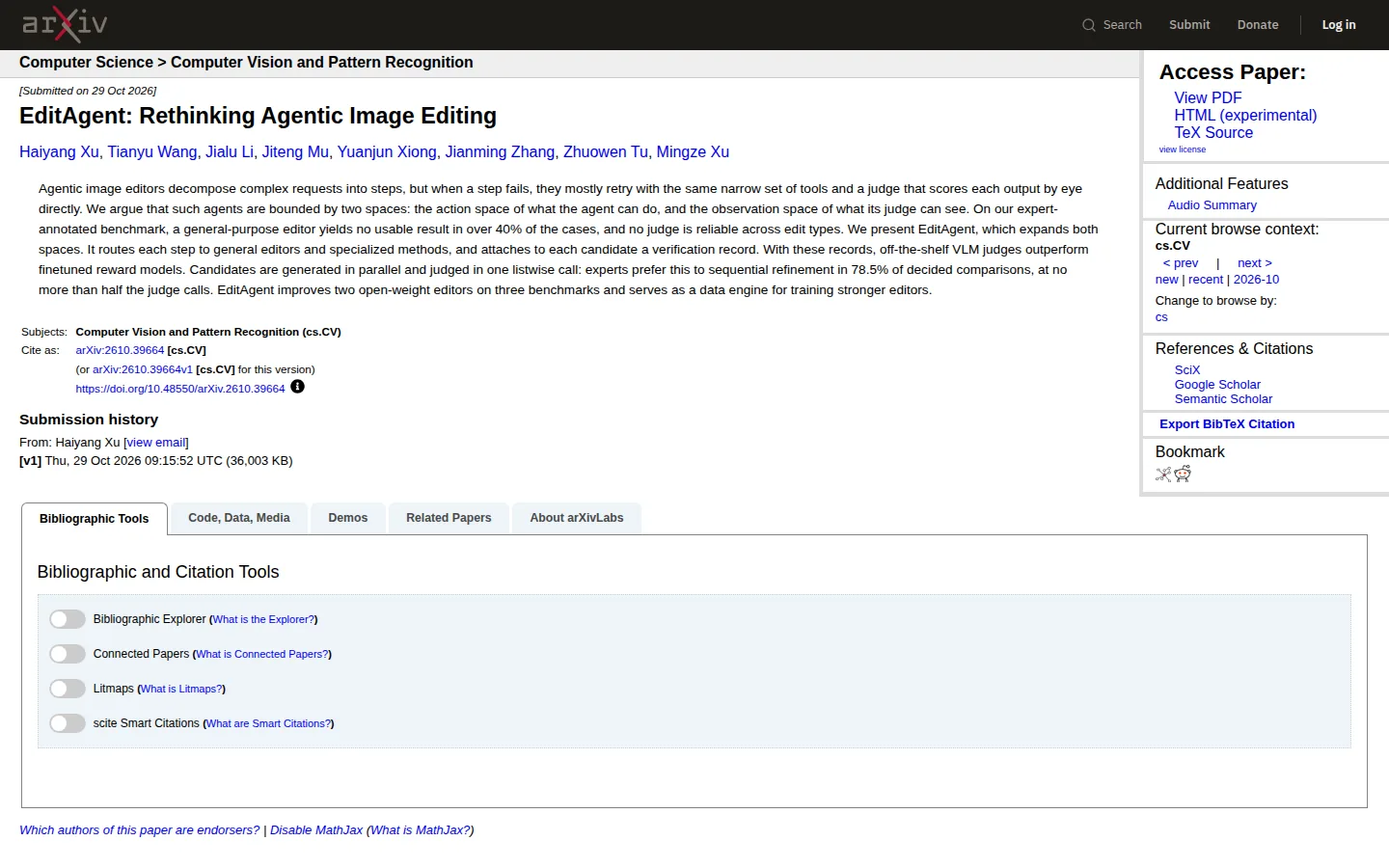
Adobe Research and UC San Diego posted EditAgent to arXiv on October 29, 2026, a system for image editing requests that arrive as a paragraph rather than a single instruction. The paper argues that an editing agent fails for two reasons: it has too few tools to reach for, and the model judging its work sees too little to judge by.
What was actually released
A paper, and nothing that can be installed. The preprint is arXiv:2610.39664, submitted on October 29, 2026 in computer vision.
The pipeline runs in four moves. A planner breaks the request into dependent steps. For each step, the agent generates candidates in parallel, some from a general-purpose editor and some from specialized operators such as masked local editing, object removal and photometric adjustments. Every candidate gets a verification record: a close-up of the edited region, a change map of the pixels that moved, and measured statistics on brightness, color shift, sharpness and noise against the source. One language model call compares the whole list. After each round, a history check tests whether a later edit undid an earlier one, as when asking for more daylight clears a window that was frosted two steps before.
Two open-weight backbones carry the experiments, Qwen-Image-Edit-2511 and FLUX.2-klein-9B. The diagnostic benchmark is 600 candidate sets over 30 edit types, 20 sets per type, every candidate labeled blind by five professional Photoshop retouchers working together.
| What the 600 expert-labeled sets contain | Sets | Share |
|---|---|---|
| Only general-editor candidates usable | 254 | 42.3% |
| Only specialized candidates usable | 175 | 29.2% |
| Both kinds usable | 90 | 15.0% |
| No usable candidate at all | 81 | 13.5% |
Because a general-editor candidate sits in every set, the general editor produced nothing usable in 256 of the 600, which is 42.7%. A specialized method rescued 175 of those failures, and extra samples from the same editor barely helped.
What the paper commits to
- 600 expert-labeled candidate sets over 30 edit types, 20 sets per type.
- A general editor alone returns nothing usable in 256 of those sets, and a specialist recovers 175.
- Off-the-shelf language models beat fine-tuned reward models at picking the usable edit once they see the verification record.
What the claim rests on
The benchmark is the paper’s own, and its size per cell is the first thing to check. Twenty sets per edit type, and photographs from COCO val2017 with each image used once, mean that a group-level percentage rests on a few dozen decisions. The instructions are not collected from users either: a vision model, Qwen3.8-27B, screens each photograph and writes one request for it. The labels come from people, the prompts do not.
The judging numbers are the strongest part of the work, and they carry a circularity the authors name. On the 515 sets with at least one usable candidate, Qwen3.8-27B picks a usable candidate 71.6% of the time when it scores candidates one by one, 73.6% when it compares them in one listwise call, and 81.3% once each candidate carries its verification record. The fine-tuned EditScore-72B reaches 74.8%. Seven off-the-shelf models were tested, all improved by 6.3 to 9.3 points with the records, and Qwen3.8-Flash-Next reached 82.8%. The awkward part is that Qwen3.8-27B is also the internal judge of the pipeline, so the paper reruns the comparison with Gemma-4-31B in its supplement.
The human study is small. Five professional Photoshop editors compared 144 samples at three complexity levels and preferred the parallel candidates in 102 cases, sequential in 28, with 14 ties, which is 78.5% of the decided comparisons, not of all of them.
Then the cost.
| Setup on EdiVal | Turn 3 score | Inference cost |
|---|---|---|
| Qwen-Image-Edit-2511 alone | 47.64 | 1.1 H100 hours |
| Qwen-Image-Edit-2511 with EditAgent | 55.46 | 12.9 H100 hours |
| FLUX.2-klein-9B alone | 53.20 | 0.5 H100 hours |
| FLUX.2-klein-9B with EditAgent | 59.45 | 6.3 H100 hours |
The gains hold on the paper’s own table. The price is 12.9 H100 hours against 1.1 for the same backbone, and the paper says performance is bounded by the editing methods plugged in.
A retoucher does not simply try again but acts differently and looks more closely.
What is not published
No code, no weights, no demo, no per-edit latency in seconds, no dollar price for a request, and no word on whether the 600 sets or their annotations will be released. Every result is measured at 512 pixels after downsampling, so nothing here speaks to a 24-megapixel file from a camera. No Adobe product page is mentioned in the paper either, which leaves the distance to a shipping Photoshop feature unstated.
On this page
What it changes for someone who buys an image editor
Three things, in the order they affect a trial.
The first is the retry loop. When a tool answers a five-part request by producing one image and trying again with the same model, the second attempt is mostly wasted. The failure is a missing tool, not a missing attempt.
The second is evidence. The largest jump in the paper comes from showing the judge a close-up and measured deltas, not from training a better judge. A tool that asks you to accept an output on a full-frame thumbnail is asking you to judge where local errors disappear.
The third is what the agent is for. Because EditAgent keeps only edits its judge accepted, the researchers used it to generate about 25.7K training sessions, roughly four turns each, and fine-tuned editors on them. Qwen-Image-Edit-2511 gained 1.95 points on EdiVal at turn 3 and 3.17 on the ComplexBench-Edit average; FLUX.2-klein-base-9B gained 2.00 and 2.14. Training on images that FLUX.2-klein-9B generated directly made that editor worse on all three benchmarks. Accepted sessions are the asset, not the agent.
The Neural Minute take
Our position on vendor numbers does not change because the vendor is Adobe: a benchmark built by the team that ships the method is a claim, and we publish what the page says plus what it leaves out. It leaves out enough to keep the headline modest: twenty sets per edit type, 512-pixel evaluation, no code. What it does not leave out is the cost.
For a buyer, the useful part is not the 175, it is the shape of the fix. An agent that spends ten times the compute is not yet what you put in front of a client with a deadline, and seat-priced editors are built for one edit at a time. The checklist: does the tool route a step to a narrow operation when one exists, does it show the crop and the measured change, does it check that step four did not undo step two. Our Claid AI deal page covers a product photo editor on the other side of that question, one that sells fixed operations instead of an agent, worth comparing before paying for a subscription that promises to understand a paragraph.
The strategic read is that Adobe published a data engine, not a feature. The finding that agent-accepted sessions train a better 9B editor than that editor’s own output is the commercially interesting one, because it turns a slow pipeline into a way to manufacture supervision. Expect a stronger Firefly or Photoshop model first, a chat box that edits a layered file much later. Until a page from Adobe says otherwise, EditAgent remains a paper with a good idea and an inference bill.
Sources
- EditAgent: Rethinking Agentic Image Editing, Adobe Research and UC San Diego, arXiv:2610.39664, submitted October 29, 2026: https://arxiv.org/abs/2610.39664
- Full text for the tables, judge comparison, human study and data engine results, read November 1, 2026: https://arxiv.org/html/2610.39664v1
- No figure here comes from another publication.