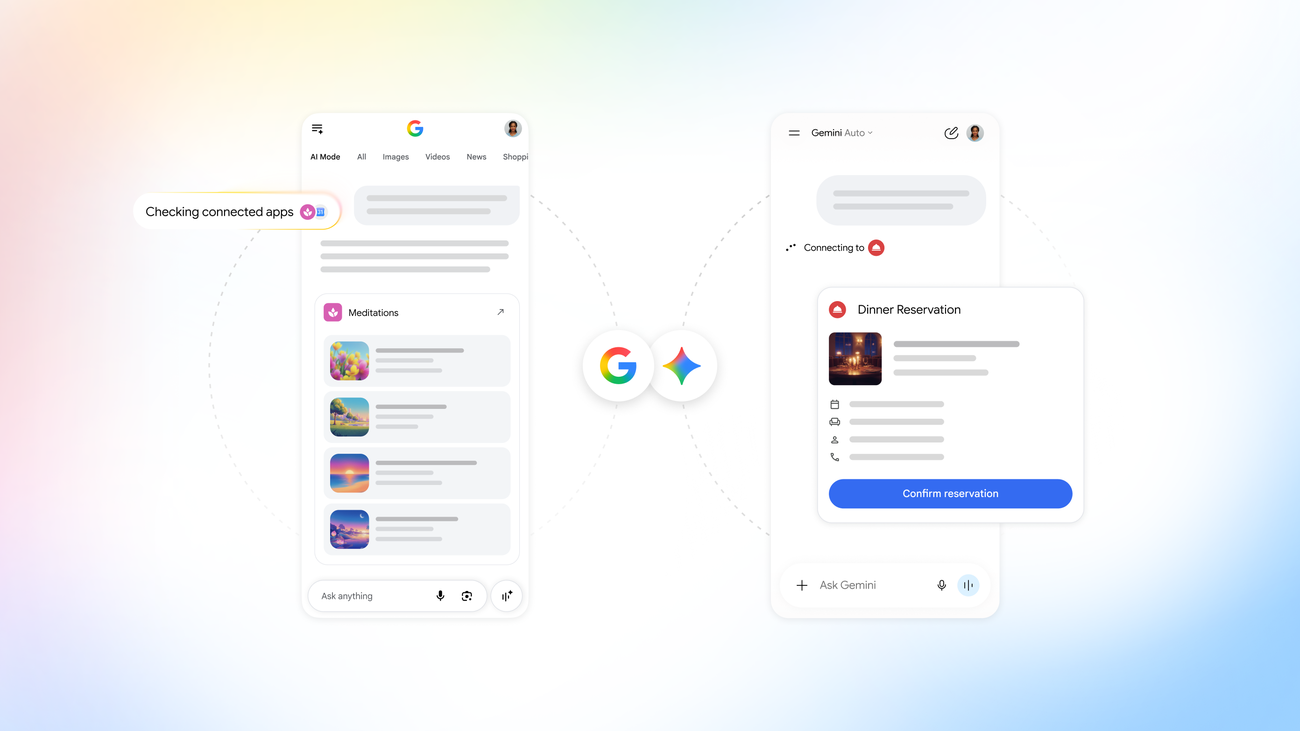
Google opened a preview of its Connected Apps Platform on October 28, 2026, a single console for building one integration and shipping it into both Search and the Gemini app. The post also names a new set of partners, four of them already live in Gemini, and says more than fifty Connected Apps are running across the two surfaces. The platform is a preview, opened in phases.
What was actually released
The problem the post describes is duplicated work: a developer who wanted an app inside Search and inside the Gemini app had to build the integration twice. The preview replaces that with one build, one registration and one review.
The technical path is narrow. A developer connects through a cloud-hosted MCP server, or through Android MCP using the AppFunctions APIs, registers the app in the Google Connected Console, tests it there and submits it. The console is the only door described in the post.
One decision comes before the review: whether the app goes live in Search, in the Gemini app, or in both. Once an app is live, the console reports traffic, latency and error rates, and the developer keeps control of brand identity, including verified logos and authenticated accounts.
| What the post states | The figure or term it uses |
|---|---|
| Connected Apps already launched across Search and Gemini | more than 50 |
| Partners named as live for users in Gemini | Adobe, Experian, Localiza, Peloton |
| Integration paths | cloud-hosted MCP server, Android MCP with AppFunctions |
| Surface chosen before review | Search, the Gemini app, or both |
| Access model | preview, opened in phases |
| New integration announced for both surfaces | Calm |
As published by Google on October 28, 2026. No figure in this table is independently verified, and none is a price.
The fifty are spread across productivity, event ticketing, health and fitness. Four integrations carry names and are described as live for users in Gemini; those four reach Search in the coming weeks, not on the day of the announcement. A Calm integration is announced for both surfaces, without a date.
What the console actually gives a developer
- One build for two surfaces that Google operates itself
- A surface choice made before review, not negotiated after it
- Traffic, latency and error rates in the same console that accepted the app
- Brand control through verified logos and authenticated accounts
What the claim rests on
The only number in the post is fifty, and it cannot be audited. Google does not break it down between Search and Gemini, does not name the apps behind it, and points to help center pages for the list rather than publishing it. Four partners carry names, which leaves more than forty-six unexplained.
The dates are relative. Search access for the named partners is due in the coming weeks, the wider opening in the coming months, and nothing carries a day. A team planning an integration gets a sequence, not a calendar.
The money is absent. The post sets no price for the console, no revenue share for an app that sells its own subscription inside Gemini, and no position on what happens when a user pays for a service without leaving the conversation.
The measurement is Google’s own: traffic, latency and error rates come from the console that also reviews the submission. No launch partner is quoted with its own numbers, and nothing suggests an outside audit.
What is not published
No price and no revenue terms, no review timeline, no rate limits for a connected app, no list of the markets covered by the preview, no per-surface split of the fifty, no statement on whether a rejected submission can be appealed, and no technical limits on what AppFunctions can expose. The post also does not say what Search shows when a connected app and a web result answer the same request.
On this page
What it changes for a team shipping an AI product
The build order changes before anything else. A team that wants its product inside Gemini and inside Search now has one integration to write instead of two, and the work sits where most teams already have something: an MCP server. If that server exists, this is registration, a review and analytics. If it does not, the cost is the server, and it is paid before anything is submitted.
The second change is where the gate sits. Distribution inside Google’s surfaces used to be a partnership conversation. It becomes a form, a review and a console, which means the gate is a review, not a contract. Cheaper to enter, harder to argue with: no published criteria to appeal against.
The third is measurement, and it is the one that will cause arguments internally. A session that begins inside the Gemini app and ends in your product will be recorded by Google’s console as traffic, and by your own analytics as something else, often a referrer you cannot classify. Two dashboards will disagree about the same week. Decide in advance which one you quote, because the console is the version Google sees.
The Neural Minute take
In a week of model releases, the least visible item from Google is the one that changes how AI products get found. A model release changes what an app can do. This changes who gets to be in the room.
Build once and reach high-intent users across both Search and the Gemini app.
That sentence is the whole business case, and it is also the reason to be careful. For anyone who has spent years earning positions in Search results, the competition moves. The competitor is no longer only the site ranked above you, it is the console entry beside you, and it arrives with Google’s layout and measurement.
Our first reservation is the missing money page. We would not build a product around this until two things exist in writing: what Google takes, if anything, when an app sells inside Gemini, and what a builder can do when a submission is refused. A distribution channel with unpublished economics is a channel you enter at the other party’s discretion.
The second reservation is ours specifically, because we publish reviews of AI tools. A review exists because a buyer wants an opinion before paying. If Search starts answering which tool fits a job with an app registered in a console, the review’s job moves from ranking to verification. We have covered Google’s agent plumbing twice this month, in Google Cloud launches a Gemini agent with hard spend caps and in Google Cloud gives each AI agent its own microVM. Both were infrastructure a buyer could inspect. This is distribution, and distribution is the part that is hardest to audit from outside.
If you build on it now, do it as a test with a known exit. Submit one capability, not the product, and compare what the console reports with what your own analytics reports for the same users. That comparison is worth more than the fifty.
Sources
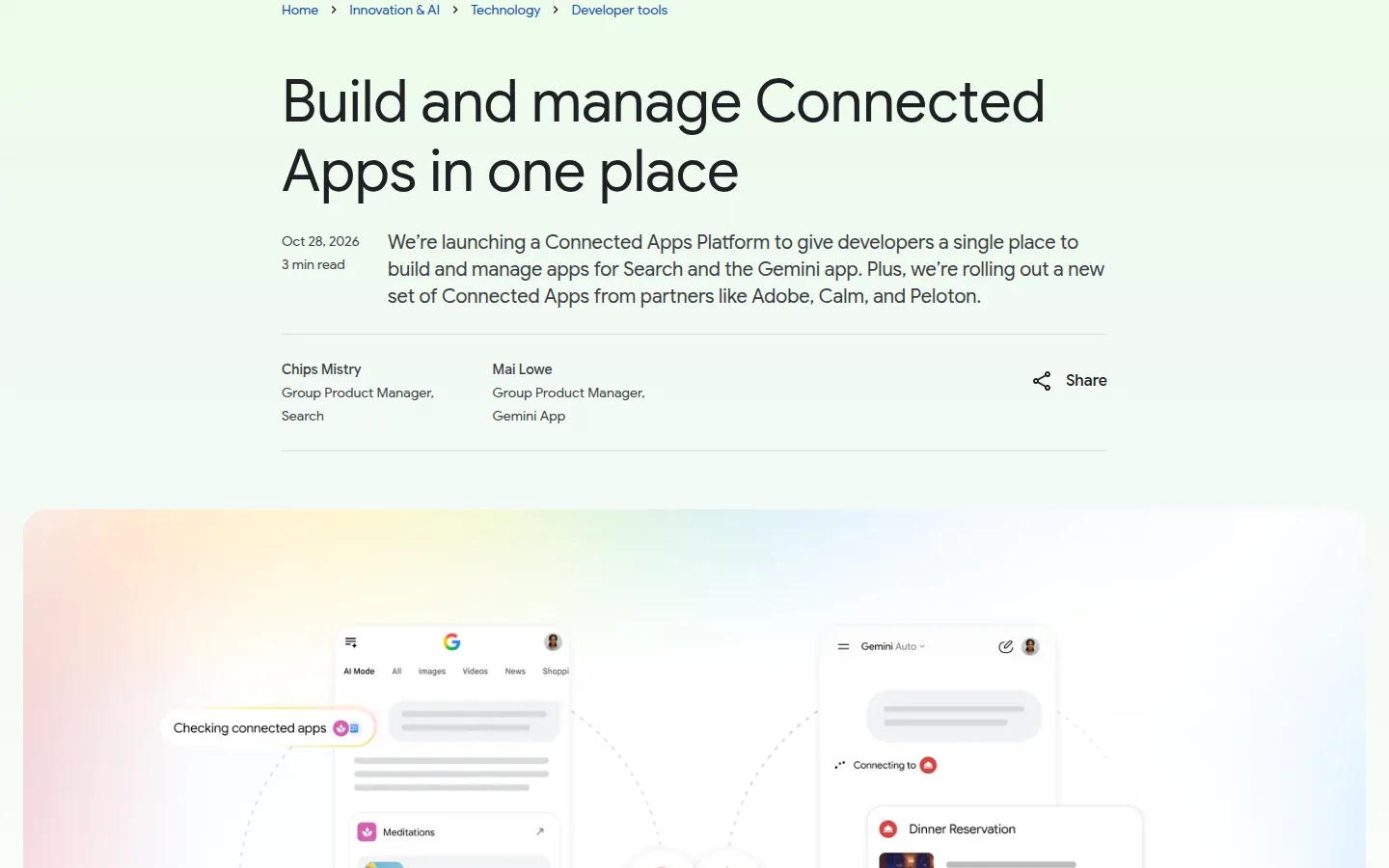
- Build and manage Connected Apps in one place, blog.google, published October 28, 2026, by Chips Mistry, Group Product Manager, Search, and Mai Lowe, Group Product Manager, Gemini App: https://blog.google/innovation-and-ai/technology/developers-tools/connected-apps-one-place/
- Figures read on that page on October 28, 2026: more than 50 Connected Apps across the two surfaces, four partners named as live in Gemini, a phased opening, and the console steps described above
- The preview documentation named in the post, at developers.google.com/connected-apps, is not linked here: the announcement page is the source this article cites